Share

Namaqua Dwarf Adder
🔤 Taxonomy
Bitis schneideri is the accepted Namaqua dwarf adder. Older labels include Vipera schneideri, Bitis paucisquamata and B. caudalis paucisquamata. No subspecies are accepted. Locality records matter because the narrow coastal strip is fragmented and historic names can conceal mixed or illegally sourced lines.
📌 Description
At about 18-28 cm and commonly under 30 g, this is the smallest known viperid. Its pale grey-brown pattern disappears against coastal sand, and it can shuffle partly beneath the surface. Field research shows rapid growth, generalist feeding, small litters and high natural adult turnover.
Small size does not mean minor risk. A short strike distance and tiny service gaps can encourage complacency while its venom remains medically significant. This is a display-only species for licensed specialists or institutions, never a “starter hot.”
📋 Quick reference
| Care point | Practical target |
|---|---|
| Adult enclosure | At least 90 x 45 x 45 cm, with external shift and neonate-proof gaps |
| Day temperatures | 20-26°C air; 28-32°C basking surface; 18-22°C cool refuge |
| Night | 14-20°C, without cold draughts |
| Humidity | 40-60%; brief localized fog and a 60-75% shed refuge |
| Lighting | Seasonal 10-14 hours; measured Ferguson Zone 2 UVB recommended |
| Feeding | Tiny frozen-thawed mice or suitable whole prey every 10-21 days |
| Substrate | 8-12 cm clean, compactable fine sand with dry cover |
| Safety | Double containment, protected contact, backup, bite and escape plans |
☠️ Venom
This species is venomous. Venom exposure can cause pain, swelling or other systemic effects, and severity varies with species, locality, bite site and the amount delivered. A small wound or apparently dry bite is not proof of safety; every bite or sting requires urgent medical assessment.
If an incident occurs, move away, call emergency services or a poison centre, keep the patient still, remove rings and other constricting items, and follow dispatcher instructions. Do not use a tourniquet, cut or suck the wound, apply ice or electricity, give alcohol or medicines as a home treatment, or attempt to catch the animal. Antivenom choice and dosing are hospital decisions; verify the relevant product and local availability in advance. Sources: WHO snakebite guidance and appropriate species-specific toxinology or medical references listed below.
🌍 Distribution
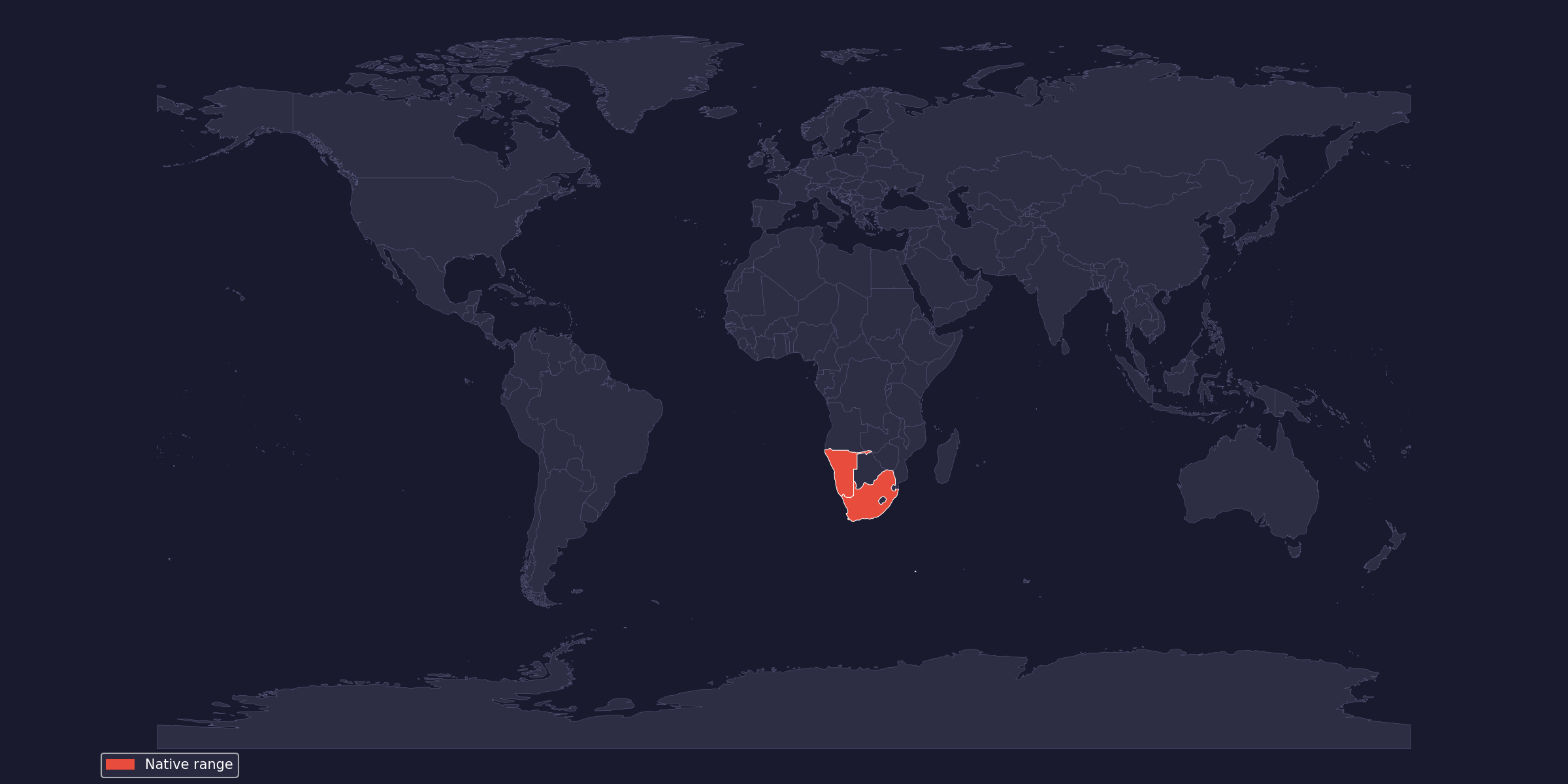
The species occupies a narrow coastal belt from southwestern Namibia around Lüderitz south into Namaqualand in South Africa. It is associated with pale coastal dunes, low hummocks and sparse succulent vegetation, where fog and cool Atlantic air temper an otherwise arid landscape.
This is not a generic hot desert. Locality influences fog exposure, substrate colour and seasonal temperature. Do not publish precise wild sites or accept unexplained locality claims from the commercial trade.
⚖️ Legal status
Checked on 21 August 2026: no B. schneideri entry was found in the CITES Appendices or current EU wildlife-trade annexes. The Bern Convention is not relevant to its African range. South Africa’s in-force TOPS list of 14 December 2007 includes it as a Protected Species, so specified activities require national TOPS authorization as well as provincial permits. Its South African range is in Namaqualand/Northern Cape, where the Northern Cape Nature Conservation Act regulates indigenous wildlife.
Namibia’s Nature Conservation Ordinance and MEFT permit system cover keeping reptiles and wildlife use. “Not CITES-listed” is not permission to collect, export, possess or breed. Accept only traceable captive-bred animals with permits, parentage, locality and an unbroken ownership record; range-state wild collection is conservation-sensitive and often unlawful.
🤌 Husbandry
House singly in a locked primary enclosure inside a controlled escape-resistant room. A tiny snake needs more, not less, operational discipline: the external shift must allow a full visual count, tracks and vents must contain newborns, and tools must not leave a door propped open.
Two trained adults attend each primary opening. No free handling, tailing, pinning or hand restraint. Quarantine at least 90 days on a shallow auditable substrate with dedicated tools; record grams as well as length because small weight changes are clinically important.
💡 Lighting
Give bright white light for 10-14 hours, varied gradually with season, plus full darkness at night. A measured Ferguson Zone 2 UVB opportunity over part of the basking zone is recommended, with complete shade beneath cover.
Place lamps and wiring outside containment. Heat from the UV fixture must be included in thermostat and surface measurements.
🌡 Heating and temperature
Maintain 20-26°C daytime air, a limited 28-32°C basking surface and an 18-22°C cool refuge; nights can fall to 14-20°C. Coastal fog desert is cooler than inland sand desert. Never heat the whole floor.
Use guarded, thermostatted overhead heat, independent probes and an alarm. Provide a warm stone or firm sandy edge for basking while preserving deep shade. Cold ventilation is necessary, but a direct draught over a small snake is not.
💧 Humidity and water
Keep most air around 40-60% with excellent ventilation. A brief dawn mist on one side can imitate coastal fog, and one refuge may reach 60-75% for shedding, but the surface should dry promptly. Constant damp sand causes skin disease.
Offer a very shallow, stable water dish that cannot trap a neonate. Exchange it through protected access and clean any sand contamination promptly.
🌿 Enclosure and decoration
One adult needs at least 90 x 45 x 45 cm. Use 8-12 cm of clean fine sand or a compactable sand-loam blend for shuffling and shallow burial. Provide low succulent-like cover, cork or flat stable stones, two snug shift-compatible refuges and a clear inspection strip.
Avoid collapsing burrows, sharp gravel, loose rock stacks and deep voids. Every seam must be inspected at the scale of a newborn, not the adult.
🐁 Feeding
Wild animals take available small lizards, frogs and mammals rather than specializing on rodents. Established captives may accept appropriately tiny frozen-thawed mice. Adults often need a small meal every 10-21 days; growing young may eat every 7-10 days.
Acquire only established feeders with a documented prey history. Do not improvise with wild lizards or amphibians, live rodents, force-feeding or hand restraint. Whole vertebrate prey requires no routine supplements; weigh serially to prevent both starvation and obesity.
🛡 Operational safety and emergencies
Rehearse protected servicing, escape, bite, fire and power-failure responses. A missing 20 cm adder can vanish into door tracks or equipment, so isolate the room before searching and never use bare hands.
Before acquisition, agree a written bite pathway with poison control, a medical toxicologist and the receiving hospital. Confirm that clinicians understand this is a dwarf African Bitis with limited species-specific clinical data. Never privately administer antivenom.
After a bite, move away, call emergency services, remove constricting items, remain still and support the limb neutrally. Do not cut, suck, ice, shock, massage or tourniquet. There is no home treatment.
🥚 Breeding notes
The species is viviparous, typically producing two to seven young. Field work suggests frequent reproduction may compensate for small litters and low adult survival; that does not justify routine captive production.
Breed only lawful, locality-compatible animals in a managed programme. Prepare individual newborn enclosures and placements before pairing. Neonates are tiny, venomous and capable of escaping gaps overlooked for adults.
🩺 Common problems
- Overheating: inland-desert settings remove the cool coastal refuge.
- Wet sand dermatitis: fog simulation without drying and ventilation.
- Poor feeding: wrong prey size, stress, excessive heat or an undocumented wild origin.
- Rapid weight loss: clinically important in a snake weighing only tens of grams.
- Retained shed and mites: inspect without compromising protected contact.
- Escape: tracks, vents and service ports designed for larger snakes.
Hands-on home treatment is unsafe. Shift, secure and use a prepared venomous-reptile veterinary team.
📌 Conclusion
Namaqua dwarf adder care is defined by cool coastal sand, brief localized moisture, tiny-prey records and uncompromising containment. Its size never reduces the legal, conservation or medical standard.
📚 Sources and further reading
- ReptiFiles — checked first on 21 August 2026; no species-specific guide was found.
- The Reptile Database: Bitis schneideri
- GBIF species record: Bitis schneideri
- Maritz & Alexander 2011 — morphology, dimorphism and growth
- Maritz 2012 — ecology of the Namaqua dwarf adder
- Maritz 2014 — generalist feeding ecology
- Barlow et al. 2019 — evolution and habitat shifts in Bitis
- South Africa’s in-force TOPS species list, Government Gazette 30568
- DFFE — current TOPS permits and legislation
- Northern Cape Department — provincial conservation legislation
- Namibia MEFT wildlife permits
- CITES Appendices
- EU wildlife-trade annexes, Commission Regulation (EU) 2026/1383
- CDC/NIOSH venomous-snake first aid
- Bern Convention appendices