Share

Red adder
🔤 Taxonomy
Bitis rubida is the accepted red adder, described as a distinct species in 1997 from material formerly confused with B. cornuta and B. inornata. It has no recognized subspecies. Historical labels in the cornuta–inornata complex are not reliable provenance; retain exact Western Cape locality, parentage and photographs.
📌 Description
The red adder is a small reddish to brown dwarf viper, normally about 25-45 cm and occasionally near 50 cm. It occupies cool mountain and plateau habitats and often moves between stones and low fynbos rather than burying deeply. It is medically significant, expert-only and display-only despite its small dimensions and often deliberate movement.
This guide is for licensed institutions and legally authorized venomous specialists. It is not an acquisition recommendation and gives no free-handling technique.
📋 Quick reference
| Care point | Practical target |
|---|---|
| Adult size and lifespan | 25-50 cm; approximately 12-18 years |
| Adult enclosure | At least 90 x 45 x 60 cm with two positively lockable shifts |
| Temperature | Ambient 19-24°C; basking 29-33°C; cool 15-19°C; night 10-16°C |
| Humidity | 40-60%; local 55-70% shedding support |
| Feeding | Small frozen-thawed whole vertebrate prey every 10-14 days, adjusted by condition |
| Safety | Double containment, protected contact, trained backup, bite and escape plans |
☠️ Venom
This species is venomous. Venom exposure can cause pain, swelling or other systemic effects, and severity varies with species, locality, bite site and the amount delivered. A small wound or apparently dry bite is not proof of safety; every bite or sting requires urgent medical assessment.
If an incident occurs, move away, call emergency services or a poison centre, keep the patient still, remove rings and other constricting items, and follow dispatcher instructions. Do not use a tourniquet, cut or suck the wound, apply ice or electricity, give alcohol or medicines as a home treatment, or attempt to catch the animal. Antivenom choice and dosing are hospital decisions; verify the relevant product and local availability in advance. Sources: WHO snakebite guidance and appropriate species-specific toxinology or medical references listed below.
🌍 Distribution
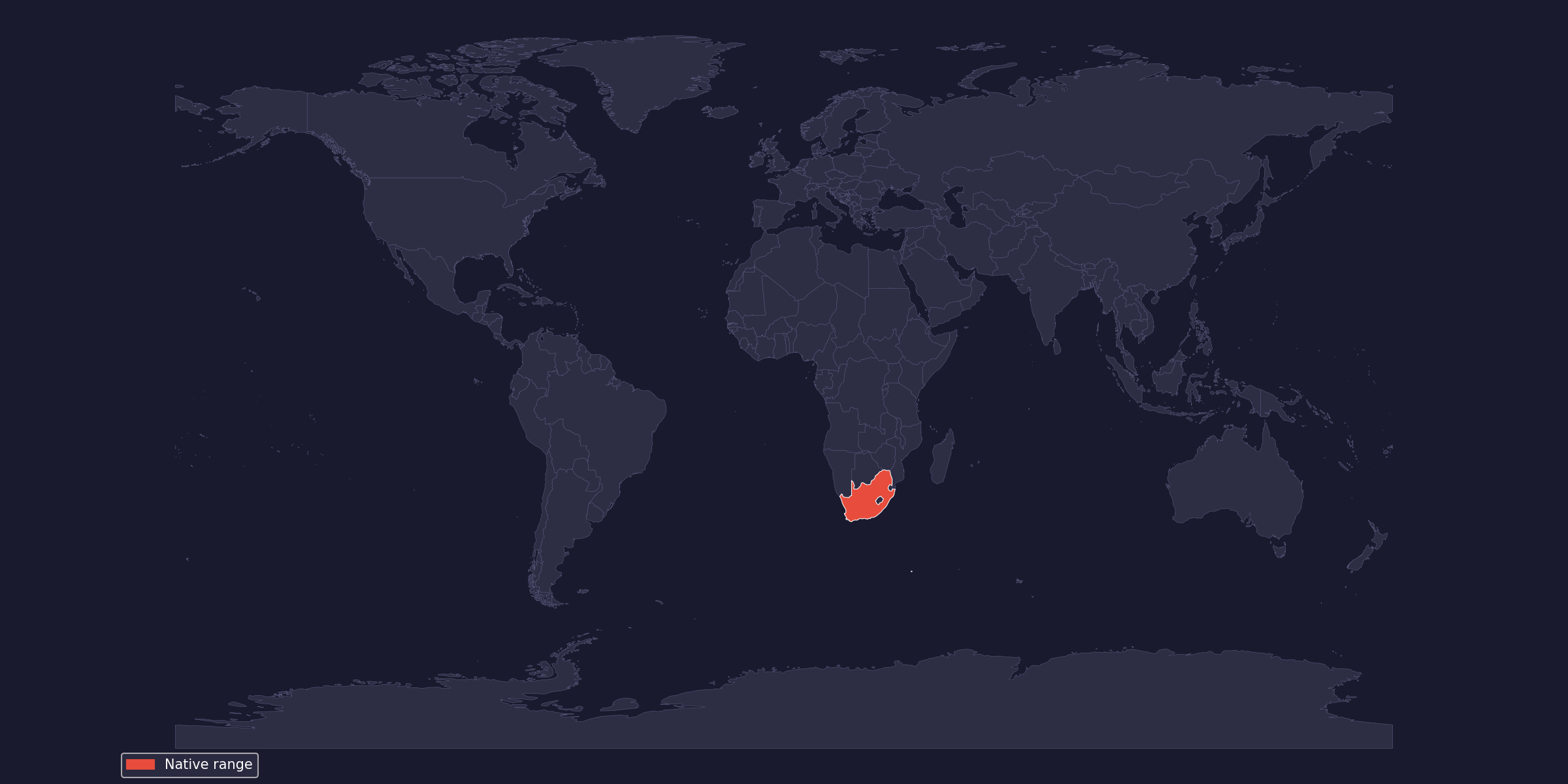
The species is endemic to South Africa’s Western Cape, including the Cederberg, Groot Winterhoek and adjacent interior mountain systems and plateaux. It occurs from well-vegetated slopes to sparsely vegetated stony ground. Range, altitude and winter-rainfall exposure matter; an old label saying only “Cape” cannot support climate or breeding decisions.
⚖️ Legal status
Checked 21 August 2026: Bitis rubida is not listed in the CITES Appendices and does not appear in an EU wildlife-trade annex under Regulation (EU) 2026/1383. The Bern Convention is not relevant to its African native range. This does not make possession or trade unrestricted.
Range-state collection, possession, transport and export rules remain decisive. CapeNature requires permits for keeping, importing, exporting and transporting wild animals in the Western Cape, and destination jurisdictions apply separate dangerous-animal law. Confirm permissions in writing before acquisition and retain invoices, breeder/importer identity, lawful-origin documents, parentage, exact locality, photographs and the legal-check date.
🤌 Husbandry
Replicate a stony fynbos mosaic, not a hot loose-sand desert. Provide dry low shrub cover, a separate slightly humid retreat and stable stone shelters. House singly: reported biting during breeding introductions and the need for unambiguous protected shifting make permanent pairs unacceptable.
Keep it in a restricted, escape-proof venomous room behind a locked secondary barrier. The enclosure needs independent mechanical locks, protected service ports and two positively lockable shift compartments. Follow a written door sequence, count and identify the animal before and after every task, and use a second trained person whenever primary containment opens. Quarantine for at least 90 days in separately secured equipment; veterinary faecal testing, weight, meals, sheds and respiratory observations belong in the record.
💡 Lighting
Provide 10-12 hours of broad visible light and complete darkness at night, adjusted gently to the documented locality. Guard or externally mount every fixture. A small measured Ferguson Zone 1 UVB opportunity may be offered, with complete shade; UVB is not a substitute for whole-prey nutrition and is not established as essential for these secretive vipers.
Low shrubs, grass or rocks should create shade without hiding the animal from a controlled visual check. Never use a hot, intensely lit box to force display activity.
🌡 Heating and temperature
Use 19-24°C ambient air, a local 29-33°C basking surface, a 15-19°C cool refuge and 10-16°C nights. The basking patch must be small enough that the snake can leave it immediately. Wild winters can be much colder, but approximately 12°C is a specialist captive lower point for planned breeding cycles—not a routine mandate.
Thermostat every heat source and verify air, basking surface, cool hide and substrate temperatures with independent probes and an infrared meter. Mount heat overhead and outside reach. Never use heat rocks or unguarded lamps, and never rely on room temperature as the only control.
💧 Humidity and water
Maintain roughly 40-60% RH with a 55-70% local shedding refuge and continuous ventilation. Provide a clean water bowl; the species drinks standing water. Do not keep the fynbos floor wet, and do not dry the enclosure to Namib levels. Use shed quality, respiratory signs and locality to refine the range.
Service water only after the animal is locked away. Do not hand-spray an occupied open enclosure or handle a snake to offer droplets. Persistent poor sheds, sunken eyes, abnormal respiration or wet ventral scales require veterinary review and a husbandry audit.
🌿 Enclosure and decoration
A single adult needs at least 90 x 45 x 60 cm. Larger usable floor area improves gradients and protected shifting even for a small snake. Use 5-8 cm of mineral soil and rounded gravel with anchored stones, dry branches, low fynbos-like cover and two lockable shift hides. Include firm walking surfaces and only a small loose pocket because this species rarely shuffles deeply. Avoid sharp stone, unstable stacks, damp peat floors and dense décor that prevents visual confirmation.
Paper towel is appropriate during quarantine because it supports parasite and waste monitoring. Seal every cable route, protect ventilation openings, and label the enclosure with scientific name, individual identity, animal count, venom hazard, emergency contacts and the location of the bite plan.
🐁 Feeding
Offer an established adult a modest frozen-thawed whole vertebrate prey item every 10-14 days, adjusting from weight and body profile. Wild prey evidence and captive records are limited, so do not claim a rodent-only natural diet. Neonates may accept small mice but require close weight records; never leave a live rodent.
Feed only after the snake is isolated in a known position and present prey with long tools through protected access. Never feed by hand, open the main door for “target training,” or retrieve refused prey while sharing open space. Whole vertebrate prey normally needs no calcium or vitamin powder.
🛡 Operational safety and emergencies
Never free-handle, pin, neck, tail, bag or manually restrain B. rubida for routine care. Use lockable shifts, transparent barriers, appropriately sized hooks and tubes only within a documented institutional protocol. A buried, motionless or recently fed snake remains fully dangerous. No task proceeds without trained backup, working communication and a clear exit route.
Before the animal arrives, agree written bite and escape plans with the receiving hospital or poison centre. The plan must identify the species, transport route, after-hours contacts and the pathway for expert antivenom consultation; do not assume a locally stocked product covers this species. Conduct drills without a live snake and maintain a current inventory for responders.
A bite is an immediate medical emergency. Move away, call emergency services, remove constricting items, keep the patient still, immobilize the affected limb and follow poison-centre advice. Do not cut, suck, massage, ice, electrically shock, tightly tourniquet, delay transport to catch the snake or administer privately held antivenom. There is no home treatment.
🥚 Breeding notes
The red adder is viviparous. Specialist captive records report mating in spring, late-summer births and litters up to about 12, but data are sparse and locality matters. There are no eggs to incubate. Cooling and pairing require veterinary condition checks, guarded introductions and individual locked housing for all young.
Introductions occur only through a shift-controlled system with two trained staff and a pre-agreed separation trigger. Breeding is not a conservation claim without a documented programme, genetic management and lawful placement.
🩺 Common problems
- Chronic overheating when a cool Cape lineage is held at tropical room temperature: review the locality profile, recorded measurements and ventilation rather than treating a number in isolation.
- Foot, scale or mouth trauma from sharp gravel and unstable rockwork: prevent access hazards through substrate screening, anchored décor and protected inspection.
- Respiratory disease from wet stagnant fynbos substrate or dehydration from excessive dryness: use serial weights and a reptile veterinarian; repeated manipulation is not a treatment.
- Respiratory or oral disease: bubbles, open-mouth breathing, abnormal sounds, swelling or discharge need urgent venomous-reptile veterinary care.
- Dysecdysis and mites: isolate equipment and correct environment; never restrain the snake for home removal.
- Reproductive disease: prolonged swelling, discharge, weakness or failure to recover after birth is an emergency.
📌 Conclusion
Bitis rubida belongs only in a licensed institutional or specialist programme able to maintain locality-specific conditions without compromising double containment. Its small size increases the need for reliable visual accounting; it never reduces the venom protocol.
📚 Sources and further reading
- ReptiFiles — checked first on 21 August 2026; no species-specific care guide was found.
- The Reptile Database: Bitis rubida — taxonomy, distribution and bibliography.
- GBIF species record: Bitis rubida — accepted taxon and occurrence framework.
- Barlow et al. (2019): phylogeny and habitat shifts in Bitis — taxonomy and evolutionary context.
- Branch (1997): original description of Bitis rubida — species-specific evidence.
- Bitis.org.za: red adder captive-care observations — species-specific evidence.
- SANBI: conservation status of South African reptiles (2023) — species-specific evidence.
- WHO: snakebite envenoming treatment and first aid — medical emergency guidance.
- Official CITES Appendices — checked 21 August 2026.
- Commission Regulation (EU) 2026/1383 — EU wildlife-trade annexes checked 21 August 2026.
- CapeNature: permits for captive wild animals — official Western Cape permit guidance.