Share

West African Gaboon Viper
🔤 Taxonomy
Bitis rhinoceros is the accepted West African Gaboon viper. Older literature commonly treats it as Bitis gabonica rhinoceros, and older combinations include Vipera rhinoceros, Echidna rhinoceros and Clotho rhinoceros. Molecular and morphological work supports separation from the Central and East African Bitis gabonica.
The two species are not interchangeable labels. B. rhinoceros has a West African range and usually a prominent paired nasal-horn complex, but photographs and pattern alone do not establish provenance. Preserve country, locality, parentage, historic name and identification evidence for every specimen.
📌 Description
This is an exceptionally heavy forest-floor viper, commonly 120-180 cm and capable of exceeding 10 kg. Its leaf-litter pattern makes a stationary animal difficult to see. It often moves slowly, but the strike is extremely fast and long fangs can deliver venom deeply.
Envenomation can cause severe pain, swelling, blistering, tissue injury, bleeding and coagulation disturbance, hypotension and shock. Large venom yield and adult mass make both a bite and an escape a major incident. This is an expert-only institutional species for barrier-based care.
📋 Quick reference
| Care point | Practical target |
|---|---|
| Adult size and lifespan | Usually 120-180 cm; approximately 15-25 years |
| Adult enclosure | At least 220 x 120 x 90 cm with two full-size lockable compartments |
| Temperature | Ambient 23-27°C; limited basking 28-30°C; cool retreat 21-24°C |
| Night | 20-23°C |
| Humidity | 70-85%, with ventilation and a dry upper substrate layer |
| Feeding | Measured frozen-thawed rodents every 21-35 days |
| Safety | Protected contact, heavy-duty shifts, two-person rule and product-specific hospital plan |
| Quarantine | At least 90 days with separate airspace, tools and veterinary screening |
☠️ Venom
This species is venomous. Venom exposure can cause pain, swelling or other systemic effects, and severity varies with species, locality, bite site and the amount delivered. A small wound or apparently dry bite is not proof of safety; every bite or sting requires urgent medical assessment.
If an incident occurs, move away, call emergency services or a poison centre, keep the patient still, remove rings and other constricting items, and follow dispatcher instructions. Do not use a tourniquet, cut or suck the wound, apply ice or electricity, give alcohol or medicines as a home treatment, or attempt to catch the animal. Antivenom choice and dosing are hospital decisions; verify the relevant product and local availability in advance. Sources: WHO snakebite guidance and appropriate species-specific toxinology or medical references listed below.
🌍 Distribution
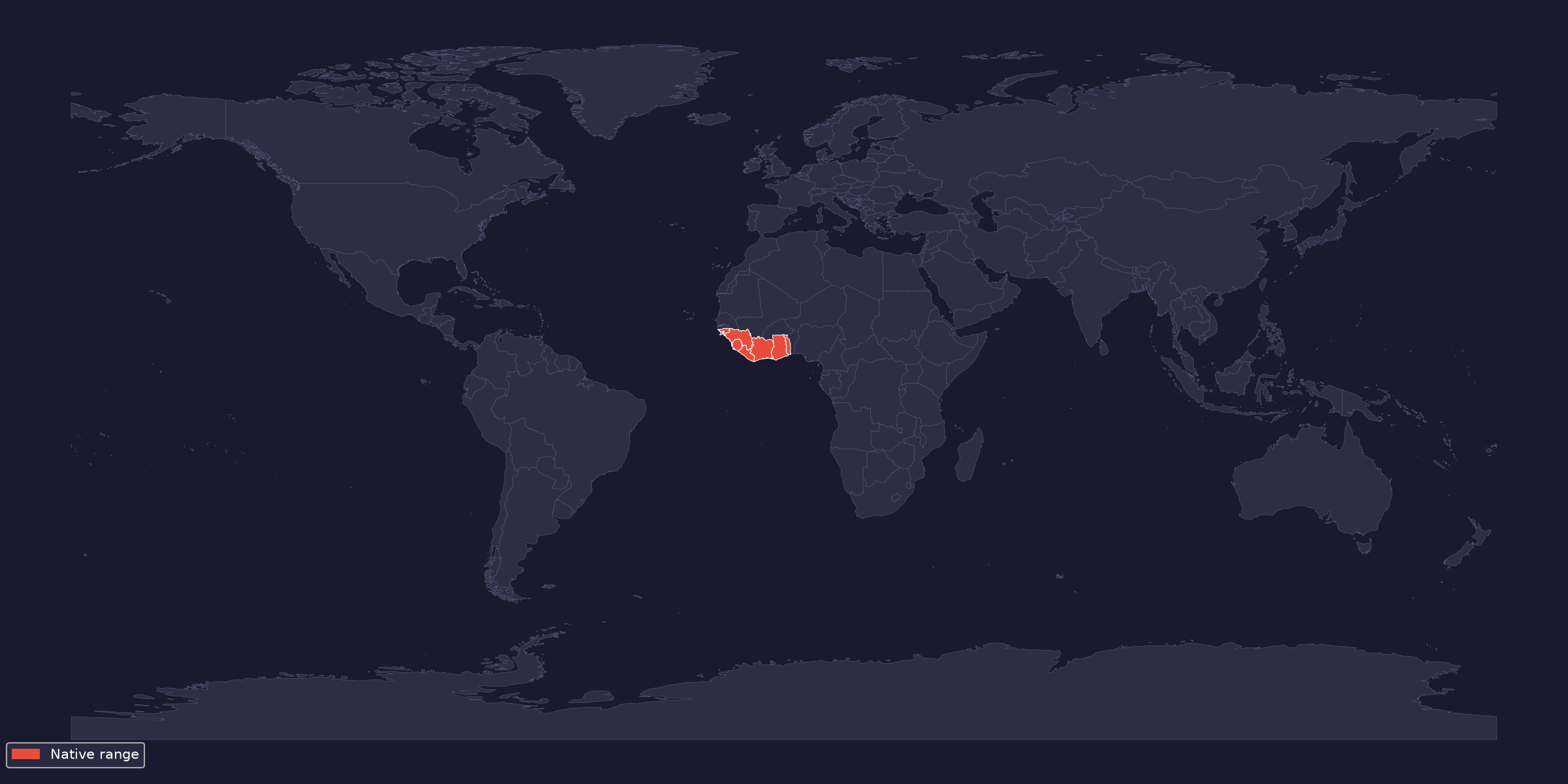
The current range extends through the Upper Guinean forest region of Guinea, Guinea-Bissau, Sierra Leone, Liberia, Côte d’Ivoire, Ghana and Togo. B. gabonica occupies areas farther east; the exact contact or separation between the two must not be reconstructed from a trade label.
Whole-country shading overstates occupancy by including savanna, dry northern zones and heavily altered areas outside humid forest and forest-edge habitat. The reviewed western Ghana point represents one warm, humid forest-belt occurrence, not the climatic limits of Guinea or Togo.
🌡 Climate across the native range
WorldClim v2.1 climate normals for 1970–2000 from a reviewed occurrence in Ghana’s humid forest belt:
Western Region — Ghana (reviewed humid-forest occurrence)
| Month | Min °C | Mean °C | Max °C | RH % |
|---|---|---|---|---|
| January | 22.3 | 26.5 | 30.6 | 83 |
| February | 23.3 | 27.4 | 31.5 | 83 |
| March | 23.4 | 27.4 | 31.5 | 83 |
| April | 23.5 | 27.4 | 31.2 | 84 |
| May | 23.4 | 27 | 30.6 | 85 |
| June | 23 | 25.9 | 28.8 | 87 |
| July | 22.4 | 24.9 | 27.5 | 87 |
| August | 21.8 | 24.3 | 26.8 | 88 |
| September | 22.2 | 25.1 | 27.9 | 87 |
| October | 22.6 | 25.8 | 29 | 86 |
| November | 23.1 | 26.7 | 30.4 | 84 |
| December | 23 | 26.8 | 30.6 | 84 |
Weather data by WorldClim v2.1 · Climate-normal period: 1970–2000. Monthly normals queried by Herpeton Academy from raster values; relative humidity is derived from vapor pressure and mean temperature.
Location references use GBIF.org occurrence data where available; original occurrence records retain their source dataset licenses.
⚖️ Legal status
As checked on 17 August 2026, Bitis rhinoceros is not listed in the CITES Appendices or EU wildlife-trade annexes. The Bern Convention is not relevant to its West African range. Do not confuse it with the separately listed Bitis worthingtoni, and do not treat absence from CITES as permission.
Range-country wildlife law may prohibit collection or export, while destination law may license or ban dangerous snakes. Confirm collection, ownership, registration, transport, breeding, sale, export and import requirements with each competent authority. Retain permits, veterinary and lawful-origin documents, invoices, exact locality and parentage records, photographs and the legal check date.
🤌 Husbandry
House one snake in a controlled-access venomous room with secondary containment, sealed service penetrations and a written door protocol. The enclosure must divide into two full-size, positively lockable compartments. Each side must support the animal’s weight and allow it to settle completely before the other side is opened.
Quarantine for at least 90 days on paper with simple heavy hides, dedicated tools and preferably separate airspace. Record weight, meals, sheds, faeces, urates, skin, mouth and respiration. Wild-caught or poorly documented animals need veterinary parasite and mite assessment.
Keep singly except for planned breeding. Never lift, tail or drag this species. Its mass makes hook-only control unreliable and puts the operator close to an extremely long strike; shifts, barriers and lockable transport boxes must do the work.
💡 Lighting
Provide 11-13 hours of diffuse visible light and complete darkness at night. Dense visual cover and shaded shifts should remain usable all day. Put lamps outside primary containment or behind locked mesh guards.
Low-output UVB may be offered as a measured Ferguson Zone 1 opportunity, with extensive shade. UVB is not required to digest whole prey and must not create a hot exposed floor. Lamp changes should never require entry into an occupied compartment.
🌡 Heating and temperature
Maintain ambient air at 23-27°C, a limited basking area at 28-30°C, a cool retreat at 21-24°C and nights around 20-23°C. Use guarded thermostatic heat, independent probes and a high-temperature alarm. Avoid heating from below where a heavy snake can remain in prolonged contact.
This is a humid tropical forest species, not a high-heat savanna viper. Persistent exposure around or above 30°C without a cool retreat is hazardous. Reproduce modest wet-dry seasonal cues through rainfall, humidity and light rather than abrupt cold cycling.
💧 Humidity and water
Maintain 70-85% humidity with strong cross-ventilation and a surface that can dry between targeted watering. A deeper layer may remain slightly moist, but the snake should always have a dry resting patch. High humidity without air exchange encourages dermatitis and respiratory infection.
Provide a broad, heavy clean-water bowl positioned for protected removal. Track drinking, urates, weight and shed quality. Do not routinely soak or spray the snake; adjust ventilation, substrate moisture and a humid shift compartment in measured steps.
🌿 Enclosure and decoration
An adult needs at least 220 x 120 x 90 cm, with greater floor area for very large females. Use two lockable full-size compartments, broad low hides, anchored cork and visual barriers. Maintain a clear inspection route and door geometry that cannot press against a coiled snake.
Use 8-12 cm of moisture-buffering soil, leaf mould and coarse leaf litter over drainage where appropriate. The top must not remain swampy. Paper is required during quarantine. Avoid unstable branches or stone, deep inaccessible hollows, aromatic wood and décor that an operator must lift.
Reinforce floors, shift gates and transport containers for adult mass. Fit two-step locks, an internal service barrier and a visible venom warning.
🐁 Feeding
Wild prey includes mammals and birds. Established adults can take appropriately sized frozen-thawed rats at 21-35-day intervals, adjusted to body condition. The broad head does not justify oversized prey, and this sedentary species becomes obese readily.
Feed through a protected port after shifting and confirm the snake before retrieving refused food. Never use live rodents. Whole prey requires no routine supplementation. Weigh remotely or through a lockable container rather than handling the snake.
🛡 Operational safety and emergencies
Never free-handle, pin, neck or manually restrain B. rhinoceros. Use heavy-duty shifts, lockable boxes, barriers and protected ports; hooks are positioning tools, not the main restraint system. Two trained adults attend every primary opening. Veterinary work requires a pre-arranged anaesthetic and airway plan.
Before acquisition, consult the receiving hospital or poison centre using the exact West African species and origin. Experimental and commercial studies show that neutralization across Bitis species and products cannot be assumed. The hospital must confirm a suitable product, supply route, dose protocol and laboratory support; antivenom is not for private administration.
After a bite, move away, call emergency services, remove constricting items, keep the patient still with the limb neutrally supported and follow poison-centre instructions. Do not apply a tourniquet or tight pressure bandage where severe local tissue injury is expected; do not cut, suck, ice, shock or massage the site.
Maintain a written escape plan for a large camouflaged floor snake: isolate the room, exclude the public, account for people, use defined search zones and prepare rated lockable containers. Stop work if location is uncertain.
🥚 Breeding notes
B. rhinoceros is viviparous. Published species-specific reproductive data are limited and older reports often combine it with B. gabonica. Roughly 8-40 young is a conservative facility-planning range drawn from the Gaboon-viper literature, not a guarantee for every West African female.
Breed only locality-backed animals and document the taxonomic decision. Pair through full-size shifts and prepare individual neonate-proof enclosures and lawful placements in advance. A neonate has functional fangs and medically significant venom from birth.
🩺 Common problems
- Obesity and fatty-liver risk: use long intervals, measured prey and regular condition records.
- Dermatitis: investigate wet dirty substrate, poor ventilation, mites and pressure abrasion.
- Respiratory disease: bubbles, wheezing, open-mouth breathing or head elevation need urgent veterinary assessment.
- Dehydration or retained shed: review clean water, moisture gradient, heat and systemic illness.
- Parasites and stomatitis: especially important in imports; watch for weight loss, abnormal faeces and oral swelling.
- Pressure injury: provide clean, yielding substrate and enough space for a heavy animal to reposition.
- Burns and overheating: prevent with guarded overhead heat, alarms and a genuine cool compartment.
Do not attempt hands-on home treatment. Secure the snake behind a shift gate and arrange an experienced reptile veterinary team.
📌 Conclusion
Bitis rhinoceros requires an institution built for a massive, camouflaged West African viper: full-size lockable shifts, ventilated humid forest-floor care, reliable locality records and a product-specific hospital plan. Calling it simply “Gaboon viper” leaves too much biological and medical information unresolved.
📚 Sources and further reading
- ReptiFiles — checked first on 17 August 2026; no species-specific care guide was found.
- The Reptile Database: Bitis rhinoceros
- GBIF species record: Bitis rhinoceros
- Lenk et al. — molecular subdivision of Bitis
- Barlow et al. — phylogeny and habitat shifts in Bitis
- African Bitis venoms and experimental antivenom neutralization
- WHO Africa snakebite-management guidelines
- Baines et al. — UV lighting guidance
- Northern Ireland government venomous-reptile guidance
- CITES Appendices
- EU wildlife-trade annexes, Commission Regulation (EU) 2026/1383
- Bern Convention appendices