Share

Ethiopian Mountain Adder
🔤 Taxonomy
Bitis parviocula is the accepted Ethiopian mountain adder. B. harenna, described from the Bale Mountains in 2016, is a separate species; older papers and labels sometimes treated that animal as B. parviocula. The two names must not be exchanged in provenance, breeding or permit records. No subspecies of B. parviocula are accepted.
📌 Description
This is a large, heavy-bodied Ethiopian Bitis, usually about 78-110 cm, with a bold dark diamond pattern and a pale postocular head bar. It is known from very few montane-forest, forest-edge and highland-grassland localities, roughly 1,700-2,800 m above sea level. Limited records make broad ecological claims unsafe.
The venom is medically significant and poorly represented in clinical literature. Stillness is camouflage, not tolerance of people. This is an expert-only display species for a licensed institutional or specialist programme; its conservation and legal status make casual private acquisition especially inappropriate.
📋 Quick reference
| Care point | Practical target |
|---|---|
| Adult enclosure | At least 180 x 90 x 90 cm, divided by a positively lockable shift |
| Day temperatures | 20-26°C air; limited 30-32°C basking surface; 18-22°C cool refuge |
| Night | 18-22°C; preserve the montane drop |
| Humidity | 55-75%; one ventilated 70-85% shed refuge, never a waterlogged floor |
| Lighting | 10-12 hours; measured low UVB around Ferguson Zone 1 recommended |
| Feeding | Modest frozen-thawed rodents, usually every 14-28 days for adults |
| Housing | Solitary; pairing only in a documented conservation programme |
| Safety | Double containment, protected contact, trained backup, bite and escape plans |
☠️ Venom
This species is venomous. Venom exposure can cause pain, swelling or other systemic effects, and severity varies with species, locality, bite site and the amount delivered. A small wound or apparently dry bite is not proof of safety; every bite or sting requires urgent medical assessment.
If an incident occurs, move away, call emergency services or a poison centre, keep the patient still, remove rings and other constricting items, and follow dispatcher instructions. Do not use a tourniquet, cut or suck the wound, apply ice or electricity, give alcohol or medicines as a home treatment, or attempt to catch the animal. Antivenom choice and dosing are hospital decisions; verify the relevant product and local availability in advance. Sources: WHO snakebite guidance and appropriate species-specific toxinology or medical references listed below.
🌍 Distribution
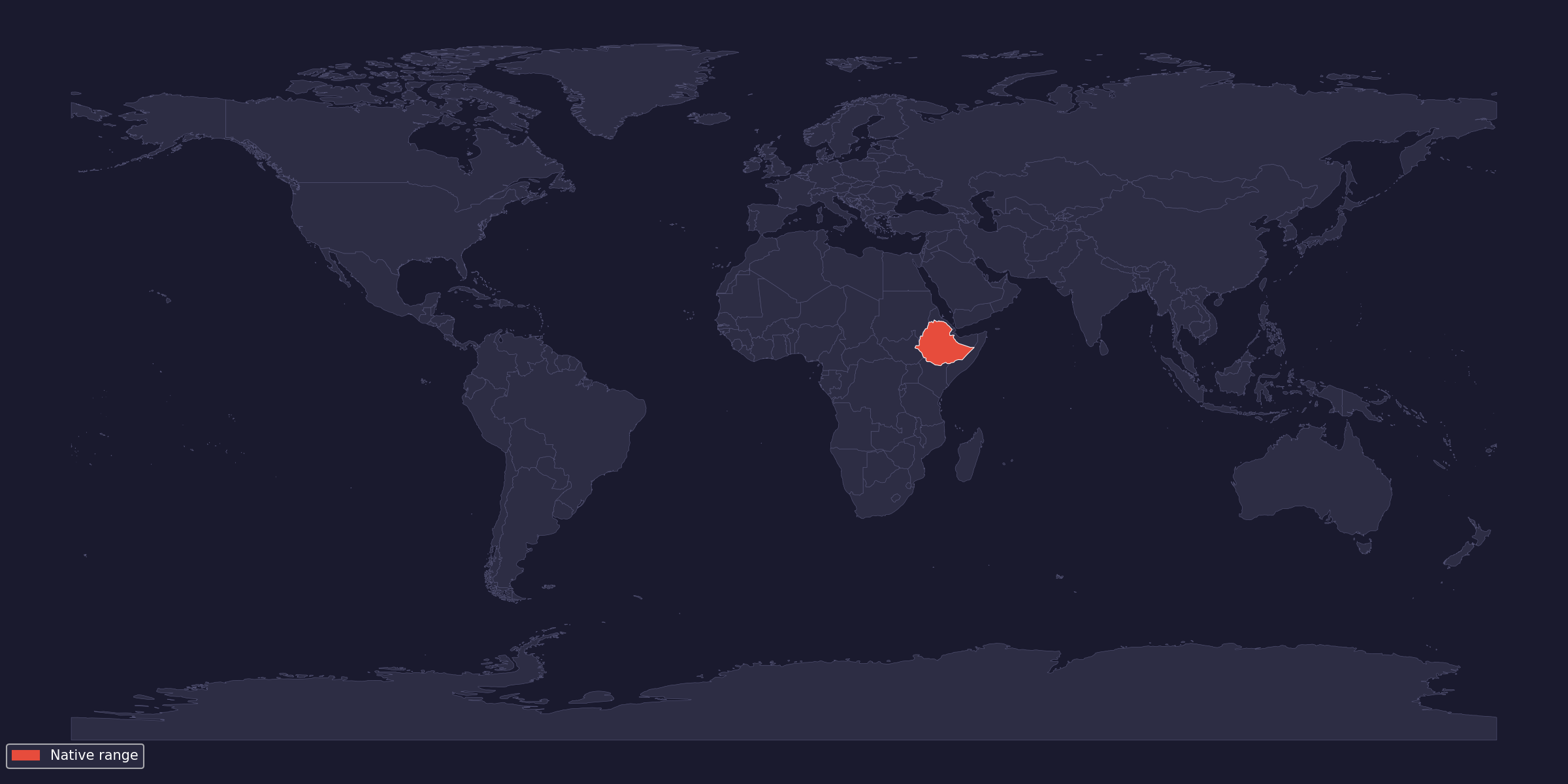
The species is endemic to Ethiopia and is documented from only a handful of localities in the southwest and south, on both sides of the Rift system. Records combine moist montane forest, coffee-forest mosaics, forest edge and highland grassland. Precise locality data are conservation-sensitive and should not be published with private stock advertisements.
Do not apply Bale Mountains records of B. harenna automatically to this species. Founder identity and lawful locality are essential because the historic confusion affects range claims, climate interpretation and trade paperwork.
⚖️ Legal status
Checked on 21 August 2026: CoP20 adopted the inclusion of B. parviocula in CITES Appendix I; under the Convention’s ordinary 90-day rule it took effect on 5 March 2026. Commission Regulation (EU) 2026/1383 places it in EU Annex A and entered into force on 29 June 2026. Commercial international trade in wild specimens is therefore prohibited, and other movements require the relevant prior permits and certificates. The Bern Convention is not relevant to this Ethiopian endemic.
Ethiopian wildlife law and export controls apply independently. Reject undocumented founders, vague “old European line” claims and paperwork that substitutes B. harenna. Before any transfer, obtain written confirmation from the competent authorities and retain CITES/EU certificates, source codes, parentage, photographs, microchip or other identity data and an unbroken transaction record.
🤌 Husbandry
Keep one animal per enclosure inside a locked, access-controlled and escape-resistant room. The primary enclosure needs two compartments or a full-body shift hide that closes positively from outside. Confirm the entire snake behind a barrier before opening a service door. Two trained adults attend every primary opening.
Quarantine for at least 90 days in separate airspace where possible. Use simple, auditable substrate, dedicated tools and written weight, feeding, shed, faecal and respiratory records. Arrange examination and parasite testing with a veterinarian already prepared to work through protected containment.
No free handling, tailing, pinning or manual restraint belongs in routine care. This scarce Appendix-I lineage should be managed by studbook-quality identity and pedigree records, not colour or market value.
💡 Lighting
Provide broad white light for 10-12 hours and complete darkness at night. Dense shade is important, but darkness throughout the day removes useful seasonal and inspection cues.
Low UVB is recommended: a measured Ferguson Zone 1 opportunity, approximately UVI 0.5-1.5 at an accessible exposed position, with UVI 0 in hides. The published ZSL programme used a wider UV gradient; it does not justify forcing every animal under high UV. Guard all lamps outside primary containment.
🌡 Heating and temperature
Maintain most daytime air at 20-26°C, a small basking surface at 30-32°C and a cool refuge at 18-22°C. Nights should return to 18-22°C. The successful ZSL programme recorded wider short-term daytime and basking ranges, but those institutional observations are not a reason to heat the whole enclosure or copy a 36°C surface without equivalent monitoring and escape options.
Use thermostats, independent probes at snake level, guarded heaters and a high-temperature alarm. Chronic warmth removes the montane gradient and can cause dehydration, food refusal or reproductive failure.
💧 Humidity and water
Use roughly 55-75% ambient humidity, with a ventilated refuge at 70-85% for shedding. Seasonal light spraying may imitate wetter months, but leaf litter and the upper substrate must dry between applications. Condensation, stagnant air and continuously wet bark are warning signs, not successful “forest” care.
Provide a stable bowl of fresh water that can be exchanged through protected access. Repeated soaking or poor sheds require review of heat, hydration, mites and disease rather than indiscriminate misting.
🌿 Enclosure and decoration
One adult needs at least 180 x 90 x 90 cm. Supply secure hides in warm and cool zones, dense visual cover, anchored low branches and broad stable shelves. Keep an unobstructed inspection route and no cavity from which the snake cannot be shifted.
Use 8-12 cm of low-dust soil and bark or leaf-litter mix that buffers moisture without remaining saturated. Quarantine on paper or a shallow disposable substrate. All vents, tracks, cable ports and drains must contain a neonate.
🐁 Feeding
Offer appropriately sized frozen-thawed whole rodents. Adults usually need one modest meal every 14-28 days; juveniles can begin around every 7-14 days. Published zoo animals also accepted birds, but dietary variety must not become large or frequent feeding.
Feed through a protected port or after a confirmed shift. Do not use live prey or loose feeding tubs. Whole vertebrate prey requires no routine supplements. Track mass and body condition because heavy Bitis hide obesity easily.
🛡 Operational safety and emergencies
Rehearse enclosure-opening, escape, bite, transport, fire and power-failure procedures without a live snake. Stop whenever its position is uncertain. The escape plan must isolate the room, exclude the public, account for people and animals and name the incident lead.
Before acquisition, agree a written response with emergency services, poison control, a medical toxicologist and the receiving hospital. State the accepted species name and provenance and verify what supportive and antivenom advice is actually available; do not assume a Gaboon-viper label or nearby stock guarantees a match. Private antivenom administration is not a substitute for hospital care.
After a bite, move out of range, call emergency services, remove rings or tight items, keep still and support the limb neutrally. Follow poison-centre instructions. Do not cut, suck, ice, massage, shock, tourniquet or delay transport to catch the snake. There is no home treatment.
🥚 Breeding notes
The species is viviparous. Published captive litters contain 11-16 young; one ZSL litter of 13 included stillborn and severely malformed offspring. That result, together with uncertain founder relatedness, makes pedigree management and veterinary review essential.
Breeding belongs only in a lawful conservation programme with permitted placements and secure neonate units prepared first. Pair through shift compartments and separate after observed courtship. Every newborn is venomous and Appendix-I documentation must follow each individual.
🩺 Common problems
- Chronic overheating: loss of the cool refuge, persistent hiding, dehydration or feeding disruption.
- Wet, stagnant housing: dermatitis and respiratory disease despite a superficially correct humidity reading.
- Obesity: frequent large rodents conceal condition in a heavy-bodied ambush predator.
- Retained shed or repeated soaking: investigate gradient, water access, mites and systemic illness.
- Parasites and stomatitis: a particular concern in undocumented or falsely represented stock.
- Pedigree failure: inbreeding, hybrid identity or lost legal provenance can compromise welfare and conservation value.
Shift and secure the snake before veterinary intervention. Hands-on home treatment creates a second emergency.
📌 Conclusion
Ethiopian mountain adder care combines cool montane choices, controlled seasonal moisture and rigorous protected contact with unusually strict conservation paperwork. Only a licensed programme with verified legal founders, redundant containment and a hospital pathway should keep it.
📚 Sources and further reading
- ReptiFiles — checked first on 21 August 2026; no species-specific guide was found.
- The Reptile Database: Bitis parviocula
- GBIF species record: Bitis parviocula
- Kane et al. 2022 — reproduction and husbandry at ZSL London Zoo
- Gower et al. 2016 — separation of B. harenna
- Petrilla et al. 2021 — venom composition and effects
- CITES CoP20 proposal notification
- Official CoP20 proposal outcome
- EU wildlife-trade annexes, Commission Regulation (EU) 2026/1383
- Baines et al. — UV lighting guidance for reptiles
- UK Standards of Modern Zoo Practice
- CDC/NIOSH venomous-snake first aid
- Bern Convention appendices