Share

Rhinoceros Viper
🔤 Taxonomy
Bitis nasicornis is the accepted name for the rhinoceros viper, also called the river jack. The occasional combination Bitis (Macrocerastes) nasicornis reflects a proposed subgeneric arrangement. Do not confuse it with the West African Gaboon viper Bitis rhinoceros, which is a separate species despite overlapping English names.
📌 Description
The rhinoceros viper is a short, very heavy-bodied rainforest viper with prominent horn-like nasal scales, cryptic multicoloured pattern, hinged front fangs, and medically significant cytotoxic and haemotoxic venom. Adults are commonly 60-100 cm; exceptional animals approach 120 cm. Females become substantially heavier than males.
It often remains motionless under leaf litter, but can strike explosively and farther than its posture suggests. A reported captive bite in Europe caused painful swelling and transient coagulopathy, and recent Bitis cases include severe local complications. Its calm appearance is not permission for close work.
📋 Quick reference
| Care point | Practical target |
|---|---|
| Adult enclosure | At least 150 x 75 x 75 cm for one adult, with external-closing shift box |
| Day temperatures | 23-27°C ambient; 28-30°C limited warm patch; 21-23°C cool hide |
| Night temperatures | 20-23°C |
| Humidity | 70-85%, damp lower layers, dry surface options, strong ventilation |
| Lighting | 11-13 hours; optional measured low-level UVB and deep shade |
| Feeding | Conservative frozen-thawed rodents; adults usually every 14-28 days |
| Housing | Solitary |
| Safety | Medically significant venom and long fangs; protected contact only |
☠️ Venom
This species is venomous. Venom exposure can cause pain, swelling or other systemic effects, and severity varies with species, locality, bite site and the amount delivered. A small wound or apparently dry bite is not proof of safety; every bite or sting requires urgent medical assessment.
If an incident occurs, move away, call emergency services or a poison centre, keep the patient still, remove rings and other constricting items, and follow dispatcher instructions. Do not use a tourniquet, cut or suck the wound, apply ice or electricity, give alcohol or medicines as a home treatment, or attempt to catch the animal. Antivenom choice and dosing are hospital decisions; verify the relevant product and local availability in advance. Sources: WHO snakebite guidance and appropriate species-specific toxinology or medical references listed below.
🌍 Distribution
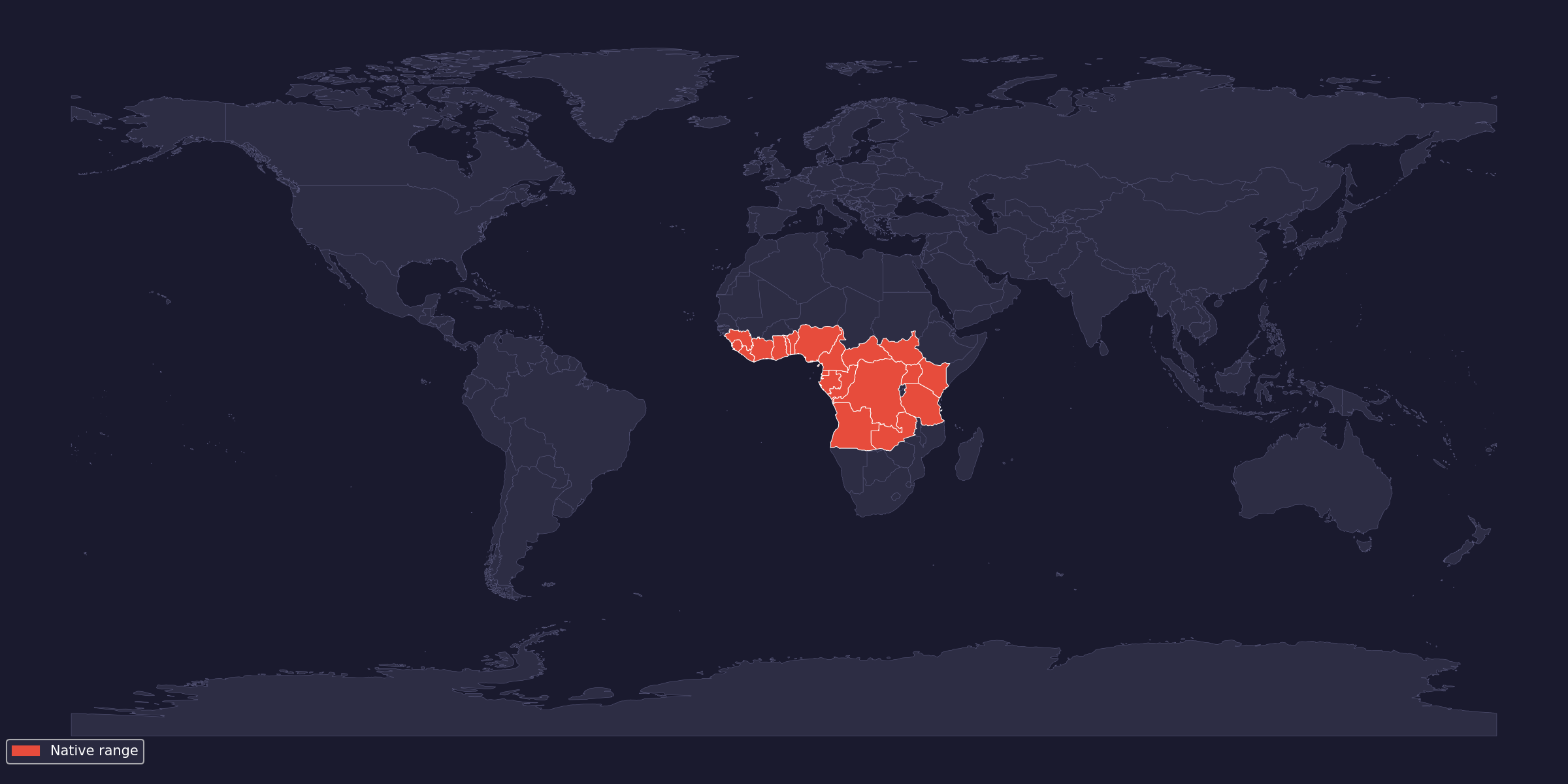
The species occurs in humid forest regions of West and Central Africa and extends locally into East and south-central Africa. Confirmed countries include Guinea, Sierra Leone, Liberia, Côte d’Ivoire, Ghana, Togo, Benin, Nigeria, Cameroon, Equatorial Guinea, Gabon, Republic of the Congo, Democratic Republic of the Congo, Central African Republic, Angola, South Sudan, Uganda, western Kenya, Tanzania, and Zambia.
It favours lowland and lower montane rainforest, swamp forest, river margins, and wet forest mosaics. The range is broad and some peripheral records in East and south-central Africa need locality-level scrutiny. Because the map colours whole countries, it overstates the continuous occupied area and should not be read as proof that the species occurs throughout Tanzania, Zambia, South Sudan, or any other highlighted state. A humid climate does not mean uniformly hot or waterlogged conditions: forest-floor shade, evaporation, and daily microclimate choices keep the animal cooler than an exposed weather station.
🌡 Climate across the native range
Monthly climate normals from a verified lowland rainforest occurrence in Cameroon:
Campo-Ma'an National Park — Cameroon (verified occurrence)
| Month | Min °C | Mean °C | Max °C | RH % |
|---|---|---|---|---|
| January | 22.9 | 25.1 | 29.2 | 90 |
| February | 23.2 | 25.5 | 29.6 | 90 |
| March | 23.3 | 25.6 | 29.8 | 90 |
| April | 23.2 | 25.5 | 29.7 | 91 |
| May | 23.1 | 25.2 | 29.1 | 91 |
| June | 22.5 | 24.4 | 27.9 | 90 |
| July | 21.9 | 23.8 | 27.1 | 89 |
| August | 22 | 23.8 | 27 | 89 |
| September | 22.3 | 24 | 27.4 | 92 |
| October | 22.4 | 24.2 | 27.8 | 93 |
| November | 22.4 | 24.5 | 28.5 | 93 |
| December | 22.7 | 24.8 | 28.7 | 91 |
Weather data by Open-Meteo.com · CC BY 4.0 · Monthly normals calculated by Herpeton Academy from daily archive values.
Location references use GBIF.org occurrence data where available; original occurrence records retain their source dataset licenses.
⚖️ Legal status
As checked on 16 August 2026, Bitis nasicornis is not listed in CITES Appendices I-III and no species-specific entry was found in EU wildlife-trade Annexes A-D. The Bern Convention is not relevant because the species is not native to Europe.
Local and national dangerous-animal laws can still require a licence, inspected secure room, insurance, transport permission, escape and bite plans, or prohibit private possession. Check both “rhinoceros viper” and B. nasicornis to avoid confusion with B. rhinoceros. Keep invoice, breeder, origin, import or transfer documents, photographs, and the legal-check date.
🤌 Husbandry
Prepare locked primary and secondary containment, hazard labels, dedicated tools, and a shift box closed from outside before the snake arrives. House singly. A heavy viper that appears reluctant to move must never be serviced by reaching around it; water, cleaning, and inspection occur only after verified shifting behind a solid barrier.
Quarantine for at least 90 days on paper with simple hides and separate equipment and airspace where possible. Record weight, meals, sheds, faeces, skin and respiratory condition. Imports warrant reptile-veterinary examination, faecal testing, and mite surveillance.
💡 Lighting
Provide 11-13 hours of bright visible light above a heavily shaded floor. Low-output UVB can be offered over a small Ferguson Zone 1 area, but the snake must have deep leaf and hide shade. Lamps, guards, probes, and cables must remain inaccessible.
Night is dark. Use a thermostatic lightless source only if the room falls below the target. Strong lamps focused on the whole floor can overheat an animal that relies on concealment rather than frequent movement.
🌡 Heating and temperature
Maintain 23-27°C ambient air, a limited 28-30°C warm surface, a 21-23°C cool hide, and 20-23°C nights. Avoid the common error of keeping a rainforest Bitis continuously near 30°C. Provide several measured floor choices and thermostat every heat source.
Secure probes where the snake cannot bury or displace them. Watch surface temperatures under hides and leaf litter. Seasonal change should be modest and based on provenance; do not cool juveniles, thin animals, new arrivals, or animals with unresolved disease.
💧 Humidity and water
Aim for 70-85% relative humidity with brief rises to 80-90% around shedding. Keep lower substrate layers lightly moist while preserving dry surface and hide choices. Cross-ventilation, drainage, and removal of fouled litter prevent humid care from becoming stagnant care.
Supply a heavy clean bowl, preferably reachable through protected access. A constantly soaked floor, sour smell, scale lesions, or condensation indicates a system failure. The animal may soak when shedding or unwell, but routine swimming space is unnecessary.
🌿 Enclosure and decoration
Provide at least 150 x 75 x 75 cm, larger for a large female. Use 8-12 cm of drainage-aware forest soil/coco mix topped with abundant leaf litter, snug warm and cool hides, cork, stable low obstacles, and visual cover. The layout must allow the entire snake to be located before opening.
Use keyed or tool-operated locks, secured vents, blocked gaps, guarded equipment, and an unobstructed shift entrance. Avoid unstable rock, sharp decor, aromatic wood, and deep foliage that prevents inspection. Audit tracks, drains, locks, and shift closure regularly.
🐁 Feeding
Wild prey includes small mammals and occasionally amphibians. Captive adults can be maintained on appropriately sized frozen-thawed rodents. Offer prey no wider than the snake’s broadest section; this heavy ambush predator is prone to obesity when fed according to appetite.
Juveniles commonly eat every 7-10 days; adults generally every 14-28 days depending on size, activity, sex, and condition. Whole rodents need no supplement. Avoid live prey and do not disturb for several days after a meal. Record prey mass, refusals, defecation, and serial weight.
🥚 Breeding
The rhinoceros viper is viviparous and published summaries report 6-35 young, often born around the onset of rains. Every neonate has functional venom and requires an individual escape-proof container, dedicated tools, records, and lawful placement.
Breeding requires confirmed sex, health, locality, separation capability, and capacity for a large litter. Pair introductions and maternal servicing are institutional-level operations. Do not cycle or breed poorly established or underweight animals.
🛡️ Handling and emergency planning
Treat every individual as display-only. Do not free-handle, tail, pin, neck, or manually restrain it. Use external-closing shifts, suitable hooks and barriers, and a second trained adult for high-risk access. The very long fangs can defeat casual assumptions about glove or container thickness.
Coordinate a written plan with emergency services, poison centre or toxicologist, and receiving hospital before acquisition. Identify accepted name, possible confusion with B. rhinoceros, exact location, contacts, and hospital route. Antivenom selection and limb-complication management are clinical decisions; never stock an uncoordinated home treatment kit.
Any bite needs immediate emergency assessment. Keep the patient still, immobilize the limb, remove rings and tight objects, and call emergency services. Do not cut, suck, ice, use electricity or chemicals, apply an arterial tourniquet, or attempt home wound treatment.
🩺 Common problems
- Overheating and dehydration: persistent exposed movement, gaping, or poor sheds can reflect a lost cool hide or dry water supply.
- Respiratory disease: bubbles, wheeze, open-mouth breathing, or abnormal head elevation needs prompt veterinary assessment.
- Dermatitis and dysecdysis: correct dirty wet substrate, weak ventilation, hydration, and temperature; do not peel retained skin.
- Obesity and regurgitation: long feeding intervals and serial weight matter more than appetite.
- Parasites: imported snakes need quarantine and diagnosis rather than blind treatment.
- Hidden contamination: deep leaf litter must be spot-cleaned and periodically renewed without compromising shifting safety.
- Unsafe routine: if the snake cannot be shifted for a water change, the enclosure requires redesign.
📌 Conclusion
The rhinoceros viper requires cool ventilated rainforest conditions, deep clean leaf cover, conservative feeding, and a protected-contact system designed around an almost invisible heavy snake with long fangs. It belongs only in a legally authorized expert facility with veterinary and hospital coordination.
📚 Sources and further reading
- ReptiFiles was searched; no species-specific care guide was located: https://reptifiles.com/
- The Reptile Database: https://reptile-database.reptarium.cz/species?genus=Bitis&species=nasicornis
- GBIF: https://www.gbif.org/species/2444873
- Animal Diversity Web: https://animaldiversity.org/accounts/Bitis_nasicornis/
- Malina & Krecsák, captive bite in Hungary: https://doi.org/10.4414/smw.2008.12063
- Acute compartment syndrome after Bitis bites: https://pubmed.ncbi.nlm.nih.gov/41430573/
- WHO Africa snakebite guidelines: https://iris.who.int/bitstream/handle/10665/204458/9789290231684.pdf
- Baines et al., UV-Tool: https://doi.org/10.19227/jzar.v4i1.150
- Swiss Animal Welfare Ordinance: https://www.fedlex.admin.ch/eli/cc/2008/416/en
- CITES: https://cites.org/eng/app/appendices.php and https://checklist.cites.org/
- Commission Regulation (EU) 2026/1383: https://eur-lex.europa.eu/eli/reg/2026/1383/oj/eng
- Bern Convention: https://www.coe.int/en/web/bern-convention/appendices