Share

Gaboon Viper
🔤 Taxonomy
Bitis gabonica is the currently accepted name for the eastern or central African Gaboon viper. Older literature and trade paperwork may use Bitis gabonica gabonica.
The West African Gaboon viper is now generally treated as the separate species Bitis rhinoceros. Its former name, Bitis gabonica rhinoceros, still appears in listings. The two should not be merged casually in locality records, breeding projects, range claims, or medical documentation.
Useful older combinations include:
- Echidna gabonica
- Urobelus gabonicus
- Bitis gabonica gabonica
📌 Description
The Gaboon viper is a massive forest-floor ambush predator with long hinged fangs, a very large venom delivery capacity, and potentially fatal envenomation. Its usual stillness is not docility and must never be used to justify free handling. This is an expert-only display animal for a purpose-designed venomous facility, not a first venomous snake.
Adults commonly measure 120-180 cm; large females are extremely heavy-bodied. A lifespan around 15-20 years is realistic under stable professional care. The leaf-like head, geometric dorsal pattern, and slow rectilinear movement make the species easy to admire and dangerously easy to underestimate.
📋 Quick reference
| Care point | Practical target |
|---|---|
| Adult size and lifespan | Usually 120-180 cm; about 15-20 years |
| Adult enclosure | At least 180 x 90 x 75 cm; more floor area for a large female |
| Temperature | Ambient 23-26°C; warm area 28-30°C; cool retreat 22-24°C |
| Night | 20-23°C, without a sudden chill |
| Humidity | 65-80%, with strong ventilation and a dry surface layer |
| Light | 10-12 hours; shaded low-level UVB may be offered |
| Feeding | Appropriately sized frozen-thawed rodents; adults often every 14-28 days |
| Safety | Locked shift system, no free handling, written bite and escape plans |
| Quarantine | At least 90 days, separate tools and veterinary parasite screening |
☠️ Venom
This species is venomous. Venom exposure can cause pain, swelling or other systemic effects, and severity varies with species, locality, bite site and the amount delivered. A small wound or apparently dry bite is not proof of safety; every bite or sting requires urgent medical assessment.
If an incident occurs, move away, call emergency services or a poison centre, keep the patient still, remove rings and other constricting items, and follow dispatcher instructions. Do not use a tourniquet, cut or suck the wound, apply ice or electricity, give alcohol or medicines as a home treatment, or attempt to catch the animal. Antivenom choice and dosing are hospital decisions; verify the relevant product and local availability in advance. Sources: WHO snakebite guidance and appropriate species-specific toxinology or medical references listed below.
🌍 Distribution
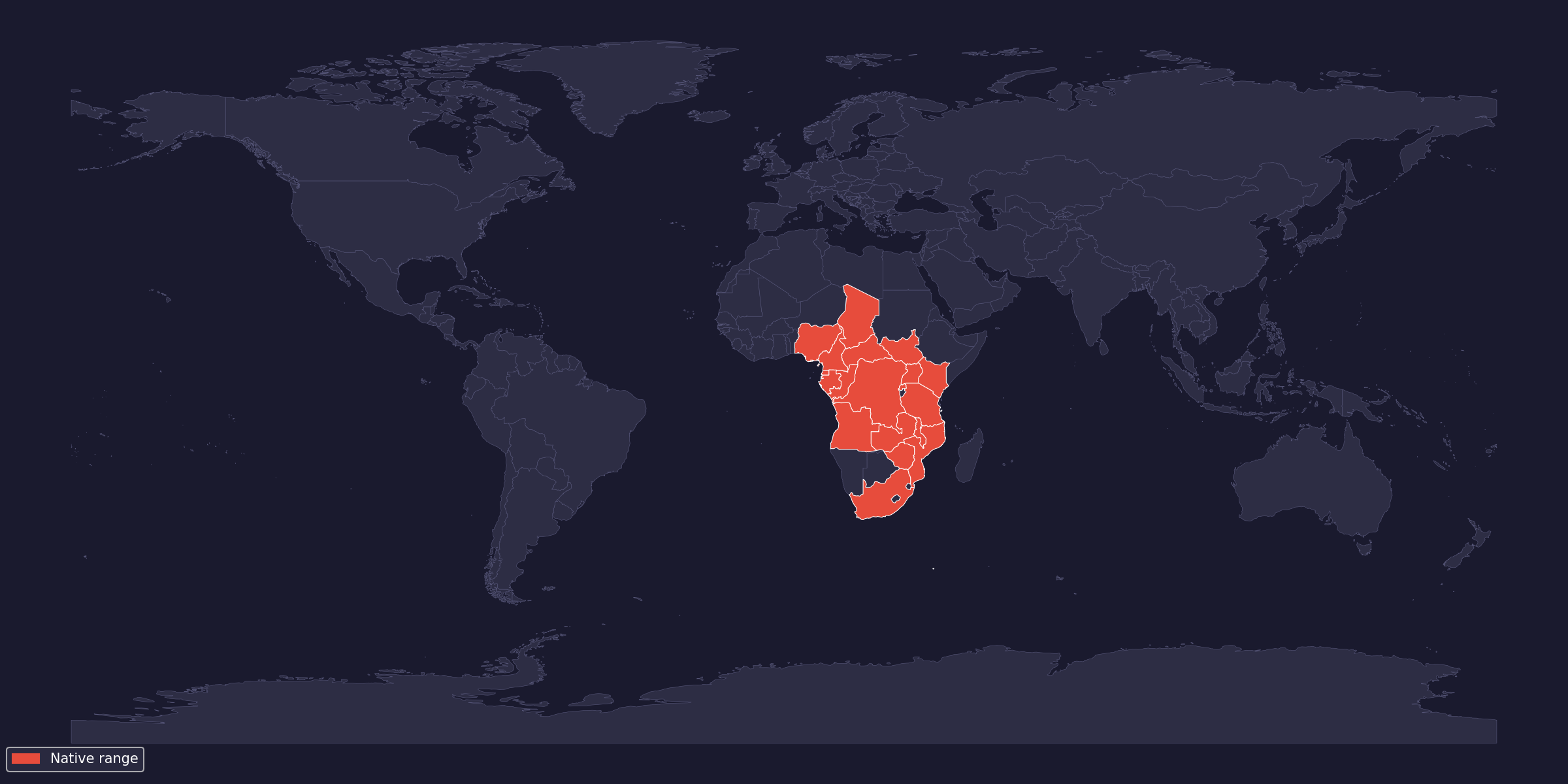
Following the split from B. rhinoceros, B. gabonica occupies forest and forest-savanna mosaics from eastern Nigeria and Cameroon through Gabon and the Congo Basin, then discontinuously toward Uganda, western Kenya and Tanzania, Zambia, Malawi, Mozambique, eastern Zimbabwe, and northeastern South Africa. Records west of the Dahomey Gap generally belong to B. rhinoceros; claims from Benin and Togo remain disputed, so country lists still differ at that boundary.
The species uses leaf litter, forest edges, plantations, damp woodland, and paths where rodents move. In a terrarium the important lesson is a cool, shaded, well-ventilated forest floor with dry resting surfaces—not permanently soaked substrate.
🌡 Climate across the native range
Monthly climate normals from a verified occurrence in the central part of the native range:
Cuvette-Ouest — Republic of the Congo (verified occurrence)
| Month | Min °C | Mean °C | Max °C | RH % |
|---|---|---|---|---|
| January | 21.2 | 24.8 | 29.8 | 82 |
| February | 21.5 | 24.8 | 29.7 | 84 |
| March | 21.6 | 24.8 | 29.6 | 87 |
| April | 21.6 | 24.7 | 29.2 | 88 |
| May | 21.5 | 24.5 | 28.9 | 89 |
| June | 20.9 | 24.1 | 28.7 | 86 |
| July | 20.6 | 23.9 | 28.5 | 82 |
| August | 20.7 | 23.9 | 28.5 | 83 |
| September | 20.7 | 23.7 | 28.3 | 87 |
| October | 20.7 | 23.6 | 28 | 89 |
| November | 20.8 | 23.8 | 28.3 | 90 |
| December | 21 | 24.3 | 29.1 | 86 |
Weather data by Open-Meteo.com · CC BY 4.0 · Monthly normals calculated by Herpeton Academy from daily archive values.
Location references use GBIF.org occurrence data where available; original occurrence records retain their source dataset licenses.
⚖️ Legal status
The official CITES Appendices and the EU wildlife-trade annexes checked on 14 August 2026 do not list Bitis gabonica. No species-specific Bern Convention listing was found; the convention is not a range-state instrument for this African snake.
That does not make possession unrestricted. National and local venomous-animal laws, permits, facility inspection, liability insurance, transport restrictions, landlord rules, and mandatory emergency arrangements can apply independently of wildlife-trade status. Obtain a written answer from the competent authority before acquisition and keep the invoice, breeder/importer identity, origin documents, photographs, veterinary records, and this legal-check date.
🤌 Husbandry
House one animal per enclosure. Design the room around protected servicing: a lockable shift box that functions as a hide, a second physical barrier at the room entrance, independently locked doors and vents, and a way to inspect water, locks, heat, and the snake’s position without entering its strike zone.
New arrivals, especially imports, need at least 90 days of quarantine in simple housing in a separate airspace where practical. Use dedicated hooks, tongs, bowls, cleaning tools, footwear, and waste handling. Record weight, meals, sheds, faeces, respiration, and behaviour; arrange faecal testing and an examination by a veterinarian experienced with venomous reptiles.
Do not cohabit Gaboon vipers for display. Temporary breeding introductions require a separate risk assessment, two trained people, and an immediate separation plan.
💡 Lighting
Use a clear 10-12 hour day-night cycle. The forest floor is shaded, but darkness all day prevents normal temporal cues and makes inspection harder. Broad visible light with dense shaded cover works better than a bright exposed enclosure.
UVB is not established as essential for a whole-prey snake, but low-level UVB over part of the enclosure can be offered with ample shade. Aim for a gentle Ferguson Zone 1 opportunity rather than forcing the animal to bask. Do not use coloured night lamps.
🌡 Heating and temperature
Maintain 23-26°C through most of the enclosure, a controlled warm area of 28-30°C, a cool retreat at 22-24°C, and nights around 20-23°C. Measure air and surface temperatures at snake level with independent digital probes and check hot surfaces with an infrared thermometer.
Overheating is a serious risk for this cool forest species. A thermostat must control every heater, and the broad-bodied snake must be able to leave the warmed area completely. Avoid hot rocks and unguarded lamps. Seasonal temperature manipulation belongs only in a documented breeding programme for established healthy adults.
💧 Humidity and water
Target roughly 65-80% relative humidity and allow brief rises to 75-85% during shedding. Keep lower substrate layers slightly moisture-retentive while the leaf-litter surface remains mostly dry. Cross-ventilation is essential: warm stagnant dampness encourages skin and respiratory disease.
Provide a stable clean water bowl that is accessible without moving the snake. Many individuals drink droplets after light spraying, but heavy daily soaking of the enclosure is not a substitute for fresh water. Change a fouled bowl using the shift system, never by reaching around the animal.
🌿 Enclosure and decoration
An adult enclosure should be at least 180 x 90 x 75 cm, with more floor area for a very large female. Provide two snug shift-capable hides, visual cover, broad open routes, and low robust objects only. Heavy snakes can overturn light décor, and awkward branches create dangerous places from which they cannot be shifted safely.
Use 8-12 cm of soil-based forest substrate, cypress mulch, or another low-dust moisture-buffering mix, topped with clean leaf litter. Quarantine animals belong on paper or another easily audited substrate. Avoid aromatic woods, sharp bark, constantly wet moss, and any setup that hides waste or prevents a full visual count of the snake.
Every vent, cable port, glass track, service hatch, and drain needs mechanical security. Labels should give the scientific name, venom risk, individual identity, emergency contacts, and the number of animals inside without advertising the collection to the public.
🐁 Feeding
Feed pre-killed or frozen-thawed whole rodents of moderate girth. Adults often need a meal only every 14-28 days; use body condition and weight records rather than feeding response. The spine should remain supported by strong muscle without deep fat folds or a disproportionately broad tail base.
Gaboon vipers are efficient ambush feeders and become obese easily. Oversized or frequent meals raise the risks of regurgitation, fatty change, and shortened life. Present food with long tongs only after the snake is contained in a predictable feeding position, and never reach in to retrieve refused prey while the animal is active.
Routine vitamin or mineral dusting is unnecessary with varied whole vertebrate prey. Do not use live rodents as standard food; they can injure a stationary snake and complicate safe removal.
🛡 Operational safety and emergencies
No part of routine care should require free handling, pinning, or hand restraint. Use trained protected-contact methods, an integrated shift box, suitable hooks and barriers, and two competent adults for any procedure that opens primary containment. Chemical restraint and clinical handling belong to a veterinarian and an agreed professional team.
Before the snake arrives, the keeper must have a written species-specific bite plan agreed with the receiving hospital or poison centre, a transport route, emergency contacts, an up-to-date enclosure card, and an escape plan shared with relevant responders. Do not assume that a nearby hospital stocks appropriate antivenom, and do not privately administer antivenom.
A bite is an immediate medical emergency even if there are no early symptoms. Move away from the snake, call emergency services, remove rings or constricting items, keep the patient still, immobilize the limb, and follow the poison centre’s instructions. Do not cut, suck, ice, electrically shock, or tightly tourniquet the bite. Do not delay transport to catch the snake.
🥚 Breeding notes
The species is viviparous. Litter size varies greatly with female size and condition; reports range from fewer than ten to several dozen, with exceptional litters around 50-60. There are no eggs for the keeper to incubate.
Breeding multiplies handling, introduction, separation, veterinary, and secure neonate-housing risks. Sexing should be performed only by a qualified team, and locality-documented B. gabonica must not be crossed with B. rhinoceros. Prepare individually locked neonate enclosures and lawful transfer records before pairing.
🩺 Common problems
- Obesity: the common captive failure; extend feeding intervals and monitor weight rather than reacting to every strike response.
- Regurgitation: investigate excess heat, large meals, disturbance, infection, and parasites with an experienced veterinarian.
- Respiratory disease: open-mouth breathing, bubbles, repeated head elevation, or abnormal sounds require urgent veterinary assessment.
- Dermatitis and scale rot: usually associated with wet dirty substrate, poor ventilation, or delayed waste removal.
- Dysecdysis: retained skin or spectacles point to hydration, humidity, surface texture, or systemic-health problems; do not restrain the snake for home removal.
- Parasites and stomatitis: imported animals are at particular risk; unexplained weight change, mites, oral discharge, or swelling needs professional examination.
📌 Conclusion
Bitis gabonica suits only a legally authorised, trained keeper with a secure room, protected-contact routines, veterinary access, and a hospital-coordinated bite plan. If routine cleaning cannot be completed while the snake remains locked behind a barrier, the facility is not ready for this species.
📚 Sources and further reading
- ReptiFiles — checked first on 14 August 2026; no species-specific care guide was found.
- The Reptile Database: Bitis gabonica
- GBIF species record: Bitis gabonica
- Wittenberg et al. — phylogeny of Bitis
- Smithsonian’s National Zoo: Gaboon viper
- WHO: snakebite envenoming treatment and first aid
- Losano et al. — clinical effects of B. gabonica venom
- Northern Ireland government guidance on keeping venomous snakes and lizards
- CITES Appendices
- EU wildlife-trade annexes, Regulation (EC) No 338/97, consolidated 29 June 2026
- Bern Convention appendices