Share

Southern Adder
🔤 Taxonomy
Bitis armata is the accepted southern adder. Its history within the B. cornuta–inornata complex produced labels such as B. cornuta cornuta, B. cornuta inornata and B. atropoides. Modern records should use B. armata and retain the identification authority. No subspecies are accepted.
📌 Description
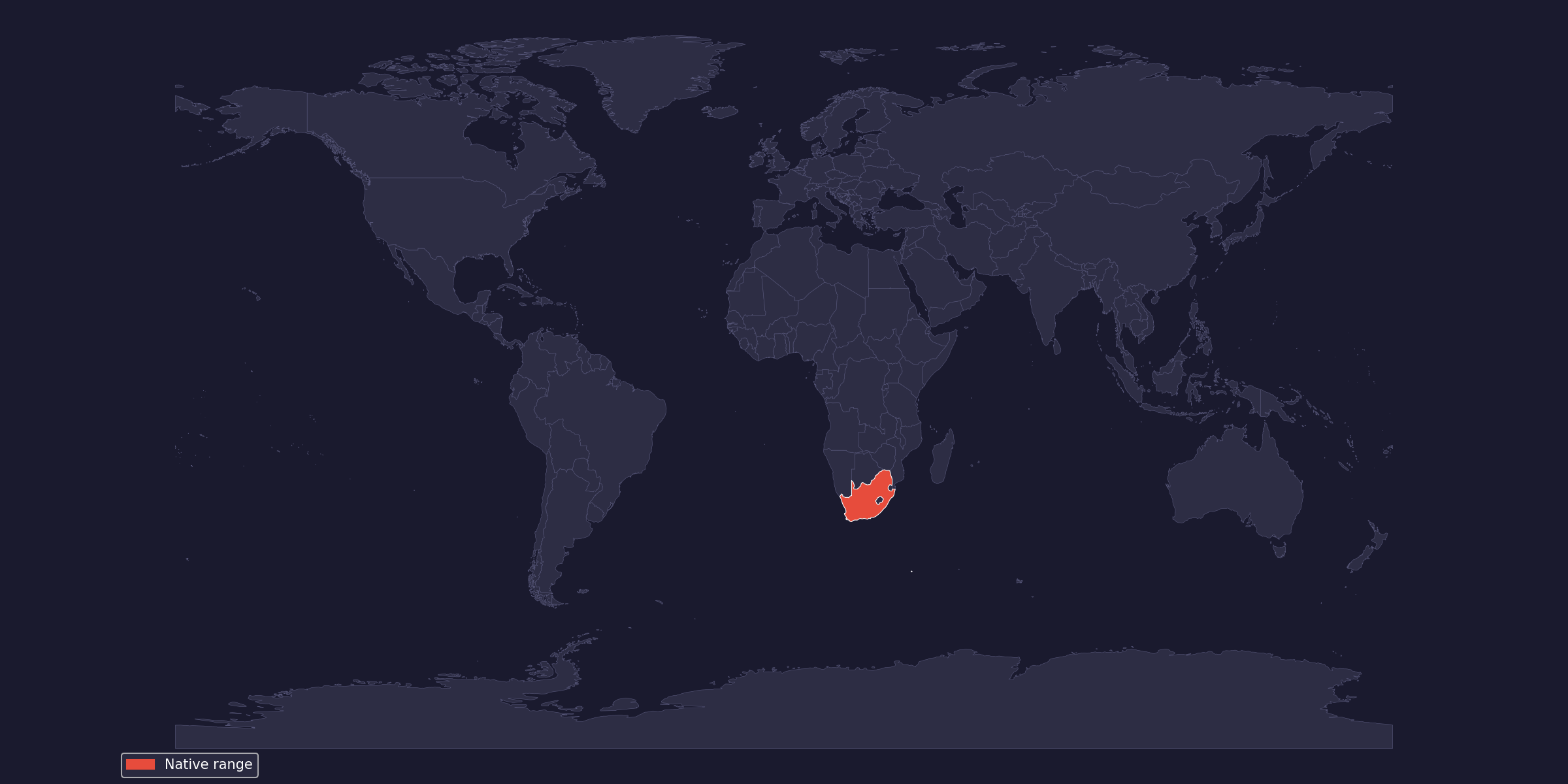
This 30-55 cm dwarf adder is endemic to South Africa’s southwestern and southern Cape, where it inhabits coastal fynbos, dune thicket and lowland shrub mosaics. It shelters beneath bushes and stones but can climb well into low vegetation, so a flat “desert box” misses important behaviour.
Its venom and clinical effects are poorly documented. That is uncertainty, not reassurance. The species is a Vulnerable, nationally regulated, medically significant snake for expert institutional or licensed specialist display only.
📋 Quick reference
| Care point | Practical target |
|---|---|
| Adult enclosure | At least 120 x 60 x 75 cm, with external lockable shift |
| Day temperatures | 20-25°C air; 28-32°C basking surface; 16-20°C cool refuge |
| Night | 12-18°C; retain the cool Cape cycle |
| Humidity | 50-70%; ventilated 65-80% shed refuge; dry resting surfaces |
| Lighting | Seasonal 10-14 hours; measured Ferguson Zone 2 UVB recommended |
| Feeding | Modest frozen-thawed rodents every 14-28 days for adults |
| Furnishing | Dense low cover plus anchored, broad climbing stems |
| Safety | Double containment, protected contact, backup, bite and escape plans |
☠️ Venom
This species is venomous. Venom exposure can cause pain, swelling or other systemic effects, and severity varies with species, locality, bite site and the amount delivered. A small wound or apparently dry bite is not proof of safety; every bite or sting requires urgent medical assessment.
If an incident occurs, move away, call emergency services or a poison centre, keep the patient still, remove rings and other constricting items, and follow dispatcher instructions. Do not use a tourniquet, cut or suck the wound, apply ice or electricity, give alcohol or medicines as a home treatment, or attempt to catch the animal. Antivenom choice and dosing are hospital decisions; verify the relevant product and local availability in advance. Sources: WHO snakebite guidance and appropriate species-specific toxinology or medical references listed below.
🌍 Distribution
The species is confined to the southwestern and southern Western Cape, from the west-coast lowlands through fragmented Cape coastal habitats toward the south coast. Agriculture, urban growth and habitat fragmentation isolate populations.
Precise surviving sites are conservation-sensitive. Do not publish coordinates or buy animals marketed by an unverified collection locality. A named fynbos site without a permit trail is a warning sign.
⚖️ Legal status
Checked on 21 August 2026: B. armata is not listed by CITES and no specific entry was found in the current EU wildlife-trade annexes; Bern is not relevant. SANBI assesses it as Vulnerable, but it is not named in South Africa’s currently in-force national TOPS list. Provincial rules still apply: CapeNature requires permits to keep, import, export or transport wild animals in the Western Cape.
International non-listing does not make an animal lawful. Use documented captive-bred stock only and retain provincial permits, parentage, photographs and all transfers. Never disclose fine wild localities or treat a gravid wild female as a source of “captive-bred” young.
🤌 Husbandry
House singly in a locked primary enclosure inside an access-controlled escape-resistant room. Provide two compartments or a full-body shift hide that closes positively from outside. Confirm the entire snake behind a barrier before service access; two trained adults attend each opening.
Quarantine at least 90 days with simple furnishings, dedicated tools and serial weight, feeding, shed, faecal and respiratory records. Arrange veterinary and parasite support before acquisition. No free handling, tailing, pinning or manual restraint.
💡 Lighting
Provide bright white light for 10-14 hours, changed gradually with season, and complete darkness at night. Recommend a measured Ferguson Zone 2 UVB opportunity over part of the warm zone, with shade beneath shrubs and in both thermal zones.
Keep lamps outside primary containment or behind locked guards. Dense cover must not prevent a complete visual count during shifting.
🌡 Heating and temperature
Maintain 20-25°C daytime air, a limited basking surface at 28-32°C and a 16-20°C cool refuge. Nights may fall to 12-18°C. This cool coastal species should not be run at inland-desert ambient temperatures.
Use guarded overhead heat, a thermostat, independent probes and an alarm. Seasonal cooling for breeding is only for healthy, locality-documented adults under a controlled programme; do not cool juveniles, new arrivals, gravid, thin or ill snakes.
💧 Humidity and water
Target 50-70% ambient humidity and a ventilated 65-80% shed refuge. Winter-rainfall habitat does not mean continuously wet substrate: maintain dry resting surfaces and cross-ventilation, with localized moisture deeper in the substrate.
Provide a stable shallow bowl that can be exchanged through protected access. Persistent soaking, blistering or condensation indicates a husbandry or health problem.
🌿 Enclosure and decoration
One adult needs at least 120 x 60 x 75 cm. Supply two shift-compatible hides, dense low visual cover, anchored broad stems and platforms up to modest height, and a clear inspection route. Cushion fall zones and avoid thin branches that cannot support the whole snake.
Use 6-10 cm of sandy soil with leaf litter and a few fixed flat stones. Quarantine on paper. Avoid loose rock, aromatic wood, thorny plants and vegetation that blocks shifting or hides the animal completely.
🐁 Feeding
Wild diet is incompletely known and likely includes small vertebrates. Established captives often take modest frozen-thawed mice. Adults usually need one meal every 14-28 days; juveniles every 7-14 days according to growth.
Feed through protected access after a confirmed shift. Do not use live prey, wild-caught vertebrates, force-feeding or loose tubs. Whole prey needs no routine supplements. Use weight and body condition; dwarf Bitis become obese on generous rodent schedules.
🛡 Operational safety and emergencies
Rehearse service, escape, bite, fire and power-failure procedures. The escape plan must isolate the room, exclude the public, account for people and animals, and define how dense décor is searched without hands.
Before acquisition, agree a written bite plan with poison control, a medical toxicologist, emergency services and the receiving hospital. Species-specific evidence and antivenom coverage are limited; never give false assurance or privately administer antivenom.
After a bite, move away, call emergency services, remove constricting items, remain still and support the limb neutrally. Do not cut, suck, ice, massage, shock or tourniquet. There is no home treatment.
🥚 Breeding notes
The species is viviparous; reported litters range from two to about twelve young. Mating and birth are seasonal in Cape populations, but a single captive schedule should not be generalized across fragmented localities.
Breed only lawful, compatible animals within a managed conservation programme. Prepare individual secure neonatal housing and placements first. Record every birth against parental permit and locality data.
🩺 Common problems
- Overheating: persistent cool-hide use, restlessness and dehydration.
- Wet-surface dermatitis or respiratory disease: high humidity without dry cover and ventilation.
- Obesity: frequent rodents and low activity.
- Falls or crushing: weak branches and unstable stone.
- Parasites, mites and stomatitis: especially with questionable origin.
- Lost provenance: destroys legal defensibility and conservation value.
Shift and secure before veterinary intervention. Hands-on home care adds a bite emergency.
📌 Conclusion
Southern adder care requires cool Cape gradients, dry-but-humid microclimates, safe low climbing structure and strict protected contact. Its Vulnerable status demands documented captive breeding and confidentiality around wild sites.
📚 Sources and further reading
- ReptiFiles — checked first on 21 August 2026; no species-specific guide was found.
- The Reptile Database: Bitis armata
- GBIF species record: Bitis armata
- SANBI/IUCN assessment for Bitis armata
- Barlow et al. 2019 — evolution and habitat shifts in Bitis
- DFFE — current TOPS permits and legislation
- CapeNature wild-animal permits
- CITES Appendices
- EU wildlife-trade annexes, Commission Regulation (EU) 2026/1383
- CDC/NIOSH venomous-snake first aid
- Bern Convention appendices