Share

Puff Adder
🔤 Taxonomy
Bitis arietans is the accepted name for the puff adder. The widespread nominate form is B. a. arietans; B. a. somalica is commonly recognized from parts of East Africa and the Horn. Old sources may use Vipera arietans or Echidna arietans.
The harmless North American hognose snake is also called “puff adder” locally. Scientific names must therefore appear on enclosure, transport, and medical documents.
📌 Description
The puff adder is a thick-bodied ambush viper with long hinged fangs, a very fast strike, large venom yield, and medically serious envenomation. Most adults are 80-120 cm; exceptional animals exceed this. Captive longevity is commonly around 12-18 years.
Its habit of remaining motionless and hissing before striking is not predictability. This is an expert-only display animal for a dedicated venomous facility. Small enclosure height does not reduce the need for a locked shift system, secondary room containment, and a hospital-coordinated emergency plan.
📋 Quick reference
| Care point | Practical target |
|---|---|
| Adult size and lifespan | Usually 80-120 cm; about 12-18 years |
| Adult enclosure | At least 150 x 75 x 60 cm; greater floor area for a large female |
| Temperature | Ambient 24-28°C; basking 30-32°C; cool retreat 22-25°C |
| Night | 21-24°C |
| Humidity | 40-60%, locally 60-75% for shedding |
| Feeding | Moderate frozen-thawed rodents every 14-21 days |
| Safety | Locked shift hides, protected contact, bite and escape plans |
| Quarantine | At least 90 days, dedicated equipment and parasite testing |
☠️ Venom
This species is venomous. Venom exposure can cause pain, swelling or other systemic effects, and severity varies with species, locality, bite site and the amount delivered. A small wound or apparently dry bite is not proof of safety; every bite or sting requires urgent medical assessment.
If an incident occurs, move away, call emergency services or a poison centre, keep the patient still, remove rings and other constricting items, and follow dispatcher instructions. Do not use a tourniquet, cut or suck the wound, apply ice or electricity, give alcohol or medicines as a home treatment, or attempt to catch the animal. Antivenom choice and dosing are hospital decisions; verify the relevant product and local availability in advance. Sources: WHO snakebite guidance and appropriate species-specific toxinology or medical references listed below.
🌍 Distribution
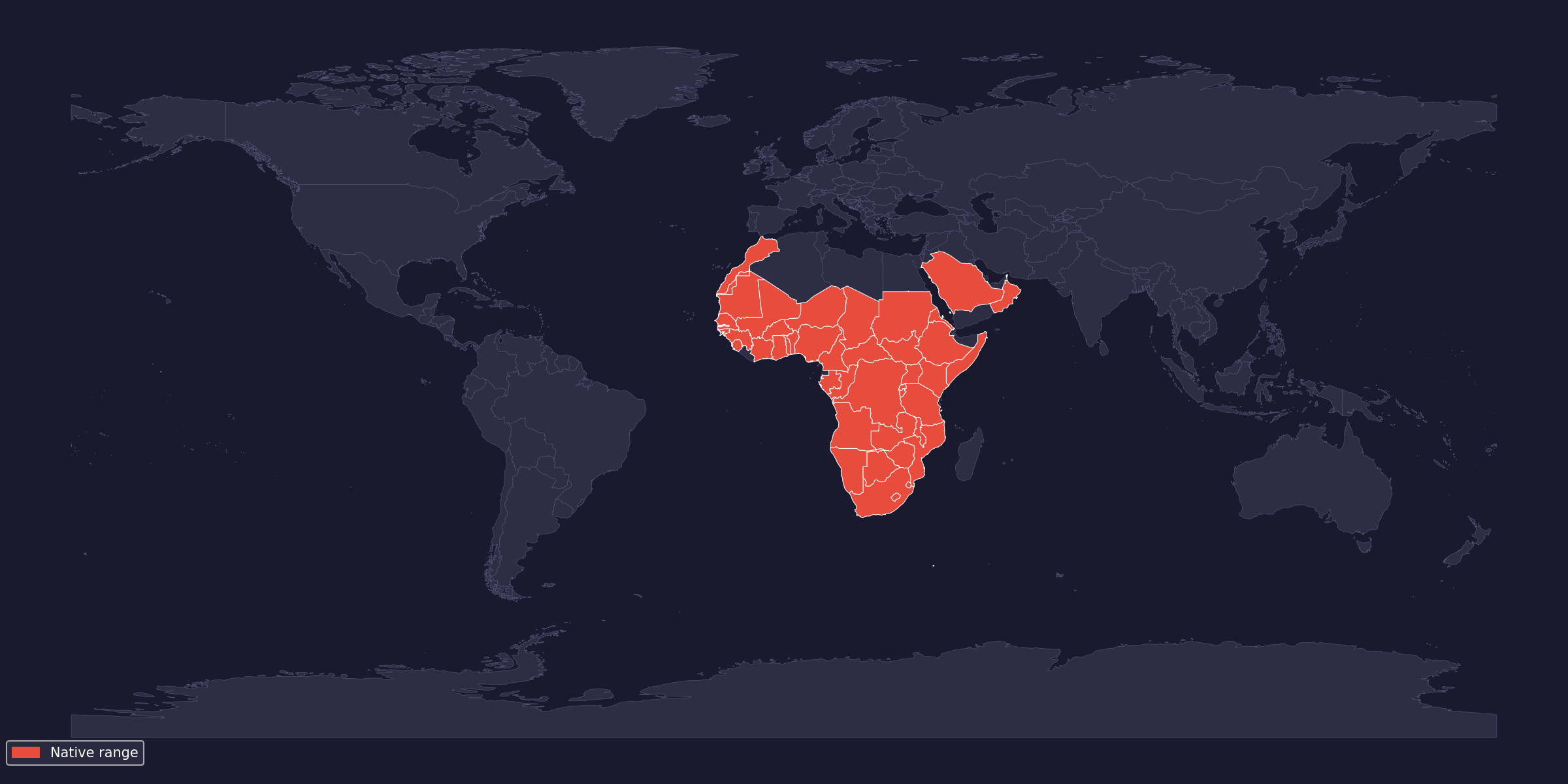
The species occupies most of sub-Saharan Africa outside the central rainforest and extreme deserts, with discontinuous populations in North Africa and the southwestern Arabian Peninsula. It occurs from Senegal and Mauritania eastward to the Horn, then south to South Africa. Country-level maps are broad because distribution within large desert and rainforest states is strongly patchy.
Puff adders use savanna, grassland, scrub, open woodland, semi-desert, farms, and mountain edges. Their camouflage and ambush behaviour favour firm ground, cover, and clear thermal choices. The climate record below represents seasonal southern African savanna, not the entire transcontinental range.
🌡 Climate across the native range
Monthly climate normals from a reviewed savanna occurrence in southern Africa; conditions vary widely across the species’ range:
Limpopo — South Africa (reviewed occurrence)
| Month | Min °C | Mean °C | Max °C | RH % |
|---|---|---|---|---|
| January | 17.3 | 21.9 | 27.2 | 70 |
| February | 17.3 | 21.9 | 27.2 | 70 |
| March | 16.2 | 20.9 | 26.3 | 70 |
| April | 13.6 | 18.6 | 24.5 | 68 |
| May | 10.5 | 16.3 | 22.9 | 61 |
| June | 7.8 | 13.8 | 20.6 | 59 |
| July | 7.1 | 13.3 | 20.1 | 58 |
| August | 9.1 | 15.8 | 22.9 | 54 |
| September | 12 | 18.7 | 25.8 | 54 |
| October | 13.9 | 20.1 | 26.6 | 59 |
| November | 15.6 | 21 | 26.9 | 65 |
| December | 16.8 | 21.7 | 27.2 | 69 |
Weather data by Open-Meteo.com · CC BY 4.0 · Monthly normals calculated by Herpeton Academy from daily archive values.
Location references use GBIF.org occurrence data where available; original occurrence records retain their source dataset licenses.
⚖️ Legal status
The official CITES Appendices and EU wildlife-trade annexes checked on 16 August 2026 do not specifically list Bitis arietans. The Bern Convention is not a relevant range-state instrument for this African and Arabian species, and no species-specific Bern listing was found.
National and local rules may still control possession through dangerous-wild-animal laws, permits, facility inspection, insurance, transport rules, and emergency-plan requirements. Range states may also restrict wildlife collection and export. Obtain written approval before acquisition and retain invoice, breeder or importer details, evidence of lawful origin, photographs, veterinary records, and the legal-check date.
🤌 Husbandry
House puff adders singly. Use a purpose-designed room with controlled access and secondary containment. Two snug lockable shift hides, protected service ports, locked vents, and a view of the snake’s full position must allow every routine task to occur without sharing open space with it.
Quarantine for at least 90 days, preferably with separate airspace and dedicated equipment. Imports have significant risks of mites, endoparasites, dehydration, stomatitis, and respiratory disease. Record weight, girth, meals, sheds, faeces, respiration, and oral appearance, and arrange veterinary testing.
Do not interpret immobility as cooperation. The enclosure and written operating procedure must control the interaction even when the snake refuses to shift.
💡 Lighting
Provide 10-12 hours of visible light and complete darkness at night. Use broad, diffuse illumination with shaded cover, not an intensely bright exposed box. Mount or guard every fixture outside reach.
Low-level UVB may be offered over part of the enclosure as a Ferguson Zone 1 opportunity, although whole-prey nutrition does not establish it as essential. The animal must be able to remain entirely shaded.
🌡 Heating and temperature
Maintain ambient air at 24-28°C, a local basking surface at 30-32°C, a cool hide at 22-25°C, and nights around 21-24°C. Thermostat all heat sources and measure air and surfaces independently at snake level.
The broad body can contact a large hot surface, so unguarded lamps, heat rocks, and uncontrolled mats cause serious burns. Warm only one section and preserve a dry cool retreat. Reproductive seasonal cycling varies by locality and should not be improvised for routine care.
💧 Humidity and water
For many savanna localities, 40-60% relative humidity with a 60-75% humid hide during shedding is a useful starting range. Coastal, montane, and arid populations differ. Use the documented origin, shedding quality, hydration, and ventilation rather than maintaining the entire enclosure wet.
Provide a heavy clean water bowl accessible from a protected port. Keep the surface dry while allowing one deeper corner to retain slight moisture. Stagnant damp substrate predisposes this heavy snake to dermatitis.
🌿 Enclosure and decoration
An adult needs at least 150 x 75 x 60 cm, with more floor space for a large female. Provide two shift-capable hides, robust low cover, and firmly fixed décor. Avoid elevated or unstable objects that complicate shifting or can fall on the snake.
Use 6-10 cm of compactable mineral soil with washed sand and a small amount of leaf or clay material. Paper is appropriate in quarantine. Avoid pure dusty sand, aromatic woods, sharp chips, wet moss floors, and clutter that prevents a complete visual count.
Use independent mechanical locks on every opening. Label the enclosure with scientific name, venom hazard, individual identity, animal count, emergency contacts, and bite-plan location.
🐁 Feeding
Feed moderate frozen-thawed rodents, usually every 14-21 days for adults. Puff adders are efficient ambush predators and become obese readily; follow weight and body profile rather than feeding response. Juveniles take smaller prey more often, but should not be power-fed.
Present food with long tongs only from the protected position. Never leave a live rodent, and shift the snake before retrieving refused prey. Routine supplements are unnecessary with varied whole vertebrate prey.
🛡 Operational safety and emergencies
Never free-handle, pin, neck, or manually restrain a puff adder in routine husbandry. Its strike can cover a substantial portion of body length and may occur from apparent stillness. Use lockable shift boxes, hooks and transparent barriers suited to a heavy viper, protected ports, and two trained adults whenever primary containment opens.
Agree written bite and escape plans with a receiving hospital or poison centre before the animal arrives. Confirm species identification, transport, responder access, and the pathway for antivenom consultation. Do not assume antivenom is locally stocked and do not privately administer it.
A bite is an immediate medical emergency. Move away, call emergency services, remove constricting objects, keep the patient still, immobilize the limb, and follow poison-centre advice. Do not cut, suck, ice, shock, tightly tourniquet, or delay transport to catch the snake.
🥚 Breeding notes
The species is viviparous. Typical litters contain roughly 20-50 young, although much larger exceptional litters are documented. There are no eggs to incubate. Females require excellent condition and a long recovery after a large litter.
Breeding creates dozens of independently dangerous neonates. Confirm legal placement and prepare individual locked containers, labels, feeding records, and transfer documents before pairing. Introductions and sexing require a professional risk plan.
🩺 Common problems
- Obesity: use measured meals, long intervals, weight records, and a clear body-condition target.
- Burns and overheating: prevent them with guarded local heat, thermostats, and a complete cool retreat.
- Respiratory disease: open-mouth breathing, bubbles, abnormal sounds, or repeated head elevation require urgent veterinary care.
- Dermatitis and scale rot: usually follow damp dirty surfaces and poor ventilation.
- Dysecdysis: review water, humid hide, temperatures, and health; do not restrain the animal for home removal.
- Parasites and stomatitis: mites, abnormal faeces, weight loss, oral swelling, or discharge are common concerns in imports.
- Regurgitation: investigate prey size, heat, disturbance, infection, and parasites with an experienced veterinarian.
📌 Conclusion
Bitis arietans is suitable only for a licensed expert who can move a heavy, fast-striking viper between locked compartments and has institutional bite and escape planning. Its stillness should increase caution, never reduce it.
📚 Sources and further reading
- ReptiFiles — checked first on 16 August 2026; no species-specific care guide was found.
- The Reptile Database: Bitis arietans
- GBIF species record: Bitis arietans
- Smithsonian’s National Zoo: puff adder
- Baines et al. — UV lighting guidance for captive reptiles
- WHO: snakebite envenoming treatment and first aid
- Northern Ireland government guidance on keeping venomous snakes and lizards
- CITES Appendices
- EU wildlife-trade annexes, Commission Regulation (EU) 2026/1383
- Bern Convention appendices