Share

Ball Python
🔤 Taxonomy
Python regius is the currently accepted scientific name. In the hobby and in trade, the species is usually sold under the same name or under its common-name equivalents.
English common names used in the hobby:
- Ball python
- Royal python
German common names used in the hobby:
- Königspython
- Ballpython
📌 Description
The ball python (Python regius), also known as the royal python, is one of the most popular pet snakes in the world. The name “ball python” comes from its characteristic defensive behavior — when stressed, it curls into a tight ball and tucks its head into the center. The species is well known for its docile temperament and exceptional longevity in captivity.
Males typically reach 90–120 cm, while females can grow up to 150 cm. The body is heavy and relatively short for its girth. Hundreds of color mutations (morphs) have been selectively bred in captivity, though the wild-type pattern features a brown and cream design with a pale belly.
🌍 Distribution
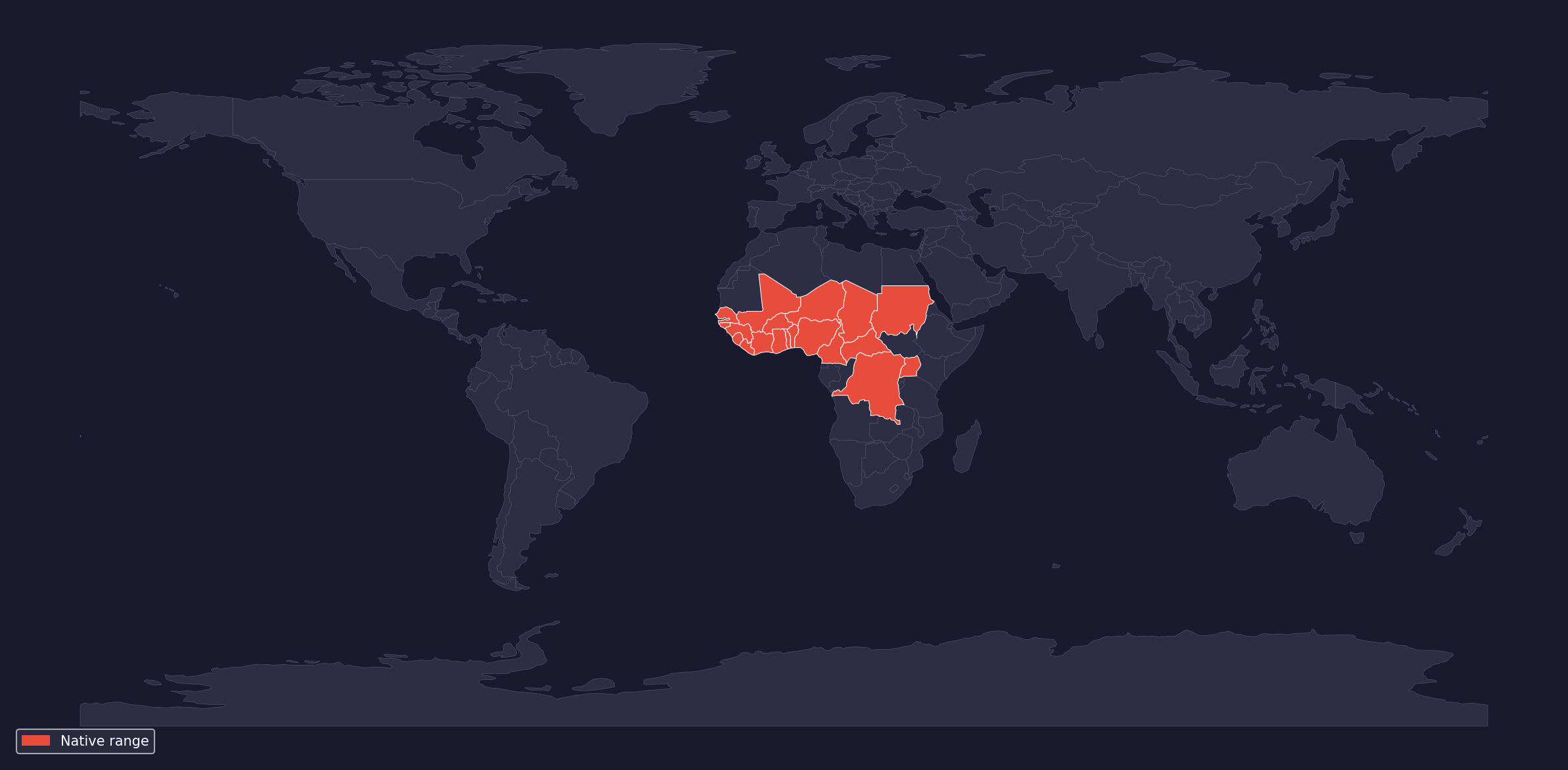
Python regius is native to West and Central Africa, especially the savanna and forest-edge belt from Senegal and Ghana east toward Nigeria and Cameroon. In the wild it is associated with savannas, grassland with scattered trees, forest edges, farms and rodent burrows used as daytime shelters.
For captive care, the useful lesson from this distribution is:
- secure hides in both warm and cool parts of the enclosure
- a clear thermal gradient instead of one uniform temperature
- substrate and cover that match the species’ natural shelter use
- humidity managed by microclimates, not by keeping the whole enclosure wet
- space and enrichment that support normal movement and hunting behaviour
🌡 Climate across the native range
Monthly climate normals from representative West African occurrence locations across the native range:
Volta Region — Ghana (verified West African savanna-edge occurrence)
| Month | Min °C | Mean °C | Max °C | RH % |
|---|---|---|---|---|
| January | 23.3 | 27.6 | 33.6 | 70 |
| February | 24.4 | 28.3 | 34.4 | 72 |
| March | 24.9 | 28.4 | 34 | 75 |
| April | 24.8 | 28.1 | 33.3 | 77 |
| May | 24.1 | 27 | 31.5 | 82 |
| June | 23.1 | 25.5 | 29.2 | 85 |
| July | 22.5 | 24.7 | 28.3 | 84 |
| August | 22.2 | 24.6 | 28.3 | 83 |
| September | 22.5 | 25 | 28.9 | 86 |
| October | 22.9 | 25.6 | 29.9 | 86 |
| November | 23.3 | 26.4 | 31 | 83 |
| December | 23.4 | 27.1 | 32.2 | 77 |
Atakora — Benin (verified northern savanna occurrence)
| Month | Min °C | Mean °C | Max °C | RH % |
|---|---|---|---|---|
| January | 19.8 | 25.9 | 33.4 | 23 |
| February | 21.3 | 27.8 | 35.3 | 25 |
| March | 23 | 29.3 | 36.3 | 41 |
| April | 24 | 28.7 | 34.9 | 64 |
| May | 23.5 | 27.2 | 32.4 | 77 |
| June | 22.3 | 25.6 | 30.1 | 82 |
| July | 21.4 | 24.1 | 28 | 87 |
| August | 21 | 23.5 | 27.3 | 89 |
| September | 21 | 24.1 | 28.6 | 89 |
| October | 21.2 | 25.1 | 30.6 | 82 |
| November | 20.2 | 26.1 | 32.8 | 52 |
| December | 19.9 | 25.9 | 33.2 | 29 |
Benue — Nigeria (verified eastern interior occurrence)
| Month | Min °C | Mean °C | Max °C | RH % |
|---|---|---|---|---|
| January | 22.9 | 29 | 35.6 | 38 |
| February | 24.2 | 30.2 | 36.7 | 44 |
| March | 25.6 | 30.3 | 36.2 | 58 |
| April | 25.4 | 29.2 | 34.4 | 69 |
| May | 24.5 | 27.6 | 32 | 78 |
| June | 23.5 | 26.1 | 30.1 | 82 |
| July | 22.8 | 25.2 | 29 | 84 |
| August | 22.7 | 25.1 | 28.9 | 83 |
| September | 22.8 | 25.5 | 29.6 | 84 |
| October | 23.1 | 26.1 | 30.2 | 83 |
| November | 23.3 | 27.4 | 32.5 | 70 |
| December | 22.3 | 28.2 | 34.7 | 47 |
Weather data by Open-Meteo.com · CC BY 4.0 · Monthly normals calculated by Herpeton Academy from daily archive values.
Location references use GBIF.org occurrence data where available; original occurrence records retain their source dataset licenses.
⚖️ Legal status
As checked against current official sources in April 2026, Python regius is listed in CITES Appendix II. Under the EU wildlife trade rules, that normally places the species in Annex B unless a stricter listing applies.
The species is not relevant to the Bern Convention because it is not native to Europe. National and local rules on import, sale, transport, breeding, and proof of legal origin may still apply. Keep purchase records and buy only from transparent, well-documented captive sources.
🤌 Husbandry
Ball pythons are considered beginner-friendly and are among the most manageable snakes to keep. That said, an improperly set up enclosure accounts for most of the health problems seen in captive specimens.
The minimum enclosure size for an adult is 120 × 60 × 45 cm. Ball pythons are not active climbers, but a low perch or sturdy branch can be included for environmental enrichment. Juveniles tend to be somewhat more arboreal.
The species is highly sensitive to feeling exposed. Providing two hides — one on the warm side and one on the cool side — is essential. Each hide should fit the animal snugly; the snake should be able to coil inside without excess space around it. An oversized hide does not provide the sense of security the animal needs and increases stress.
Suitable enclosure materials include PVC, moisture-sealed wood, or glass. Ventilation should be adequate but not excessive — retaining humidity is important for this species.
💡 Lighting
Unlike chameleons or many lizards, ball pythons do not strictly require UVB lighting. The species is nocturnal and receives minimal direct sunlight in the wild.
That said:
- Low-intensity UVB (2–5%, T5 or T8) can support metabolism and reduce the risk of D3 deficiency
- A clear 12-hour day/night cycle is important for regulating the animal’s circadian rhythm
- Avoid strong direct lighting — the species prefers a dim environment
If a UVB lamp is used, it should be positioned at an appropriate distance and replaced every 12 months.
For UV planning, treat this species as Ferguson Zone 1. Aim for about UVI 0.5-1.0 in the upper exposed area, while leaving retreats and a gradient down to shaded areas near zero UVI. This usually points to a low-output UVB tube such as a ShadeDweller-style or 2-7% T5, chosen for the enclosure height; measure with a Solarmeter 6.5 when possible, because reflector, mesh, distance, and lamp age change the real exposure.
🌡 Heating and temperature
Ball pythons regulate body temperature by moving between zones within the enclosure.
The temperature gradient should include:
- Warm hide (floor heater or heat mat under the hide): 32–35°C surface temperature
- Warm side ambient: 28–30°C
- Cool side: 24–26°C
- Night temperature: 22–24°C
A thermostat is mandatory for every heating element. Overheating is dangerous and can be fatal quickly. Heat mats used without a thermostat should never be used.
Suitable heating solutions include under-tank heaters (UTH), ceramic infrared heat emitters, or radiant heat panels. Visible-light bulbs are not recommended for nighttime heating.
💧 Humidity and water
Maintaining correct humidity is one of the most important requirements for keeping a ball python. Low humidity leads to difficult sheds (retained skin around the eyes, tail, or full body), dehydration, and increased susceptibility to respiratory infections.
Recommended values:
- Normal conditions: 60–70%
- During shedding: 70–80%
Practical ways to maintain humidity:
- Coconut fiber substrate, cypress mulch, or a blend of both retains moisture well
- Partially covering ventilation openings (with care not to overheat the enclosure)
- Providing a moist hide (moisture box) lined with damp sphagnum moss — especially useful during shedding
- A water bowl large enough for the snake to soak in fully
If shedding problems occur, a short 30-minute warm soak helps soften and remove retained skin.
🌿 Enclosure and decoration
The enclosure should provide a sense of security and sufficient cover:
- Two hides (warm and cool side) sized correctly for the individual animal
- Cork bark, hollow logs, or similar structures
- Substrate at least 5–8 cm deep to allow partial burrowing
- A sturdy water bowl
Live plants are not necessary, but low-maintenance species such as cast iron plant or snake plant can be included. All décor should be stable — ball pythons are heavy animals and can topple poorly secured items.
🪳 Feeding
In captivity, ball pythons are fed exclusively on rodents. The standard practice is to offer pre-frozen and thawed prey (frozen/thawed), which is safer for the snake and more practical than live feeders.
Prey size should roughly match the diameter of the widest point of the snake’s body. Prey that is too large can cause regurgitation; prey that is too small does not provide adequate nutrition.
Feeding frequency:
- Hatchlings (up to 6 months): mouse or small rat every 5–7 days
- Juveniles (6–18 months): small to medium rat every 7 days
- Adults: medium to large rat every 10–14 days
Ball pythons are well known for food strikes — periods during which they refuse to eat. This is particularly common in males during the breeding season (autumn–winter). A strike lasting 2–3 months in an otherwise healthy animal with normal body weight is generally not a cause for concern.
Never handle the snake for at least 48 hours after feeding to avoid regurgitation.
🥚 Breeding
Ball pythons are bred very widely, so breeding should be done for healthy, well-planned animals rather than simply because a pair is available. Keep exact records of origin, genetics, pairings, sheds, ovulation, laying dates, and offspring.
Females should be fully mature, well muscled, and in strong body condition before breeding; age alone is not enough. Undersized or overweight females are at greater risk of egg binding, poor recovery, and weak clutches. Males should also be healthy and feeding reliably outside the breeding season.
Pairing is usually seasonal and should be supervised. Females need correct heat, security, hydration, and a suitable egg-laying box. A typical clutch is often around 4-8 eggs, but size varies with the female. Artificial incubation is commonly around 31-32°C for about 55-60 days with stable humidity and ventilation.
Because Python regius is CITES Appendix II and normally EU Annex B, keep proof of legal origin and records for all offspring and transfers. Avoid breeding morph combinations associated with welfare problems, and plan housing or buyers before eggs are produced.
🩺 Common problems
The most common ball python problems come from low humidity, insecure hides, wrong temperatures, obesity, and stress-related feeding refusal. Warning signs include repeated bad sheds, wheezing, bubbles around the mouth or nostrils, weight loss, burns, mites, and regurgitation.
If something seems wrong, first check humidity, thermostat accuracy, hide size, prey size, and enclosure security. Respiratory signs, repeated regurgitation, ongoing weight loss, burns, or parasites should be handled with a reptile veterinarian.
📌 Conclusion
The ball python is an ideal first snake — docile, manageable in size, and exceptionally long-lived (20–30 years in captivity). The main challenges are maintaining proper humidity and managing food strikes. With the right setup and care, the species is healthy, engaging, and can be a rewarding long-term addition to any collection.
📚 Sources and further reading
- CITES Appendices and Species+ trade database, checked April 2026
- EU wildlife trade regulations and annex references, checked April 2026
- GBIF species backbone and occurrence data for taxonomy and distribution context
- IUCN Red List and specialist husbandry references where applicable