Share

Small-scaled Stiletto Snake
🔤 Taxonomy
Atractaspis microlepidota is the accepted name for the small-scaled stiletto snake or small-scaled burrowing asp. Older sources applied this name to a much broader African and Arabian complex. A. micropholis, A. watsoni, A. phillipsi, A. andersonii, and A. engaddensis are now treated separately by major current references.
The restricted species is a West African animal. A label from Sudan, East Africa, or Arabia should trigger a complete identity review rather than being accepted as A. microlepidota.
📌 Description
Most adults measure 30-50 cm and the documented maximum is about 67 cm. The head is scarcely wider than the neck, the eyes are small, the tail is short, and the smooth body is uniformly dark. Captive longevity is poorly documented; 8-12 years is a planning range, not a published species record.
This snake cannot be handled safely in the way a conventional viper can. Each long fang can protrude sideways while the mouth is almost closed, allowing a lateral stab against a restraining hand, bag, or container wall. Pinning behind the head is especially dangerous. There is no species-specific antivenom, so only a legally authorised professional facility with protected-contact procedures should keep it.
📋 Quick reference
| Care point | Practical target |
|---|---|
| Adult size | Usually 30-50 cm; maximum about 67 cm |
| Adult enclosure | At least 90 x 45 x 45 cm; 15-20 cm diggable substrate and two lockable shifts |
| Temperature | Air 24-28°C; local warm zone 29-31°C; cool retreat 22-24°C |
| Humidity | 45-65%; one deeper humid refuge at 65-80% |
| Feeding | Documented prey include toads, lizards, and snakes; captive diet must use safe whole-prey alternatives |
| Safety | No manual restraint; rigid barriers and fang-resistant transfer containers |
| Quarantine | At least 90 days with separate tools and veterinary parasite screening |
☠️ Venom
This species is venomous. Venom exposure can cause pain, swelling or other systemic effects, and severity varies with species, locality, bite site and the amount delivered. A small wound or apparently dry bite is not proof of safety; every bite or sting requires urgent medical assessment.
If an incident occurs, move away, call emergency services or a poison centre, keep the patient still, remove rings and other constricting items, and follow dispatcher instructions. Do not use a tourniquet, cut or suck the wound, apply ice or electricity, give alcohol or medicines as a home treatment, or attempt to catch the animal. Antivenom choice and dosing are hospital decisions; verify the relevant product and local availability in advance. Sources: WHO snakebite guidance and appropriate species-specific toxinology or medical references listed below.
🌍 Distribution
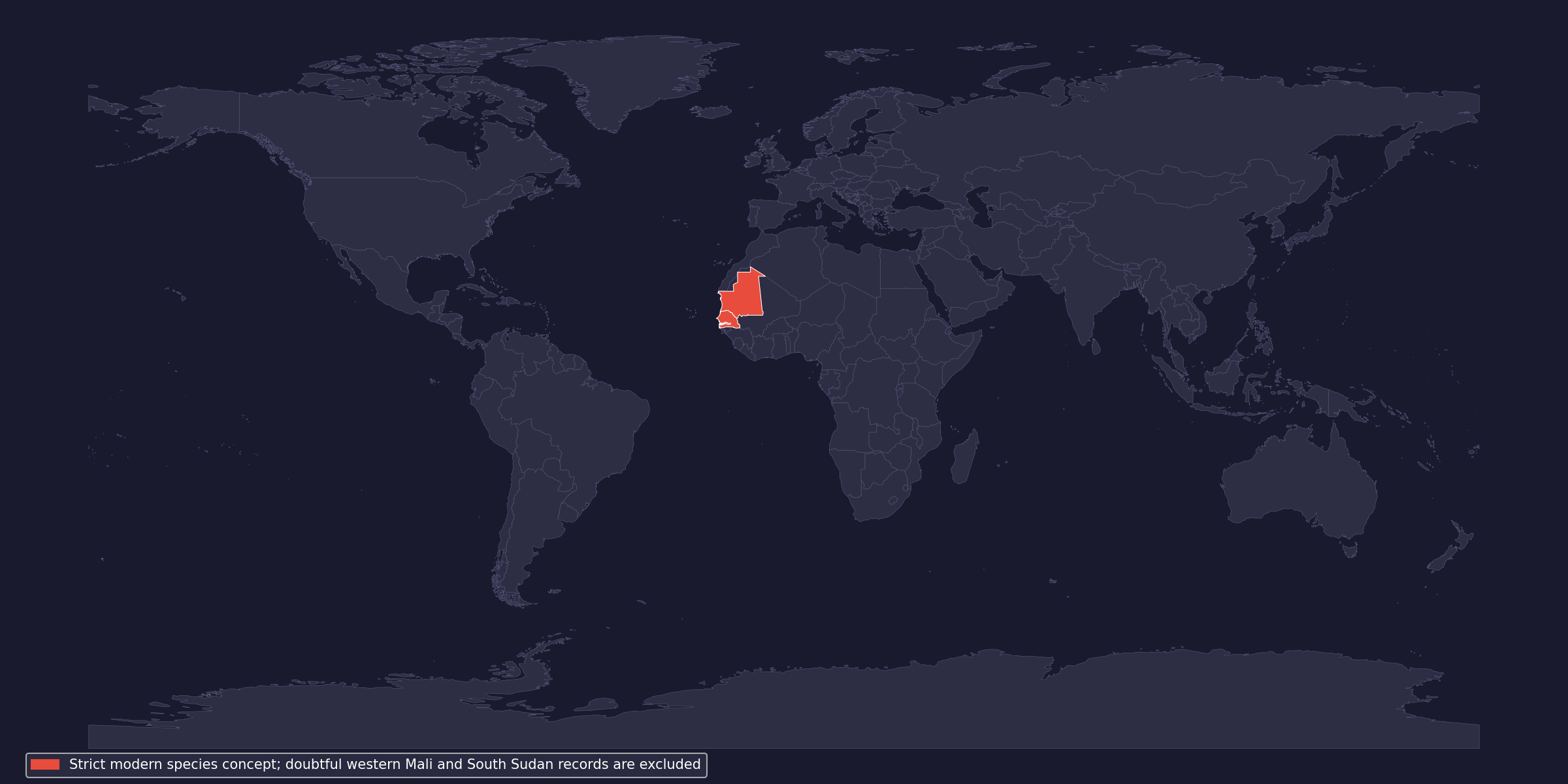
Modern taxonomic work restricts A. microlepidota to Senegal, The Gambia, and southern Mauritania in Sahelian and Sudan-Sahelian habitat. Western Mali and South Sudan records remain doubtful or reflect older species concepts; they are not used for the map.
The species is associated with sandy ground and appears at the surface mainly at night, especially after rain. In a vivarium it needs a stable, dry surface over deeper moisture-buffering substrate, not uniformly wet soil.
⚖️ Legal status
The official CITES Appendices and EU wildlife-trade annexes checked on 29 August 2026 do not specifically list Atractaspis microlepidota. The Bern Convention is not relevant to this non-European species. These absences do not make ownership or import automatically lawful.
Venomous-animal, veterinary-import, transport, and public-safety rules can require a licence, inspected premises, or prohibit private possession. Obtain written decisions from the competent authorities before acquisition. Keep the invoice, breeder and parentage details, export/import and transfer papers, photographs, exact locality, and this legal-check date. Do not buy a locality-free animal from the old broad taxonomic complex.
🤌 Husbandry
House singly in a restricted venomous room with secondary containment. Two shallow, externally closable shift boxes should sit at different temperatures beneath or beside the substrate. Water, waste, and substrate must be serviceable only after the snake is positively located and locked away.
Quarantine for at least 90 days in simple housing with dedicated tools and preferably separate airspace. Record weight, feeding, sheds, faeces, respiration, skin, and burrowing. Most available animals are likely to have uncertain or wild origin, so a reptile veterinarian should plan parasite testing and treatment without routine manual restraint.
Published species-specific husbandry is extremely sparse. The values here are conservative working ranges derived from its Sahelian ecology and professional care of comparable Atractaspis; adjust only from measured behaviour, condition, and documented locality.
💡 Lighting
Provide 11-13 hours of broad visible light with full darkness at night. Dense cover and substrate should allow the snake to avoid light completely. Fixtures must be outside primary containment or protected by guards.
UVB has not been shown to be necessary for this fossorial whole-prey snake. If low-level UVB is used for a natural day signal, keep it within Ferguson Zone 1 and leave all shifts and most substrate shaded.
🌡 Heating and temperature
Keep most air at 24-28°C, one local surface or hide at 29-31°C, a cool retreat at 22-24°C, and nights at 21-24°C. Heat from above or from a guarded side panel; never use an unregulated heat mat below the full substrate depth.
Thermostat every heater and measure both the surface and burrow layers. Deep substrate can hide dangerous hot spots. A snake repeatedly leaving the substrate, pushing at vents, or remaining in the water needs an immediate temperature and moisture review.
💧 Humidity and water
Maintain ambient humidity around 45-65%, with a lower-layer or enclosed humid refuge at 65-80% for shedding. Add moisture to one deep corner and let the upper surface dry. Constantly wet substrate, stale air, and frequent whole-enclosure spraying invite dermatitis and respiratory disease.
Provide a small, stable bowl of clean water through protected access. Watch body mass and skin condition because a hidden fossorial snake can dehydrate before the keeper notices a poor shed.
🌿 Enclosure and decoration
An adult needs at least 90 x 45 x 45 cm. Provide 15-20 cm of compactable sandy soil: approximately two parts pesticide-free topsoil to one part washed sand, with some clay or fine leaf material to hold burrow shape. Paper over shallow substrate is safer during quarantine.
Use low cork cover and no heavy rocks that can collapse. Avoid pure loose sand, sharp gravel, aromatic wood, deep inaccessible décor, and fabric bags. Every hatch, vent, track, and cable port needs a mechanical lock or rigid fastener. Transfer containers must be rigid and designed so a fang cannot reach a hand through mesh or flexible walls.
🐁 Feeding
Field records document toads, lizards, and snakes. This is a specialist-feeding problem: do not assume every individual will accept mice, and do not use wild amphibians that may carry parasites, pesticides, or protected status. Establish a lawful supply of suitable captive-produced whole prey before acquiring the snake; scenting or gradual transition to frozen-thawed prey should be overseen by an experienced institution.
Offer a small meal every 7-14 days according to body condition. Present and retrieve prey only from a protected position after a secure shift. Live vertebrate prey creates avoidable injury and access risk. Balanced whole prey requires no routine dusting.
🛡 Operational safety and emergencies
Never free-handle, pin, neck, or hold this species in a cloth bag. Its lateral stabbing mechanism defeats ordinary head-restraint assumptions. Use externally operated shifts, rigid transparent barriers, appropriate tubes only under a veterinary protocol, and two trained adults whenever primary containment is opened.
Before arrival, agree written bite and escape plans with a poison centre or toxicologist and the receiving hospital. Confirm transport, species identification, and specialist consultation. Do not assume an antivenom exists and never keep products for private administration.
A fang puncture is an immediate medical emergency. Move away, call emergency services, remove rings and tight items, keep the patient still, immobilize the limb, and follow poison-centre advice. Do not cut, suck, ice, shock, tightly tourniquet, or delay transport.
🥚 Breeding notes
The species is oviparous, but species-specific captive records are inadequate. The structured planning range of 3-11 eggs and 26-28°C for 60-80 days is conservative genus-level guidance and must not be presented as a validated A. microlepidota protocol.
Do not breed without verified identity, locality, lawful placement, and individually secured neonate containers. Egg access must occur only after both adults are locked in shifts. Treat every hatchling as capable of a lateral fang strike.
🩺 Common problems
- Refusal and nutritional decline: often reflect inappropriate prey, stress, parasites, or wrong identity; repeated random prey changes are not a treatment plan.
- Dermatitis and scale rot: follow wet, dirty substrate and poor ventilation.
- Dysecdysis and dehydration: review the deep moisture refuge, water, and temperature; never restrain the snake for home removal.
- Respiratory disease: bubbles, open-mouth breathing, abnormal sounds, or persistent surface posture require urgent veterinary care.
- Parasites and stomatitis: mites, weight loss, abnormal faeces, oral swelling, or discharge are especially likely in undocumented imports.
- Burrow injury or escape: collapsed décor, loose vents, and unseen access gaps are enclosure failures, not normal fossorial behaviour.
📌 Conclusion
Atractaspis microlepidota is suitable only for a professional venomous collection that can verify the restricted West African identity, source specialist whole prey, and perform every task behind a rigid barrier. If safe transfer depends on pinning, bagging, or touching the animal, the facility is not equipped for a stiletto snake.
📚 Sources and further reading
- ReptiFiles — checked first on 29 August 2026; no species-specific care guide was found.
- IRD guide: Atractaspis microlepidota
- The Reptile Database: Atractaspis microlepidota
- GBIF species record
- Trape, Mané & Ineich — revision of the A. microlepidota complex
- Mané & Trape — documented prey in West African Atractaspis
- Evolution of burrowing-asps and fang mechanics
- WHO: snakebite first aid and treatment
- CITES Appendices
- EU wildlife-trade annexes, Commission Regulation (EU) 2026/1383
- Bern Convention appendices