Share

Variable Bush Viper
🔤 Taxonomy
Atheris squamigera is the accepted scientific name for the variable bush viper, an African true viper. Older literature may use Echis squamigera or the altered spelling Atheris squamiger. Neither should be confused with other bush vipers once placed within a broad A. squamigera concept.
Common English names include variable bush viper, African bush viper, green bush viper, and rough-scaled bush viper. Colour is not a dependable identification feature: adults may be green, yellow, orange, red, brown, grey, or combinations of these.
📌 Description
This small viper presents a disproportionately large safety problem. It has solenoglyphous front fangs, medically significant venom, fast close-range strikes, and no species-specific antivenom routinely available in much of Europe. Published envenomations include progressive swelling and clinically important clotting abnormalities. It is a display-only animal for a keeper already trained in venomous-snake work; it is not a “starter” venomous species.
Adults are usually about 45-80 cm long. Females tend to be heavier than males. Species-specific longevity records are limited, so 10-20 years is a planning range rather than a promise. The strongly keeled scales, broad head, prehensile tail, and variable colour make the species distinctive, but documented identity and locality remain more useful than colour labels.
📋 Quick reference
| Care point | Practical target |
|---|---|
| Adult enclosure | At least 60 x 60 x 90 cm for one adult, with locked access and a shift box |
| Day temperatures | 23-27°C ambient; a small 27-29°C upper warm zone; 21-24°C cool retreat |
| Night temperatures | 18-22°C, without cold draughts |
| Humidity | Usually 60-80%, with drinking droplets and complete drying between misting cycles |
| Lighting | 10-12 hours; low-level UVB is optional but recommended when shade is available |
| Feeding | Lean, appropriately sized frozen-thawed rodents; adults commonly every 3-5 weeks |
| Social housing | Solitary except for a controlled expert breeding introduction |
| Safety | Medically significant venom; protected-contact servicing only |
☠️ Venom
This species is venomous. Venom exposure can cause pain, swelling or other systemic effects, and severity varies with species, locality, bite site and the amount delivered. A small wound or apparently dry bite is not proof of safety; every bite or sting requires urgent medical assessment.
If an incident occurs, move away, call emergency services or a poison centre, keep the patient still, remove rings and other constricting items, and follow dispatcher instructions. Do not use a tourniquet, cut or suck the wound, apply ice or electricity, give alcohol or medicines as a home treatment, or attempt to catch the animal. Antivenom choice and dosing are hospital decisions; verify the relevant product and local availability in advance. Sources: WHO snakebite guidance and appropriate species-specific toxinology or medical references listed below.
🌍 Distribution
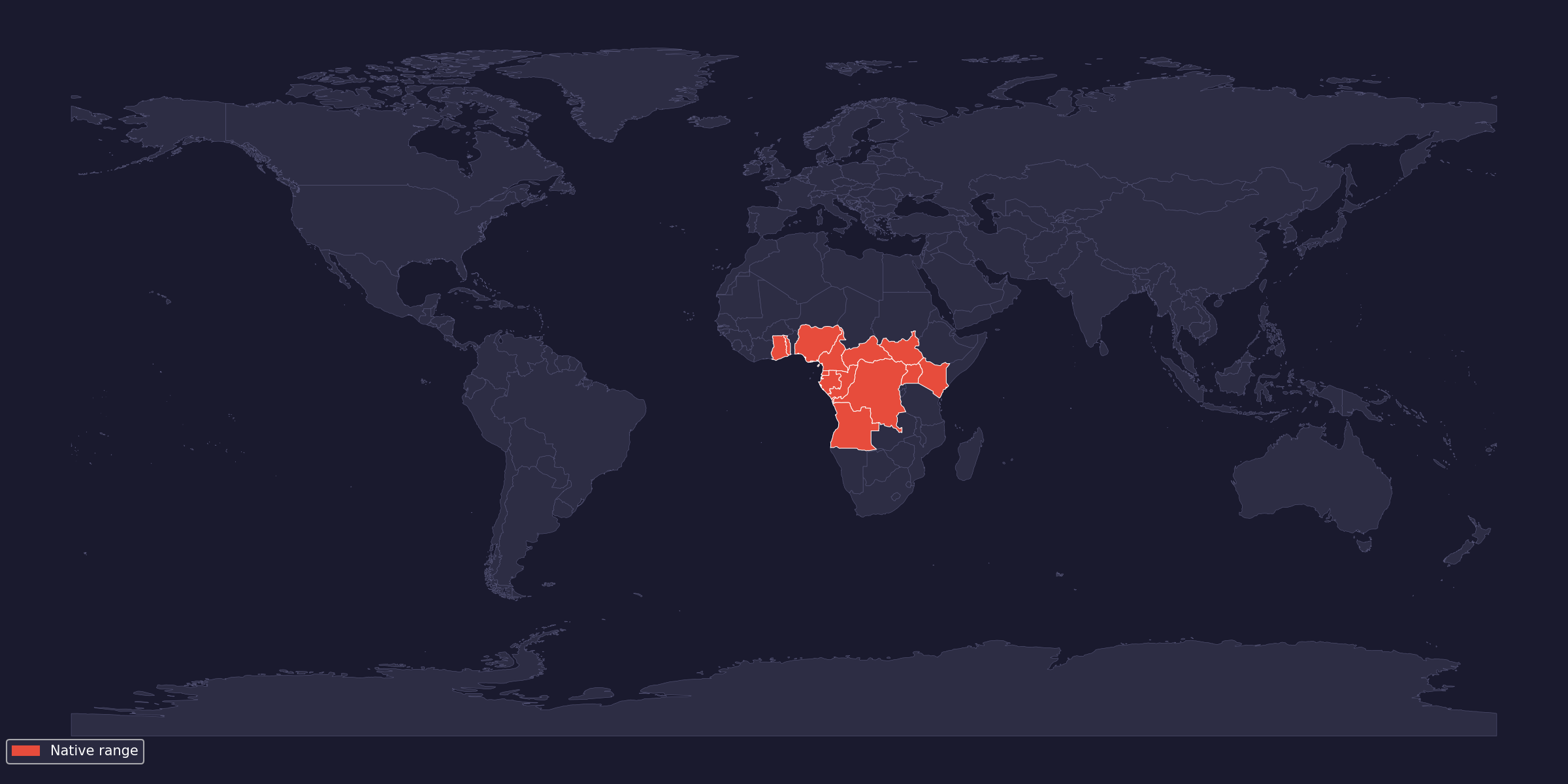
The species occupies tropical forest and dense secondary vegetation across parts of West and Central Africa, extending locally east toward Uganda and western Kenya. Verified records include Ghana, Togo, Nigeria, Cameroon, Equatorial Guinea including Bioko, Gabon, Republic of the Congo, Democratic Republic of the Congo, Central African Republic, Angola, Uganda, and Kenya; some edge records remain uncertain or taxonomically difficult.
Field work in southeastern Nigeria found the snakes mainly in primary and secondary forest, flooded forest patches, and shrub-rich cover, and only rarely in heavily altered farms or suburbs. They are nocturnal ambush predators and feed chiefly on small mammals, with lizards and birds recorded less often. In the enclosure this translates into stable horizontal perches, foliage that breaks sight lines, cool humid air, and a strong day-night drop—not a permanently wet box.
🌡 Climate across the native range
Monthly climate normals from a verified occurrence in the eastern part of the native range:
Wakiso — Uganda (verified occurrence)
| Month | Min °C | Mean °C | Max °C | RH % |
|---|---|---|---|---|
| January | 19 | 22.1 | 25 | 78 |
| February | 19.6 | 22.6 | 25.4 | 77 |
| March | 19.6 | 22.4 | 24.8 | 81 |
| April | 19.2 | 21.6 | 23.7 | 84 |
| May | 18.9 | 21.3 | 23.5 | 84 |
| June | 18.4 | 21.1 | 23.5 | 81 |
| July | 18.1 | 20.8 | 23.4 | 78 |
| August | 18.1 | 20.9 | 23.8 | 81 |
| September | 18.4 | 21.2 | 24.2 | 82 |
| October | 18.7 | 21.2 | 24.1 | 84 |
| November | 18.4 | 21.1 | 23.8 | 85 |
| December | 18.5 | 21.4 | 24.1 | 82 |
Weather data by Open-Meteo.com · CC BY 4.0 · Monthly normals calculated by Herpeton Academy from daily archive values.
Location references use GBIF.org occurrence data where available; original occurrence records retain their source dataset licenses.
⚖️ Legal status
As checked on 14 August 2026, Atheris squamigera is not listed in CITES Appendices I-III and has no specific entry in EU wildlife-trade Annexes A-D. The Bern Convention is not relevant because the species is not native to Europe.
Those trade listings do not make possession automatically legal. National and local venomous-animal laws, municipal permits, inspections, liability insurance, transport restrictions, landlord rules, and veterinary conditions differ sharply between countries and regions. Obtain the written decision of the competent authority before acquiring or moving an animal. Keep the invoice, breeder and origin details, transfer or import records, photographs, and the date of each legal check.
🤌 Husbandry
The enclosure, room, tools, and emergency procedure must be complete before the snake arrives. Use a dedicated locked room or other legally accepted secondary containment, clear species and hazard labels, and a door policy that excludes children, visitors, and untrained helpers. A locked primary enclosure is not a substitute for secondary containment.
House one animal per enclosure. Reports of apparently stable pairs ending in injury or death make permanent cohabitation unjustifiable. Build routine work around protected contact: the snake moves into a lockable shift box before bowls, plants, substrate, or lamps are serviced. Direct restraint belongs to trained professionals performing an essential veterinary procedure.
Quarantine a new arrival for at least 90 days in a simple, secure enclosure in a separate airspace where possible. Use dedicated tools, record weight, meals, defecation, drinking, and sheds, and arrange reptile-veterinary examination and fecal testing for an import, an animal of uncertain origin, or any animal with symptoms.
💡 Lighting
Provide a consistent 10-12 hour light period with bright visible light over part of the enclosure. A low-output UVB zone can be offered, but the snake must be able to withdraw into deep shade while staying within its thermal range. Treat it as Ferguson Zone 1 and measure at the perch rather than choosing a lamp by percentage alone.
Do not use coloured night lamps. Darkness and the nocturnal temperature fall are part of the daily cycle. Protect all lamps and heaters with guards that the snake cannot reach through or coil against.
🌡 Heating and temperature
Aim for 23-27°C through most of the enclosure, a limited upper warm area of 27-29°C, and a cool retreat at 21-24°C. Nights can fall to 18-22°C for established healthy animals. Sustained temperatures near 30°C throughout the enclosure, especially with high humidity and weak airflow, are a serious overheating risk.
Control every heat source with a thermostat and verify air and perch temperatures independently. Place probes so that the snake cannot dislodge them. A gradient should exist both vertically and horizontally; “room temperature” is not a measurement.
💧 Humidity and water
Maintain roughly 60-80% relative humidity, allowing a temporary rise toward 75-90% during shedding. Mist foliage enough to provide droplets for drinking, then let leaves and the upper substrate dry. Many animals readily drink droplets, but a clean water bowl must remain available.
Ventilation is as important as humidity. Constantly saturated substrate, condensation, a blocked drainage layer, or stale air encourages skin and respiratory disease. A 5 cm moisture-buffering substrate over drainage can support plants, but it must never become a swamp. During quarantine, paper substrate makes feces, mites, and fluid discharge easier to detect.
🌿 Enclosure and decoration
For one adult, use at least 60 x 60 x 90 cm and enlarge the enclosure for a large female or where local welfare rules require more. Provide several firmly anchored horizontal and diagonal perches at different heights and diameters, elevated cover, foliage, and an accessible ground-level retreat. Test every branch with more force than the snake can apply.
The most important feature is safe servicing. Use keyed or tool-operated locks, secured vents and cable ports, guarded equipment, and a shift box that closes without placing a hand inside the strike zone. Removable water and waste trays should be reachable only after the animal is contained. Inspect hinges, glass tracks, mesh, drains, and lock alignment on a written schedule.
🥗 Feeding
Small mammals dominate the documented wild diet, so appropriately sized whole rodents are a practical captive staple. Offer frozen-thawed prey with long tongs after the snake has been secured in a predictable feeding position. Routine live feeding adds an avoidable injury risk and complicates safe observation.
Juveniles may take a small meal every 7-10 days while established adults often need only one lean meal every 3-5 weeks. Adjust to measured weight and body condition rather than feeding whenever the snake strikes. Arboreal vipers can become obese without looking obviously fat; shortening the interval after every refusal or using oversized prey raises regurgitation and organ-disease risk.
Do not routinely dust whole vertebrate prey with supplements. Record prey type and mass, feeding date, refusal, defecation, and body weight. A persistent refusal requires a review of temperature, cover, hydration, pregnancy, parasites, and other illness rather than repeated disturbance.
🥚 Breeding
Atheris squamigera is viviparous. Published summaries give 2-19 young, with 7-9 often reported, but field reproductive data remain limited. Newborns are fully venomous and require individual escape-proof housing and the same protected-contact discipline as adults.
Breeding is an expert institutional-level project. Confirm sex and identity, screen both animals, plan a controlled introduction with continuous observation, and separate them promptly. Never cool a thin, juvenile, newly imported, or unwell animal for breeding. Secure homes and lawful transfer documentation for every neonate must exist before pairing.
🛡️ Handling and emergency planning
This species is display-only. Normal care should use a shift box, appropriate hooks, barriers, and a second trained adult for higher-risk tasks. Never free-handle, tail, pin, or neck the snake for photography or routine maintenance. Gloves do not make direct contact safe.
Before acquisition, agree a written bite plan with the relevant emergency service, poison centre or medical toxicology contact, and a hospital willing to receive an exotic envenomation. The plan should identify the exact species, likely clinical effects, keeper location, emergency contacts, and transport route; clinicians decide treatment and antivenom use.
A bite is an immediate medical emergency even if pain or swelling is initially slight. Move away from the snake, secure the scene without attempting another capture, remove rings or tight objects, keep the person still, immobilize the bitten limb, and call emergency services. Do not cut or suck the wound, apply ice or chemicals, use an arterial tourniquet, or wait for symptoms.
🩺 Common problems
- Overheating: persistent exposed posture, agitation, gaping, or neurological decline can follow a hot enclosure without a cool retreat.
- Stagnant wet conditions: wheezing, nasal bubbles, open-mouth breathing, skin lesions, or abnormal resting posture require urgent reptile-veterinary assessment.
- Dysecdysis and dehydration: incomplete sheds indicate a need to review drinking access, misting cycle, heat, and airflow rather than repeatedly soaking or restraining the snake.
- Obesity and regurgitation: large or frequent meals are common preventable causes; compare serial weights and body shape.
- Parasites and fungal disease: imports and mixed collections need strict quarantine. Paranannizziopsis australasiensis has caused a fatal outbreak in captive African bush vipers, so unexplained scales, nodules, or sudden deaths demand isolation and diagnostic testing.
- Unsafe servicing: most bite opportunities arise during transfers, cleaning, feeding, or direct restraint. Redesign the system after any near miss.
📌 Conclusion
The variable bush viper suits only a legally authorised, trained venomous-snake keeper who can maintain cool, ventilated humidity and protected-contact servicing for the animal’s lifetime. Its small size does not reduce the consequence of a bite or escape. If secondary containment, a shift box, veterinary access, and a rehearsed emergency plan are not already in place, acquisition should not proceed.
📚 Sources and further reading
- ReptiFiles was searched before drafting; no species-specific Atheris squamigera care guide was located: https://reptifiles.com/
- The Reptile Database, Atheris squamigera: https://reptile-database.reptarium.cz/Atheris/squamigera
- GBIF Backbone Taxonomy, Atheris squamigera: https://www.gbif.org/species/2443752
- Luiselli & Akani, ecology of Atheris squamigera: https://doi.org/10.1560/RUW9-CERW-BDBF-P01J
- Animal Diversity Web, Atheris squamigera: https://animaldiversity.org/accounts/Atheris_squamigera/
- German Exotics, documented captive husbandry experience: https://www.german-exotics.de/atheris-squamigera.html
- Díaz-Delgado et al., Paranannizziopsis outbreak in captive African bush vipers: https://doi.org/10.1016/j.jcpa.2020.10.004
- Green bush viper envenomation case report: https://pmc.ncbi.nlm.nih.gov/articles/PMC9764243/
- WHO, snakebite envenoming and first aid: https://www.who.int/news-room/questions-and-answers/item/snakebite-envenoming
- Baines et al., UV-Tool: https://doi.org/10.19227/jzar.v4i1.150
- Swiss Animal Welfare Ordinance, arboreal venomous-snake enclosure standards: https://www.fedlex.admin.ch/eli/cc/2008/416/en
- CITES Appendices and species checklist: https://cites.org/eng/app/appendices.php and https://checklist.cites.org/
- Commission Regulation (EU) 2026/1383, current EU wildlife-trade annexes: https://eur-lex.europa.eu/eli/reg/2026/1383/oj/eng
- Council of Europe, Bern Convention appendices: https://www.coe.int/en/web/bern-convention/appendices