Share

Hairy Bush Viper
🔤 Taxonomy
Atheris hispida is the accepted hairy, rough-scaled or spiny bush viper. Older literature often uses the grammatically different spelling Atheris hispidus. Some early material was assigned to Atheris squamigera, but A. hispida is a distinct species.
Do not identify an animal from “hairy” scales alone. Atheris taxonomy and trade labels can be unreliable, and range records remain incomplete. Preserve country, precise locality, parentage, photographs and the identification source with every specimen.
📌 Description
This slender arboreal viper is usually 50-75 cm. Strongly keeled, elongated scales produce the characteristic bristled outline, while a prehensile tail anchors the snake on vegetation. It can remain motionless among leaves, then strike rapidly from a perch and retain its grip.
Bites are uncommon in the clinical literature, which creates uncertainty rather than reassurance. Atheris envenomation may cause pain, swelling, tissue injury, bleeding and coagulation disturbance, and there is no basis for ranking this species as “mild.” It belongs only in an expert institutional collection.
📋 Quick reference
| Care point | Practical target |
|---|---|
| Adult size and lifespan | Usually 50-75 cm; planning estimate 10-15 years |
| Adult enclosure | At least 90 x 60 x 120 cm with two lockable arboreal shift boxes |
| Temperature | Ambient 22-26°C; limited basking 27-29°C; cool retreat 20-23°C |
| Night | 18-22°C |
| Humidity | 65-85% with continuous ventilation; local 75-90% shedding support |
| Feeding | Small whole prey every 10-21 days, adjusted to condition |
| Safety | Protected contact, perch-linked shifts, two-person rule and hospital plan |
| Evidence limit | Many captive values are cautious working ranges, not controlled species-specific trials |
☠️ Venom
This species is venomous. Venom exposure can cause pain, swelling or other systemic effects, and severity varies with species, locality, bite site and the amount delivered. A small wound or apparently dry bite is not proof of safety; every bite or sting requires urgent medical assessment.
If an incident occurs, move away, call emergency services or a poison centre, keep the patient still, remove rings and other constricting items, and follow dispatcher instructions. Do not use a tourniquet, cut or suck the wound, apply ice or electricity, give alcohol or medicines as a home treatment, or attempt to catch the animal. Antivenom choice and dosing are hospital decisions; verify the relevant product and local availability in advance. Sources: WHO snakebite guidance and appropriate species-specific toxinology or medical references listed below.
🌍 Distribution
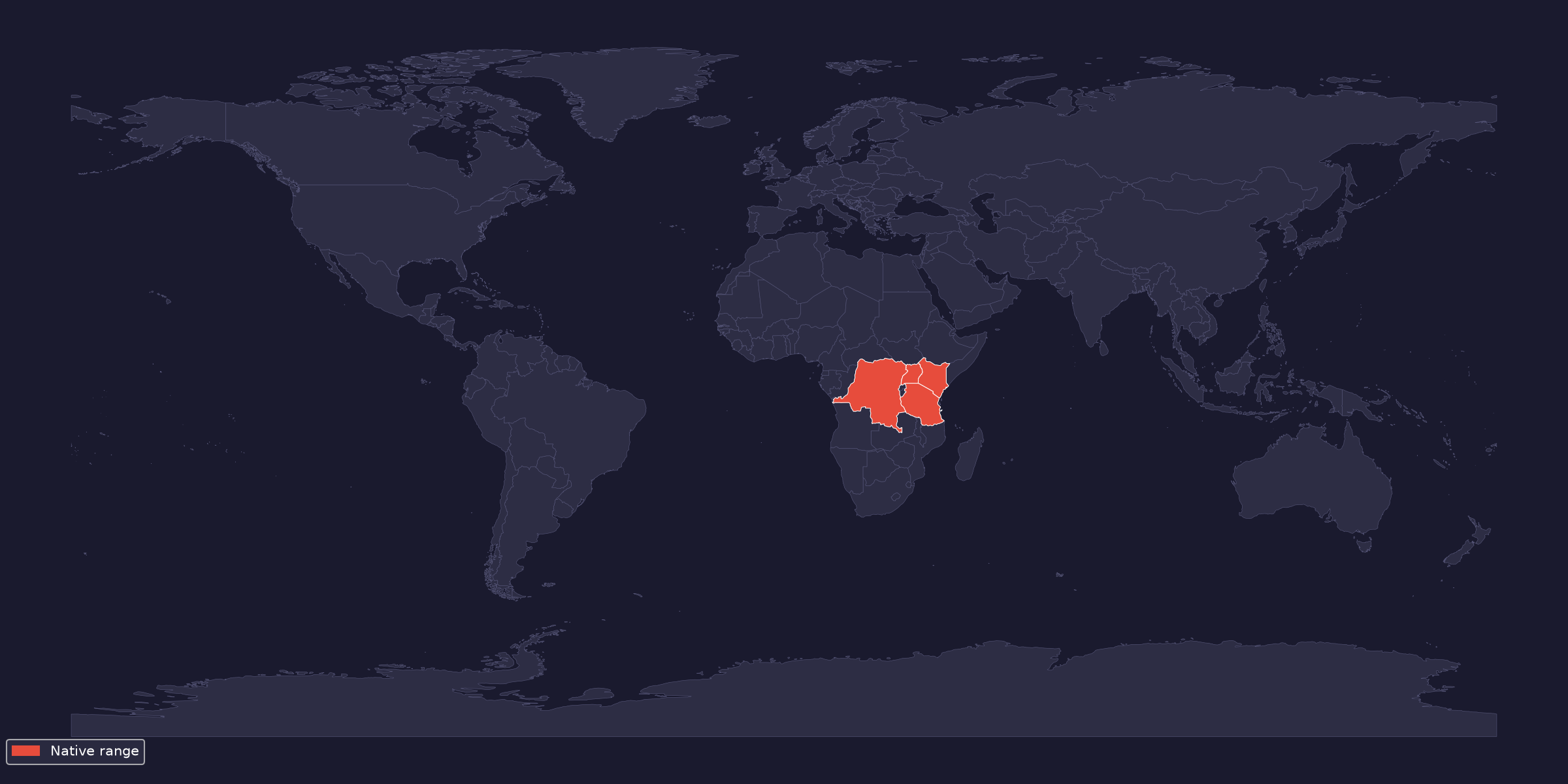
Current records place A. hispida in northern and eastern Democratic Republic of the Congo, southwestern Uganda, western Kenya and northwestern Tanzania. It uses humid forest, forest edge and dense secondary vegetation, often above ground. Published locality additions show that the known boundary is still being refined.
Whole-country shading substantially overstates its range, especially in the Democratic Republic of the Congo, Kenya and Tanzania. It cannot show the Albertine region, forest fragmentation, elevation or unconfirmed gaps. The reviewed Kamwenge occurrence represents one western Ugandan forest-edge setting, not the whole range.
🌡 Climate across the native range
WorldClim v2.1 climate normals for 1970–2000 from a reviewed western Ugandan occurrence:
Kamwenge — Uganda (reviewed western forest-edge occurrence)
| Month | Min °C | Mean °C | Max °C | RH % |
|---|---|---|---|---|
| January | 15.4 | 21.1 | 26.8 | 74 |
| February | 15.8 | 21.5 | 27.2 | 71 |
| March | 15.8 | 21.4 | 27 | 75 |
| April | 16.1 | 21.2 | 26.4 | 79 |
| May | 16 | 21 | 26 | 79 |
| June | 15.4 | 20.6 | 25.7 | 77 |
| July | 15.1 | 20.2 | 25.4 | 77 |
| August | 15.7 | 20.7 | 25.8 | 77 |
| September | 15.6 | 20.8 | 25.9 | 77 |
| October | 15.6 | 20.6 | 25.7 | 80 |
| November | 15.6 | 20.7 | 25.8 | 80 |
| December | 15.2 | 20.5 | 25.9 | 79 |
Weather data by WorldClim v2.1 · Climate-normal period: 1970–2000. Monthly normals queried by Herpeton Academy from raster values; relative humidity is derived from vapor pressure and mean temperature.
Location references use GBIF.org occurrence data where available; original occurrence records retain their source dataset licenses.
⚖️ Legal status
As checked on 17 August 2026, Atheris hispida is not listed in the CITES Appendices or EU wildlife-trade annexes. Do not confuse it with Atheris desaixi, which is CITES-listed. The Bern Convention is not relevant to the Central and East African range.
National wildlife law may prohibit collection or export, and destination law may restrict dangerous animals. Confirm ownership, registration, transport, breeding, sale, collection, export and import rules in writing with all competent authorities. Retain permits, veterinary and lawful-origin documents, invoices, exact locality and parentage records, photographs and the legal check date.
🤌 Husbandry
House one snake in a controlled-access venomous room with secondary containment and a written door protocol. Two positively lockable arboreal shift boxes should connect to stable perch routes, allowing the animal to enter and be secured without being dislodged. Never open an occupied climbing space because the head appears to face away.
Quarantine for at least 90 days in a simple, well-ventilated enclosure with paper, removable perches, dedicated tools and preferably separate airspace. Record weight, meals, sheds, faeces, skin, mouth and respiration; imports need veterinary parasite and mite assessment.
Keep singly. Dense foliage makes visual confirmation difficult, so use strategic sight lines and counted fixed perches. Species-specific husbandry literature is limited; changes should be measured, recorded and conservative rather than copied uncritically from A. squamigera.
💡 Lighting
Provide 11-13 hours of diffuse bright visible light and complete darkness at night. Create dappled shade across several perch heights. All fixtures belong outside primary containment or behind locked guards.
Low-output UVB may be offered as a measured Ferguson Zone 1 opportunity, with a fully shaded path. Do not force the snake to choose between UV exposure and a safe temperature. Lamp servicing must remain outside the occupied compartment.
🌡 Heating and temperature
Maintain ambient air at 22-26°C, a small basking opportunity at 27-29°C, a cool retreat at 20-23°C and nights around 18-22°C. Use guarded thermostatic heat, multiple height-specific probes and a high-temperature alarm. Warm air collects near the top, so a floor probe alone is inadequate.
Avoid sustained heat near 30°C and above. The species is associated with humid forest and upland-influenced regions, not a uniformly hot lowland box. Reproduce gentle seasonal shifts in rainfall and night temperature only for healthy, established animals with known provenance.
💧 Humidity and water
Maintain roughly 65-85% humidity while continuously exchanging air. Brief daily rises may be followed by partial drying; leaves and the top substrate should not remain wet around the clock. A local shift retreat can reach 75-90% for shedding while another perch stays drier.
Provide a stable clean-water bowl and droplets on selected leaves through an automated or protected system, then allow surfaces to dry. Monitor drinking, weight and shed quality. Stagnant humid air is a greater respiratory risk than a short, measured humidity dip.
🌿 Enclosure and decoration
An adult needs at least 90 x 60 x 120 cm. Install two lockable elevated shift boxes, several firmly anchored horizontal and diagonal perches of different diameters, visual foliage and clear inspection lanes. Perches must not attach to an opening door or block a shift gate.
Use 5-8 cm of moisture-buffering soil and leaf litter over drainage, with a dry upper layer between watering. Paper is safer in quarantine. Avoid thorny plants, unstable branches, inaccessible hollow décor, saturated moss beds and any furnishing that requires hands to enter for routine cleaning.
Use narrow vent tolerances, two-step locks, an internal service barrier and a visible venom warning. Design for the reach of a strike from any perch, not just the snake’s body length.
🐁 Feeding
Wild diet includes small mammals, frogs, lizards and possibly birds. Established adults may accept small frozen-thawed mice every 10-21 days, but juveniles or new arrivals may require carefully scent-assisted whole prey under an institutional protocol. Avoid overfeeding a sedentary arboreal snake.
Present food through a protected port with long tongs and shift before recovering refusals. Never use live rodents. Whole prey needs no routine powder supplement. Record every meal and body weight because refusal may reflect season, unsuitable prey, excessive heat, stress or disease.
🛡 Operational safety and emergencies
Never free-handle, pin, neck or manually restrain A. hispida. Work through locked shifts, transparent shields and protected ports. Hooks may guide a snake along a perch route but must not replace a barrier. Two trained adults attend every primary opening; veterinary care requires a pre-arranged anaesthetic, airway and containment team.
Before acquisition, consult the receiving hospital or poison centre with the exact species and origin. No antivenom specifically validated for A. hispida was identified in the reviewed evidence, and cross-neutralization by another African-viper product must not be assumed. The hospital needs an expert toxicology, laboratory, blood-product and supportive-care pathway.
After a bite, move away, call emergency services, remove constricting items, keep the patient still with the limb neutrally supported and follow poison-centre instructions. Do not use a tourniquet or tight pressure bandage where local tissue injury is possible; do not cut, suck, ice, shock or massage the site.
Maintain a written escape plan for a small arboreal snake, including room isolation, public exclusion, high and low search zones, accountability and secure containers. Stop work whenever the snake is not positively located.
🥚 Breeding notes
A. hispida is viviparous, but robust species-specific reproductive datasets are scarce. A planning range of roughly 2-12 young reflects limited captive and genus-level reports; it must not be presented as a predictable litter size or used to infer a universal cooling schedule.
Pair only healthy, locality-backed adults through adjacent shift systems. Record courtship, temperatures and outcomes rather than extrapolating from A. squamigera. Prepare individually lockable neonate arboreal enclosures and lawful placements before introduction; neonates are fully venomous and difficult to locate among foliage.
🩺 Common problems
- Respiratory disease: wheezing, bubbles, open-mouth breathing or unusual low perching require prompt veterinary assessment.
- Dermatitis: investigate continuously wet surfaces, stagnant air, mites and abrasion.
- Dehydration or retained shed: review drinking opportunities, humidity cycles, ventilation and health.
- Overheating: monitor upper perches independently and maintain a cooler route.
- Obesity or poor muscle condition: use small prey, appropriate intervals and varied stable perches.
- Parasites and stomatitis: weight loss, abnormal faeces or oral swelling are especially concerning in imports.
- Falls and perch injury: replace loose, smooth or badly spaced branches.
Do not attempt hands-on home treatment. Secure the animal in a shift box and use an experienced reptile veterinary team.
📌 Conclusion
Atheris hispida belongs only in a licensed facility able to combine continuous ventilation with adjustable humidity, service every perch through lockable shifts and prepare a hospital for an envenomation with limited species-specific evidence. Its striking appearance is not a substitute for provenance or data.
📚 Sources and further reading
- ReptiFiles — checked first on 17 August 2026; no species-specific care guide was found.
- The Reptile Database: Atheris hispida
- GBIF species record: Atheris hispida
- Broadley — review of the genus Atheris
- Groen et al. — Ugandan range extension of A. hispida
- Menegon et al. — East African Atheris phylogeny
- WHO Africa snakebite-management guidelines
- Baines et al. — UV lighting guidance
- Northern Ireland government venomous-reptile guidance
- CITES Appendices
- EU wildlife-trade annexes, Commission Regulation (EU) 2026/1383
- Bern Convention appendices