Share

Spotted Python
🔤 Taxonomy
Antaresia maculosa is the currently accepted scientific name for the spotted python. Trade names can blur spotted pythons, Children’s pythons, Stimson’s pythons, and locality Antaresia, so purchase records should state the scientific name, origin history, hatch date where known, and feeding record.
Common names used in the hobby:
- Spotted python
📌 Description
This is the largest commonly kept Antaresia, but it is still a compact python. It is usually manageable when bred in captivity, settled, and housed securely, yet juveniles can be defensive and adults can have an enthusiastic feeding response.
Adults typically reach 90-140 cm and can live 15-25 years with stable long-term care.
🌍 Distribution
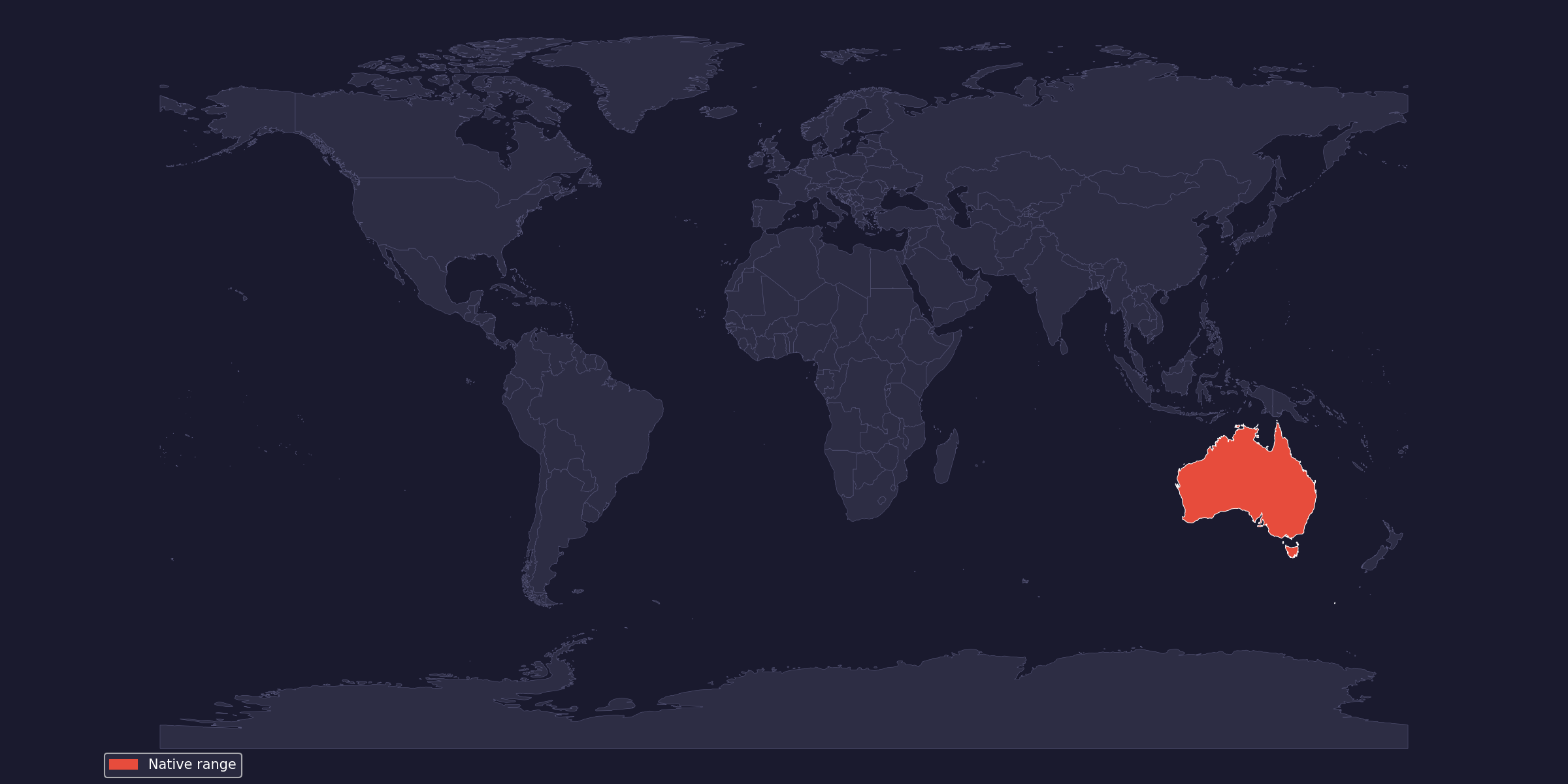
The species is native to north-eastern and eastern Australia and nearby islands. It is associated with open forest, sclerophyll forest, rainforest edges, grassland, agricultural edges, rock outcrops, caves, hollow logs, termite mounds, leaf litter, and occasional shrub or tree use.
That range supports a semi-arboreal enclosure plan: secure ground hides, usable low branches or ledges, a warm retreat, a real cool end, and enough cover to travel without crossing open glass.
🌡 Climate across the native range
Monthly climate normals from reviewed GBIF occurrence locations:
Queensland — Australia
| Month | Min °C | Mean °C | Max °C | RH % |
|---|---|---|---|---|
| January | 24.3 | 28 | 31.6 | 73 |
| February | 24.1 | 27.7 | 31.4 | 76 |
| March | 23.1 | 27 | 30.9 | 72 |
| April | 21 | 25.3 | 29.6 | 71 |
| May | 18.6 | 23.1 | 27.5 | 68 |
| June | 15.2 | 20.2 | 25.3 | 67 |
| July | 14 | 19.4 | 24.7 | 65 |
| August | 15.2 | 20.5 | 25.7 | 65 |
| September | 17.7 | 22.6 | 27.5 | 66 |
| October | 20.4 | 24.9 | 29.3 | 68 |
| November | 22.7 | 26.8 | 30.8 | 68 |
| December | 23.8 | 27.6 | 31.4 | 71 |
Weather data by WorldClim v2.1 · Monthly normals queried by Herpeton Academy from raster values; relative humidity is derived from vapor pressure and mean temperature.
Location references use GBIF.org occurrence data where available; original occurrence records retain their source dataset licenses.
⚖️ Legal status
Pythonidae spp. are listed in CITES Appendix II, so international trade needs the correct CITES paperwork even when the individual animal was bred in captivity. EU wildlife-trade rules generally place Appendix II pythons in Annex B unless a stricter listing applies. These trade listings do not replace local ownership, transport, breeding, import, tenancy, or public-display rules. The Bern Convention is not relevant because the species is not native to Europe.
Keep invoices, breeder or seller details, transfer/import documents where relevant, photographs, and the date of your legal check with the animal’s records.
🤌 Husbandry
Plan the adult enclosure before purchase. Treat 120 x 60 x 60 cm (0.72 m² floor area) as the practical minimum for a normal adult, and use more space when the animal is large, active, or difficult to furnish well. Use tight hides, locked doors or clips, covered movement routes, clean water, and a measured thermal gradient before adding decorative space.
💡 Lighting
Use a regular 10-12 hour day-night cycle. Low-level UVB can be offered as an option, but the animal must be able to leave both light and UV exposure without leaving the correct heat range.
🌡 Heating and temperature
- ambient air: 26-30°C
- basking surface: 32-34°C
- cool retreat: 24-26°C
- night: 22-25°C
Use thermostats on every heat source and verify the warm hide, basking surface, cool retreat, and night temperature with independent instruments. Do not run the whole enclosure at one average temperature.
💧 Humidity and water
Baseline humidity: 45-65%. Temporary shed support: 65-75%.
Manage humidity with microclimates: a dry retreat, a more humid shed hide, fresh water, and ventilation. Retained shed should lead to checks of hydration, heat, and airflow rather than repeated forced soaking.
🌿 Enclosure and decoration
Use at least two snug hides, partial cover between hides, rough shedding surfaces, and stable low climbing pieces. Avoid heavy unsecured rocks, adhesive tape inside the enclosure, decor holes that can trap the snake, and cable gaps that a juvenile can test.
🥗 Feeding
Feed whole prey for body condition, not maximum appetite. Juveniles may eat every 7-10 days; many adults do better on a 10-21 day rhythm depending on prey size, season, activity, and reproductive condition. Frozen-thawed rodents are the normal staple, and repeated refusals should prompt a check of temperature, cover, disturbance, shed cycle, and prey size before force-feeding is considered.
🥚 Breeding notes
The species is oviparous. Typical clutches are around 7-20 eggs, with incubation often managed near 30-32°C for about 50-60 days. Breeding should wait until the pair is correctly identified, unrelated where possible, legally held, established on food, and in adult body condition; hatchling housing and transfer records should be ready before pairing.
🧍 Handling and safety
Handling should be short, low, calm, and delayed until the snake has fed reliably. Support the body, avoid handling during shed or after meals, wash hands before and after, and supervise children closely rather than treating the snake as a child’s pet.
🩺 Common problems
Common problems include escape, overfeeding, retained shed, dehydration, mites, respiratory signs, mouth inflammation, regurgitation, nose rub, and stress from open housing. Change one husbandry variable at a time and keep temperature, feeding, shed, weight, and cleaning records.
📌 Conclusion
Spotted pythons are good first pythons only when the keeper plans for escape prevention, semi-arboreal enrichment, and adult feeding intervals before purchase. A small enclosure with no cover usually creates more problems than the snake’s temperament does.
📚 Sources and further reading
- ReptiFiles, Spotted Python Care Sheet: https://reptifiles.com/spotted-python-care-sheet/
- The Unusual Pet Vets, Antaresia Species Caresheet: https://www.unusualpetvets.com.au/wp-content/uploads/2018/05/Antaresia-Stimsons-Childrens-Spotted-and-Pygmy-Python-Care-Sheet.pdf
- SASH Vets, Python Care - Antaresia Species: https://sashvets.com/wp-content/uploads/2025/09/Python-Care-Antaresia-Species.pdf
- The Reptile Database, Antaresia maculosa: https://reptile-database.reptarium.cz/Antaresia/maculosa
- GBIF Backbone Taxonomy, Antaresia maculosa: https://www.gbif.org/species/2465017
- CITES Appendices: https://cites.org/eng/app/appendices.php
- European Commission wildlife trade overview: https://environment.ec.europa.eu/topics/nature-and-biodiversity/wildlife-trade_en
- Council of Europe, Bern Convention appendices: https://www.coe.int/en/web/bern-convention/appendices