Share

Northern Cottonmouth
🔤 Taxonomy
Agkistrodon piscivorus is the accepted name for the northern cottonmouth. The former western cottonmouth A. p. leucostoma is now included in this species, so “western cottonmouth” is a regional common name rather than a separate current taxon.
The Florida cottonmouth is Agkistrodon conanti. It was formerly A. p. conanti and is now a separate species centred on Florida and adjacent southeastern Georgia, with a contact and admixture zone. Preserve state, county and lineage provenance. Adult colour, an open white mouth or a generic “water moccasin” label cannot reliably separate the two species.
📌 Description
The northern cottonmouth is a heavy semi-aquatic pit viper, generally 75-120 cm and exceptionally larger. It uses wetlands, floodplains and nearby terrestrial cover, and it swims with much of the body visible. The white mouth display is defensive; absence of that display does not imply safety.
Envenomation may cause severe pain, rapidly progressive swelling, tissue injury, coagulation disturbance and systemic effects. This is an expert-only institutional display species. Protected contact, a dry service route, safe water management and a hospital-coordinated bite plan are required before acquisition.
📋 Quick reference
| Care point | Practical target |
|---|---|
| Adult size and lifespan | Usually 75-130 cm; approximately 15-25 years |
| Adult enclosure | At least 150 x 75 x 75 cm, with two lockable shift hides |
| Temperature | Ambient 24-28°C; basking 30-32°C; cool hide 21-24°C |
| Night | 19-23°C |
| Humidity and water | 50-70%; removable clean soaking basin and dry retreats |
| Feeding | Appropriate whole prey every 10-21 days, adjusted to condition |
| Safety | Protected contact, two-person rule, bite plan and escape plan |
| Quarantine | At least 90 days with dedicated equipment and faecal screening |
☠️ Venom
This species is venomous. Venom exposure can cause pain, swelling or other systemic effects, and severity varies with species, locality, bite site and the amount delivered. A small wound or apparently dry bite is not proof of safety; every bite or sting requires urgent medical assessment.
If an incident occurs, move away, call emergency services or a poison centre, keep the patient still, remove rings and other constricting items, and follow dispatcher instructions. Do not use a tourniquet, cut or suck the wound, apply ice or electricity, give alcohol or medicines as a home treatment, or attempt to catch the animal. Antivenom choice and dosing are hospital decisions; verify the relevant product and local availability in advance. Sources: WHO snakebite guidance and appropriate species-specific toxinology or medical references listed below.
🌍 Distribution
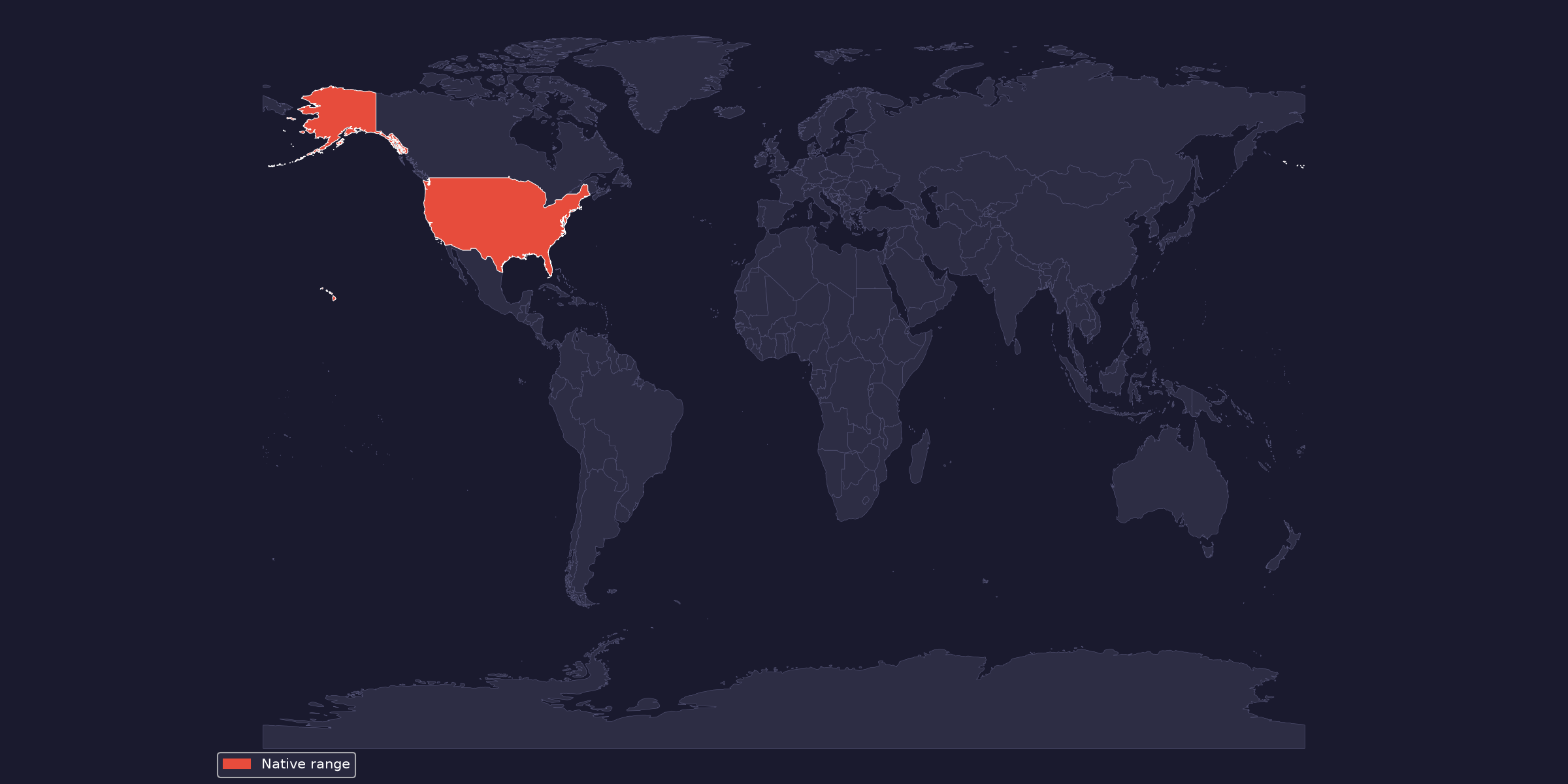
In the current strict sense, A. piscivorus ranges across the southeastern and south-central United States, from southeastern Virginia and the Carolinas west through much of Georgia outside the Florida-lineage core, Alabama, Mississippi and Louisiana, and into Arkansas, eastern Texas, eastern Oklahoma and parts of Missouri, Kansas, Tennessee, Kentucky, southern Illinois and Indiana. Fine boundaries are discontinuous around suitable wetland systems.
Florida and adjacent southeastern Georgia require particular caution because A. conanti occupies the peninsula and the two lineages meet and admix in a regional contact zone. Older maps and permits often apply A. piscivorus to both. The country-level map highlights the United States as a whole and cannot show the conanti boundary, hybrid zone, state-scale gaps or unsuitable dry interiors.
The climate table uses a Louisiana Gulf Coastal Plain point near a reviewed strict-sense occurrence. It represents a warm humid lowland portion, not the cooler northern edge of the species.
🌡 Climate across the native range
Monthly normals from a Louisiana Gulf Coastal Plain climate point near a reviewed strict-sense occurrence:
Baton Rouge, Louisiana — United States (near reviewed strict-sense occurrence)
| Month | Min °C | Mean °C | Max °C | RH % |
|---|---|---|---|---|
| January | 6.9 | 10.9 | 16.3 | 76 |
| February | 8.6 | 12.8 | 18.4 | 77 |
| March | 11.7 | 16.1 | 21.7 | 76 |
| April | 15.0 | 19.7 | 25.2 | 75 |
| May | 19.2 | 23.8 | 29.1 | 75 |
| June | 22.7 | 26.6 | 31.4 | 78 |
| July | 23.9 | 27.5 | 32.1 | 80 |
| August | 23.8 | 27.5 | 32.2 | 79 |
| September | 21.6 | 25.5 | 30.4 | 76 |
| October | 16.5 | 21.0 | 26.4 | 72 |
| November | 11.2 | 15.5 | 21.1 | 74 |
| December | 8.2 | 12.1 | 17.4 | 77 |
Weather data by Open-Meteo.com · CC BY 4.0 · Monthly normals calculated by Herpeton Academy from daily archive values for 1991-2020.
Location references use GBIF.org occurrence data where available; original occurrence records retain their source dataset licenses.
⚖️ Legal status
Agkistrodon piscivorus was not found in the CITES Appendices or EU wildlife-trade annexes checked on 17 August 2026. The Bern Convention is not relevant to this North American species. Non-listing does not authorize collection, ownership, breeding or trade.
U.S. state, county and municipal rules may protect native populations or regulate venomous possession, registration, transport, breeding, sale and import. Identification as A. piscivorus or A. conanti can affect wildlife records. Obtain written confirmation from every competent authority and keep invoices, transfer records, photographs and exact locality provenance.
🤌 Husbandry
Keep one animal per enclosure inside a restricted venomous room with secondary containment and a door protocol. Install two lockable dry shift hides so the snake can be isolated without hooks before a water basin, drain or main door is serviced.
Quarantine for at least 90 days in simple housing with dedicated equipment and preferably separate airspace. Record weight, prey, shed, faeces, skin, mouth and breathing. Wild-origin animals need reptile-veterinary examination, faecal testing and ectoparasite control.
Do not create an aquarium with a small dry ledge. The snake needs secure dry floor area, cover and thermal choice; water is a removable resource, not the whole enclosure. Permanent cohabitation adds feeding, water-hygiene and accountability hazards.
💡 Lighting
Provide 10-14 hours of visible light adjusted seasonally and full darkness at night. Dense shaded cover must connect both thermal zones. Keep lamps and electrical equipment outside primary containment or behind locked guards protected from splashing.
Low-output UVB can be offered over part of the warm land area as a Ferguson Zone 1 opportunity. Measure at animal level and retain deep shade. UVB does not replace a complete whole-prey diet.
🌡 Heating and temperature
Maintain ambient air at 24-28°C, a local basking surface at 30-32°C, a cool dry hide at 21-24°C and nights around 19-23°C. Guard and thermostat every heater; use independent air, surface and water probes plus high-temperature alarms.
Provide a gradient, not uniformly warm swamp housing. The species moves between sun, shade, water and terrestrial retreats. Seasonal cooling for breeding must follow known locality and veterinary assessment; never cool thin, sick, juvenile or newly acquired animals.
💧 Humidity and water
Maintain 50-70% ambient humidity with strong air exchange and dry hides. During shedding, one retreat can reach 65-80%. Wet surfaces without ventilation encourage scale and skin disease even in a wetland-associated species.
Provide a stable soaking basin large enough for the snake to enter, with a guarded drain or protected removal route. Replace fouled water promptly and disinfect without leaving residues. Deep open pools complicate accountability and rescue and are not needed for routine swimming.
🌿 Enclosure and decoration
An adult needs at least 150 x 75 x 75 cm. Divide usable space into a dry thermal gradient and an accessible removable basin. Add two dry shift hides, anchored cork, low stable branches, visual cover and a clear inspection corridor.
Use 6-10 cm of compactable soil and leaf litter outside the basin; paper suits quarantine. Avoid waterlogged mulch, aromatic wood, loose rock stacks, hidden drains and décor that must be lifted during service. All vents and cable ports require escape-proof mesh and two-step locks.
🐁 Feeding
Wild cottonmouths take mammals, fish, frogs, salamanders, birds, reptiles and carrion. Captive-established adults usually thrive on appropriately sized frozen-thawed rodents offered every 10-21 days. Occasional responsibly sourced whole fish may add behavioural variety, but avoid feeder fish with uncertain disease or thiaminase exposure.
Use long tongs through a protected port and shift the animal before retrieving uneaten prey. Live prey creates avoidable wounds and forces hazardous recovery. Whole prey needs no routine supplement dusting; body-condition records are more important than dietary novelty.
🛡 Operational safety and emergencies
Never free-handle, pin, neck or hand-restrain this species in routine care. Use lockable shifts, correctly sized hooks, transparent shields and protected feeding ports. Two trained adults should attend any opening of primary containment; veterinary restraint requires a planned professional anaesthetic protocol.
Before acquisition, arrange a written plan with the receiving hospital or poison centre covering native pit-viper antivenom, transport and consultation. Keep photographs, strict taxon, locality and old names with the protocol. Antivenom belongs under hospital monitoring, not in private self-treatment.
A bite is an immediate emergency. Move away, call emergency services, remove constricting objects, keep the person still and follow poison-centre advice. Do not cut, suck, ice, shock, tightly tourniquet or delay for snake capture.
The escape plan must include room isolation, drainage and water-area searches, public exclusion, animal accountability, capture containers and named decision-makers. Stop work whenever the animal cannot be positively located.
🥚 Breeding notes
Northern cottonmouths are viviparous and usually produce several young; litters from one to around 20 are reported. Facultative parthenogenesis is known in the species. Reproductive timing and the need for winter cooling vary by locality.
Breeding creates multiple venomous neonates able to exploit very small gaps. Confirm sex, strict species identity, lawful authority and future placements first. Prepare individually locked neonate boxes, parentage records and an expanded escape and bite response before pairing.
🩺 Common problems
- Dermatitis and scale lesions: review contaminated water, wet substrate, ventilation and basin hygiene.
- Respiratory disease: wheezing, bubbles, open-mouth breathing or persistent head elevation need urgent veterinary care.
- Obesity: prevent with measured prey, long feeding intervals and weight records.
- Dehydration or retained shed: assess fresh water, humid retreat, temperature and systemic illness.
- Parasites and stomatitis: weight loss, abnormal faeces, mites or oral swelling are common concerns in wild-origin animals.
- Burns and overheating: prevent with guarded thermostatic heating and a genuine cool dry retreat.
- Regurgitation: review meal size, water temperature, land temperature, disturbance and infection with a reptile veterinarian.
Do not improvise hands-on treatment. Shift and secure the snake before arranging examination by an experienced reptile veterinarian.
📌 Conclusion
Agkistrodon piscivorus requires a licensed institution able to combine redundant venomous containment with clean, serviceable semi-aquatic housing. Strict separation from A. conanti and locality records are essential for law, husbandry and emergency communication.
📚 Sources and further reading
- ReptiFiles — checked first on 17 August 2026; no species-specific care guide was found.
- The Reptile Database: Agkistrodon piscivorus
- GBIF species record: Agkistrodon piscivorus
- Burbrink & Guiher — species delimitation and gene flow in Agkistrodon
- Comparative thermal ecology of copperheads and cottonmouths
- CDC/NIOSH — venomous-snake first aid
- Baines et al. — UV lighting guidance for captive reptiles
- Northern Ireland government guidance on keeping venomous snakes and lizards
- CITES Appendices
- EU wildlife-trade annexes, Commission Regulation (EU) 2026/1383
- Bern Convention appendices