Share

Eastern Copperhead
🔤 Taxonomy
Agkistrodon contortrix is the currently accepted name for the eastern copperhead. The former northern, southern and Osage subspecies (A. c. mokasen, A. c. contortrix and much of A. c. phaeogaster) are now included in one variable species.
The broad-banded and Trans-Pecos forms formerly called A. c. laticinctus and A. c. pictigaster are now generally treated as Agkistrodon laticinctus. The two species meet and hybridize across a broad central contact zone. Keep state, county and breeder-line records; a historical subspecies label or colour pattern alone cannot establish the current species.
📌 Description
The eastern copperhead is a stout North American pit viper, commonly 55-90 cm and occasionally near 100 cm. Copper-coloured crossbands provide excellent camouflage in leaf litter. Remaining still is common defensive behaviour, but a hidden animal can strike rapidly if approached or trapped.
Envenomation usually causes pain, progressive swelling and local tissue injury and may produce systemic or coagulation effects. Familiarity in its native range must never normalize contact. It is an expert-only institutional display snake requiring redundant locks, protected servicing and a prearranged medical response.
📋 Quick reference
| Care point | Practical target |
|---|---|
| Adult size and lifespan | Usually 55-100 cm; approximately 15-20 years |
| Adult enclosure | At least 120 x 60 x 60 cm, with two lockable shift hides |
| Temperature | Ambient 23-27°C; basking surface 29-31°C; cool hide 20-23°C |
| Night | 18-22°C |
| Humidity | 45-65%; local 60-75% shedding support |
| Feeding | Appropriately sized frozen-thawed rodents every 10-21 days |
| Safety | Protected contact, two-person rule, bite plan and escape plan |
| Quarantine | At least 90 days with dedicated equipment and veterinary screening |
☠️ Venom
This species is venomous. Venom exposure can cause pain, swelling or other systemic effects, and severity varies with species, locality, bite site and the amount delivered. A small wound or apparently dry bite is not proof of safety; every bite or sting requires urgent medical assessment.
If an incident occurs, move away, call emergency services or a poison centre, keep the patient still, remove rings and other constricting items, and follow dispatcher instructions. Do not use a tourniquet, cut or suck the wound, apply ice or electricity, give alcohol or medicines as a home treatment, or attempt to catch the animal. Antivenom choice and dosing are hospital decisions; verify the relevant product and local availability in advance. Sources: WHO snakebite guidance and appropriate species-specific toxinology or medical references listed below.
🌍 Distribution
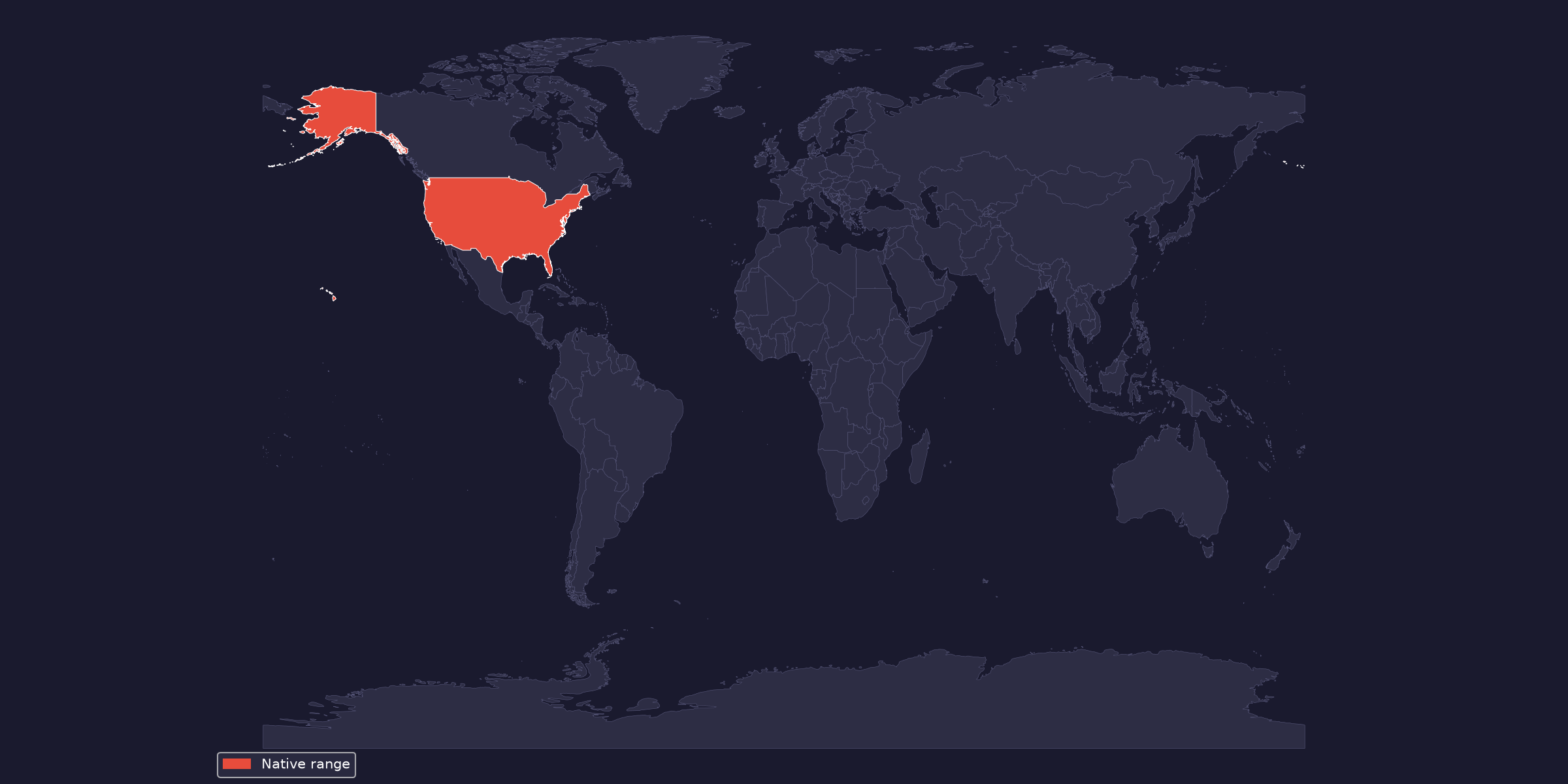
Under the current split, A. contortrix occupies much of the eastern and central United States: parts of Texas, Oklahoma, Kansas and Nebraska eastward through Missouri, Arkansas and Louisiana; Mississippi, Alabama, Georgia, the Florida Panhandle and the Carolinas; Tennessee, Kentucky, Virginia and West Virginia; and north through southern Illinois, Indiana and Ohio, Iowa, Pennsylvania, Maryland, Delaware, New Jersey, southern New York, Connecticut and Massachusetts. Boundaries are patchy, and western records may lie in the contact zone with A. laticinctus.
Some databases still report northeastern Mexico under A. contortrix, reflecting older broad concepts or unresolved records. The country-level map highlights the United States only. It cannot show state protections, county-scale gaps, hybrid zones or the current boundary with A. laticinctus, and it must not be treated as evidence that the species occurs everywhere in the country.
Habitats include deciduous woodland, rocky slopes, forest edges, stream valleys and wooded suburban mosaics. The climate point below is near a reviewed strict-sense record in coastal Georgia; it illustrates one warm, humid part of a much broader seasonal range.
🌡 Climate across the native range
Monthly normals from a coastal Georgia climate point near a reviewed strict-sense occurrence:
Coastal Georgia — United States (near reviewed strict-sense occurrence)
| Month | Min °C | Mean °C | Max °C | RH % |
|---|---|---|---|---|
| January | 8.9 | 11.9 | 15.6 | 75 |
| February | 10.1 | 13.1 | 16.8 | 76 |
| March | 12.7 | 15.7 | 19.4 | 74 |
| April | 16.4 | 19.4 | 22.9 | 73 |
| May | 20.6 | 23.5 | 26.6 | 73 |
| June | 23.8 | 26.2 | 29.0 | 79 |
| July | 25.3 | 27.6 | 30.5 | 79 |
| August | 25.1 | 27.2 | 29.7 | 81 |
| September | 23.6 | 25.6 | 28.0 | 79 |
| October | 19.4 | 21.8 | 24.6 | 75 |
| November | 14.2 | 17.0 | 20.3 | 75 |
| December | 10.8 | 13.5 | 17.0 | 78 |
Weather data by Open-Meteo.com · CC BY 4.0 · Monthly normals calculated by Herpeton Academy from daily archive values for 1991-2020.
Location references use GBIF.org occurrence data where available; original occurrence records retain their source dataset licenses.
⚖️ Legal status
Agkistrodon contortrix was not found in the CITES Appendices or EU wildlife-trade annexes checked on 17 August 2026. The Bern Convention is not relevant to this North American species. Those absences do not authorize capture, possession or movement.
U.S. national and local wildlife and dangerous-animal rules vary by state, county and municipality. Native collection may be prohibited or seasonally limited; institutional possession can require a permit, inspected rooms, inventory and escape records. Before acquisition, obtain written decisions for possession, registration, transport, breeding, sale and import, and retain invoices, transfer papers and precise lawful provenance.
🤌 Husbandry
House one snake per enclosure in a restricted venomous room with secondary containment, sealed service penetrations and a controlled-door protocol. Two lockable shift hides across the gradient must allow the animal to be positively located and isolated before the main enclosure opens.
Quarantine for at least 90 days in simple housing with dedicated tools and preferably separate airspace. Record weight, meals, sheds, faeces, mouth and respiratory signs. Veterinary examination and parasite testing are particularly important for wild-origin or poorly documented animals.
Do not cohabit for display. Seasonal aggregations and mating encounters in nature do not make permanent mixed housing safe, and invisible leaf-litter camouflage makes individual accountability harder.
💡 Lighting
Provide a seasonally adjusted 10-14-hour visible-light cycle and full darkness at night. Offer shaded hides and cover throughout the enclosure. Lamps belong outside primary containment or behind locked guards.
Low-output UVB may be provided as a Ferguson Zone 1 opportunity over part of the warm area. It is not established as essential for a whole-prey snake; measure exposure at snake level and preserve a fully shaded route.
🌡 Heating and temperature
Maintain 23-27°C ambient air, a 29-31°C basking surface, a 20-23°C cool hide and nights around 18-22°C. Use guarded heat controlled by a thermostat, plus independent surface and air probes and a high-temperature alarm.
Northern lineages experience real winters, while coastal southern animals remain active for longer. A controlled 6-12°C brumation is a breeding tool only for identified, healthy, acclimated adults and a facility with continuous monitoring. Do not cool juveniles, thin or sick animals, new arrivals, or any snake whose provenance and seasonal physiology are uncertain.
💧 Humidity and water
Use 45-65% relative humidity as a working range with ventilation and a dry surface. During shedding, provide one humid retreat around 60-75% rather than wetting the entire enclosure. Coastal and upland localities should not be managed as identical.
Provide a stable bowl of clean water that can be removed from a protected service position. Persistent dampness promotes dermatitis; chronic dryness and inadequate access contribute to dehydration and retained shed.
🌿 Enclosure and decoration
An adult requires at least 120 x 60 x 60 cm. Provide two shift hides, anchored cork or rock-like cover, low branches, visual barriers and an unobstructed inspection route. Every vent, track and cable opening must exclude neonates as well as adults.
Use 6-10 cm of compactable soil with leaf litter and bark on top; paper is preferable during quarantine. Avoid aromatic wood, unstable rock stacks, deep loose clutter and décor that must be lifted by hand. Fit two-step mechanical locks and a clear venom warning label.
🐁 Feeding
Wild prey includes mice and other small mammals, lizards, frogs, birds and large invertebrates, with juveniles using more ectothermic prey. Captive-established adults usually accept an appropriately sized frozen-thawed rodent every 10-21 days. Adjust the interval to measured weight and body condition.
Feed through a protected port with long tongs, and shift the animal before retrieving refused prey. Live rodents create avoidable injury and servicing risk. Balanced whole prey requires no routine calcium or vitamin dusting.
🛡 Operational safety and emergencies
Never free-handle, pin, neck or manually restrain this species during routine work. Use lockable shift boxes, correctly sized hooks, transparent barriers and protected feeding ports. Two trained adults should be present whenever primary containment opens; veterinary procedures need planned professional chemical restraint.
Before acquisition, consult the receiving hospital or poison centre about native pit-viper antivenom access, transport time and the exact institutional protocol. Keep photographs, current and historical names, provenance and emergency contacts at the room entrance. Antivenom is a hospital treatment, never a private-stock self-treatment.
A bite is an immediate medical emergency. Move away, call emergency services, remove rings and watches, keep the person still and follow poison-centre instructions. Do not cut, suck, ice, shock, tightly tourniquet or delay transport to catch the snake.
Maintain a written escape plan covering room isolation, public exclusion, animal accountability, search zones, capture containers and named decision-makers. Stop all routine work when an animal cannot be positively located.
🥚 Breeding notes
This species is viviparous. Litters commonly contain several young, with approximately 2-18 documented, and facultative parthenogenesis has been reported. Mating and birth timing vary with latitude and seasonal cycle.
Breeding is an institutional project, not routine enrichment. Confirm sex and lineage, legal authority, safe placement and complete parentage records before cycling animals. Individually locked neonate enclosures and an expanded bite and escape plan must be ready before birth.
🩺 Common problems
- Obesity: prevent with measured prey, long feeding intervals and regular weighing.
- Retained shed and dehydration: review water access, humid-hide use, ventilation and systemic disease.
- Respiratory disease: wheezing, bubbles, open-mouth breathing or persistent head elevation require urgent veterinary care.
- Dermatitis: investigate wet dirty substrate, poor ventilation, mites and abrasive décor.
- Parasites and stomatitis: weight loss, abnormal faeces, oral swelling or discharge are especially concerning in wild-origin animals.
- Burns and overheating: prevent with guarded thermostatic heat, independent probes and a true cool retreat.
- Regurgitation: review meal size, disturbance, temperatures and infection or parasite risk with a reptile veterinarian.
Do not attempt hands-on home treatment. Secure the snake in a shift compartment and coordinate examination with an experienced reptile veterinarian.
📌 Conclusion
Agkistrodon contortrix belongs only in a licensed facility that can maintain protected contact for its full lifespan. Correct separation from A. laticinctus, state-level provenance and cautious seasonal management matter as much as the enclosure numbers.
📚 Sources and further reading
- ReptiFiles — checked first on 17 August 2026; no species-specific care guide was found.
- The Reptile Database: Agkistrodon contortrix
- GBIF species record: Agkistrodon contortrix
- Burbrink & Guiher — species delimitation and gene flow in Agkistrodon
- Booth et al. — facultative parthenogenesis in wild vertebrates
- Christensen et al. — thermal characteristics of eastern copperhead gestation sites
- CDC/NIOSH — venomous-snake first aid
- Baines et al. — UV lighting guidance for captive reptiles
- Northern Ireland government guidance on keeping venomous snakes and lizards
- CITES Appendices
- EU wildlife-trade annexes, Commission Regulation (EU) 2026/1383
- Bern Convention appendices