Share

Common Death Adder
🔤 Taxonomy
Acanthophis antarcticus is the accepted name for the common or southern death adder. Despite its viper-like body and ambush strike, it is an Australian elapid. Older literature used A. antarcticus broadly for death adders across Australia and New Guinea; A. laevis and A. rugosus are now full species, and the genus still contains unresolved populations. Animals without locality and documented parentage should not be assigned to this strict species by colour alone.
📌 Description
The common death adder is a short, heavy-bodied ambush predator with a broad head, narrow neck, banded body, and a thin tail tip used to lure prey. Adults are commonly 40-80 cm, with exceptional specimens approaching 1 m. Its postsynaptic neurotoxic venom can cause progressive paralysis and respiratory failure.
It hides almost completely beneath litter and may remain still when approached. That behaviour creates a particular servicing hazard: a keeper can overlook the snake and place a hand within strike range. This is an expert institutional species, not a handling animal.
📋 Quick reference
| Care point | Practical target |
|---|---|
| Adult enclosure | At least 120 x 60 x 60 cm, with external-closing shift box |
| Day temperatures | 23-28°C ambient; 30-32°C limited warm patch; 20-23°C cool retreat |
| Night temperatures | 18-22°C |
| Humidity | 40-60%; a monitored humid hide during shedding |
| Lighting | 10-14 hours seasonally; optional low-level UVB with deep shade |
| Feeding | Appropriately sized frozen-thawed rodents; adults usually every 14-21 days |
| Housing | Solitary |
| Safety | Medically significant neurotoxic venom; protected contact only |
☠️ Venom
This species is venomous. Venom exposure can cause pain, swelling or other systemic effects, and severity varies with species, locality, bite site and the amount delivered. A small wound or apparently dry bite is not proof of safety; every bite or sting requires urgent medical assessment.
If an incident occurs, move away, call emergency services or a poison centre, keep the patient still, remove rings and other constricting items, and follow dispatcher instructions. Do not use a tourniquet, cut or suck the wound, apply ice or electricity, give alcohol or medicines as a home treatment, or attempt to catch the animal. Antivenom choice and dosing are hospital decisions; verify the relevant product and local availability in advance. Sources: WHO snakebite guidance and appropriate species-specific toxinology or medical references listed below.
🌍 Distribution
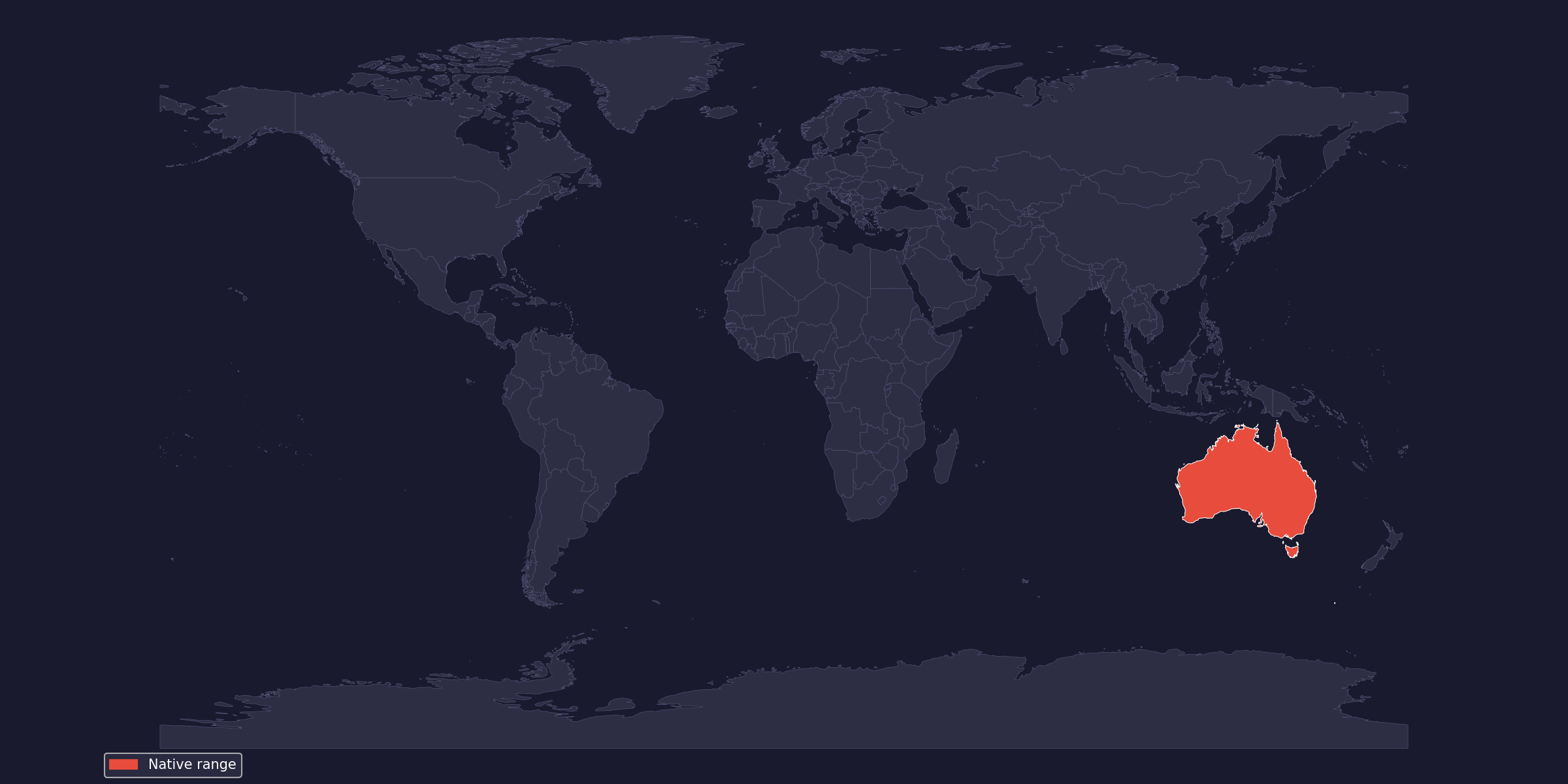
In the strict modern sense, A. antarcticus is an Australian species centred on southeastern and southern mainland Australia, including New South Wales, Victoria, southern Queensland, and South Australia, with some western records requiring locality-level taxonomic care. It uses open woodland, coastal heath, grassland, scrub, and forest edges with loose litter or ground cover.
Historical sources and some databases apply the name to a much broader Australian and New Guinean complex. Those records may represent A. praelongus, A. rugosus, A. laevis, A. hawkei, or other lineages. The country-level map therefore highlights Australia only and is not evidence of continuous occupancy or of species identity in every highlighted area.
🌡 Climate across the native range
Monthly climate normals from a verified strict-species occurrence in southeastern New South Wales:
Southeastern New South Wales — Australia (verified occurrence)
| Month | Min °C | Mean °C | Max °C | RH % |
|---|---|---|---|---|
| January | 16.3 | 20.8 | 27.1 | 77 |
| February | 16 | 20.1 | 25.8 | 80 |
| March | 14.2 | 18.3 | 23.8 | 80 |
| April | 11.3 | 15.4 | 20.9 | 79 |
| May | 8.4 | 12.4 | 17.8 | 79 |
| June | 6.5 | 10.1 | 14.9 | 80 |
| July | 5.4 | 9.3 | 14.7 | 76 |
| August | 5.9 | 10.4 | 16.2 | 71 |
| September | 8.2 | 13 | 19.3 | 70 |
| October | 10.4 | 15.4 | 21.9 | 71 |
| November | 12.6 | 17.3 | 23.9 | 74 |
| December | 14.5 | 19.1 | 25.5 | 75 |
Weather data by Open-Meteo.com · CC BY 4.0 · Monthly normals calculated by Herpeton Academy from daily archive values.
Location references use GBIF.org occurrence data where available; original occurrence records retain their source dataset licenses.
⚖️ Legal status
As checked on 17 August 2026, Acanthophis antarcticus is not listed in CITES Appendices I-III and no species-specific entry was found in EU wildlife-trade Annexes A-D. The Bern Convention is not relevant because the species is not native to Europe.
Australia nevertheless controls native wildlife independently of CITES. Commercial export of live native reptiles is prohibited, other movements require federal permits, and state or territory licences govern possession. New South Wales, for example, places A. antarcticus among venomous reptiles requiring a Class 2 keeper licence. Elsewhere, dangerous-animal rules may require training records, an inspected facility, insurance, and emergency plans. Confirm lawful captive origin and retain permits, transfer records, locality data, and invoices.
🤌 Husbandry
Use a locked snake room as secondary containment, a locked primary enclosure, visible hazard labels, dedicated tools, and a shift box that closes from outside. House singly. Service only after the animal is positively located and secured behind a solid barrier; never search leaf litter by hand.
Quarantine new arrivals for at least 90 days in a simple locked setup with paper substrate and two tight hides. Maintain separate tools and record weight, meals, sheds, faeces, respiration, and skin. Wild-origin or uncertain animals require reptile-veterinary examination, parasite testing, and strict collection biosecurity.
💡 Lighting
Provide a seasonally adjusted 10-14-hour light cycle and bright visible daylight over part of the enclosure. Low-output UVB may be offered across a small Ferguson Zone 1 area, but dense shade and buried retreats must remain available. Lamps, cages, cables, and probes must be inaccessible to the snake.
Night should be dark. The enclosure, not an exposed snake, should contain the gradient; death adders often thermoregulate while partly covered.
🌡 Heating and temperature
Maintain 23-28°C daytime air, a limited 30-32°C warm surface, a 20-23°C cool retreat, and 18-22°C at night. Thermostat every heat source and measure both exposed ground and the substrate beneath hides. A broad hot floor removes the cool option from an animal that may not move visibly when overheated.
Healthy adults of known southern provenance may receive gradual winter cycling, with a shorter photoperiod and cool area around 14-18°C, only for a planned institutional programme. Do not cool juveniles, thin or sick animals, new arrivals, or specimens of uncertain locality.
💧 Humidity and water
Keep general humidity around 40-60% with good cross-ventilation. Provide a small humid hide during shedding rather than wetting the entire enclosure. Moist lower substrate in one zone can buffer humidity, but the surface must include dry choices.
Supply a heavy clean water bowl positioned for protected access. Persistently wet litter, condensation, sour substrate, or reddened ventral scales signals excessive moisture and poor ventilation.
🌿 Enclosure and decoration
For one adult, use at least 120 x 60 x 60 cm and enlarge for an unusually large individual. Provide 8-12 cm of compactable soil-and-sand or soil-based substrate topped with abundant dry leaf litter, snug warm and cool hides, low cork, and stable visual cover. The layout must still allow the entire snake to be seen before any door opens.
Fit keyed or tool-operated locks, secured vents, blocked cable gaps, guarded heating, and a clear shift entrance. Avoid unstable rock, aromatic wood, and decor that must be lifted by hand during routine service.
🐁 Feeding
Wild death adders lure and eat lizards, frogs, birds, and mammals; diet shifts toward endothermic prey as snakes grow. Established adults can normally be maintained on appropriately sized frozen-thawed rodents. Offer a modest item no wider than the snake’s broadest section and feed by long tongs only after the shift and barrier plan is ready.
Juveniles commonly feed every 7-10 days and adults every 14-21 days, adjusted to body condition and season. Whole prey requires no supplement. Avoid live vertebrate prey; a reluctant specialist feeder belongs under an institutional veterinarian’s protocol, not an improvised force-feeding attempt.
🥚 Breeding
The species is viviparous. Published work across death adders reports mean litters commonly around 8-14, while A. antarcticus accounts range from about 3 to more than 30 young. Every neonate is venomous and needs an individual escape-proof container, records, dedicated tools, and a lawful placement plan.
Pairing, winter cycling, sex confirmation, and neonatal management are institutional operations. Keep provenance separate and do not breed unverified animals as “pure” A. antarcticus. Never cycle or pair animals that are underweight, newly acquired, or medically unstable.
🛡️ Handling and emergency planning
Treat every specimen as display-only. Do not free-handle, tail, pin, neck, or manually restrain it. Use external-closing shifts, appropriate hooks and shields, and a second trained adult for high-risk work. Pressure-immobilisation training and equipment should match current Australian clinical guidance, but remote instructions do not replace certified practical training.
Before acquisition, coordinate a written bite plan with emergency services, a poison centre or clinical toxicologist, and the receiving hospital. Record the accepted name, locality or parentage, contacts, route, and current antivenom pathway. Antivenom selection and administration are hospital decisions.
Any suspected bite is an emergency. Keep the patient still, call emergency services, and follow the regional poison-centre protocol. For an Australian-type elapid bite, current Australian guidance recommends a pressure-immobilisation bandage and splint applied by a trained responder; do not remove it before clinical direction. Do not wash, cut, suck, ice, shock, or apply an arterial tourniquet.
🩺 Common problems
- Overheating: persistent exposure, restlessness, gaping, or loss of coordination demands an immediate equipment check without breaching safe contact.
- Dysecdysis: correct hydration and the humid retreat; never pull retained skin from an unsecured venomous snake.
- Dermatitis: chronically damp or dirty litter can cause ventral inflammation and bacterial disease.
- Respiratory disease: bubbles, wheeze, open-mouth breathing, or abnormal posture needs prompt reptile-veterinary assessment.
- Obesity and regurgitation: use serial weights and conservative prey rather than appetite as the feeding guide.
- Parasites and mites: quarantine and diagnose; do not apply unmeasured pesticides around an elapid.
- Unsafe visibility: if the animal cannot be located and shifted reliably, simplify and redesign the enclosure.
📌 Conclusion
The common death adder needs a dry-to-mesic litter floor, a real seasonal thermal gradient, conservative whole-prey feeding, and a protected-contact system built around an almost invisible ambush snake. It is appropriate only for legally authorised experts with verified taxonomy, institutional backup, and a rehearsed hospital plan.
📚 Sources and further reading
- ReptiFiles was searched; no species-specific care guide was located: https://reptifiles.com/
- The Reptile Database: https://reptile-database.reptarium.cz/Acanthophis/antarcticus
- GBIF: https://www.gbif.org/species/2449648
- Shine et al., morphology, reproduction and diet in death adders: https://doi.org/10.1371/journal.pone.0094267
- Australian Resuscitation Council snakebite guidance: https://www.anzcor.org/home/first-aid/guideline-9-4-1-first-aid-management-of-australian-snake-bite
- Australian Government native-wildlife trade guidance: https://www.dcceew.gov.au/environment/wildlife-trade/natives
- NSW Reptile Keepers’ Licence species list: https://www.environment.nsw.gov.au/resources/nature/reptileLicensingOutline.pdf
- Baines et al., UV-Tool: https://doi.org/10.19227/jzar.v4i1.150
- CITES Appendices: https://cites.org/eng/app/appendices.php and https://checklist.cites.org/
- Commission Regulation (EU) 2026/1383: https://eur-lex.europa.eu/eli/reg/2026/1383/oj/eng
- Bern Convention appendices: https://www.coe.int/en/web/bern-convention/appendices