Share

Black-tailed monitor
🔤 Taxonomy
GBIF and the Australian Faunal Directory currently accept Varanus tristis (Schlegel, 1839). Older field and hobby literature commonly divided it into V. t. tristis and the northeastern freckled monitor V. t. orientalis. A peer-reviewed genomic revision published in 2025 found the northeastern lineage independently evolving and elevated it to Varanus orientalis. Major databases and legal documents do not all update at the same speed, so locality, breeder records and the scientific name used on permits should be kept together.
English common names used for V. tristis include:
- black-tailed monitor or black-tailed goanna
- black-headed monitor
- racehorse monitor or mourning monitor in older material
German hobby names include Schwarzschwanzwaran and Trauerwaran.
📌 Description
The black-tailed monitor is a slender, alert Australian dwarf monitor, but “dwarf” is relative: adults commonly reach 80 cm and large animals approach 1 m total length. Captive weights vary with sex and locality; roughly 150–500 g is a useful condition-checking range, not a feeding target. Recorded captive lifespan is about 12–15 years.
This species uses trees, hollow logs, bark, rock fissures and open ground. It can sprint, climb and wedge itself into very narrow retreats. Its intelligence and feeding response make it rewarding to observe, but also create the central care problem: a secure, complex enclosure must offer intense heat without trapping the animal in uniformly hot air.
☠️ Venom
Like other monitors, V. tristis should be treated as venomous in practical risk planning. Its venom system is not comparable to that of a medically significant front-fanged snake, but a bite can produce deep lacerations, pain, swelling and prolonged bleeding. Teeth, claws and tail can all injure a keeper.
Do not hand-feed or grab a monitor from a retreat. Use tongs, target training and a secure transfer tube or box. Wash a bite thoroughly and seek medical assessment for deep wounds, uncontrolled bleeding, marked swelling, loss of movement or signs of infection.
🌍 Distribution
Varanus tristis occurs widely through arid, semi-arid and seasonally tropical Australia, from Western Australia through the interior and parts of the north and east, but it is absent from the coldest southern regions. The 2025 revision removes the northeastern freckled lineage as V. orientalis; older range maps and occurrence portals may still combine those records under V. tristis.
Habitats include mulga and eucalypt woodland, savanna, desert scrub, rocky country and watercourse vegetation. Animals shelter below exfoliating bark, inside tree hollows, under logs or in rock cracks. A Great Victoria Desert study recorded long spring movements between trees and marked seasonal activity, while northern localities experience a different rainfall and temperature rhythm.
For a captive enclosure, the shared habitat signals are more useful than copying regional weather:
- strong overhead heat and light with genuinely cool shaded retreats
- vertical trunks, cork slabs, ledges and tight hollows as well as floor space
- a dry, ventilated surface plus at least one moisture-buffered retreat
- a deep nest area for an adult female
- seasonal changes only when the animal’s documented locality and condition justify them
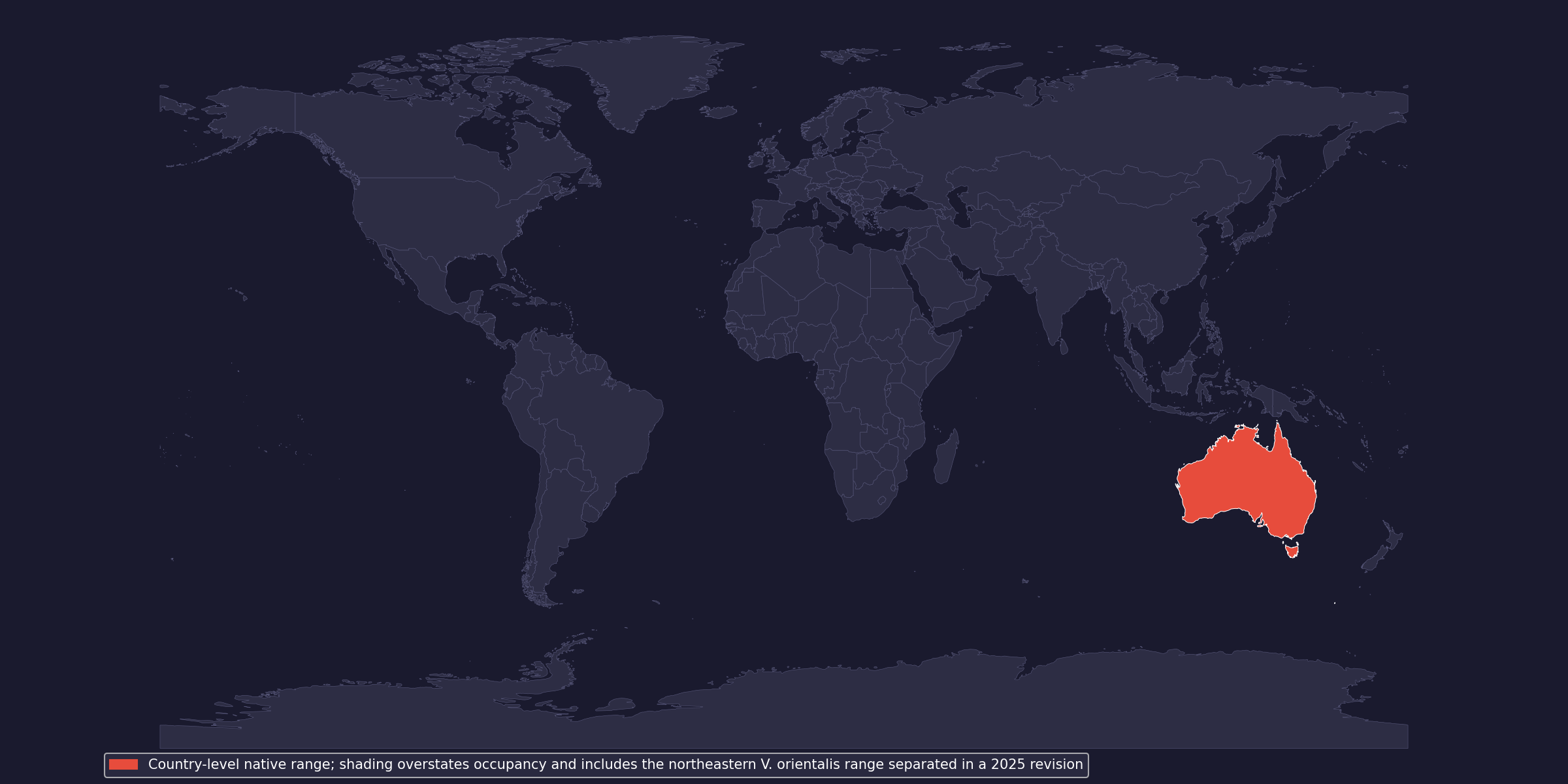
🌡 Climate across the native range
Monthly climate normals for a published V. tristis field-study site in the western Great Victoria Desert:
Western Great Victoria Desert — Australia (published V. tristis study site)
| Month | Min °C | Mean °C | Max °C | RH % |
|---|---|---|---|---|
| January | 21.4 | 28.6 | 35.6 | 36 |
| February | 20.5 | 27.2 | 33.9 | 42 |
| March | 17.9 | 24.3 | 30.8 | 45 |
| April | 14.7 | 20.8 | 27.3 | 49 |
| May | 10.3 | 16 | 22.3 | 53 |
| June | 7 | 12.5 | 18.5 | 60 |
| July | 6 | 12 | 18.4 | 56 |
| August | 7.5 | 14.1 | 21.2 | 45 |
| September | 10.8 | 18.2 | 25.5 | 36 |
| October | 14.9 | 22.4 | 29.9 | 32 |
| November | 17.2 | 24.8 | 32.2 | 33 |
| December | 19.5 | 26.9 | 34.1 | 35 |
Weather data by Open-Meteo.com · CC BY 4.0 · Monthly normals calculated by Herpeton Academy from daily archive values.
⚖️ Legal status
Checked against official sources on 2026-08-30, Varanus tristis is covered by the CITES Appendix II listing for Varanus species and by EU Annex B. It is not a European native species, so the Bern Convention is not relevant to its normal trade status. Appendix II/Annex B does not make ownership automatically legal: import, transfer, registration, breeding and dangerous-animal rules remain national or regional matters.
Australia prohibits commercial export of live native reptiles. Within Australia, wildlife possession and movement are controlled by state or territory systems; for example, Western Australia requires an appropriate licence to keep reptiles and lists which taxa each licence category covers. An animal offered outside Australia should therefore have a traceable captive-bred lineage, invoice, breeder identity and any applicable CITES import or re-export documents. A locality label is biologically and taxonomically important, but it is not proof of legal origin by itself.
🤌 Husbandry
House one monitor per permanent enclosure. Breeding pairs are not socially necessary, and quiet coexistence can conceal unequal access to the best hollow, heat and food. Introductions belong to experienced breeding projects with duplicate housing ready; separate animals at the first persistent chase, bite, weight loss or exclusion from a resource.
For one adult, provide at least 150 × 75 × 120 cm, with more height, width and connected climbing surface strongly preferred. A smaller historical minimum may keep the animal alive, but it does not give an active 80–100 cm monitor enough choice. A juvenile may start in about 90 × 60 × 90 cm if it contains the complete heat, UVB and retreat gradient. Upgrade before pacing, nose rubbing or cramped turning appears.
Every door needs a lock. Protect cable ports, sliding-door gaps and lamp cages; test decor with firm hand pressure. Build handling around voluntary behaviour. A feeding target, station perch and closed transfer box allow routine weighing and cleaning without chasing the animal. Never pull it by the tail or peel it from bark by force.
Quarantine new animals for at least 60–90 days in a separate airspace where practical. Use dedicated tools and easily inspected furnishings, and record weight, appetite, feces and sheds. Uncertain origin, diarrhea, weight loss or persistent poor appetite warrants examination and fecal testing by a reptile-experienced veterinarian before the animal enters a naturalistic enclosure.
💡 Lighting
Provide bright visible light across most of the enclosure, a warm white basking cluster and a high-output linear UVB lamp. A practical baseline is 10–13 hours of light, adjusted gradually rather than switched abruptly between seasons. Do not use visible red, blue or “moonlight” lamps at night.
Treat the species as a Ferguson Zone 3 sun-basker pending better locality-specific measurements. Start around UVI 2.5–4 at the animal’s back on the main basking route, with sub-UVI 1 shade and fully dark hollows. Lamp percentage does not predict exposure on its own. Measure at animal height with a Solarmeter 6.5, through any mesh, and recheck after moving branches or changing lamps. Follow the manufacturer’s replacement interval unless readings decline earlier.
UVB and heat should overlap so the monitor receives both while basking. Guard every lamp and keep the animal farther than the manufacturer’s minimum distance even if it climbs onto the highest branch.
🌡 Heating and temperature
Offer a broad basking surface of 50–65°C, warm-side air of 28–33°C, cool retreats of 24–28°C and nights of 18–24°C. The upper end of the basking range is a surface measurement, not an air-temperature target. Use a cluster of lower-wattage halogen lamps to warm the full body evenly rather than a single narrow, scorching beam.
Measure each basking surface with an infrared thermometer and measure shaded air with digital probes at more than one height. Control heat sources with suitable dimming thermostats and verify the thermostat independently. A monitor hiding continuously in the coolest hollow, gaping away from the basking area or pacing at the door may be escaping excessive heat rather than seeking more space.
Some southern and arid localities show pronounced winter inactivity. Cooling is optional reproductive cycling, not routine pet care. Never cool a juvenile, thin, ill or newly acquired animal, and never begin while the gut may contain a large meal. A locality-specific plan should be based on veterinary clearance, gradual photoperiod change and measured refuge temperatures.
💧 Humidity and water
Because the species spans several climate zones, ambient humidity should follow known locality rather than one universal number. A daytime range of roughly 30–60% suits many setups when ventilation is strong, but every enclosure needs a slightly humid hollow or substrate pocket around 55–70%. The retreat should feel cool and faintly damp, not wet or stagnant.
Provide a heavy bowl of fresh water at all times, large enough for the animal to enter if it chooses. Replace water daily and immediately after fouling. Lightly wet one deep substrate area or spray a bark face when needed; do not keep all walls and floor wet. Persistent condensation, sour substrate and damp basking surfaces indicate excessive moisture or weak ventilation.
🌿 Enclosure and decoration
Install load-bearing trunks, cork tubes, bark slabs, shelves and rock-like ledges before adding loose substrate. A useful route lets the monitor move from a hot exposed perch into warm cover and then a cool hollow without dropping to an empty floor. Fix heavy pieces to the enclosure frame or support them from the base so digging cannot cause collapse.
Use 15–25 cm of packed sand-loam-soil mix across much of the floor, deeper in a nesting zone. The substrate should hold a shallow scrape and retain some moisture below a dry surface. For an adult female, provide a secure 30–40 cm deep laying area even outside planned breeding; failure to provide a suitable site raises egg-retention risk. Avoid calcium sand, crushed walnut, cedar, sharp gravel and dusty loose sand.
Leaf litter and safe prey-searching areas improve foraging. Feed from a clean slab or smooth bowl when substrate ingestion is likely. Check crevices for sharp screws, trapped insects and unseen dampness without stripping all familiar cover at every clean.
🪳 Feeding
Make varied, well-fed invertebrates the routine diet: roaches, crickets, locusts, silkworms, black soldier fly larvae and other suitable insects. Wild V. tristis also take lizards, frogs, eggs and small vertebrates. In captivity, occasional appropriately sized whole vertebrate prey can provide variety, but fatty rodents, mince and frequent egg rapidly create obesity and do not replace a varied whole-prey diet.
Offer juveniles small meals daily or every other day; feed adults measured portions every two to four days. Prey should be easy to overpower and generally no wider than the monitor’s head. Adjust by monthly weight and body condition: the tail base should remain muscular, the limbs defined and the abdomen not persistently rounded.
Gut-load insects for 24–48 hours. With correctly measured UVB, dust most juvenile insect meals and two or three adult meals weekly with plain calcium, then use a reptile multivitamin at the product’s conservative interval. D3-containing powder is used less often when UVB is reliable. Do not stack multiple vitamin products. Reproductive females require closer calcium and body-condition monitoring, ideally with veterinary input.
Use feeding tongs, puzzle cups and hidden insects to encourage searching, but remove uneaten crickets before they bite a resting monitor. Keep fingers outside the feeding response.
🩺 Common problems
- Pale, darkened or blistered skin beneath a lamp → thermal burn or an unsafe basking surface
- Swollen limbs, tremors, weak jaw or poor grip → possible metabolic bone disease from UVB, calcium or dietary failure
- Retained shed on toes or tail, sunken eyes or hard urates → dehydration or inadequate humid retreat
- Persistent straining, swelling or absent feces → possible impaction, obstruction or reproductive disease; do not give oil or other home remedies
- Rapid weight gain and a bulbous tail base → overfeeding and insufficient activity
- Nose rubbing, damaged claws or repeated escape attempts → enclosure, security or chronic stress problem
- Wheezing, mucus or open-mouth breathing away from basking → respiratory disease or overheating
Egg binding can occur even when breeding was not planned. A female that repeatedly digs, becomes restless and then weak, or retains abdominal swelling needs an urgent reptile-veterinary assessment. Serious bites, burns, falls, progressive weight loss, neurologic signs or repeated refusal to feed also require prompt professional care.
📌 Conclusion
Varanus tristis suits a keeper who can provide a tall locked enclosure, measured high heat and UVB, and a largely insect-based diet for more than a decade. Buy by documented taxon and locality, not colour alone, and have the adult enclosure, quarantine space and legal-origin records ready before the monitor arrives.
📚 Sources and further reading
- GBIF species record for Varanus tristis
- Atlas of Living Australia / Australian Faunal Directory record for Varanus tristis
- Pavón-Vázquez et al. (2025), genomic and taxonomic revision of the Varanus tristis complex
- Thompson & Pianka (1999), reproductive ecology of Varanus tristis
- Monsoon Monitors, revised Varanus tristis husbandry notes
- Baines et al. (2016), UV-Tool and reptile UVB guidance
- CITES Appendices, checked 2026-08-30
- EU wildlife-trade legislation and annex references, checked 2026-08-30
- Australian Government guidance on commercial wildlife trade, checked 2026-08-30
- Western Australian fauna-licensing guidance, checked 2026-08-30