Share

Varanus ornatus
🔤 Taxonomy
Varanus ornatus is the currently accepted scientific name. Monitor taxonomy and common names can be confusing in trade, so use the Latin name when comparing animals or paperwork.
English common names used in the hobby:
- Ornate monitor
German common names used in the hobby:
- Bindenwaran
- Ornatenwaran
📌 Description
Varanus ornatus is a monitor lizard that reaches about 120-180 cm. It is intelligent, powerful for its size, and far more demanding than a typical pet lizard. This is a display and advanced husbandry species, not a casual handling animal.
☠️ Venom
Varanus ornatus is a monitor lizard and should be treated as mildly venomous. Monitor venom is not comparable to dangerous front-fanged snake venom, but bites can be deep, painful and contaminated with oral bacteria, and swelling or prolonged soreness can occur.
The practical safety rule is prevention: do not hand-feed, do not restrain the animal casually, and use calm tools and enclosure design to avoid bites. Any serious monitor bite should be cleaned thoroughly and assessed by a medical professional, especially if it is deep, bleeding heavily, swelling, or showing signs of infection.
🌍 Distribution
Varanus ornatus is associated with humid forests, swamp forest, river systems and wetland margins in West and Central Africa. In older pet-trade language it is often called the ornate monitor or ornate Nile monitor, and some sources have treated ornate-looking animals as part of a broader Nile monitor complex. For keepers, the practical point is to pay attention to locality and habitat rather than relying on the trade name alone.
Compared with dry savanna monitors, this is a forest and water-edge animal. It uses dense cover, roots, banks, branches, shallow water and small basking openings.
In captivity, this usually means:
- a very large, humid enclosure with water, land and climbing structure
- strong basking heat combined with shaded forest-style retreats
- dense visual barriers to reduce stress
- clean water and substrate that can handle humidity without becoming foul
- caution with identification and sourcing, because locality and taxonomy affect expectations for adult size, behaviour and humidity tolerance
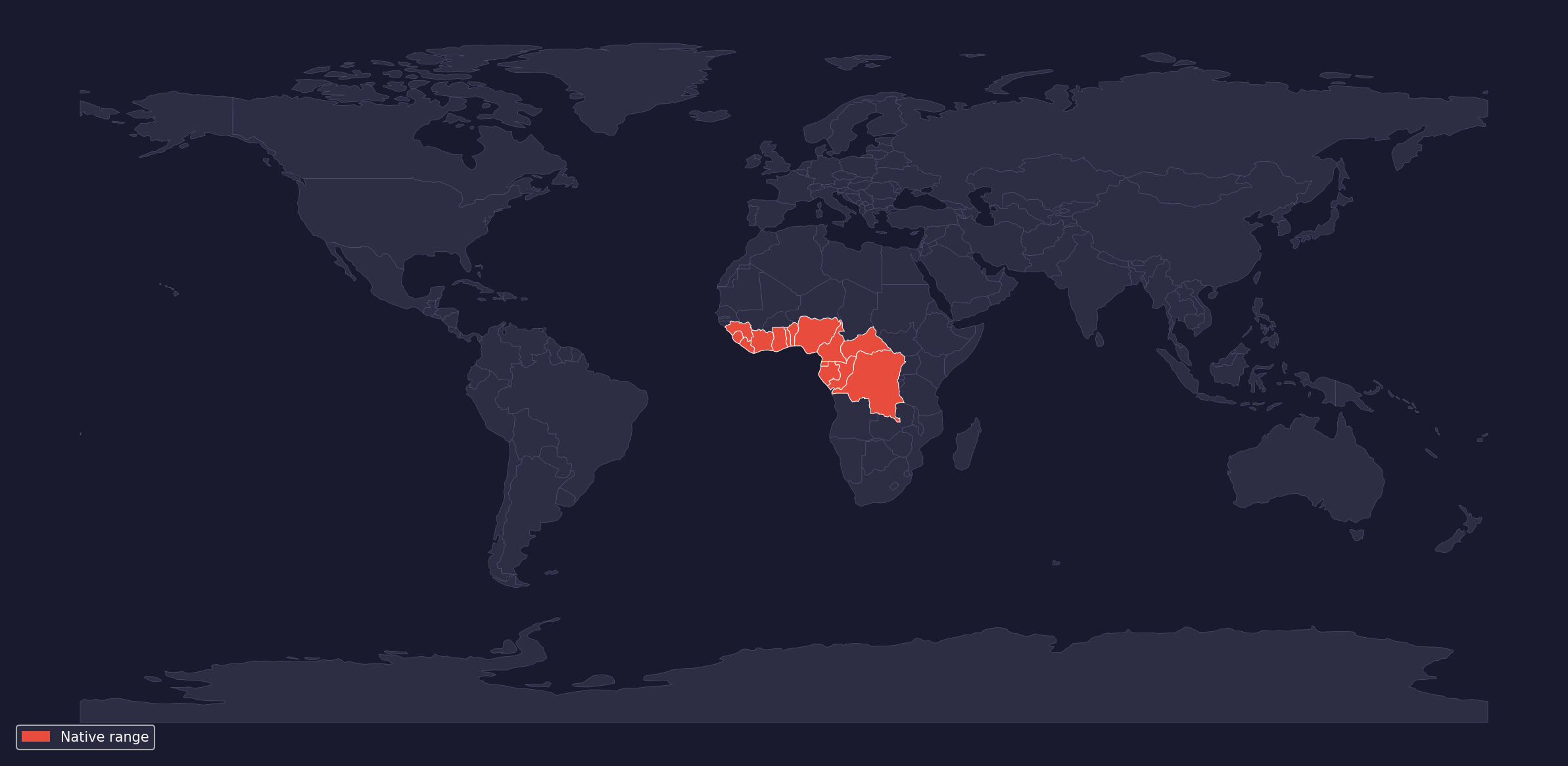
🌡 Climate across the native range
Monthly climate normals from reviewed GBIF occurrence locations:
Gola National Forest — Liberia
| Month | Min °C | Mean °C | Max °C | RH % |
|---|---|---|---|---|
| January | 21.3 | 25.3 | 31.4 | 77 |
| February | 22.1 | 25.9 | 32.1 | 78 |
| March | 22.5 | 25.6 | 31.1 | 83 |
| April | 22.5 | 25.2 | 30.1 | 87 |
| May | 22.2 | 24.7 | 29.4 | 89 |
| June | 21.6 | 23.8 | 28.1 | 90 |
| July | 21.1 | 23 | 27 | 90 |
| August | 21.1 | 22.9 | 26.6 | 91 |
| September | 21.3 | 23.3 | 27.6 | 91 |
| October | 21.4 | 23.8 | 28.5 | 90 |
| November | 21.5 | 24.2 | 28.9 | 89 |
| December | 21.6 | 24.7 | 29.8 | 84 |
Monte Alen National Park — Equatorial Guinea
| Month | Min °C | Mean °C | Max °C | RH % |
|---|---|---|---|---|
| January | 20.4 | 22.9 | 27.5 | 89 |
| February | 20.7 | 23.1 | 27.9 | 89 |
| March | 20.8 | 23.3 | 28.2 | 90 |
| April | 21 | 23.4 | 28.2 | 91 |
| May | 20.9 | 23.1 | 27.6 | 91 |
| June | 20.3 | 22.4 | 26.6 | 90 |
| July | 19.7 | 21.8 | 26 | 88 |
| August | 19.7 | 21.9 | 26 | 88 |
| September | 20.2 | 22.1 | 26.3 | 91 |
| October | 20.4 | 22.3 | 26.5 | 92 |
| November | 20.2 | 22.5 | 27 | 92 |
| December | 20.2 | 22.6 | 27.2 | 90 |
Makokou — Gabon
| Month | Min °C | Mean °C | Max °C | RH % |
|---|---|---|---|---|
| January | 21 | 24.6 | 29.5 | 81 |
| February | 21.3 | 24.6 | 29.5 | 83 |
| March | 21.4 | 24.6 | 29.4 | 86 |
| April | 21.4 | 24.6 | 29.5 | 86 |
| May | 21.3 | 24.4 | 29 | 86 |
| June | 20.7 | 23.9 | 28.5 | 83 |
| July | 20.2 | 23.4 | 28.1 | 80 |
| August | 20.4 | 23.5 | 28.1 | 79 |
| September | 20.7 | 23.6 | 28.4 | 83 |
| October | 20.7 | 23.5 | 28.1 | 86 |
| November | 20.7 | 23.7 | 28.3 | 87 |
| December | 20.8 | 24.1 | 28.8 | 84 |
Weather data by Open-Meteo.com · CC BY 4.0 · Monthly normals calculated by Herpeton Academy from daily archive values.
Location references use GBIF.org occurrence data where available; original occurrence records retain their source dataset licenses.
⚖️ Legal status
As checked against current official sources in April 2026, Varanus ornatus falls under the CITES Appendix II listing for Varanus species. Under EU wildlife-trade rules, that generally means Annex B unless a stricter listing applies. The species is not native to Europe, so the Bern Convention is not normally relevant. National rules on import, sale, transport, breeding, and proof of legal origin may still apply. Captive-bred animals with reliable origin records are preferable.
🤌 Husbandry
This species is best kept in a very large humid terrestrial to semi-aquatic enclosure with secure hides and a water area. Monitor lizards are active predators and should normally be kept alone except for carefully supervised breeding introductions. A practical adult enclosure is at least around 240 x 120 x 90 cm. Juveniles can be started in around 90 x 60 x 60 cm but grow quickly and will need upgrades within the first year.
The juvenile enclosure is a management stage, not a long-term home. Young monitors should be easy to observe, feed, hydrate, and remove safely, but they still need a real heat and UV gradient, secure hides, and enough depth or structure to behave normally. Increase enclosure size before the animal becomes cramped; do not wait until nose-rubbing, frantic pacing, or food aggression appear.
- Secure locks and escape-proof construction
- Strong overhead heat and bright light
- Multiple hides and visual barriers
- Enough usable space for daily movement
- Routine cleaning and safe keeper access
💡 Lighting
Monitor lizards are diurnal and depend on intense visible light. Use a 10-12 hour photoperiod, strong full-enclosure illumination, and suitable linear UVB with shaded retreats. Weak lighting often leads to poor activity, poor appetite, and long-term health problems.
For UV planning, treat this species as Ferguson Zone 3. Aim for about UVI 3-4 at the animal’s back or shell height in the basking zone, with a gradient down to shaded areas near zero UVI. This usually points to a stronger 10-12% T5/Desert-style UVB tube, or a suitable mercury vapor system in a large open setup; measure with a Solarmeter 6.5 when possible, because reflector, mesh, distance, and lamp age change the real exposure.
🌡 Heating and temperature
Useful approximate targets are basking 50-60°C, daytime ambient 28-32°C, cool retreats 24-27°C, night 22-25°C. The goal is a very hot basking surface with cooler retreat options, not an enclosure that is uniformly hot. Measure surface and air temperatures with reliable equipment.
💧 Humidity and water
Humidity and water should match the habitat: 60-80% with clean water and dry basking surfaces. Even dry-country monitors need access to clean water and a microclimate that prevents chronic dehydration. Stagnant wetness and dirty water are major risks.
🌿 Enclosure and decoration
The enclosure should support thermoregulation, digging or climbing, and secure retreat behavior. Use stable rocks, cork, branches, packed substrate, ledges and hides suited to the species. Heavy decor must be fixed securely because monitors dig, push and climb with force.
🪳 Feeding
Feed a varied carnivorous diet based on large insects, snails, roaches, fish used carefully and occasional whole prey. Juveniles are fed daily or every other day; adults do well every 5–7 days. Avoid routine fatty rodents and oversized meals; captive monitors become obese quickly when diet and exercise are poorly managed.
Stage matters with feeding. Juveniles need smaller prey more often because they are growing, but they should still look athletic rather than round. Adults need fewer, leaner meals and more reliance on invertebrates or lean whole prey; frequent large meals, fatty rodents, and poor exercise quickly create obesity, fatty liver disease, and weak long-term condition.
🩺 Common problems
For this large humid forest and water-edge monitor, the main captive problems are dirty-water skin disease, respiratory problems from damp stagnant air, burns, obesity, toe and tail injuries, and stress when water, hides, or floor area are too limited.
Warning signs include red or damaged skin, swollen digits, wheezing, constant soaking, nose rubbing, poor appetite, heavy fat deposits, and defensive behavior that worsens in cramped housing.
When something changes, check water hygiene, airflow, basking surface temperature, dry resting areas, adult enclosure size, diet, and secure visual cover. Serious wounds, swelling, breathing signs, repeated refusal to feed, weakness, or suspected burns need a reptile veterinarian. Monitors hide illness well, so a visible decline is already urgent.
📌 Conclusion
Varanus ornatus is rewarding only when its heat, space, diet and security needs are taken seriously. A keeper should plan the adult enclosure before acquiring the animal, because monitors quickly outgrow temporary setups.
📚 Sources and further reading
- CITES Appendices, checked 2026-05-04
- EU wildlife trade regulations and annex references, checked April 2026
- GBIF species backbone and occurrence data for taxonomy and distribution context
- IUCN Red List and specialist husbandry references where applicable
💬 Feedback
For questions, corrections, or practical notes, leave us a message in the forum thread.