Share

Mangrove Monitor
🔤 Taxonomy
Varanus indicus is the currently accepted scientific name. Monitor taxonomy and common names can be confusing in trade, so use the Latin name when comparing animals or paperwork.
English common names used in the hobby:
- Mangrove monitor
- Pacific monitor
German common names used in the hobby:
- Mangrovenwaran
📌 Description
Varanus indicus is a monitor lizard that reaches about 90-120 cm. It is intelligent, powerful for its size, and far more demanding than a typical pet lizard. This is a display and advanced husbandry species, not a casual handling animal.
☠️ Venom and safety
For Varanus indicus, bite prevention must address sharp teeth, gripping force and contaminated wounds. Monitor bites can cause punctures, lacerations, bleeding and infection; the contribution of oral secretions to human symptoms is not reliably established for every species. Do not infer a snakebite syndrome or an antivenom requirement from a venom label.
Use feeding tongs, predictable routines and voluntary movement into a secure compartment; avoid hand-feeding and forced restraint. After a bite, wash the wound with soap and water, cover it with a clean dressing and seek medical advice for broken skin, especially on a hand or near a joint. Large or deep wounds, uncontrolled bleeding, loss of movement or feeling need urgent care. Increasing redness, heat, swelling, discharge or fever may indicate infection. A clinician should assess wound damage, tetanus protection and any need for antibiotics.
🌍 Distribution
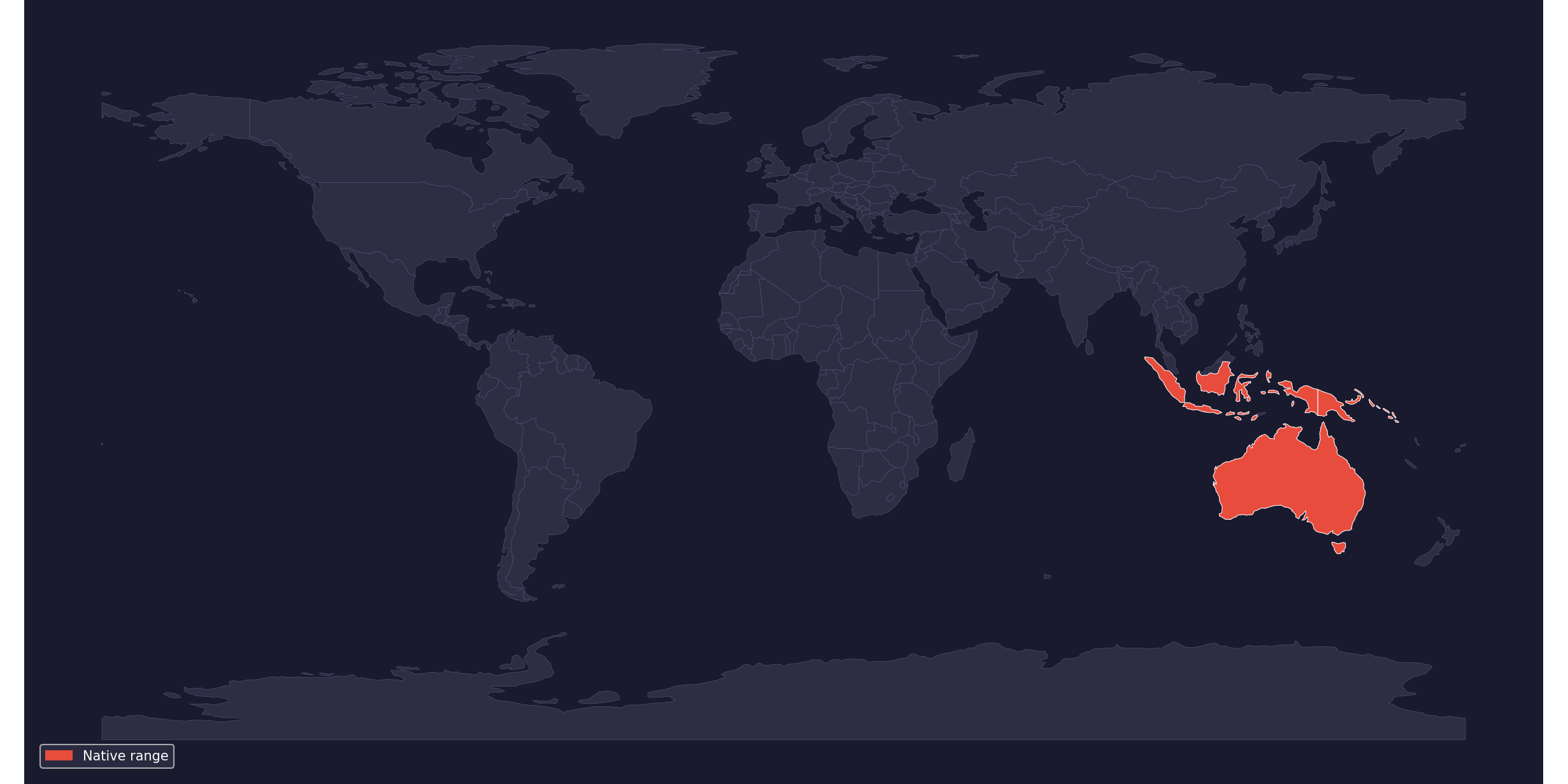
Varanus indicus belongs to a complicated western Pacific monitor group. In the broad hobby sense, “mangrove monitor” animals come from northern Australia, New Guinea and nearby island systems, with records and related forms through parts of the Moluccas, Solomon Islands and surrounding archipelagos. Several island populations that were once treated casually under the indicus label are now separated or debated, so locality labels should be treated with caution.
Typical habitat is humid and coastal: mangroves, swamp forest, river edges, tidal margins, coastal woodland and dense vegetation near permanent water. These monitors climb well, swim well and use both trees and shoreline cover.
In captivity, the distribution points to:
- a large, humid enclosure with both climbing structure and usable floor space
- a substantial water area or soaking zone that can be kept clean
- strong basking heat with cooler humid cover nearby
- branches, cork tubes and dense visual barriers for a shy, fast animal
- extra caution with wild-caught or uncertain-locality animals, which may be stressed, parasite-loaded and less tolerant of handling
🌡 Climate across the native range
Monthly climate normals from reviewed GBIF occurrence locations:
Papua Barat — Indonesia
| Month | Min °C | Mean °C | Max °C | RH % |
|---|---|---|---|---|
| January | 26.1 | 26.9 | 27.6 | 82 |
| February | 26.1 | 26.9 | 27.6 | 82 |
| March | 26.1 | 27 | 27.7 | 82 |
| April | 26.1 | 27 | 27.8 | 82 |
| May | 26.3 | 27.1 | 27.8 | 83 |
| June | 25.9 | 26.7 | 27.3 | 83 |
| July | 25.7 | 26.4 | 27 | 82 |
| August | 25.8 | 26.4 | 26.9 | 82 |
| September | 25.8 | 26.6 | 27.2 | 81 |
| October | 26.1 | 27 | 27.6 | 81 |
| November | 26.2 | 27.1 | 27.9 | 82 |
| December | 26.2 | 27.1 | 27.9 | 82 |
Queensland — Australia
| Month | Min °C | Mean °C | Max °C | RH % |
|---|---|---|---|---|
| January | 25.5 | 27 | 28.9 | 84 |
| February | 25.4 | 26.9 | 28.9 | 85 |
| March | 25.2 | 26.5 | 28.2 | 84 |
| April | 25.1 | 26.1 | 27.3 | 82 |
| May | 24.4 | 25.2 | 26.4 | 80 |
| June | 23.3 | 24.1 | 25.2 | 80 |
| July | 22.7 | 23.5 | 24.6 | 77 |
| August | 22.6 | 23.5 | 24.8 | 76 |
| September | 23.3 | 24.3 | 25.8 | 76 |
| October | 24.2 | 25.3 | 26.8 | 78 |
| November | 25.2 | 26.5 | 28 | 79 |
| December | 25.7 | 27.1 | 28.8 | 82 |
Maluku — Indonesia
| Month | Min °C | Mean °C | Max °C | RH % |
|---|---|---|---|---|
| January | 23 | 25.1 | 27.8 | 89 |
| February | 22.8 | 25 | 27.7 | 89 |
| March | 22.9 | 25.1 | 27.8 | 89 |
| April | 23 | 25.2 | 28 | 89 |
| May | 23.2 | 25.4 | 28.3 | 88 |
| June | 22.9 | 25 | 28 | 88 |
| July | 22.7 | 24.8 | 27.8 | 86 |
| August | 22.4 | 24.9 | 28.3 | 84 |
| September | 22.6 | 25.1 | 28.6 | 84 |
| October | 22.8 | 25.4 | 28.7 | 86 |
| November | 23.1 | 25.5 | 28.4 | 88 |
| December | 23.1 | 25.3 | 28.1 | 89 |
Weather data by Open-Meteo.com · CC BY 4.0 · Monthly normals calculated by Herpeton Academy from daily archive values.
Location references use GBIF.org occurrence data where available; original occurrence records retain their source dataset licenses.
⚖️ Legal status
As checked against current official sources in April 2026, Varanus indicus falls under the CITES Appendix II listing for Varanus species. Under EU wildlife-trade rules, that generally means Annex B unless a stricter listing applies. The species is not native to Europe, so the Bern Convention is not normally relevant. National rules on import, sale, transport, breeding, and proof of legal origin may still apply. Captive-bred animals with reliable origin records are preferable.
🤌 Husbandry
- Adult enclosure: 240 × 120 × 180 cm (length × width × height).
A practical plan for one adult; furnishing and the animal’s actual size determine whether more space is needed.
This species is best kept in a very large semi-arboreal humid enclosure with climbing routes and a large water area. Monitor lizards are active predators and should normally be kept alone except for carefully supervised breeding introductions. A practical adult enclosure is at least around 240 × 120 × 180 cm with significant height. Juveniles can be started in around 90 x 60 x 60 cm and upgraded as the animal grows.
The juvenile enclosure is a management stage, not a long-term home. Young monitors should be easy to observe, feed, hydrate, and remove safely, but they still need a real heat and UV gradient, secure hides, and enough depth or structure to behave normally. Increase enclosure size before the animal becomes cramped; do not wait until nose-rubbing, frantic pacing, or food aggression appear.
- Secure locks and escape-proof construction
- Strong overhead heat and bright light
- Multiple hides and visual barriers
- Enough usable space for daily movement
- Routine cleaning and safe keeper access
💡 Lighting
Monitor lizards are diurnal and depend on intense visible light. Use a 10-12 hour photoperiod, strong full-enclosure illumination, and suitable linear UVB with shaded retreats. Weak lighting often leads to poor activity, poor appetite, and long-term health problems.
For UV planning, treat this species as Ferguson Zone 3. Aim for about UVI 3-4 at the animal’s back or shell height in the basking zone, with a gradient down to shaded areas near zero UVI. This usually points to a stronger 10-12% T5/Desert-style UVB tube, or a suitable mercury vapor system in a large open setup; measure with a Solarmeter 6.5 when possible, because reflector, mesh, distance, and lamp age change the real exposure.
🌡 Heating and temperature
Useful approximate targets are basking 45-55°C, daytime ambient 27-31°C, night 23-26°C. The goal is a very hot basking surface with cooler retreat options, not an enclosure that is uniformly hot. Measure surface and air temperatures with reliable equipment.
💧 Humidity and water
Humidity and water should match the habitat: 70-90% with clean water and strong ventilation. Even dry-country monitors need access to clean water and a microclimate that prevents chronic dehydration. Stagnant wetness and dirty water are major risks.
🌿 Enclosure and decoration
The enclosure should support thermoregulation, digging or climbing, and secure retreat behavior. Use stable rocks, cork, branches, packed substrate, ledges and hides suited to the species. Heavy decor must be fixed securely because monitors dig, push and climb with force.
🪳 Feeding
Feed a varied carnivorous diet based on roaches, locusts, fish used carefully, snails, crustaceans and occasional whole prey.
- Adult maintenance meals: Every 3–7 days.
This is a starting schedule for measured portions in healthy, established adults, not an instruction to offer a large whole-prey meal at every feeding. Small insect meals and larger whole prey have different energy contents; reduce the portion or frequency if weight and body fat rise. Growing juveniles need smaller meals daily or every other day, with intake adjusted to growth. Reproductive, recovering or underweight animals need an individual plan. Record food, weight and condition; persistent refusal or weight loss needs veterinary review.
The interval is editorial planning guidance informed by general lizard nutrition; a species-specific optimal interval has not been established.
🩺 Common problems
For this humid semi-aquatic monitor, the main captive problems are skin infections from dirty water, respiratory trouble from stagnant humidity, burns, toe and tail wounds, stress from lack of water depth or climbing routes, and obesity in inactive adults.
Warning signs include foul-smelling water, swollen toes, red or damaged skin, wheezing, persistent hiding, frantic rubbing, poor swimming strength, and wounds around the tail base.
When something changes, check water filtration and changes, ventilation, basking temperature, dry basking surfaces, climbing structure, enclosure size, and diet variety. Serious wounds, swelling, breathing signs, repeated refusal to feed, weakness, or suspected burns need a reptile veterinarian. Monitors hide illness well, so a visible decline is already urgent.
📌 Conclusion
Varanus indicus is rewarding only when its heat, space, diet and security needs are taken seriously. A keeper should plan the adult enclosure before acquiring the animal, because monitors quickly outgrow temporary setups.
📚 Sources and further reading
Taxonomy and legal references identify names and listing frameworks; they do not establish care limits. General husbandry references support the precautions described. Unless tied to a specific study in the text, the numerical enclosure, climate and feeding recommendations are editorial planning guidance, not experimentally established species-specific limits.
- CITES Appendices, checked 2026-05-04
- European Commission: wildlife-trade framework and annex resources
- GBIF: Varanus indicus — taxonomy and recorded distribution; not a husbandry study
- NHS: animal bites, wound care and medical assessment
- Vikrant and Verma (2014): a severe monitor-lizard bite case; not a risk estimate for all Varanus
- Merck Veterinary Manual: thermal gradients, ventilation, quarantine and recordkeeping; general reptile guidance
- Species+: CITES and EU listing records
- Enclosure planning reference: DGHT Switzerland — Reptilienhaltung: enclosure layout — layout guidance; the exact dimensions selected here are an editorial planning example.
💬 Feedback
For questions, corrections, or practical notes, leave us a message in the forum thread.