Share

Pygmy mulga monitor
🔤 Taxonomy
Varanus gilleni Lucas & Frost, 1895 is the accepted scientific name in GBIF and the Australian Faunal Directory. It belongs to the Australian dwarf-monitor subgenus Odatria and has no accepted subspecies. The obsolete combination Worrellisaurus gilleni may appear in older lists, but adds no useful distinction for modern care or paperwork.
English common names include pygmy mulga monitor, Gillen’s monitor and pygmy mulga goanna. The established German hobby name is Gillens Zwergwaran.
📌 Description
The pygmy mulga monitor is a very small, predominantly arboreal monitor with a grasping tail and powerful curved claws. Adults are about 30–40 cm total length; Parks Australia gives an average weight of 60–80 g. Its small mass does not make it a miniature terrestrial lizard: it needs height, bark layers, intense light, high basking-surface temperature and a constant supply of varied live insects.
Well-settled individuals can become confident around a keeper and learn a target or feeding routine. They remain fast, fragile and unsuitable for routine restraint. With appropriate care, lifespan exceeds 10 years and may reach about 15.
☠️ Venom
As a monitor lizard, V. gilleni should be treated as venomous in practical safety planning. A bite is unlikely to produce the systemic emergency associated with a dangerous front-fanged snake, but small size does not prevent sharp teeth from causing pain, bleeding, swelling or contamination.
Use tongs and target training; do not hand-feed or pry the animal from beneath bark. Clean any bite thoroughly. Deep wounds, persistent bleeding, marked swelling, reduced movement or signs of infection require medical assessment.
🌍 Distribution
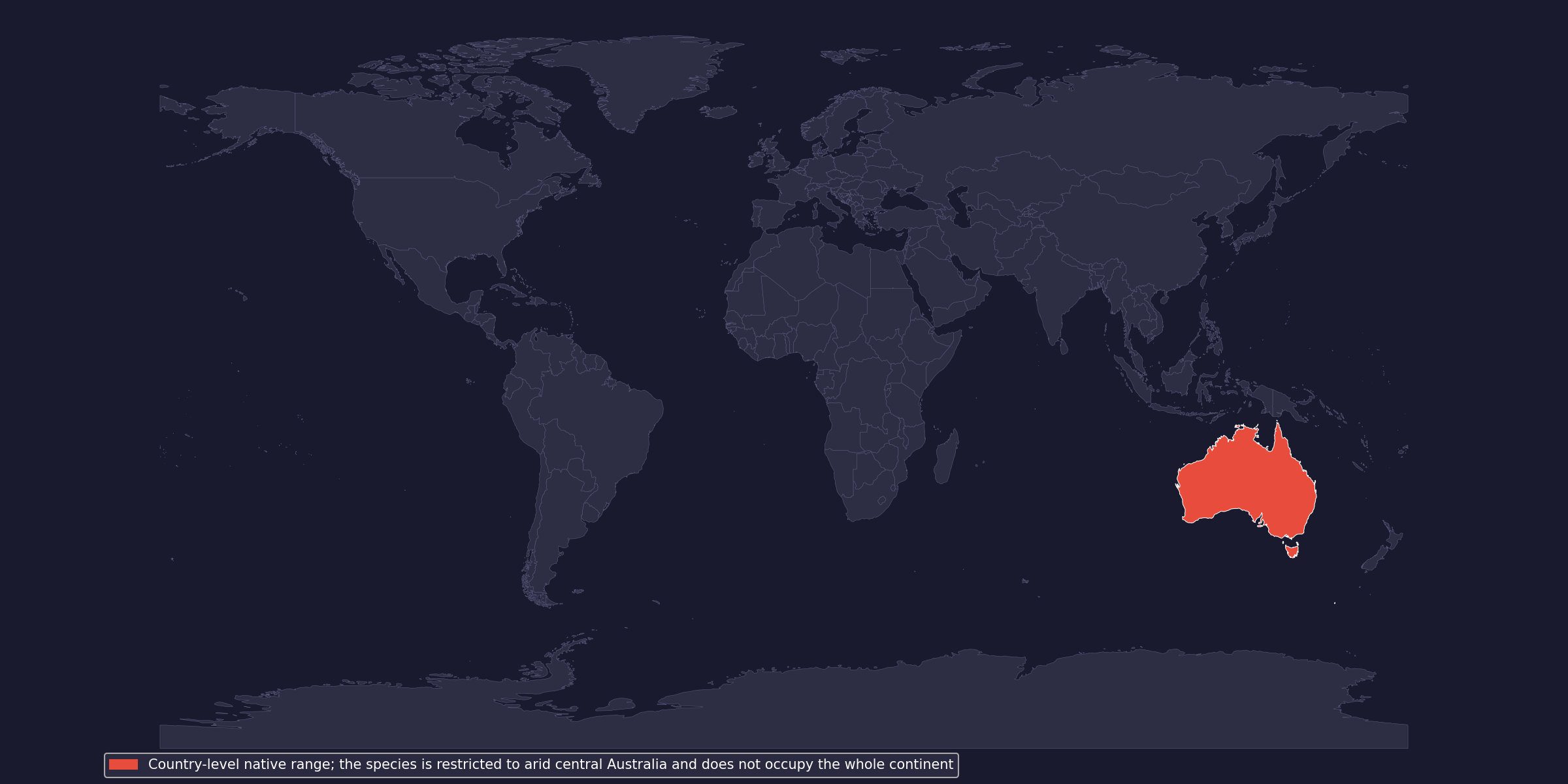
Varanus gilleni is endemic to arid central Australia, with records from Western Australia, the Northern Territory, northern South Australia and western Queensland. Official and museum sources place it in mulga, myall and desert-oak country as well as spinifex sandplains. It shelters beneath loose bark and in tree hollows, using the trunk as cover, hunting surface and escape route.
The climate has very hot summers, cool winter nights, low and irregular rainfall and large daily swings. Tree hollows and bark layers soften those extremes. Captive care therefore needs dry moving air without making every refuge hot and bone dry.
The useful enclosure signals are:
- several vertical and diagonal bark layers, hollow trunks and narrow retreats
- a very hot measured basking surface with cooler shaded routes behind bark
- low ambient humidity plus a local humid refuge
- loose litter or a packed substrate area for digging and prey searching
- reliable escape-proof construction for a monitor that can disappear into a cable-width gap
🌡 Climate across the native range
Monthly climate normals from a reviewed central-Australian GBIF occurrence near Uluṟu:
Uluṟu region — Northern Territory, Australia (reviewed V. gilleni occurrence)
| Month | Min °C | Mean °C | Max °C | RH % |
|---|---|---|---|---|
| January | 24.5 | 31.3 | 37.5 | 30 |
| February | 23.7 | 30.1 | 36.2 | 32 |
| March | 21 | 27.5 | 33.7 | 31 |
| April | 16.5 | 23 | 29.2 | 35 |
| May | 11.1 | 17.2 | 23.3 | 45 |
| June | 7.4 | 13.1 | 19.2 | 53 |
| July | 6.5 | 12.9 | 19.5 | 48 |
| August | 8.5 | 15.7 | 22.7 | 37 |
| September | 13.4 | 21 | 28.2 | 29 |
| October | 17.1 | 24.8 | 31.9 | 28 |
| November | 20.2 | 27.6 | 34.3 | 29 |
| December | 22.4 | 29.2 | 35.6 | 32 |
Weather data by Open-Meteo.com · CC BY 4.0 · Monthly normals calculated by Herpeton Academy from daily archive values.
Location references use GBIF.org occurrence data where available; original occurrence records retain their source dataset licenses.
⚖️ Legal status
Checked against official sources on 2026-08-30, Varanus gilleni is listed in CITES Appendix II and EU Annex B. It is not native to Europe, so the Bern Convention is not relevant to its normal trade status. National or regional rules can still regulate ownership, import, transfer, registration, breeding and transport.
Australia prohibits commercial export of live native reptiles. State and territory laws separately control keeping and movement within Australia; Western Australia, for example, requires a fauna licence for reptile keeping and assigns species to licence categories. Outside Australia, insist on a traceable captive-bred origin, breeder identity, invoice and any required CITES import or re-export papers. The small European captive gene pool reported in specialist literature also makes truthful lineage records valuable for breeding decisions.
🤌 Husbandry
Keep one animal per permanent enclosure unless an experienced breeder is conducting a controlled introduction. Male combat is documented and a male may harass a female. A pair needs more space, duplicated hot perches and hides, close weight monitoring and a second ready enclosure; cohabitation is never required for welfare.
For one adult, use at least 100 × 60 × 80 cm. More height and length create safer thermal choice. Furnish every level so that the enclosure is not just an empty tall box. A juvenile can start in about 60 × 45 × 60 cm when that makes feeding and fecal monitoring easier, but it still needs full UVB, heat and shaded-retreat gradients.
Lock the doors and block cable gaps. Secure lamps behind guards and fix bark so it cannot close like a trap. Train the monitor to approach a target and enter a small transfer tube or box. Never catch it by the tail; the body and toes are too small for rough restraint.
Quarantine for 60–90 days away from established reptiles. Use separate tools and simple removable bark or tubes, and record weight, food, feces and sheds. Animals with uncertain origin, diarrhea, poor growth or persistent anorexia need a reptile-veterinary assessment and, when indicated, fecal testing.
💡 Lighting
Use bright full-enclosure LED lighting, a warm basking lamp or small cluster, and a linear high-output UVB tube. A 10–13 hour photoperiod can be changed gradually across the year. Darkness at night is essential; do not use red or blue visible lamps.
Treat V. gilleni as a Ferguson Zone 3 sun-basker pending species-specific field measurements. A practical initial target is UVI 2.5–4 at the animal’s back on the main basking bark, falling below 1 behind bark and to near zero in hollows. Measure through mesh with a Solarmeter 6.5. Recheck after moving decor and at the lamp maker’s replacement interval.
Place useful UVB and heat together, while retaining several shaded exits. Lamp guards and minimum safe distances matter especially because this monitor climbs directly toward light.
🌡 Heating and temperature
Provide a broad basking surface of 50–65°C, daytime warm-zone air of 28–33°C, cool shaded areas of 24–28°C and nights around 18–24°C. Those hot values apply to the bark or tile surface, not all enclosure air. A small halogen cluster spreads heat over the whole lizard better than one narrow beam.
Check surfaces with an infrared thermometer and shaded air with digital probes at different heights. Use a dimming thermostat for each heat circuit and verify it independently. Thin bark can overheat quickly; measure both its exposed face and the hollow behind it.
Wild activity is seasonal, but forced winter cooling is unnecessary for an ordinary display animal. Only cycle a healthy, established adult for planned breeding, using locality-aware temperatures and gradual changes. Do not cool a juvenile, underweight, ill or newly acquired monitor.
💧 Humidity and water
Keep exposed air relatively dry and well ventilated, commonly around 25–45% during the day, while preserving a humid bark pocket or hide around 50–65%. Light misting of one bark face every few days may stimulate drinking and improve shedding. Let surfaces dry; do not turn an arid enclosure into a persistently damp box.
Provide a stable shallow bowl of fresh water, changed daily and after fouling. Monitor hydration through weight, normal urates, bright eyes and complete sheds. Retained shed and dehydration are not solved by soaking the entire enclosure.
🌿 Enclosure and decoration
Stack and fix cork slabs vertically with narrow spaces between them, and add hollow cork tubes, rough branches and stable ledges. Offer at least one retreat at basking height, another in the warm shade and a cool humid hollow. Every space must allow the animal to reverse or exit without being pinned.
Use 10–20 cm of packed sandy loam or soil-sand-clay mix with a dry surface and slightly damper lower layer. Add leaf litter for foraging. An adult female needs a deeper, secure laying container even if breeding is not intended. Avoid calcium sand, dusty loose sand, aromatic wood, sharp gravel and unstable stone piles.
Support heavy decor from the base or enclosure frame. Feed on a clean platform or in a smooth-sided cup when insects become coated in substrate, and remove prey that hides near a sleeping monitor.
🪳 Feeding
Base the diet on varied, gut-loaded insects: small roaches, crickets, locusts, silkworms, black soldier fly larvae and appropriately sized beetle larvae. Prey should be readily subdued and no wider than the monitor’s head. Occasional small pieces of whole vertebrate prey or egg are possible for healthy adults, but mince and frequent rodents are calorie-dense and nutritionally poor as staples.
Feed growing juveniles daily or every other day. Most adults do well on small measured meals every two to three days, adjusted to weight and activity. This species becomes obese readily; a permanently rounded abdomen and thick, soft tail base mean portions should fall and foraging opportunities should rise.
Gut-load insects for 24–48 hours. With measured UVB, dust most juvenile meals and two or three adult meals per week lightly with plain calcium. Use a reptile multivitamin at the conservative product interval and D3 less often when UVB is reliable. Do not combine several vitamin products or coat prey heavily.
Use tongs, feeder cups and insects hidden in safe bark crevices to encourage movement. Remove uneaten crickets before they injure the monitor.
🩺 Common problems
- Missing claws, swollen toes or repeated falls → unsafe bark gaps, poor route design or nutritional disease
- Pale, dark or blistered areas → thermal burn from bark or an unguarded lamp
- Tremors, soft jaw or weak grip → possible metabolic bone disease from UVB, calcium or dietary failure
- Retained shed on toes or tail and hard urates → dehydration or inadequate humid refuge
- Rapid weight gain and declining activity → overfeeding and too little usable climbing space
- Nose rubbing or frantic gap-testing → security, heat or chronic stress problem
- Breathing noise, discharge or open-mouth breathing away from heat → respiratory disease or overheating
Females can retain eggs when no suitable laying site is available. Repeated digging followed by weakness, persistent swelling, serious injuries, burns, marked weight loss or repeated food refusal warrants prompt examination by a reptile-experienced veterinarian.
📌 Conclusion
Varanus gilleni is a compact monitor for an advanced keeper, not an easy substitute for a larger species. Prepare vertical bark structure, a safely measured 50–65°C basking surface, UVB, quarantine space and dependable live-food supply before purchase, and reject animals whose captive-bred origin cannot be documented.
📚 Sources and further reading
- GBIF species record for Varanus gilleni
- Atlas of Living Australia / Australian Faunal Directory record for Varanus gilleni
- Parks Australia, pygmy mulga monitor profile
- Monsoon Monitors, Varanus gilleni husbandry notes
- Eidenmüller & Wicker (1997), breeding Varanus gilleni
- Baines et al. (2016), UV-Tool and reptile UVB guidance
- CITES Appendices, checked 2026-08-30
- EU wildlife-trade legislation and annex references, checked 2026-08-30
- Australian Government guidance on commercial wildlife trade, checked 2026-08-30
- Western Australian fauna-licensing guidance, checked 2026-08-30