Share

African Pygmy Mouse
🔤 Taxonomy
Mus minutoides is the accepted scientific name for the African pygmy mouse covered here. GBIF treats Mus minimus as a synonym, and some lists write the animal as Mus (Nannomys) minutoides, so labels should be checked carefully.
English common names used in the hobby:
- African pygmy mouse
- Southern African pygmy mouse
- Free State pygmy mouse
German common names used in the hobby:
- Afrikanische Zwergmaus
- Afrikanische Knirpsmaus
📌 Description
Mus minutoides is a tiny African rodent best kept as a no-handling colony animal in a sealed, heavily enriched enclosure. Adult size is about 8-13 cm including tail where relevant, with typical adult weight around 3-8 g. A realistic lifespan is 1.5-4 years when heat, hygiene, diet, and group management are stable.
These animals are poor choices for children or keepers who expect routine handling. The main failure points are escape, stress from bare housing, wrong social grouping, overheating or chilling, and food that is too rich for a small active rodent.
🌍 Distribution
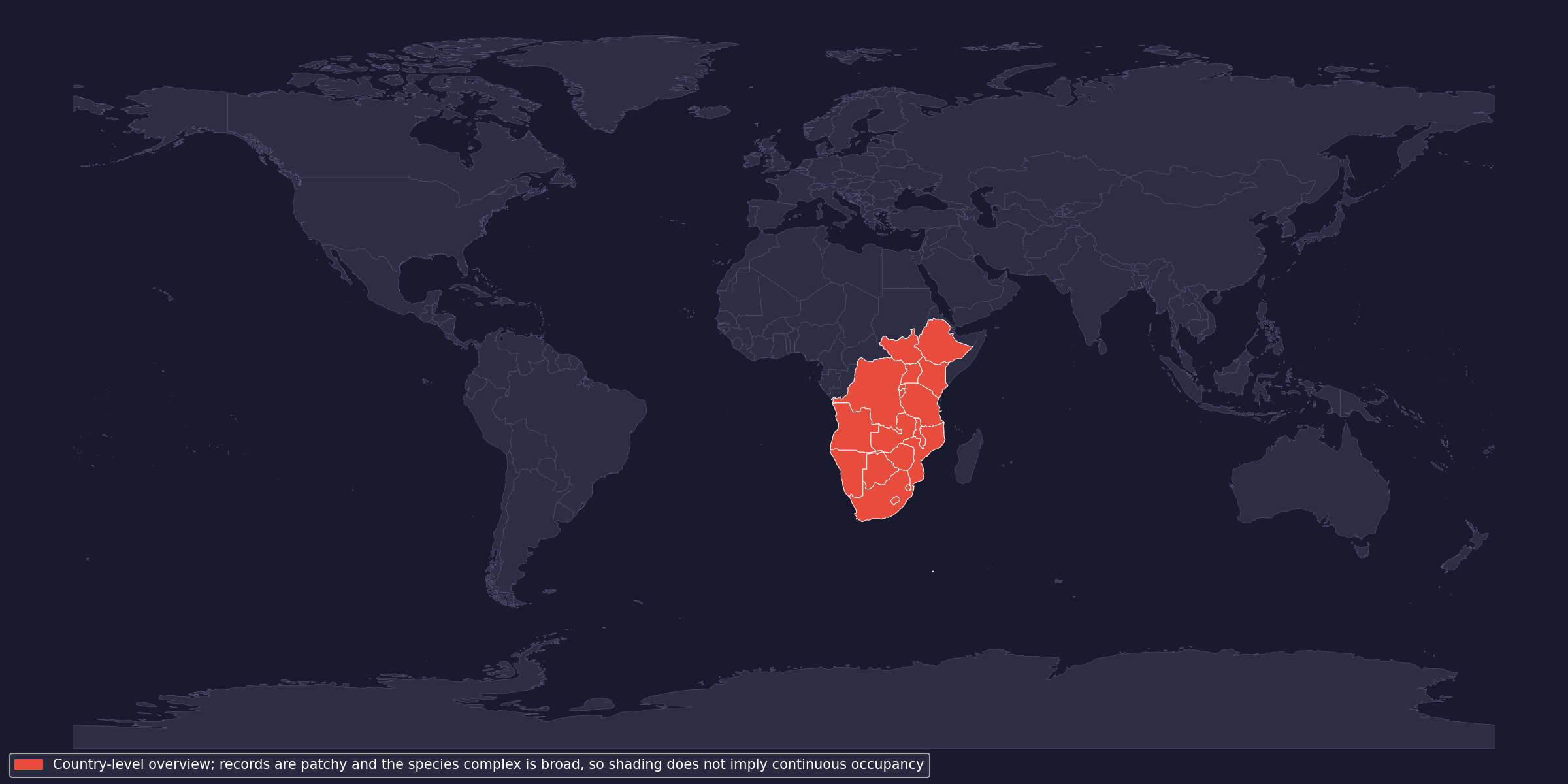
Patchy but broad sub-Saharan African range; grassland, savanna, shrub cover, rocky areas, riverbank dunes, and other covered microhabitats. Country shading on the map is a broad range guide, not proof that the species occurs in every habitat inside each country. In captivity, use the distribution to provide cover, measured temperature choices, dry hygienic retreats, and secure ventilation rather than trying to copy outdoor weather.
⚖️ Legal status
Checked 2026-09-02: Mus minutoides was not found in the current CITES Appendices, the current EU wildlife-trade Annexes A-D, or the Bern Convention protected-fauna appendices. This does not make trade or ownership automatically unrestricted; local and national rules may still apply. All three animals in this batch are African rodents for US import purposes: CDC states that African rodents, including rodents whose native habitat is in Africa even when born elsewhere, may not be imported into the United States except with written CDC permission for scientific, exhibition, or educational purposes. Keep invoices, breeder/importer details, transfer documents, health records, and never release animals or bedding outdoors.
🌿 Habitat
The useful habitat cues are cover, small routes, nest security, dry resting places, and rapid access to hiding. Provide a complex enclosure before the animal arrives; adding enrichment only after stereotyped pacing, hiding, or fighting begins is late husbandry.
🤌 Husbandry
This is a tiny, fast, easily injured rodent. Do not plan routine handling. Use a sealed glass or acrylic enclosure with a very fine metal mesh lid and service openings that close before the animal can jump out. Even small cable holes and loose lid corners are escape routes.
Quarantine new arrivals in a simpler escape-proof enclosure for at least 30-60 days, with separate tools, weight records, fecal checks when origin is unclear, and no contact with established mammals. Imported or recently traded rodents deserve extra caution because parasites, bite wounds, pregnancy, and stress-related illness are common hidden problems.
💡 Lighting
UVB is not required for normal care. Provide a stable 10-12 hour light period, shade inside the enclosure, and real darkness at night. Avoid visible night lamps. Keep fixtures and cables outside chewing reach, and never place a glass enclosure in direct sun.
🌡 Heating and temperature
Use an ambient range of 20-26 °C, a limited warm area around 26-28 °C if extra heat is needed, cooler retreats around 20-22 °C, and nights around 18-22 °C. Measure with digital probes; do not guess from room comfort.
Any heat source must be controlled and protected from chewing. Avoid heat rocks, unguarded bulbs, and sealed hot boxes. If animals pant, stretch out, hide continuously, fight more, or refuse food, check temperatures before changing the diet or group.
💧 Humidity and water
Target 40-60% relative humidity with good ventilation. The enclosure should be dry enough to prevent mold but not so dusty that eyes, nose, and feet become irritated. Provide fresh water at all times in a checked bottle, shallow heavy dish, or both.
Remove wet bedding quickly. For very small rodents, a blocked bottle or tipped dish can become dangerous within a day, so water checks are not optional.
🌿 Enclosure and decoration
Keep a compatible pair or small colony with many hides, dry grass nests, cork, roots, fine branches, leaf litter, and a deep dry substrate layer for digging. Provide several feeding points and visual barriers. Because identification and sexing can be difficult, acquire animals only from a keeper who can separate sexes reliably and who has a plan for surplus young.
Substrate should be dust-free, absorbent, and deep enough for digging or nest building, usually 10 cm or more where the enclosure allows it. Avoid cedar, strong aromatic shavings, fluffy nesting fiber, fraying fabric, sticky tape inside the enclosure, unstable rocks, and any mesh or wheel that can trap feet or tails.
🪳 Feeding
Feed daily in small amounts: fine seed mix, millet sprays, tiny grains, small insects, dried herbs, and limited fresh greens. Water should be in a shallow heavy dish, a checked bottle, or both. Clean in sections so the colony keeps familiar scent trails, but remove damp food and wet bedding promptly.
Food size matters: insects and hard items should be small enough to carry and chew safely. Offer multiple feeding points in groups so subordinate animals can eat. Sudden weight loss, wet chin, overgrown incisors, diarrhea, and persistent food guarding all need prompt review.
🩺 Common problems
Common problems include escape injuries, tail wounds, bite abscesses, respiratory irritation from dusty or damp bedding, obesity, dental overgrowth, parasites in poorly documented stock, heat stress, dehydration, and social stress. Warning signs are repeated food refusal, weight loss, hunched posture, labored breathing, wet nose, swollen eyes, poor coat, wounds, limping, diarrhea, or an animal excluded from nests and food.
First check measured heat, water, food access, locks, ventilation, bedding condition, and group dynamics. Serious weakness, breathing signs, wounds, swelling, pregnancy trouble, neurological signs, or rapid decline need an exotic-animal veterinarian.
📌 Conclusion
Mus minutoides suits keepers who want a small, active display mammal and can maintain escape-proof housing, measured climate, daily feeding, careful records, and legal paperwork. Do not buy before the enclosure, quarantine setup, and local import/ownership checks are ready.
📚 Sources and further reading
Sources checked for taxonomy, husbandry, legal status, and import risk:
- www.gbif.org/species/2438796
- pmc.ncbi.nlm.nih.gov/articles/PMC4048158/
- pmc.ncbi.nlm.nih.gov/articles/PMC10113032/
- repository.up.ac.za/bitstreams/06442b26-c50d-4ac3-bf39-ee262b6c7981/download
- genomics.senescence.info/species/entry.php?species=Mus_minutoides
- www.cdc.gov/importation/bringing-an-animal-into-the-us/index.html
- www.law.cornell.edu/cfr/text/42/71.56
- cites.org/eng/app/appendices.php
- eur-lex.europa.eu/eli/reg/2026/1383/oj/eng
- www.coe.int/en/web/bern-convention/appendices