Share

Chinchilla
🔤 Taxonomy
GBIF and Chilean conservation authorities currently use Chinchilla lanigera for the long-tailed or Chilean chinchilla. The Mammal Diversity Database uses the gender-corrected combination Chinchilla laniger. Both forms therefore appear in current authoritative sources, while veterinary literature and the pet trade still overwhelmingly use C. lanigera.
This article concerns the domesticated pet form traditionally assigned to C. lanigera. It must not be confused with wild long-tailed chinchillas or with the short-tailed chinchilla, Chinchilla chinchilla (often called C. brevicaudata in older literature).
📌 Description
Chinchillas are crepuscular and nocturnal South American rodents with dense insulating fur, powerful hind legs, continuously growing teeth, and a strong drive to jump, explore, chew, hide, and dust-bathe. Pet adults are commonly 30–45 cm including the tail and about 400–800 g, with females often larger. A well-kept animal may live 10–20 years.
They are not low-maintenance cage pets. Welfare depends on cool dry air, a compatible companion, a genuinely large multilevel enclosure, unlimited grass hay, safe chewing material, and access to an exotic-mammal veterinarian. Their dense coat makes heat and humidity much more dangerous than many new keepers expect.
🌍 Distribution
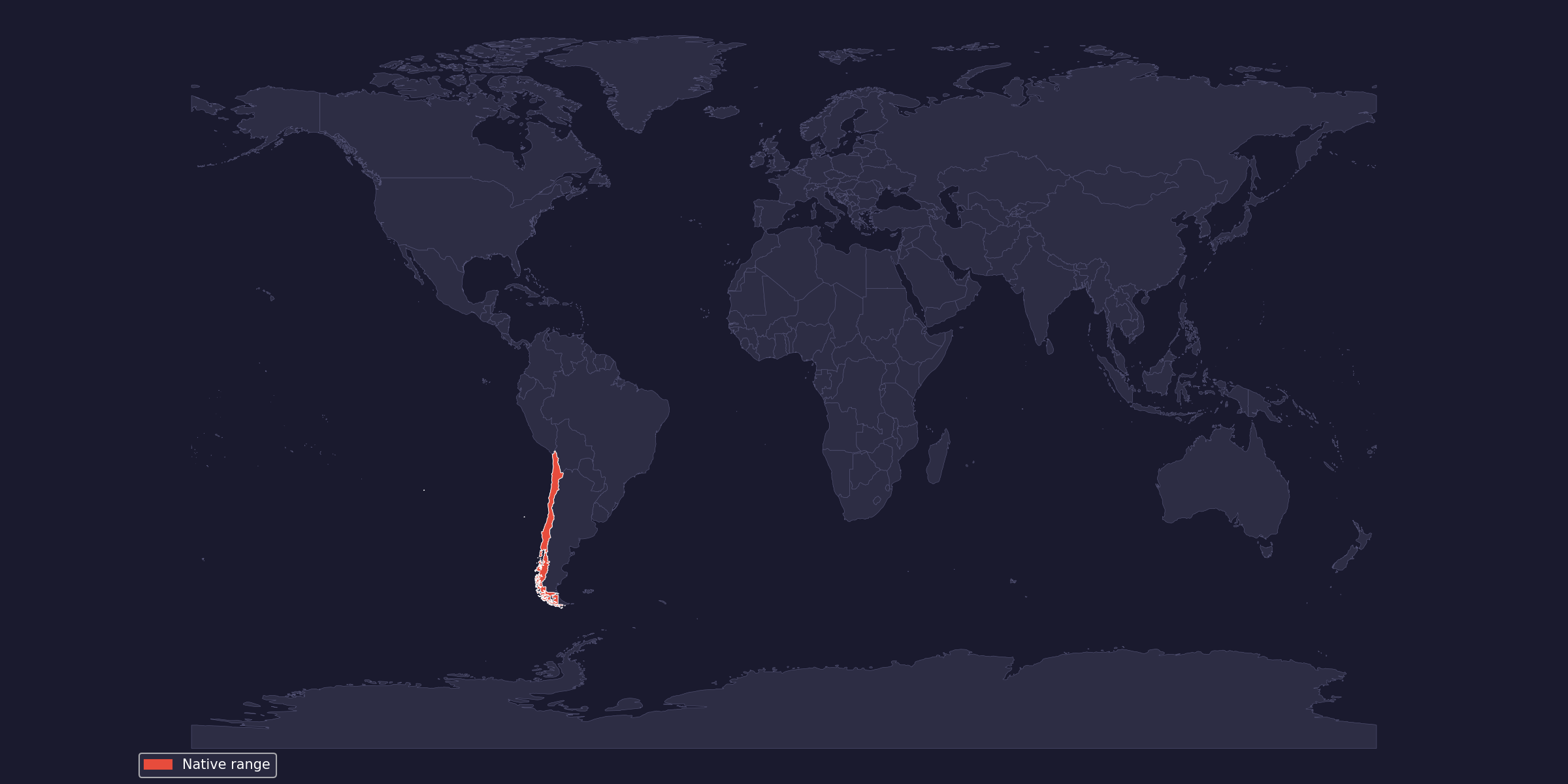
Wild long-tailed chinchillas are endemic to Chile. Surviving colonies occur in arid and semi-arid rocky shrubland in the Coquimbo region, including the Las Chinchillas National Reserve near Illapel and isolated northern populations. They use rock crevices and complex slopes as shelter rather than living on open bare ground.
The map highlights Chile at country scale; it does not imply that wild chinchillas occupy the whole country. Pet chinchillas are a domesticated population with a long captive history and should not be presented as animals taken from those threatened wild colonies.
🌡 Climate across the native range
Monthly climate normals from two representative parts of the surviving Chilean range:
Las Chinchillas National Reserve, Coquimbo — Chile
| Month | Min °C | Mean °C | Max °C | RH % |
|---|---|---|---|---|
| January | 18 | 22.1 | 27.4 | 57 |
| February | 17.8 | 21.8 | 27.2 | 57 |
| March | 16.8 | 20.8 | 26.1 | 57 |
| April | 14.1 | 18.3 | 23.5 | 56 |
| May | 11.2 | 15.5 | 20.7 | 55 |
| June | 8.2 | 12.8 | 18.2 | 56 |
| July | 6.8 | 11.6 | 17.4 | 59 |
| August | 7.7 | 12.7 | 18.5 | 61 |
| September | 9.4 | 14.4 | 20 | 63 |
| October | 11.8 | 16.6 | 22.2 | 61 |
| November | 14.4 | 19.1 | 24.6 | 57 |
| December | 16.5 | 20.8 | 26.3 | 56 |
Northern Coquimbo population area — Chile
| Month | Min °C | Mean °C | Max °C | RH % |
|---|---|---|---|---|
| January | 14.4 | 18 | 23 | 68 |
| February | 14.6 | 18 | 22.9 | 69 |
| March | 14.2 | 17.3 | 22 | 69 |
| April | 12.7 | 15.4 | 19.8 | 68 |
| May | 10.5 | 13.4 | 17.4 | 65 |
| June | 8.2 | 11.4 | 15.6 | 65 |
| July | 6.9 | 10.5 | 15.1 | 64 |
| August | 7.6 | 11.3 | 16 | 65 |
| September | 8.7 | 12.4 | 17.2 | 66 |
| October | 10.3 | 14 | 19 | 65 |
| November | 11.9 | 15.6 | 20.7 | 66 |
| December | 13.2 | 16.9 | 22 | 66 |
Weather data by Open-Meteo.com · CC BY 4.0 · Monthly normals calculated by Herpeton Academy from daily archive values.
⚖️ Legal status
The current CITES Appendices and EU wildlife-trade Annexes were checked on 5 August 2026. Chinchilla spp. are in CITES Appendix I and EU Annex A, but both listings expressly state that specimens of the domesticated form are not subject to those provisions. The Bern Convention is not relevant because the species is not native to Europe. The exemption is central: it does not turn a wild specimen into an unrestricted pet, and it does not remove national animal-welfare, sale, import, transport, or breeding rules.
Buy only a clearly domesticated animal from a traceable source. Keep the invoice, breeder and transfer details, identifying photographs, and veterinary records. If origin is unclear, or an animal is represented as wild type, recently imported, or suitable for conservation breeding, obtain advice from the competent wildlife-trade authority before any transaction.
🌿 Habitat
Wild chinchillas live among dry rocky slopes, scrub, cavities, and crevices where they can avoid sun, predators, and temperature extremes. The practical captive lessons are cool air, low humidity, solid shelters, multiple levels, short safe jumping routes, and abrasive but foot-safe surfaces.
A cage full of narrow wire shelves does not reproduce rock habitat. Usable complexity comes from broad solid platforms, ledges, branches, hides, chew items, and routes that allow one animal to pass another without conflict.
🤌 Husbandry
Chinchillas are social. Keep a compatible same-sex pair or a carefully managed neutered mixed-sex pair unless a veterinarian or clinical behaviourist has documented why an individual must live alone. Introductions must be gradual; placing strangers together can cause severe bites. Provide one hide per animal plus at least one shared shelter, duplicated food and water points, and enough separation for choice.
For a pair, plan around an enclosure at least 200 × 100 × 200 cm. The Royal Veterinary College recommends a multilevel cage of at least 2 × 2 × 1 m, and welfare research supports much larger, more complex housing than traditional commercial cages. Keep uninterrupted drops below about 60 cm by staggering broad shelves and hammocks.
Quick reference:
| Parameter | Practical target |
|---|---|
| Social unit | Compatible pair or group; solitary only for a documented reason |
| Pair enclosure | About 200 × 100 × 200 cm or larger, with safe multilevel routes |
| Ambient | 15–21 °C; reliable cooling before hot weather |
| Humidity | 30–50%, dry bedding and good ventilation |
| Diet | Unlimited grass hay plus measured chinchilla pellets |
| Dust bath | 10–15 minutes most days; remove after use |
Quarantine newcomers in a separate room for at least 30 days and arrange an exotic-mammal examination. Use separate tools and record weight, appetite, fecal output, teeth, eyes, feet, coat, breathing, and activity. A stable animal should still be weighed weekly or at least every two weeks because dental and digestive disease can be advanced before obvious body condition changes appear.
💡 Lighting
Provide a consistent 10–12-hour day followed by darkness. Chinchillas do not require a basking lamp or routine UVB for standard indoor care. Daylight or a protected room light should be bright enough to establish rhythm without shining directly into sleeping boxes.
Keep the cage completely out of direct sun. Even a cool room can develop a lethal hot patch behind glass. Protect every cable and fixture from chewing, and avoid visible night lamps during the animal’s active period.
🌡 Heating and temperature
Aim for 15–21 °C, with cooler resting choices around 12–18 °C. Do not provide a basking area. MSD Veterinary Manual notes heatstroke risk above about 26.7 °C, especially when humidity is high; for pet housing, a conservative warning threshold of 23–25 °C gives time to act before the cage becomes dangerous.
If summer room temperature can exceed 23 °C, install and test air conditioning before acquiring the animals. Fans move air but do not cool a chinchilla below room temperature. Frozen bottles and stone tiles are temporary emergency supports, not a substitute for controlled cooling. Measure at upper shelves, hides, and floor level with digital probes.
Warm ears, panting, drooling, weakness, lying stretched out, uncoordinated movement, or collapse are possible heat-stress signs. Move the animal to a cool environment without sudden ice-cold shock and seek emergency veterinary care.
💧 Humidity and water
Keep relative humidity around 30–50% with strong ventilation. Warm humid air mats the dense coat and raises heat-stress and skin-disease risk. Avoid enclosed glass tanks, wet bedding, room humidifiers near the cage, and leaving a soiled dust bath in place.
Provide fresh water continuously, preferably with two checked sources for a pair. Bottles must flow when tested; bowls must be heavy and positioned where they stay clean. Chinchillas should not be washed or allowed to swim. If fur becomes wet, dry the environment, blot gently, and seek veterinary advice if the skin or coat does not dry normally.
🌿 Enclosure and decoration
Use a chew-resistant metal enclosure with a solid base and broad solid resting platforms. Mesh sides provide ventilation, but prolonged standing on wire can injure feet. Stagger shelves to limit falls, secure every heavy object, and provide wooden nest boxes, tunnels, untreated branches, kiln-dried chew blocks, pumice, and a solid-surface exercise wheel at least about 38 cm in diameter if space and design allow safe use.
Use 5–10 cm of low-dust paper bedding or kiln-dried aspen over the solid base. Avoid cedar, scented or dusty litter, clumping cat litter, loose fibers, plastic furniture that can be swallowed, and wheels or platforms with mesh running surfaces. Supervised exercise belongs in a cool, fully chinchilla-proof room with cables, toxic plants, gaps, water, and other pets secured.
Offer a commercial chinchilla dust bath for 10–15 minutes most days or at least several times per week, adjusting to coat and skin condition. Remove it afterward so it does not become a toilet or a constant source of airborne dust. Never use water, beach sand, or construction dust.
🪳 Feeding
Unlimited fresh grass hay is the foundation of the diet and supports both gut motility and dental wear. Timothy, meadow, or another appropriate grass hay should smell fresh and remain dry and mold-free. Offer a measured plain chinchilla pellet, commonly about 1–2 tablespoons per adult daily depending on product energy, body condition, and veterinary advice.
Introduce any leafy herb or vegetable slowly and in very small amounts; individuals with soft stools or digestive disease may need a simpler hay-and-pellet plan. Treats should be rare and tiny. Avoid muesli mixes, seeds, nuts, bread, cereal, yogurt drops, honey sticks, dried fruit, frequent fresh fruit, high-fat foods, and sudden diet changes.
A healthy adult on suitable hay and a complete chinchilla pellet does not normally need routine calcium, vitamin, or mineral additions. Unplanned supplements can create imbalances. Provide several hay and pellet stations in group housing, refresh hay daily, and never let an anorexic chinchilla “wait until tomorrow”: reduced intake and fecal output can become an emergency.
🩺 Common problems
Dental disease is one of the most important chronic risks. Drooling, a wet chin, selective eating, dropping food, smaller feces, eye discharge, jaw swelling, or weight loss can indicate molar overgrowth or root disease even when the front teeth look normal. Diagnosis requires an experienced veterinarian and often imaging.
Gastrointestinal stasis, dysbiosis, constipation, diarrhea, heatstroke, respiratory irritation, ringworm, fur chewing, fur slip, foot sores, urinary stones, trauma, and reproductive disease also occur. Reduced fecal output, a swollen painful abdomen, refusal to eat, labored breathing, persistent diarrhea, blood, collapse, or inability to move normally needs urgent care.
Do not give antibiotics, gut medicines, dental trimming, or force-feeding without veterinary direction; some common drugs are dangerous to hindgut-fermenting rodents, and assisted feeding can be unsafe with obstruction or severe bloat.
📌 Conclusion
Chinchillas suit keepers who can guarantee cool conditions through every summer, provide a large social enclosure, maintain a strict hay-based diet, and fund specialist dental care over a long lifespan. A small cage, warm apartment, or expectation of frequent cuddling is a poor match, however calm the animal appears in a shop.
📚 Sources and further reading
- MSD Veterinary Manual: Chinchillas
- Royal Veterinary College: Chinchilla Care
- RSPCA: Creating a Good Home for Chinchillas
- RSPCA: Keeping Chinchillas Together
- Husbandry Conditions and Welfare State of Pet Chinchillas, 2024
- Chilean Ministry of the Environment: Chinchilla lanigera species profile
- CONAF: Las Chinchillas National Reserve
- Mammal Diversity Database: Chinchilla laniger
- Current CITES Appendices
- Commission Regulation (EU) 2026/1383, current EU wildlife-trade Annexes