Share

Algerian Hedgehog
🔤 Taxonomy
Atelerix algirus is the currently accepted scientific name. In older literature and in parts of the pet trade, the species was often listed as Erinaceus algirus.
The latest renames that hobbyists most often encounter are:
- Erinaceus algirus -> Atelerix algirus (modern hedgehog taxonomy places the species in Atelerix)
Older names and combinations associated with the species include:
- Erinaceus algirus
English common names used in the hobby:
- Algerian hedgehog
- North African hedgehog
German common names used in the hobby:
- Algerischer Igel
📌 Description
The Algerian hedgehog (Atelerix algirus) is a small nocturnal mammal from the family Erinaceidae, a close relative of the decorative African hedgehogs that are kept as pets. Its body is covered with short, stiff spines that serve as its main defense. When threatened, the animal curls into a ball, exposing its spines outward.
Adult specimens reach a length of 15–25 cm and a weight of 300–600 g. The coloration varies from light brown to gray, and the underside is covered with soft light fur. The snout is relatively elongated, and the ears are larger compared to other hedgehog species.
The Algerian hedgehog is a nocturnally active species that spends the day hidden in shelters and comes out to forage for food after sunset.
🌍 Distribution
The species is distributed in North Africa, including Algeria, Morocco, and Tunisia. It is also found in parts of Southern Europe, such as Spain and Portugal, as well as on some Mediterranean islands.
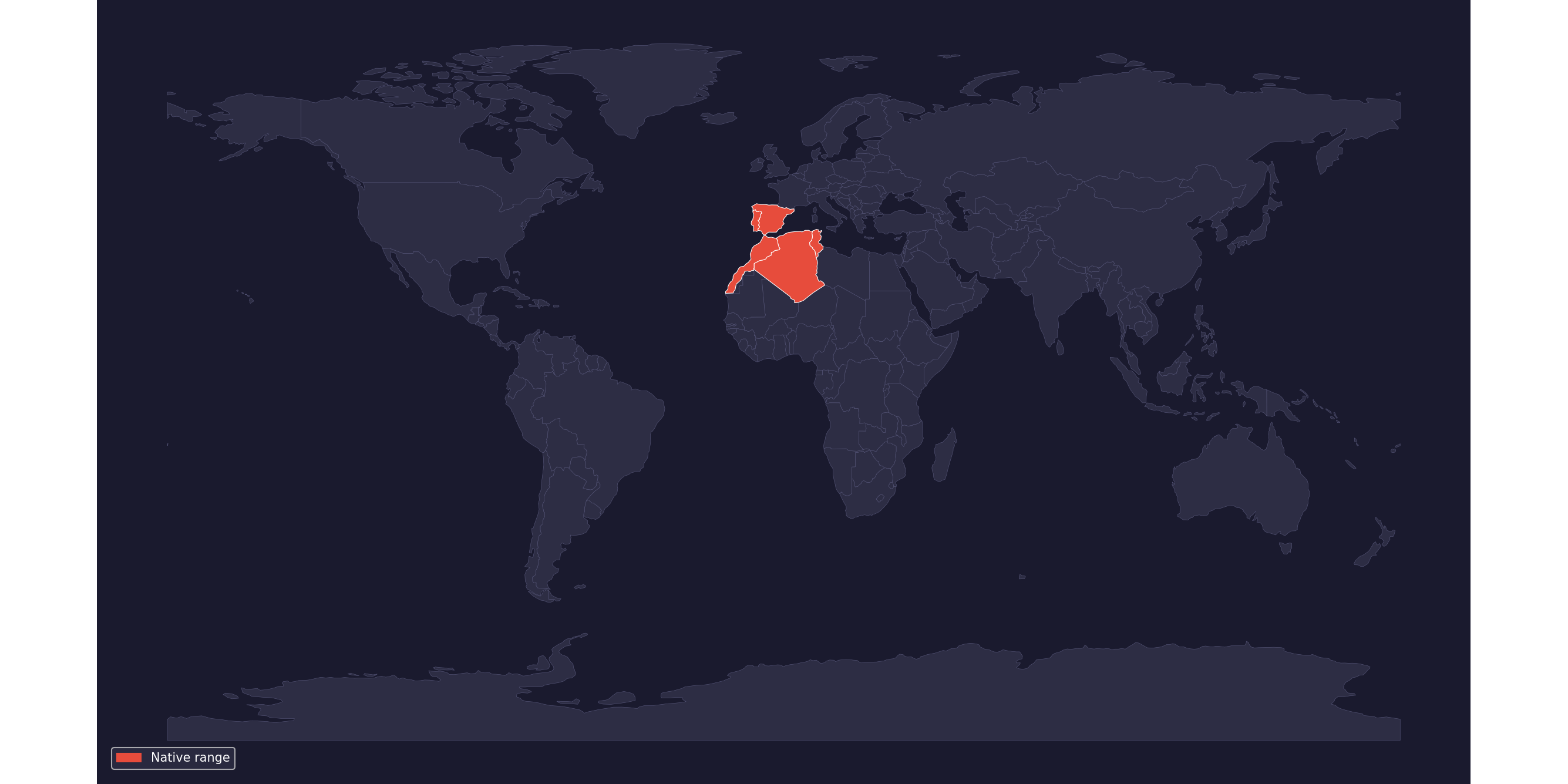
🌡 Climate across the native range
Monthly climate normals from reviewed GBIF occurrence locations:
Fuerteventura - Puerto del Rosario — Spain
| Month | Min °C | Mean °C | Max °C | RH % |
|---|---|---|---|---|
| January | 13.3 | 15.5 | 18 | 68 |
| February | 13.3 | 15.7 | 18.4 | 69 |
| March | 13.9 | 16.5 | 19.7 | 69 |
| April | 14.8 | 17.3 | 20.3 | 68 |
| May | 16 | 18.5 | 21.6 | 69 |
| June | 17.7 | 20.1 | 23.2 | 71 |
| July | 18.9 | 21.3 | 24.5 | 75 |
| August | 19.8 | 22.2 | 25.5 | 75 |
| September | 19.6 | 22 | 25 | 73 |
| October | 18.4 | 20.9 | 23.8 | 73 |
| November | 16.5 | 18.7 | 21.3 | 70 |
| December | 14.5 | 16.7 | 19.2 | 71 |
Oriental — Morocco
| Month | Min °C | Mean °C | Max °C | RH % |
|---|---|---|---|---|
| January | 8 | 11.9 | 16.5 | 75 |
| February | 8.6 | 12.6 | 16.8 | 76 |
| March | 10.2 | 14.2 | 18.5 | 76 |
| April | 12 | 16.1 | 20.1 | 73 |
| May | 14.8 | 18.8 | 22.7 | 72 |
| June | 18.1 | 22.2 | 26.1 | 70 |
| July | 20.9 | 25 | 29 | 69 |
| August | 21.9 | 25.6 | 29.7 | 72 |
| September | 19.7 | 23.1 | 27.1 | 75 |
| October | 16.4 | 20 | 24.1 | 77 |
| November | 12.1 | 15.8 | 20 | 74 |
| December | 9.2 | 13.1 | 17.4 | 76 |
Weather data by Open-Meteo.com · CC BY 4.0 · Monthly normals calculated by Herpeton Academy from daily archive values.
Location references use GBIF.org occurrence data where available; original occurrence records retain their source dataset licenses.
⚖️ Legal status
As checked against current official sources in April 2026, Atelerix algirus was not found in the CITES Appendices and no specific EU wildlife trade Annex listing was found for this species.
For the European part of its range, the Bern Convention is relevant: Atelerix algirus appears in Appendix II as strictly protected fauna. It is also named as Erinaceus algirus in Annex IV of the EU Habitats Directive. These conservation listings are separate from the EU wildlife-trade Annexes and can make capture from the wild, disturbance, possession, transport, or sale unlawful without specific authority.
This is therefore not a species to collect outdoors or buy on an undocumented advertisement. Before acquiring or moving one, obtain written advice from the relevant national or regional wildlife authority. Keep the invoice, breeder identity, parentage or captive-bred declaration, permits, transfer documents, and veterinary records. A found or injured native hedgehog should go to an authorized wildlife rehabilitator rather than into a private pet collection.
🌿 Habitat
The Algerian hedgehog uses Mediterranean scrub, grassland, agricultural mosaics, open forest, gardens, and semi-urban edges. Field studies show that it can exploit human-modified landscapes, but that does not make roads, pesticides, domestic animals, or fragmented cover harmless. During the day it shelters beneath vegetation, roots, stones, or other dense cover and emerges to forage after dusk.
For a legally held captive animal, the useful lessons are ground-level cover, several dark retreats, room to search for food, and a dry but not barren substrate. Outdoor climate values should not be copied directly into a cage. Wild animals can select protected nest sites and alter their activity seasonally; a confined hedgehog needs a stable, measured microclimate and must always be able to move away from a heat source.
🤌 Husbandry
Published husbandry information is much stronger for the commonly kept four-toed hedgehog than for A. algirus. The recommendations below are therefore conservative care for a legally held captive-bred or rehabilitation animal, informed by veterinary guidance for African hedgehogs and the species’ natural history. They are not evidence that A. algirus is a routine pet or that care parameters should be used to justify taking one from the wild.
The Algerian hedgehog is solitary. Routine cohabitation creates competition for food, hides, and wheel access and can end in injury; introductions belong only in a lawful, planned breeding or rehabilitation program with experienced supervision.
Before arrival, prepare the complete enclosure, thermostatic heat control, carrier, gram scale, and an exotics or wildlife veterinarian willing to treat the species. Quarantine a legally sourced new animal in a separate room for at least 30 days, using paper bedding and dedicated bowls and cleaning tools. Record weight, appetite, feces, urine, activity, skin, and respiration. An imported, wild-origin, or symptomatic animal needs veterinary examination and parasite assessment rather than preventive medication chosen at home.
Handle only when necessary until the animal is eating and following a normal nocturnal routine. Scoop from below with both hands or a small fleece, support the body close to a low surface, and never force the animal to unroll. For a rehabilitation case, minimizing human contact may be more appropriate than taming; follow the release plan set by the authorized rehabilitator.
🌿 Enclosure and decoration
The Algerian hedgehog needs floor area rather than height. Young or compromised animals may begin in a simple low-risk observation setup, but this must not become a small permanent cage. For an established adult, 100 x 50 cm is a practical minimum, with 120 x 60 cm or larger preferable. The enclosure must be escape-proof, well ventilated, and easy to service without repeatedly disturbing the sleeping hide.
The cage should be:
- A solid floor, never mesh
- Smooth, secure sides without toe-trapping gaps
- Good cross-ventilation without a cold draught
- A low layout without unguarded shelves or fall hazards
The interior equipment includes:
- At least two opaque hides in slightly different thermal positions
- A stable, solid-surface wheel roughly 28-30 cm in diameter
- Heavy, shallow food and water bowls
- 8-10 cm of dust-free paper or aspen substrate over a useful digging area
- Tunnels, paper bags without handles, and safe cover for exploration
Avoid wire wheels, narrow crossbars, cedar, scented litter, dusty sawdust, clumping cat litter, and fabric with loose loops. The wheel should let the adult run with a level back and should be cleaned whenever feces accumulate. It supplements rather than replaces floor area. Supervised roaming is useful only in a warm, escape-proof room without cables, gaps, reclining furniture, other pets, or pesticide residues.
Spot-clean wet bedding and remove fresh-food leftovers each morning. Inspect toes for hair or thread constriction, check that the wheel turns freely, and confirm the water source works. Full substrate changes should follow actual soiling rather than a rigid calendar, leaving a small amount of clean familiar nesting material when medically appropriate. Clean equipment away from food-preparation areas and wash hands after touching the animal or its enclosure because hedgehogs can carry zoonotic organisms without looking ill.
💡 Lighting
The Algerian hedgehog is nocturnal and does not require UVB lighting for routine indoor care. Provide a predictable photoperiod near 12 hours light and 12 hours dark with ordinary room daylight or a low-output timed light.
Keep the enclosure out of direct sun, which can overheat a tub or glass-fronted cage. Do not illuminate the active period with a bright white lamp. A dim room or camera allows observation without suppressing normal nocturnal behaviour.
🌡 Heating and temperature
For a non-releasable or captive-bred animal kept actively indoors, maintain a stable usable gradient around 22-27°C unless the attending veterinarian or licensed rehabilitation protocol sets a different seasonal plan. Measure both the warm sleeping area and cooler end with digital thermometers. Control every heater with a thermostat and secure its probe against displacement. A guarded ceramic emitter or radiant panel can warm part of the enclosure; avoid exposed hot elements and unregulated heat mats.
Wild A. algirus can reduce activity seasonally, but deliberate winter cooling is not a generic pet-care step. Do not cool a juvenile, thin, ill, newly arrived, or rehabilitation animal without a species-specific plan and veterinary oversight. Unusual daytime activity, failure to wake, cold limbs, weakness, or wobbling may indicate chilling or disease. Restore the normal safe range gradually and contact the veterinarian if behaviour does not normalize. Open-mouth breathing, drooling, or frantic escape behaviour in excessive heat is also urgent.
💧 Humidity and water
The Algerian hedgehog does not require a constantly damp enclosure. A moderate indoor range around 40-60% relative humidity is practical when ventilation is good and bedding remains dry. Persistent moisture promotes skin and respiratory problems, while very dry dusty bedding may worsen irritation. Adjust ventilation and substrate rather than misting the entire enclosure routinely.
Provide fresh water at all times in a stable shallow bowl; a checked bottle can be a backup or an alternative for an individual that uses it reliably. Replace water daily, scrub the container regularly, and keep it away from the main digging area. A sudden change in drinking or urination belongs in the health record and should be discussed with the veterinarian.
🪳 Feeding
The Algerian hedgehog is an omnivore with a strongly insectivorous natural diet. Field work in Algeria found insects dominating prey remains, but a bowl of mealworms is not nutritionally complete. For a legally held captive animal, use a complete commercial hedgehog or insectivore food as the measured staple. Where it is unavailable, choose an alternative only with an exotics veterinarian because cat foods vary greatly in fat, energy density, and mineral balance.
The basis of the diet includes:
- A measured portion of complete hedgehog or insectivore food in the evening
- An appropriate lower-fat adult cat food only when professionally selected as an alternative
Additionally, the following can be given:
- Varied gut-loaded crickets, roaches, and other safely cultured invertebrates
- Mealworms or waxworms only sparingly because they are energy-dense
Plant food:
- Small amounts of vegetables such as zucchini or cooked carrot
- Fruit rarely and in tiny portions because of sugar content
To be avoided:
- Fatty or sugary foods
- Seasoned food, milk, and routine dairy treats
- Wild-caught insects exposed to pesticides or parasites
- Raw meat or raw egg because of pathogen risk
Begin with the manufacturer’s portion and adjust from weekly weight, body condition, activity, life stage, and veterinary advice. Record food offered and leftovers. Scatter a small part of the dry ration through clean bedding to encourage foraging, and remove moist food in the morning. Change diets gradually. Do not stack calcium and vitamin powders onto a complete food automatically; supplementation depends on the staple and the proportion of invertebrates.
Obesity is common in captive African hedgehogs. A rising weight trend, fat rolls that obstruct the limbs, or difficulty curling requires review of portions, treats, and activity. Weight loss must be gradual and supervised because severe restriction can cause serious metabolic complications. Unplanned weight loss, even in an apparently active animal, is a medical warning rather than a successful diet.
🩺 Common problems
Common risks include obesity, dental disease, skin mites or fungal infection, nail overgrowth, respiratory disease, gastrointestinal parasites or infection, trauma, and tumours. Free-ranging or wild-origin individuals may carry parasite burdens that require diagnosis before treatment. Flaking or quill loss does not prove mites, and indiscriminate parasite products can be harmful.
Check the animal briefly each day and weigh weekly. Seek veterinary advice promptly for:
- Refusal to eat, a sustained weight change, or inability to curl normally
- Wheezing, nasal discharge, open-mouth breathing, or repeated sneezing
- Drooling, bad breath, dropping food, facial swelling, or oral bleeding
- Persistent scratching, crusting, sores, quill loss, or swollen feet
- Diarrhoea, black stool, blood, repeated straining, or abnormal urine
- Wobbling, dragging limbs, circling, seizures, collapse, or lasting lethargy
- Any growing lump, abdominal enlargement, injury, or reproductive discharge
While arranging care, record temperature, weight, diet, stool, and recent changes and place the animal in a quiet enclosure within its normal thermal range. Do not use leftover antibiotics, dog or cat parasite products, forced hibernation, or home dental procedures. A baseline examination soon after acquisition and at least annual preventive checks help establish what is normal; an older or previously ill hedgehog may need more frequent review.
📌 Conclusion
Atelerix algirus is first a protected wild species in parts of its range, not a substitute for the commonly captive-bred four-toed hedgehog. It is appropriate only where possession and origin are documented and the keeper can provide solitary nocturnal housing, stable heat, measured feeding, quarantine, records, and specialist veterinary care. Before acquisition, confirm the legal position in writing and prepare the adult enclosure, safe wheel, thermostat, gram scale, transport carrier, and veterinary contact. The most preventable failures are undocumented sourcing, intentional or accidental chilling, cramped exercise space, obesity, and delayed treatment.
📚 Sources and further reading
- Council of Europe: Bern Convention Appendix II
- EUR-Lex: Habitats Directive 92/43/EEC, Annex IV
- CITES Appendices and EU wildlife-trade legislation, checked April 2026
- Rym et al. 2022: Environmental and habitat preferences of the Algerian hedgehog
- Guerzou et al. 2019: Diet of Atelerix algirus in Algerian agricultural habitats
- MSD Veterinary Manual: Management of Hedgehogs
- MSD Veterinary Manual: Diseases of Hedgehogs
- CDC: Hedgehog zoonoses and hygiene
- GBIF species record for Atelerix algirus and occurrence data used for taxonomy and distribution context
💬 Feedback
For questions, corrections, or practical notes, leave us a message in the forum thread.