Share

Algerian Hedgehog
🔤 Taxonomy
Atelerix algirus is the currently accepted scientific name. In older literature and in parts of the pet trade, the species was often listed as Erinaceus algirus.
The latest renames that hobbyists most often encounter are:
- Erinaceus algirus -> Atelerix algirus (modern hedgehog taxonomy places the species in Atelerix)
Older names and combinations associated with the species include:
- Erinaceus algirus
English common names used in the hobby:
- Algerian hedgehog
- North African hedgehog
German common names used in the hobby:
- Algerischer Igel
📌 Description
The Algerian hedgehog (Atelerix algirus) is a small nocturnal mammal from the family Erinaceidae, a close relative of the decorative African hedgehogs that are kept as pets. Its body is covered with short, stiff spines that serve as its main defense. When threatened, the animal curls into a ball, exposing its spines outward.
Adult specimens reach a length of 15–25 cm and a weight of 300–600 g. The coloration varies from light brown to gray, and the underside is covered with soft light fur. The snout is relatively elongated, and the ears are larger compared to other hedgehog species.
The Algerian hedgehog is a nocturnally active species that spends the day hidden in shelters and comes out to forage for food after sunset.
🌍 Distribution
The species is distributed in North Africa, including Algeria, Morocco, and Tunisia. It is also found in parts of Southern Europe, such as Spain and Portugal, as well as on some Mediterranean islands.
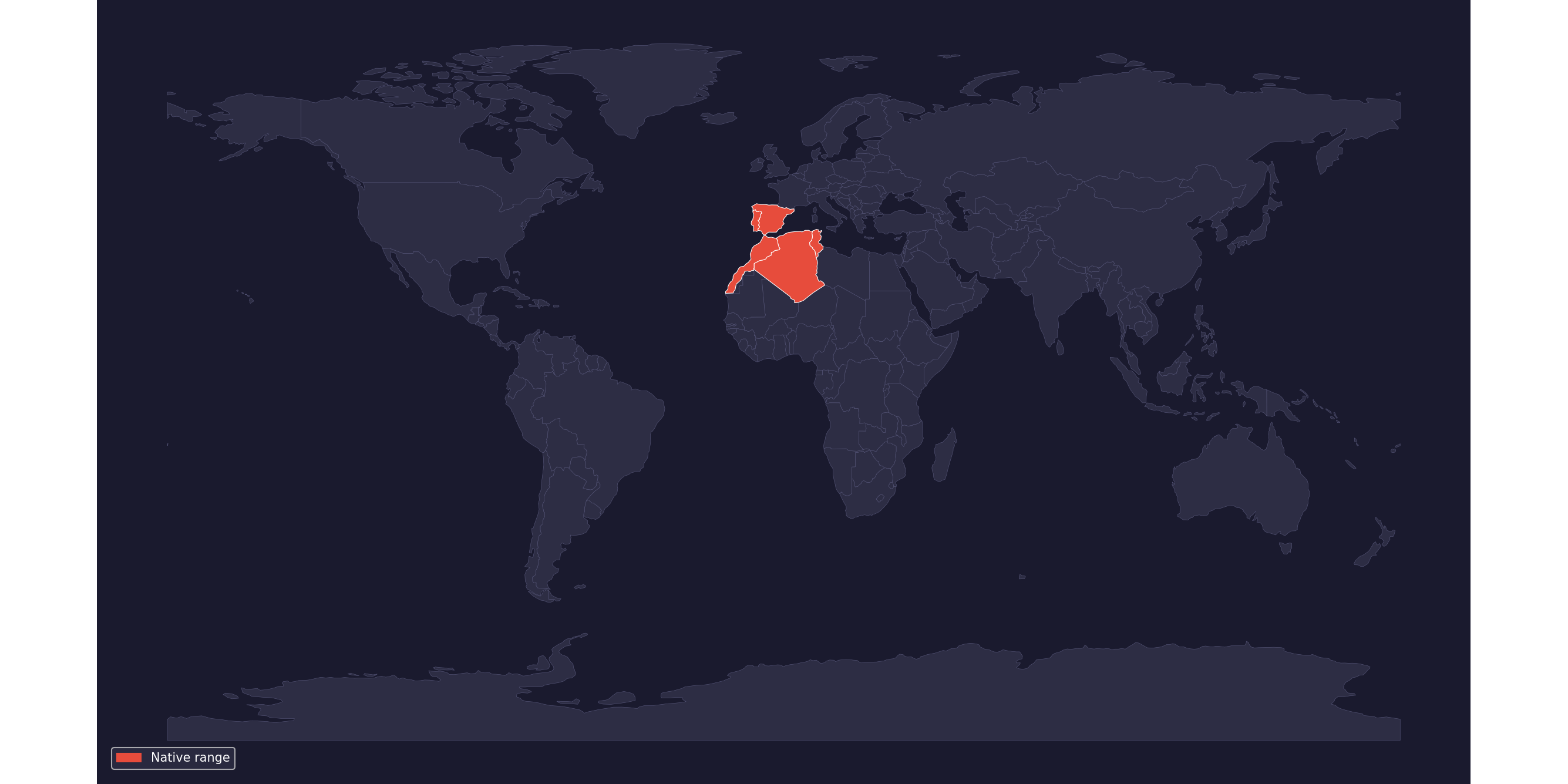
🌡 Climate across the native range
Monthly climate normals from reviewed GBIF occurrence locations:
Fuerteventura - Puerto del Rosario — Spain
| Month | Min °C | Mean °C | Max °C | RH % |
|---|---|---|---|---|
| January | 13.3 | 15.5 | 18 | 68 |
| February | 13.3 | 15.7 | 18.4 | 69 |
| March | 13.9 | 16.5 | 19.7 | 69 |
| April | 14.8 | 17.3 | 20.3 | 68 |
| May | 16 | 18.5 | 21.6 | 69 |
| June | 17.7 | 20.1 | 23.2 | 71 |
| July | 18.9 | 21.3 | 24.5 | 75 |
| August | 19.8 | 22.2 | 25.5 | 75 |
| September | 19.6 | 22 | 25 | 73 |
| October | 18.4 | 20.9 | 23.8 | 73 |
| November | 16.5 | 18.7 | 21.3 | 70 |
| December | 14.5 | 16.7 | 19.2 | 71 |
Oriental — Morocco
| Month | Min °C | Mean °C | Max °C | RH % |
|---|---|---|---|---|
| January | 8 | 11.9 | 16.5 | 75 |
| February | 8.6 | 12.6 | 16.8 | 76 |
| March | 10.2 | 14.2 | 18.5 | 76 |
| April | 12 | 16.1 | 20.1 | 73 |
| May | 14.8 | 18.8 | 22.7 | 72 |
| June | 18.1 | 22.2 | 26.1 | 70 |
| July | 20.9 | 25 | 29 | 69 |
| August | 21.9 | 25.6 | 29.7 | 72 |
| September | 19.7 | 23.1 | 27.1 | 75 |
| October | 16.4 | 20 | 24.1 | 77 |
| November | 12.1 | 15.8 | 20 | 74 |
| December | 9.2 | 13.1 | 17.4 | 76 |
Weather data by Open-Meteo.com · CC BY 4.0 · Monthly normals calculated by Herpeton Academy from daily archive values.
Location references use GBIF.org occurrence data where available; original occurrence records retain their source dataset licenses.
🌿 Habitat
The Algerian hedgehog inhabits dry and semi-dry areas, including:
Shrublands
Grasslands
Agricultural areas
Sparse forest patches
It prefers places with shelters such as stones, roots, and dense vegetation, where it hides during the day.
The climate in its natural range is characterized by warm days, cooler nights, and relatively low humidity. The species is not adapted to a constantly wet environment.
⚖️ Legal status
As checked against current official sources in April 2026, Atelerix algirus was not found in the CITES Appendices and no specific EU wildlife trade Annex listing was found for this species.
For the European part of its range, the Bern Convention is relevant: Atelerix algirus appears in Appendix II. National rules on capture, keeping, transport, sale, rehabilitation, and proof of legal origin may therefore be stricter than hobby keepers expect, especially where the species is native.
🤌 Husbandry
The Algerian hedgehog can be successfully kept in a home environment if suitable parameters are provided. It is a solitary and territorial species that should not be kept in pairs.
The animal is active at night and spends a large part of its time moving, which requires sufficient space and opportunities for physical activity.
🌿 Enclosure and decoration
The Algerian hedgehog needs floor area rather than height. Young animals can start in a simple, low-risk layout around 80 x 50 cm, but avoid a huge sparse pen where food, water, and heat are hard to find. For an established adult, 100 x 50 cm is a better practical minimum, with 120 x 60 cm or larger preferable when space allows.
The cage should be:
- With a solid floor (not mesh)
- Well-ventilated
- Easy to clean
The interior equipment includes:
Hiding place (house)
Running wheel (mandatory)
Bowls for food and water
Suitable substrate (paper or wood, dust-free)
The wheel is a key element, as the species expends a large amount of energy at night.
💡 Lighting
The Algerian hedgehog is a nocturnal species and does not require UVB lighting.
Natural daylight in the room is sufficient. It is important to maintain a stable day-night cycle without strong lighting at night.
🌡 Heating and temperature
The optimal temperature for keeping is:
22–26°C
Temperatures below 20°C can induce a state similar to hibernation, which is dangerous in a home environment.
If necessary, the following can be used:
- Heating pad (under part of the cage)
- Ceramic heater
Heating should allow for a cooler area.
💧 Humidity and water
The Algerian hedgehog does not require high humidity. The suitable range is 40–60%.
Excessive humidity can lead to skin problems and the development of pathogens. The environment should be dry and well-maintained.
🪳 Feeding
The Algerian hedgehog is an omnivorous species with a predominantly insectivorous diet.
The basis of the diet includes:
- High-quality cat food (rich in protein)
- Specialized foods for hedgehogs
Additionally, the following can be given:
Crickets, mealworms, waxworms (in moderation)
Plant food:
Small amounts of vegetables (zucchini, carrots)
Fruits – rarely, due to sugar content
To be avoided:
Fatty foods
Sweet products
Milk and dairy products
Fresh water should be available at all times.
🩺 Common problems
Common captive problems include obesity, chronic low temperature, dirty housing, skin irritation, nail overgrowth, diarrhea, and reduced activity. Wheezing, repeated sneezing, weight loss, poor appetite, crusting around the face, and persistent scratching should not be ignored.
If problems appear, first check temperature, hygiene, wheel safety, diet balance, and stool quality. Respiratory signs, significant weight loss, injury, or lasting lethargy require an exotics veterinarian.
📌 Conclusion
The Algerian hedgehog is an interesting and relatively easy-to-keep exotic species, suitable for people looking for a nocturnal pet. The main factors for its successful care are appropriate temperature, a dry and clean environment, enough space to move, and a balanced diet.
With good care, it can live 4–6 years and remain active and healthy throughout its life.