Share

Cairo Spiny Mouse
🔤 Taxonomy
Acomys cahirinus is the accepted scientific name for the Cairo spiny mouse covered here. GBIF also lists the original combination Mus cahirinus and several synonym names, so invoices and import documents should be checked against the accepted binomial.
English common names used in the hobby:
- Cairo spiny mouse
- Northeast African spiny mouse
- Egyptian spiny mouse
German common names used in the hobby:
- Ägyptische Stachelmaus
📌 Description
Acomys cahirinus is a social desert rodent with fragile skin, strong escape ability, and a diet that must stay lean and varied. Adult size is about 18-23 cm including tail where relevant, with typical adult weight around 30-50 g. A realistic lifespan is 2-5 years when heat, hygiene, diet, and group management are stable.
These animals are poor choices for children or keepers who expect routine handling. The main failure points are escape, stress from bare housing, wrong social grouping, overheating or chilling, and food that is too rich for a small active rodent.
🌍 Distribution
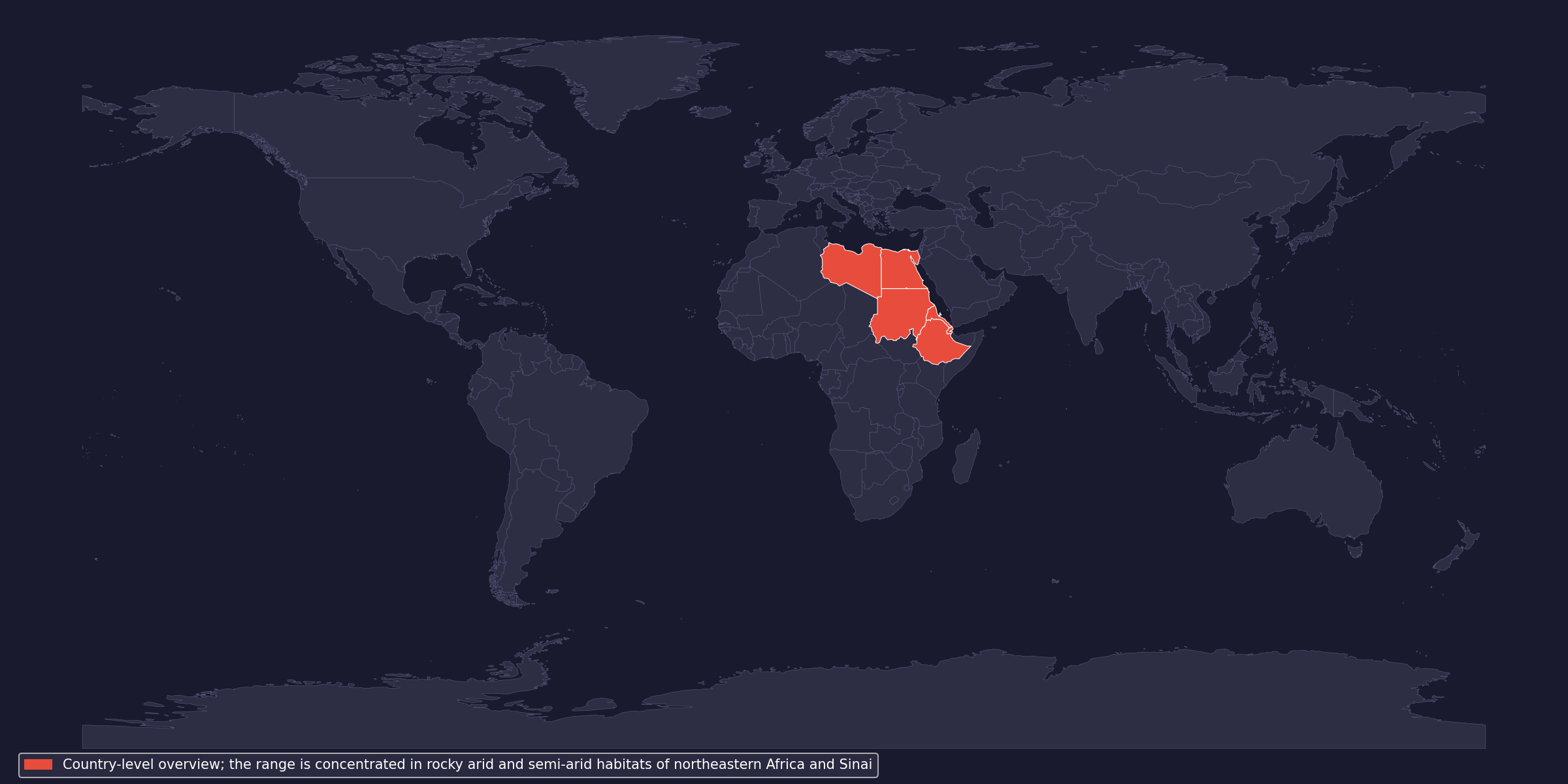
Northeastern Africa, especially Egypt, Libya, Sudan, Eritrea, Ethiopia, Djibouti, and Sinai; rocky deserts, wadis, cliffs, palms, buildings, and semi-arid scrub. Country shading on the map is a broad range guide, not proof that the species occurs in every habitat inside each country. In captivity, use the distribution to provide cover, measured temperature choices, dry hygienic retreats, and secure ventilation rather than trying to copy outdoor weather.
⚖️ Legal status
Checked 2026-09-02: Acomys cahirinus was not found in the current CITES Appendices, the current EU wildlife-trade Annexes A-D, or the Bern Convention protected-fauna appendices. This does not make trade or ownership automatically unrestricted; local and national rules may still apply. All three animals in this batch are African rodents for US import purposes: CDC states that African rodents, including rodents whose native habitat is in Africa even when born elsewhere, may not be imported into the United States except with written CDC permission for scientific, exhibition, or educational purposes. Keep invoices, breeder/importer details, transfer documents, health records, and never release animals or bedding outdoors.
🌿 Habitat
The useful habitat cues are cover, small routes, nest security, dry resting places, and rapid access to hiding. Provide a complex enclosure before the animal arrives; adding enrichment only after stereotyped pacing, hiding, or fighting begins is late husbandry.
🤌 Husbandry
Use a secure glass tank or smooth-sided vivarium with a locking mesh lid. Spiny mice climb, squeeze, and chew better than their size suggests, so ordinary mouse bars are often unsafe. Keep stable same-sex groups or breeding groups only with a plan for offspring; overcrowding increases fighting and tail chewing.
Quarantine new arrivals in a simpler escape-proof enclosure for at least 30-60 days, with separate tools, weight records, fecal checks when origin is unclear, and no contact with established mammals. Imported or recently traded rodents deserve extra caution because parasites, bite wounds, pregnancy, and stress-related illness are common hidden problems.
💡 Lighting
UVB is not required for normal care. Provide a stable 10-12 hour light period, shade inside the enclosure, and real darkness at night. Avoid visible night lamps. Keep fixtures and cables outside chewing reach, and never place a glass enclosure in direct sun.
🌡 Heating and temperature
Use an ambient range of 21-26 °C, a limited warm area around 26-28 °C if extra heat is needed, cooler retreats around 21-23 °C, and nights around 20-24 °C. Measure with digital probes; do not guess from room comfort.
Any heat source must be controlled and protected from chewing. Avoid heat rocks, unguarded bulbs, and sealed hot boxes. If animals pant, stretch out, hide continuously, fight more, or refuse food, check temperatures before changing the diet or group.
💧 Humidity and water
Target 30-50% relative humidity with good ventilation. The enclosure should be dry enough to prevent mold but not so dusty that eyes, nose, and feet become irritated. Provide fresh water at all times in a checked bottle, shallow heavy dish, or both.
Remove wet bedding quickly. For very small rodents, a blocked bottle or tipped dish can become dangerous within a day, so water checks are not optional.
🌿 Enclosure and decoration
Handle only when necessary and never by the tail or loose skin. Peer-reviewed husbandry work notes that Acomys have weak skin and tail-sheath loss, so transfer with a cup, tube, or small box rather than grabbing. Provide rock piles fixed against collapse, cork, hides, sand-bath areas, dry bedding, and several food points.
Substrate should be dust-free, absorbent, and deep enough for digging or nest building, usually 8 cm or more where the enclosure allows it. Avoid cedar, strong aromatic shavings, fluffy nesting fiber, fraying fabric, sticky tape inside the enclosure, unstable rocks, and any mesh or wheel that can trap feet or tails.
🪳 Feeding
A lean omnivore diet works best: quality mouse or small-rodent pellets, small seeds, dried grasses or herbs, and measured insects. Avoid sugary fruit-heavy feeding, fatty seed bowls, and constant treats. Laboratory colony reports give useful targets of 21-26 °C and ordinary rodent-room humidity, but pet housing still needs cooler retreats and ventilation.
Food size matters: insects and hard items should be small enough to carry and chew safely. Offer multiple feeding points in groups so subordinate animals can eat. Sudden weight loss, wet chin, overgrown incisors, diarrhea, and persistent food guarding all need prompt review.
🩺 Common problems
Common problems include escape injuries, tail wounds, bite abscesses, respiratory irritation from dusty or damp bedding, obesity, dental overgrowth, parasites in poorly documented stock, heat stress, dehydration, and social stress. Warning signs are repeated food refusal, weight loss, hunched posture, labored breathing, wet nose, swollen eyes, poor coat, wounds, limping, diarrhea, or an animal excluded from nests and food.
First check measured heat, water, food access, locks, ventilation, bedding condition, and group dynamics. Serious weakness, breathing signs, wounds, swelling, pregnancy trouble, neurological signs, or rapid decline need an exotic-animal veterinarian.
📌 Conclusion
Acomys cahirinus suits keepers who want a small, active display mammal and can maintain escape-proof housing, measured climate, daily feeding, careful records, and legal paperwork. Do not buy before the enclosure, quarantine setup, and local import/ownership checks are ready.
📚 Sources and further reading
Sources checked for taxonomy, husbandry, legal status, and import risk:
- www.gbif.org/species/9800308
- pmc.ncbi.nlm.nih.gov/articles/PMC4747004/
- animaldiversity.org/accounts/Acomys_cahirinus/
- www.cdc.gov/importation/bringing-an-animal-into-the-us/index.html
- www.law.cornell.edu/cfr/text/42/71.56
- cites.org/eng/app/appendices.php
- eur-lex.europa.eu/eli/reg/2026/1383/oj/eng
- www.coe.int/en/web/bern-convention/appendices