Share

Red-eyed Crocodile Skink
🔤 Taxonomy
Tribolonotus gracilis de Rooij, 1909 is the accepted scientific name. No subspecies are currently recognized. It has sometimes been confused with the white-eyed crocodile skink, T. novaeguineae, but modern references retain them as separate species.
Common names used in the hobby:
- Red-eyed crocodile skink
- Red-eyed bush crocodile skink
- New Guinea crocodile skink
German common names:
- Rotaugen-Buschkrokodil
- Orangeaugen-Helmskink
📌 Description
The red-eyed crocodile skink is a secretive, semi-fossorial forest-floor lizard. The orange ring around each eye, broad head, keeled scales, and four rows of backward-pointing dorsal spines give it a distinctive appearance. Adults are usually about 16-20 cm in total length; published zoo specimens were approximately 18.4-19.5 cm.
This is primarily a display species. When frightened it may freeze, flee under cover, vocalize, open its mouth defensively, or become limp. These responses are not invitations to handle it. Reliable species-specific longevity data are limited; the often-repeated figure is up to about ten years, so acquisition should still be treated as a long-term commitment.
| Quick reference | Target |
|---|---|
| Adult size | about 16-20 cm total length |
| Enclosure for one adult | at least 60 x 45 x 45 cm |
| Ambient temperature | 22-26°C |
| Warm hide surface | 27-28°C |
| Night temperature | 20-23°C |
| Humidity | 70-85% by day, with higher nocturnal peaks and airflow |
| Light | 10-12 hour cycle; low-level UVB recommended |
| Food | varied, gut-loaded live invertebrates |
🌍 Distribution
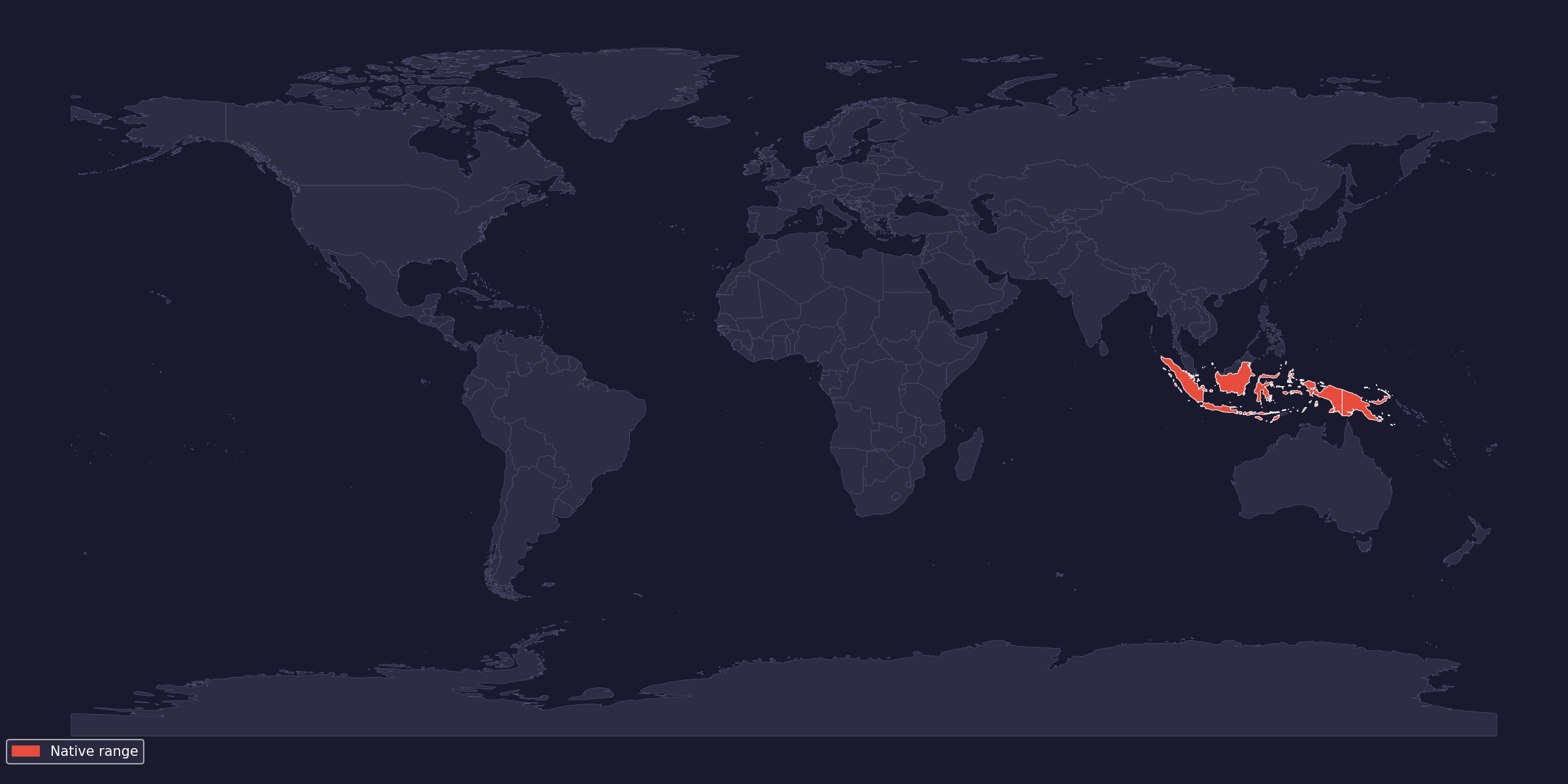
The species occurs on New Guinea, in both Indonesian New Guinea and Papua New Guinea, mainly in humid northern lowlands and on several nearby islands. Some older locality records are uncertain because T. gracilis and T. novaeguineae have been confused; the often-cited Manus record is considered doubtful.
It lives beneath leaf litter, fallen vegetation, bark, and coconut husks, typically close to water. The map shows countries, not the much smaller suitable forest-floor habitat within them, and therefore overstates the actual occupied area.
⚖️ Legal status
Checked on 2026-08-14: Tribolonotus gracilis was not found in the current CITES Appendices. It is, however, listed in Annex D of the current EU wildlife-trade regulation. Annex D is an EU trade-monitoring category, not a CITES Appendix; introduction into the EU requires the applicable import notification and border formalities. The Bern Convention is not relevant to this New Guinean species.
Annex D does not by itself impose the Annex A or B ownership-certificate system on an animal already lawfully inside the EU, but national rules and evidence-of-origin requirements can still apply. Much of the recorded trade has involved wild-sourced animals from Indonesia. Prefer a correctly identified captive-bred animal and retain the invoice, breeder or importer details, import paperwork where applicable, and transfer history. Check current national rules before purchase, breeding, sale, transport, or cross-border movement.
🤌 Husbandry
For one adult, use at least 60 x 45 x 45 cm. The larger footprint improves the temperature and moisture gradient and allows several tight retreats. House pets singly by default. Pairs have bred successfully and field reports describe small groups, but that does not prove that unrelated adults tolerate permanent confinement. Attempt pair housing only for a planned breeding project, with confirmed sexes, close monitoring, and a complete spare enclosure.
Prepare the enclosure and confirm its readings before the animal arrives. New animals, especially imports, need quarantine away from the collection with separate tools. Record weight, feeding, feces, shedding, and activity; arrange a reptile-veterinary examination and fecal testing when origin is uncertain or health is poor.
💡 Lighting
Provide a consistent 10-12 hour light-dark cycle, moderate visible light for plants, and deep shaded cover. Do not use red, blue, or other night lamps. Darkness is part of the normal cycle.
Species-specific UV requirements have not been experimentally established. Low-level UVB is recommended as a voluntary resource rather than forced exposure. A Ferguson Zone 1 gradient, roughly UVI 0.5-1.0 at the most exposed usable surface and near zero inside hides, is a conservative target. Measure through the installed mesh, follow the lamp maker’s distance guidance, and preserve shade. If no UVB is provided, dietary vitamin D3 becomes more important and should be planned with a reptile veterinarian rather than guessed.
🌡 Heating and temperature
- ambient air: 22-26°C
- warm hide surface: 27-28°C
- cool retreat: 21-24°C
- night: 20-23°C
Create gentle warmth at one end with a thermostated overhead source only when room temperatures require it. Measure the inside of the warm hide and the air at animal level with independent probes; use an infrared thermometer for accessible surfaces. Avoid heat rocks and heat mats beneath deep wet substrate. Sustained temperatures around 30°C or higher leave too little safety margin for a cool, cover-using species.
Routine seasonal cooling is not required. A modest natural night drop is useful, but a cold import should be warmed gradually within the normal range and examined rather than overheated in an attempt to stimulate it.
💧 Humidity and water
Use 70-85% relative humidity by day as a starting range, with sheltered areas reaching about 85-95% after evening misting. The leaf-litter surface may start to dry between cycles while lower substrate and selected hides remain lightly moist. Measure humidity with digital probes and adjust from the animal’s hydration, sheds, ventilation, and substrate condition.
High humidity is not the same as waterlogging. Provide cross-ventilation, drainage, and a broad shallow water dish that is easy to enter and leave. Replace drinking water daily and disinfect the dish regularly. A deep pool or paludarium is not required and adds drowning and hygiene risks. Remove feces and dead feeders promptly; stagnant wet enclosures favor skin and bacterial problems.
🌿 Enclosure and decoration
Build a stable, cluttered forest floor:
- 8-10 cm of drainage-capable tropical soil or soil-coconut mix beneath generous leaf litter
- several body-tight cork, bark, and root retreats at different moisture levels
- low plants and visual barriers that allow movement without exposure
- stable low branches and cork for optional climbing
- a humid egg-laying retreat for mature females
- secure door, lid, vent, and cable gaps
Support heavy bark and stones so digging cannot bring them down. Avoid aromatic cedar or pine, fertilizer, pesticides, sharp gravel, calcium sand, and permanently saturated sphagnum across the whole floor. During quarantine, paper towel simplifies observation, but opaque tight hides remain essential.
🪳 Feeding
Offer adults a varied meal of appropriately sized live invertebrates every 2-3 days. Juveniles can receive small meals daily or every other day. Useful foods include crickets, small roaches, black soldier fly larvae, silkworms, cultured earthworms, small snails from a safe source, and occasional mealworms. Rotate feeders rather than relying on one staple.
Gut-load feeders for 24-48 hours and remove uneaten prey before it hides or bites the skink. As a starting cadence, lightly dust most juvenile meals and about every second or third adult meal with plain calcium. Use a multivitamin and calcium with D3 less often according to the product strength, feeder variety, and measured UVB access. Overlapping fortified products can overdose fat-soluble vitamins.
🥚 Breeding notes
Females lay one egg at a time. In the Dallas Zoo observations, eggs were deposited in sphagnum beneath cork and hatched after approximately 60 days. The female curled around the egg, lunged and sometimes vocalized when it was disturbed, and apparently reburied exposed eggs. Hatchlings remained close to their mother during the two weeks observed after hatching. This unusual parental care is a reason not to uncover, rotate, or automatically remove a sound egg.
Captive reports commonly use about 24-26°C and 60-80 days as an incubation range, but controlled comparative data are sparse. If an egg must be moved, preserve its orientation and use a separate, monitored incubator. Repeated single-egg production can deplete a female; monitor weight and calcium intake, and seek veterinary help for persistent digging, straining, weakness, swelling, or suspected egg retention.
🩺 Common problems
The main preventable problems are dehydration, retained shed, overheating, nutritional secondary hyperparathyroidism, wounds from live prey or unstable décor, parasites in recent imports, and skin or respiratory disease in dirty, stagnant housing. A published case report documented fatal Aeromonas hydrophila infection in a shipment of ten stressed wild-caught skinks; it supports strict quarantine, clean water, temperature control, and early veterinary care, not routine preventive antibiotics.
Weigh a hidden animal regularly because visibility is a poor health measure. Persistent food refusal with weight loss, sunken eyes, abnormal feces, skin ulcers, swelling, tremors, weakness, noisy or open-mouth breathing, or prolonged failure to shed requires a reptile-experienced veterinarian. A constantly visible or unusually unresponsive skink may be stressed or ill rather than tame.
📌 Conclusion
Tribolonotus gracilis suits an observant keeper who can maintain a cool, humid but well-ventilated forest floor and accept that the animal may rarely appear. Secure captive-bred stock, prepare quarantine and live food before purchase, and make cover, clean water, stable measurements, and minimal disturbance the priorities.
📚 Sources and further reading
- ReptiFiles: Red-eyed Crocodile Skink care sheet
- The Reptile Database: Tribolonotus gracilis
- Mys 1988: Zoogeography of scincid lizards from North Papua New Guinea
- Austin et al. 2010: Phylogeny and biogeography of Tribolonotus
- Hartdegen et al. 2001: Vocalization and evidence of parental care
- Kwon et al. 2020: Aeromonas hydrophila mortality in wild-caught red-eyed crocodile skinks
- Janssen and Shepherd 2018: Trade in non-CITES-listed crocodile skinks
- Baines et al. 2016: UVB provision for captive reptiles
- Merck Veterinary Manual: Routine health care of reptiles
- Merck Veterinary Manual: Disorders and diseases of reptiles
- CITES Appendices, checked 2026-08-14
- Commission Regulation (EU) 2026/1383, checked 2026-08-14
- European Commission: EU wildlife-trade rules, checked 2026-08-14
- Bern Convention Appendices, checked 2026-08-14