Share

Shingleback Skink
🔤 Taxonomy
Tiliqua rugosa is the accepted scientific name for this species.
Common names used in the hobby:
- Shingleback skink
- Bobtail skink
📌 Description
Shingleback skinks are heavy, slow Australian blue-tongued skinks with strong jaws and a very long lifespan. They need dry-temperate housing, a broad basking zone, sturdy hides, controlled feeding, and minimal stress; they are not a casual beginner choice.
Adults usually reach 35-45 cm and may live 20-40 years with stable long-term care.
🌍 Distribution
Shingleback skinks occur in southern and western Australia, using dry scrub, open woodland, grassland, and semi-arid edges. Their range includes cooler seasonal conditions than tropical blue-tongues, so the enclosure should be dry, bright, and ventilated rather than humid.
In captivity, prioritize a dry ventilated setup, strong basking heat, cooler retreats, sturdy hides, shallow water, and a slow-feeding omnivorous diet.
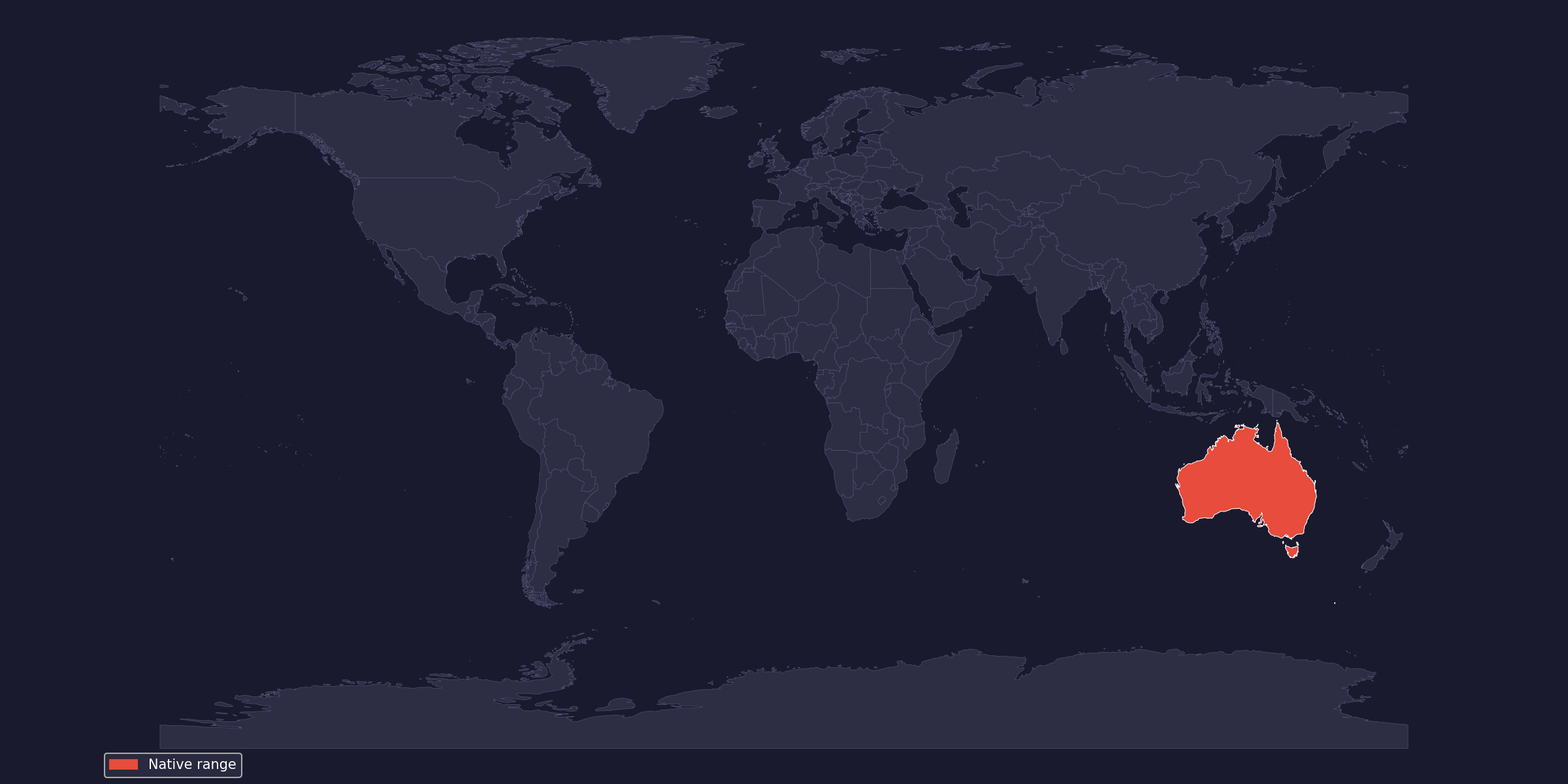
🌡 Climate across the native range
Monthly climate normals from reviewed GBIF occurrence locations:
South Australia — Australia
| Month | Min °C | Mean °C | Max °C | RH % |
|---|---|---|---|---|
| January | 15.3 | 22.2 | 29.1 | 52 |
| February | 15.6 | 22.7 | 29.7 | 52 |
| March | 13.8 | 20.4 | 26.9 | 55 |
| April | 11 | 17.1 | 23.2 | 61 |
| May | 9 | 14.2 | 19.5 | 69 |
| June | 7.1 | 11.7 | 16.2 | 77 |
| July | 6.3 | 10.9 | 15.4 | 75 |
| August | 6.8 | 11.7 | 16.6 | 70 |
| September | 8 | 13.6 | 19.1 | 66 |
| October | 9.5 | 16 | 22.4 | 58 |
| November | 12 | 18.6 | 25.1 | 54 |
| December | 14 | 20.7 | 27.5 | 52 |
Victoria — Australia
| Month | Min °C | Mean °C | Max °C | RH % |
|---|---|---|---|---|
| January | 13.3 | 20.7 | 28.2 | 48 |
| February | 13.6 | 21.1 | 28.6 | 49 |
| March | 11.7 | 18.5 | 25.4 | 53 |
| April | 8.4 | 14.6 | 20.7 | 60 |
| May | 6.4 | 11.5 | 16.6 | 71 |
| June | 4.1 | 8.6 | 13.1 | 81 |
| July | 3.2 | 7.8 | 12.3 | 80 |
| August | 4.1 | 9 | 13.8 | 73 |
| September | 5.7 | 10.9 | 16.2 | 69 |
| October | 7.4 | 13.6 | 19.8 | 60 |
| November | 9.6 | 16.4 | 23.1 | 55 |
| December | 11.6 | 19 | 26.3 | 48 |
Western Australia — Australia
| Month | Min °C | Mean °C | Max °C | RH % |
|---|---|---|---|---|
| January | 16 | 23.1 | 30.2 | 48 |
| February | 16.6 | 23.5 | 30.4 | 48 |
| March | 15.5 | 21.8 | 28.1 | 50 |
| April | 12.9 | 18.4 | 23.9 | 59 |
| May | 10 | 15.1 | 20.2 | 67 |
| June | 8.3 | 12.7 | 17.2 | 71 |
| July | 7.4 | 11.8 | 16.1 | 73 |
| August | 7.2 | 11.9 | 16.5 | 73 |
| September | 8.1 | 13.2 | 18.3 | 69 |
| October | 9.4 | 14.9 | 20.5 | 64 |
| November | 11.8 | 17.8 | 23.9 | 57 |
| December | 14 | 20.9 | 27.7 | 50 |
Weather data by WorldClim v2.1 · Monthly normals queried by Herpeton Academy from raster values; relative humidity is derived from vapor pressure and mean temperature.
Location references use GBIF.org occurrence data where available; original occurrence records retain their source dataset licenses.
⚖️ Legal status
Checked on 2026-06-11: no listing was found for this species in the CITES Appendices, EU wildlife trade Annexes, or Bern Convention appendices. Because shinglebacks are Australian native wildlife and are uncommon in legal trade outside Australia, keep strong proof of legal captive origin and check local ownership, import, sale, breeding, and transport rules before moving animals.
🤌 Husbandry
Plan the adult enclosure before purchase. The minimum adult setup used here is 150 x 75 x 60 cm, with about 1.125 m² of floor area. These skinks are slow but bulky, and cramped enclosures make thermoregulation, turning, shedding, and weight control harder.
Use a sturdy horizontal enclosure with dry substrate, broad hides, and a basking area that does not overheat the entire cage. These skinks are powerful pushers, so doors and edges must close securely.
💡 Lighting
Use bright visible light and species-appropriate UVB. Measure lamp output when possible, because reflector, mesh, distance, and lamp age change real exposure, and provide shaded retreats for self-regulation.
Plan lighting around Ferguson Zone 2 and a 10-12 hour photoperiod. During any planned seasonal cooling, shorten light and feeding gradually only for healthy, established adults.
🌡 Heating and temperature
- ambient or water: 24-30°C
- basking surface: 34-38°C
- cool retreat: 20-24°C
- night: 16-22°C
Use thermostats and independent thermometers. A good setup lets the animal choose, rather than trapping it at one average temperature.
💧 Humidity and water
Target humidity is 30-50%, with temporary shed support around 45-60%. Provide humidity as cycles and retreats rather than making the entire enclosure constantly wet; keep bowls, hides, and substrate clean.
Provide a shallow, heavy water bowl. Drinking water should be available, but soaking tubs and wet substrate should not replace a dry, well-ventilated setup.
🌿 Enclosure and decoration
Use 8-12 cm of firm, dry, reptile-safe substrate that permits traction and limited digging. A soil/sand/clay style mix, dry cypress-based blend, or other structured arid substrate can work if it does not become dusty; use paper during quarantine or medical monitoring.
Provide broad hides, flat stones or rough cork for shed assistance, and a basking surface wide enough to warm the body evenly. Avoid cedar, pine, scented bedding, slick floors, and tall décor that encourages falls.
🥗 Feeding
Feed for steady body condition rather than maximum appetite. Most adults should be fed every 3-7 days depending on season, body condition, and activity; juveniles can be fed more often in smaller portions.
Use a slower omnivorous rotation: leafy greens, safe vegetables, snails or insects where appropriate, small amounts of egg or lean protein, occasional fruit, and quality prepared diets as part of the mix. Shinglebacks gain weight easily, so weigh adults and reduce rich protein or fruit before obesity becomes established.
Use calcium and a reptile multivitamin according to UVB access, diet quality, age, reproductive status, and product directions. Live food can be useful enrichment, but it is not a requirement for a stable adult diet.
🥚 Breeding notes
Reproduction is viviparous. Litters are usually 1-4 young; breeding difficulty is moderate. Breeding should wait until legal status, unrelated stock, adult body condition, and placement for offspring are clear.
🧍 Handling and safety
Handle only when necessary, with the whole body supported and the head guided without squeezing. Blue-tongued skinks have strong jaws and a strong feeding response, so keep fingers away from the mouth and do not let children handle them unsupervised. Secure doors, vents, and enclosure edges.
🩺 Common problems
Quarantine new animals, record weight, and watch for appetite loss, abnormal posture, retained shed, skin lesions, mouth injury, respiratory signs, swelling, diarrhea, and sustained hiding. Husbandry correction is often as important as medication.
Most chronic problems trace back to enclosure size, incorrect heat, weak UVB, obesity, poor substrate hygiene, rough handling, or repeated stress. Do not brumate juveniles, thin animals, sick animals, or new arrivals; seasonal cooling is only for stable adults with measured temperatures.
✅ Conclusion
Shingleback skinks suit patient keepers who want a long-lived, heavy terrestrial lizard and can verify legal origin. The main husbandry risks are overfeeding, damp stagnant housing, and underestimating the space needed by a slow but powerful animal.
📚 Sources and further reading
- ReptiFiles, Blue Tongue Skink Care Guide: https://reptifiles.com/blue-tongue-skink-care/
- Baines et al. 2016, UV-Tool: https://jzar.org/jzar/article/view/150
- GBIF Backbone Taxonomy, Tiliqua rugosa: https://www.gbif.org/species/2462522
- The Reptile Database, Tiliqua rugosa: https://reptile-database.reptarium.cz/species?genus=Tiliqua&species=rugosa
- CITES Appendices: https://cites.org/eng/app/appendices.php
- European Commission wildlife trade overview: https://environment.ec.europa.eu/topics/nature-and-biodiversity/wildlife-trade_en
- Bern Convention appendices: https://www.coe.int/en/web/bern-convention/appendices