Share

Indonesian Blue-tongued Skink
🔤 Taxonomy
Tiliqua gigas is the accepted scientific name for this species.
Common names used in the hobby:
- Indonesian blue-tongued skink
📌 Description
Indonesian blue-tongued skinks are large humid-tropical omnivores. They need a secure horizontal enclosure, higher humidity than Australian blue-tongues, deep substrate, broad hides, measured heat and UVB, and a varied diet; confusing them with drier Australian forms is a common care failure.
Adults usually reach 45-65 cm and may live 15-25 years with stable long-term care.
🌍 Distribution
The species complex is associated with Indonesia and nearby New Guinea-region humid forests, forest edges, plantations, and disturbed tropical habitats. Locality and subspecies labels in trade can be unreliable, so manage the animal in front of you while keeping the general humid-tropical requirement.
In captivity, prioritize a secure horizontal enclosure, higher humidity, dry and humid retreat choices, deep substrate, measured heat and UVB, and a varied omnivorous diet.
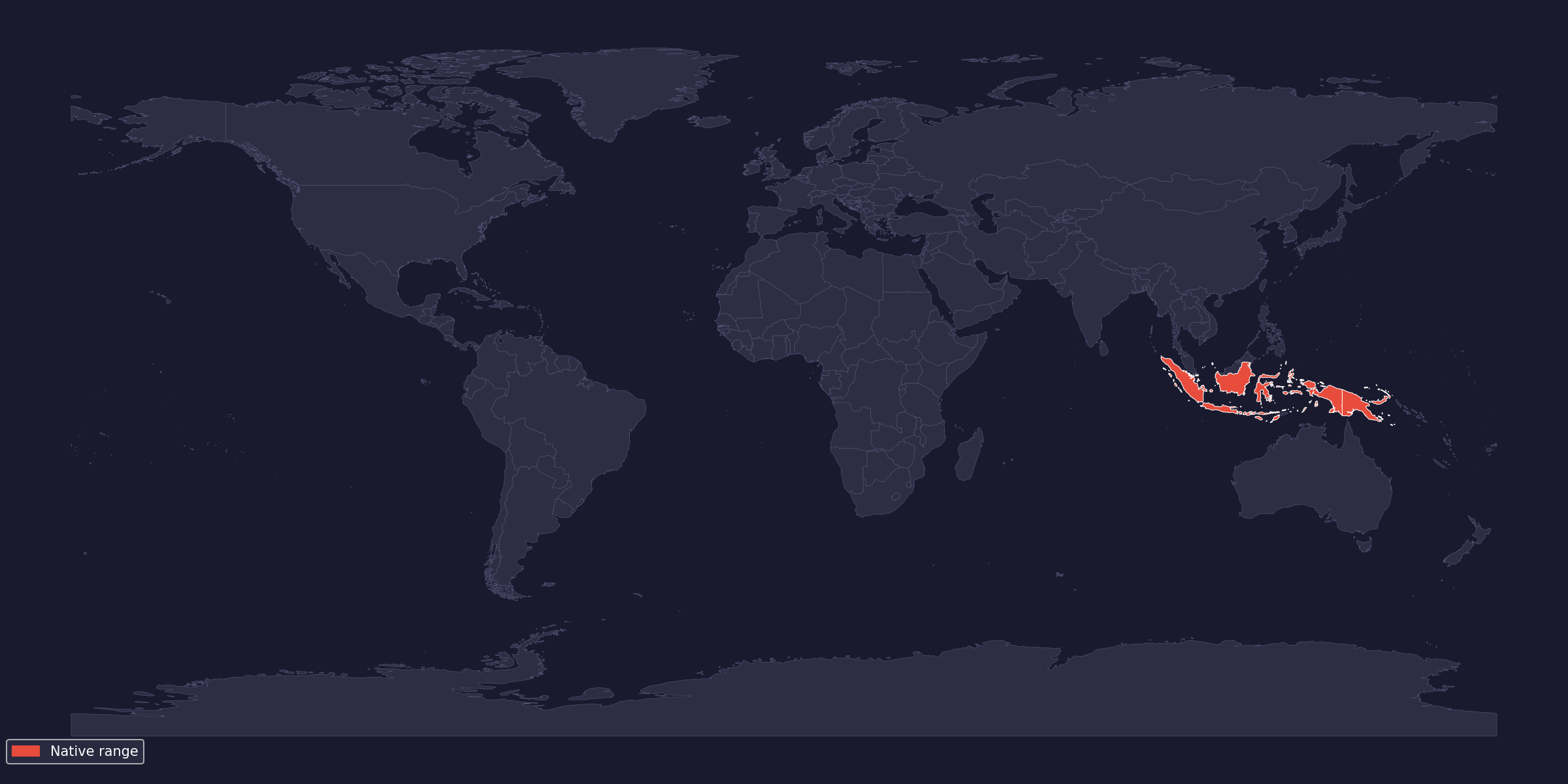
🌡 Climate across the native range
Monthly climate normals from reviewed GBIF occurrence locations:
Papua Barat — Indonesia
| Month | Min °C | Mean °C | Max °C | RH % |
|---|---|---|---|---|
| January | 24 | 27.5 | 31.1 | 81 |
| February | 23.7 | 27.3 | 31 | 81 |
| March | 23.9 | 27.4 | 30.9 | 81 |
| April | 23.9 | 27.5 | 31 | 82 |
| May | 24 | 27.4 | 30.8 | 83 |
| June | 23.5 | 26.8 | 30 | 84 |
| July | 23.3 | 26.4 | 29.5 | 85 |
| August | 23.1 | 26.3 | 29.4 | 83 |
| September | 23.4 | 26.8 | 30.2 | 83 |
| October | 23.5 | 27.2 | 30.9 | 82 |
| November | 23.8 | 27.5 | 31.3 | 81 |
| December | 23.6 | 27.4 | 31.2 | 82 |
National Capital District — Papua New Guinea
| Month | Min °C | Mean °C | Max °C | RH % |
|---|---|---|---|---|
| January | 23 | 27.3 | 31.6 | 78 |
| February | 22.9 | 27 | 31.2 | 79 |
| March | 22.9 | 26.9 | 31 | 80 |
| April | 22.9 | 26.8 | 30.8 | 82 |
| May | 23 | 26.7 | 30.3 | 81 |
| June | 22.4 | 26 | 29.5 | 80 |
| July | 22 | 25.6 | 29.1 | 77 |
| August | 22 | 25.7 | 29.4 | 75 |
| September | 22.4 | 26.3 | 30.2 | 75 |
| October | 22.6 | 26.8 | 31.1 | 75 |
| November | 22.8 | 27.4 | 32 | 76 |
| December | 23 | 27.5 | 31.9 | 77 |
Papua — Indonesia
| Month | Min °C | Mean °C | Max °C | RH % |
|---|---|---|---|---|
| January | 23.5 | 27.4 | 31.4 | 76 |
| February | 23.5 | 27.3 | 31.2 | 77 |
| March | 23.5 | 27.3 | 31.1 | 77 |
| April | 23.3 | 27.2 | 31.1 | 76 |
| May | 23 | 26.8 | 30.5 | 78 |
| June | 22.3 | 25.9 | 29.6 | 81 |
| July | 21.9 | 25.3 | 28.8 | 79 |
| August | 21.7 | 25.4 | 29.1 | 76 |
| September | 22.1 | 26 | 30 | 75 |
| October | 22.7 | 26.9 | 31.1 | 74 |
| November | 23.2 | 27.6 | 32 | 72 |
| December | 23.4 | 27.6 | 31.9 | 74 |
Weather data by WorldClim v2.1 · Monthly normals queried by Herpeton Academy from raster values; relative humidity is derived from vapor pressure and mean temperature.
Location references use GBIF.org occurrence data where available; original occurrence records retain their source dataset licenses.
⚖️ Legal status
Checked on 2026-06-11: no listing was found for this species in the CITES Appendices, EU wildlife trade Annexes, or Bern Convention appendices. This does not remove national import, export, veterinary, invasive-species, or ownership rules; keep seller details, origin documents, and import or transfer paperwork where applicable.
🤌 Husbandry
Plan the adult enclosure before purchase. The minimum adult setup used here is 150 x 75 x 60 cm, with about 1.125 m² of floor area. Humid skinks still need floor space and air exchange; a small wet enclosure is not an acceptable shortcut.
Use a low, sturdy enclosure with deep substrate, broad hides, and easy access for cleaning. Keep humidity available in retreats without letting the whole enclosure become stale and wet.
💡 Lighting
Use bright visible light and species-appropriate UVB. Measure lamp output when possible, because reflector, mesh, height, and lamp age change real exposure. Night lighting is unnecessary unless used briefly for observation.
Plan lighting around Ferguson Zone 2 and a 10-12 hour photoperiod, with shaded retreats so the skink can leave the UV and heat zone.
🌡 Heating and temperature
- ambient or water: 26-30°C
- basking surface: 35-40°C
- cool retreat: 23-26°C
- night: 21-24°C
Use thermostats and independent thermometers. A good setup lets the animal choose, rather than trapping it at one average temperature.
💧 Humidity and water
Target humidity is 60-80%, with temporary shed support around 75-90%. Provide humidity as cycles and retreats rather than making the entire enclosure constantly wet; keep bowls, hides, and substrate clean.
Use ventilation and substrate depth to hold humidity without stagnant air. A humid hide is useful, but repeated retained shed usually means the whole moisture gradient, temperature, or hydration routine needs review.
🌿 Enclosure and decoration
Use 12-18 cm of moisture-buffering substrate such as cypress mulch, soil/coco mix, leaf litter, or another reptile-safe blend that holds humidity without becoming sour. Keep new arrivals on simpler substrate during quarantine until feeding, feces, mites, and skin condition are clear.
Provide broad hides on both warm and cool sides, a humid retreat, rough surfaces for shedding, and a basking zone wide enough for the body. Avoid cedar, pine, scented bedding, slick floors, and swampy setups with poor airflow.
🥗 Feeding
Feed for steady body condition rather than maximum appetite. Juveniles may eat every 2-3 days; most healthy adults do better around every 5-7 days, with frequency adjusted for body condition and activity.
Use a varied omnivorous rotation: leafy greens and safe vegetables, snails or insects where appropriate, egg or lean animal protein in moderation, occasional fruit, and quality prepared diets as part of the mix. Keep fruit and rich protein controlled because overweight adults develop quickly in captivity.
Use plain calcium regularly when UVB is provided, calcium with D3 only when the lighting and diet plan justify it, and a reptile multivitamin sparingly according to product directions. Remove wet food before it spoils in humid enclosures.
🥚 Breeding notes
Reproduction is viviparous. Litters are usually 5-15 young; breeding difficulty is moderate. Breeding should wait until legal status, unrelated stock, adult body condition, and placement for offspring are clear.
🧍 Handling and safety
Handle only when necessary, with the whole body supported and the head guided without squeezing. Blue-tongued skinks have strong jaws and a strong feeding response, so keep fingers away from the mouth and do not let children handle them unsupervised. Secure doors, vents, and enclosure edges.
🩺 Common problems
Quarantine new animals, record weight, and watch for appetite loss, abnormal posture, retained shed, skin lesions, mites, mouth injury, respiratory signs, swelling, diarrhea, and sustained hiding. Many Indonesian blue-tongues in trade are imports or recent descendants of imports, so fecal testing and a reptile-veterinary check are often worth planning.
Most chronic problems trace back to enclosure size, incorrect heat, poor ventilation, weak UVB, unsuitable diet, dirty wet substrate, dehydration, or repeated stress. Fixing the environment early is usually easier than treating advanced respiratory or skin disease.
✅ Conclusion
Indonesian blue-tongued skinks suit keepers who can combine high humidity with clean airflow, strong heat, and controlled feeding. The main mistake is borrowing dry Australian blue-tongue care without adjusting humidity, substrate, and quarantine expectations.
📚 Sources and further reading
- ReptiFiles, Blue Tongue Skink Care Guide: https://reptifiles.com/blue-tongue-skink-care/
- Baines et al. 2016, UV-Tool: https://jzar.org/jzar/article/view/150
- GBIF Backbone Taxonomy, Tiliqua gigas: https://www.gbif.org/species/2462515
- The Reptile Database, Tiliqua gigas: https://reptile-database.reptarium.cz/species?genus=Tiliqua&species=gigas
- CITES Appendices: https://cites.org/eng/app/appendices.php
- European Commission wildlife trade overview: https://environment.ec.europa.eu/topics/nature-and-biodiversity/wildlife-trade_en
- Bern Convention appendices: https://www.coe.int/en/web/bern-convention/appendices