Share

Chinese Crocodile Lizard
🔤 Taxonomy
Shinisaurus crocodilurus is the accepted scientific name and the only living species in the family Shinisauridae. The Vietnamese form is often listed as Shinisaurus crocodilurus vietnamensis; older material may treat all animals simply as S. crocodilurus.
Common names used in the hobby:
- Chinese crocodile lizard
- Crocodile lizard
German common names used in the hobby:
- Krokodilschwanzhöckerechse
📌 Description
Chinese crocodile lizards are cool, semi-aquatic, legally sensitive display lizards. They need clean water, planted land areas, branches over water, cool temperatures, high humidity, UVB, cautious feeding, and complete documentation.
Adults usually reach 40-46 cm. They are often sedentary, but that does not mean they tolerate poor water, warm stagnant air, or cramped paludariums. This is an expert species.
🌍 Distribution
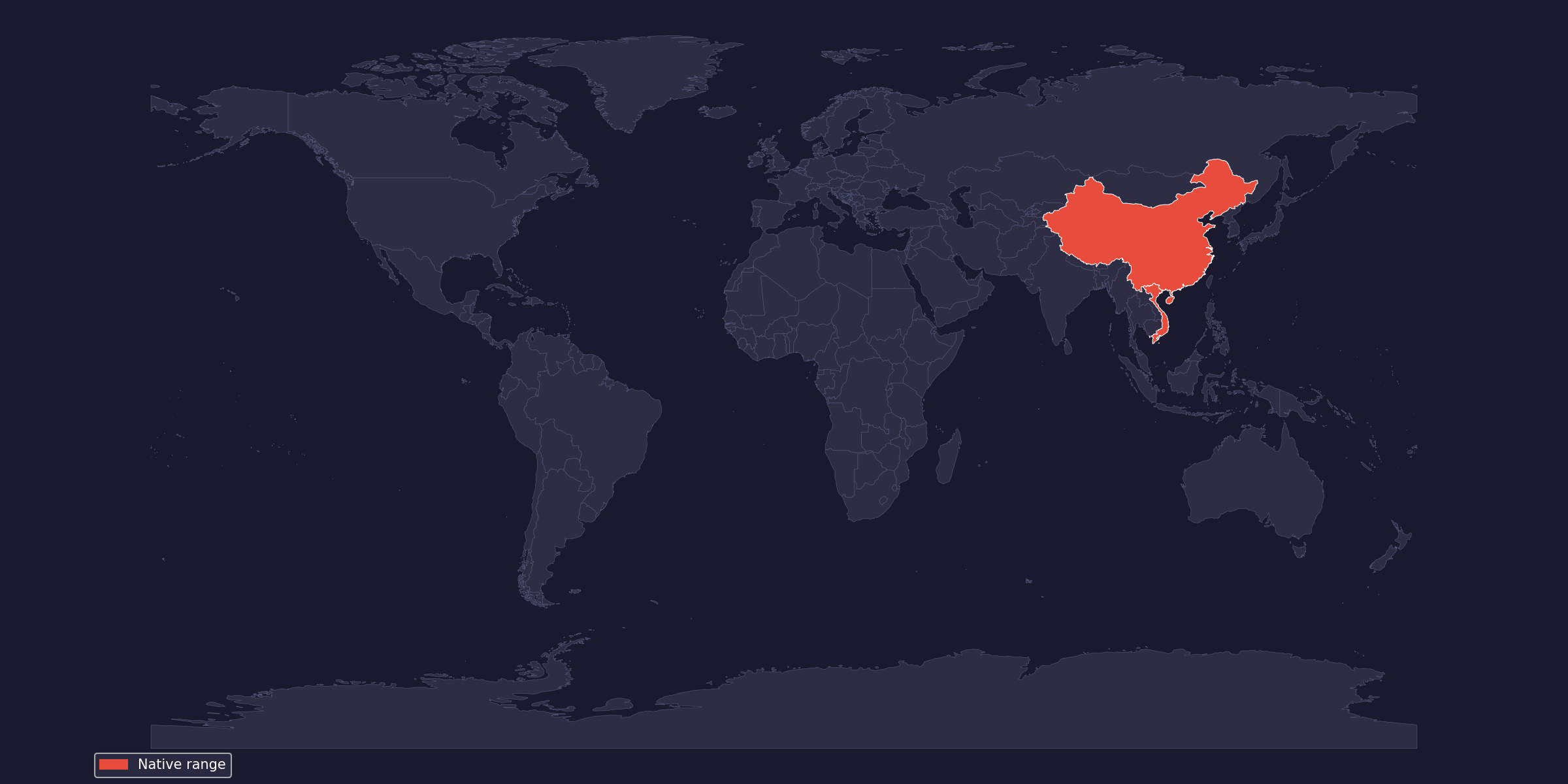
The species occurs in fragmented areas of southern China and northeastern Vietnam. It is associated with vegetated subtropical forest streams, pools, and wet ravines where animals rest on branches above or beside water.
Captive care should prioritize cool stable conditions, clean shallow water, easy exits, secure branches, and quiet cover. A decorative warm waterfall tank is not a substitute for water quality and temperature control.
🌡 Climate across the native range
Monthly climate normals from reviewed GBIF occurrence locations:
Guangdong — China
| Month | Min °C | Mean °C | Max °C | RH % |
|---|---|---|---|---|
| January | 6.2 | 10.2 | 14.2 | 76 |
| February | 8.6 | 12.4 | 16.2 | 78 |
| March | 12.2 | 15.7 | 19.2 | 82 |
| April | 17.2 | 20.3 | 24 | 83 |
| May | 21 | 23.8 | 27.2 | 84 |
| June | 23.5 | 25.9 | 29.2 | 87 |
| July | 24.6 | 27.5 | 31.2 | 82 |
| August | 24.5 | 27.6 | 31.5 | 80 |
| September | 22.2 | 25.6 | 29.6 | 77 |
| October | 17.7 | 21.8 | 26.5 | 70 |
| November | 12.6 | 16.8 | 21.4 | 71 |
| December | 7.3 | 11.5 | 16.2 | 71 |
Weather data by Open-Meteo.com · CC BY 4.0 · Monthly normals calculated by Herpeton Academy from daily archive values.
Location references use GBIF.org occurrence data where available; original occurrence records retain their source dataset licenses.
⚖️ Legal status
Checked on 2026-06-09: Shinisaurus crocodilurus is listed in CITES Appendix I and EU Annex A. The Bern Convention is not relevant for this Asian species.
Treat purchase, sale, breeding transfer, import, export, and transport as document-heavy activities. Captive-bred availability is not proof of legal transfer by itself. Keep certificates, source-code information, invoices, breeder details, transfer documents, and identification photos for every animal. Local and national rules may add registration, marking, or permit requirements.
🤌 Husbandry
A practical minimum for one adult is 120 x 60 x 90 cm, but layout matters as much as dimensions. The enclosure should provide a cool planted land section, a clean water section, branches above water, shaded retreats, and service access that does not require chasing the animal.
Keep animals singly unless there is a specific breeding plan and spare housing. Pairing can create stress, bite injuries, or repeated reproductive pressure.
🧪 Filtration and water
Water quality is central to this species. Use mature biological filtration, protected intakes, regular partial water changes, and water testing during setup. Ammonia and nitrite should be zero in an established system.
Water should be easy to exit from every side used by the animal. Avoid smooth steep walls, unguarded heaters, loose filter parts, and deep sections without resting points.
💡 Lighting
Provide bright visible light and low-level UVB over part of the land and branch area. Plan around Ferguson Zone 1, with shaded retreats and water-edge cover.
A 10-12 hour photoperiod is suitable for normal maintenance. UVB should not turn the entire enclosure into an exposed zone; this lizard uses cover heavily.
🌡 Heating and temperature
- ambient air or water: 20-25°C
- basking surface: 26-28°C
- cool retreat: 18-22°C
- night: 16-20°C
Avoid tropical heat. Summer overheating is a serious risk, especially in humid rooms. Use thermostats, independent thermometers, and a cooling plan before hot weather arrives.
💧 Humidity and water
Aim for 70-90% humidity with strong ventilation and clean surfaces. High humidity should come with airflow, not stale air.
The animal must be able to soak and swim, but it also needs dry resting positions. Branches, cork, and plants should let it choose between water, damp edges, and dry elevated cover.
🌿 Enclosure and decoration
Useful setup elements include:
- a filtered water area with easy exits
- branches fixed above water and land
- cork, roots, and plants for visual cover
- a dry basking perch under heat and UVB
- shaded retreats near water
- protected heaters, cables, and pump intakes
- a secure lid or rim
Use materials that tolerate moisture and cleaning. Unstable rock piles and narrow underwater gaps can trap or injure the lizard.
🪳 Feeding
Feed varied invertebrate prey every 2-3 days, adjusted for season and body condition. Suitable foods include crickets, roaches, earthworms, locusts where legal, silkworms, black soldier fly larvae, and other safe soft-bodied feeders.
Some natural prey may include aquatic animals, but feeder fish should not become the staple. They can introduce parasites, damage water quality, and skew nutrition. Dust or gut-load feeders according to UVB access and veterinary guidance.
🥚 Breeding notes
This species is viviparous. Litters are usually 2-12 young, and gestation can be long. Breeding should be attempted only with legal, unrelated, healthy adults and a plan for paperwork and offspring placement.
Young need shallow water, many exits, small food, and careful monitoring. Do not assume a decorative adult paludarium is safe for neonates.
💤 Seasonality
Wild crocodile lizards experience seasonal cooling, and winter rest may be part of breeding management. It should not be improvised in a small indoor tank.
Only cool healthy, well-conditioned animals with known history, stable water quality, oxygenation, and monitoring. Animals of uncertain origin, recent imports, thin animals, and sick animals should not be wintered casually.
🧍 Handling and safety
Minimize handling. Move the animal with a lined container or controlled two-hand support over a low surface. The bite is not medically significant, but it can be painful and stress the lizard.
Quarantine new animals separately with dedicated tools. Recent imports or undocumented animals deserve particular caution.
🩺 Common problems
Common failures include warm stagnant enclosures, dirty water, weak filtration, no dry resting site, poor UVB placement, overfeeding, parasite loads, bite injuries, and stress from forced cohabitation.
Watch for buoyancy problems, skin sores, swollen toes, cloudy eyes, open-mouth breathing, weight loss, refusal to use water, persistent soaking, or sudden aggression. Correct temperature and water quality immediately and involve a reptile veterinarian when signs persist.
📌 Conclusion
Shinisaurus crocodilurus is a conservation-sensitive specialist, not a casual paludarium animal. The enclosure, cooling plan, filtration, quarantine space, and legal documents should all be ready before purchase.
📚 Sources and further reading
- CITES Appendices, checked 2026-06-09
- Commission Regulation (EU) 2023/966, checked 2026-06-09
- Commission Regulation (EU) 2017/160, checked 2026-06-09
- GBIF Backbone Taxonomy: Shinisaurus crocodilurus
- The Reptile Database: Shinisaurus crocodilurus
- EDGE of Existence: Chinese crocodile lizard
- IUCN/TRAFFIC analysis for CITES CoP17