Share

African Fire Skink
🔤 Taxonomy
Mochlus fernandi (Burton, 1836) is the accepted combination used by GBIF and the 2019 molecular reclassification of supple and writhing skinks. The animal has moved repeatedly between genera, which explains why otherwise sound care and field literature may use a different scientific name.
The combinations most useful for searches are:
- Tiliqua fernandi — original combination
- Riopa fernandi
- Lygosoma fernandi
- Lepidothyris fernandi — used after the 2009 revision; Lepidothyris was synonymized with Mochlus in 2019
The 2009 revision also split the old broad “fire skink” concept into several taxa. True M. fernandi comprises a western form often called M. f. harlani and a west-central nominate form; similarly coloured M. hinkeli and M. striatus are separate species. Useful common names are African fire skink, fire skink, Fernand’s skink, and the German Feuerskink.
📌 Description
The African fire skink is a robust, glossy forest-floor skink reaching about 30-38 cm. Bronze-gold dorsal scales contrast with red, black, and pale flank markings. It has strong legs but spends much of its time beneath litter or in self-made tunnels. Captive longevity is commonly estimated at 15-20 years.
This is an intermediate display animal rather than a reptile for frequent handling. A settled captive-bred individual may emerge for food and learn to take prey from tongs, but a frightened skink can vanish underground or escape with remarkable speed. Deep correctly moist soil, a reliable heat gradient, varied live food, and quarantine are the main planning points.
| Parameter | Practical target |
|---|---|
| Adult size | about 30-38 cm total length |
| Enclosure for one adult | at least 90 x 45 x 45 cm |
| Basking surface | 33-36°C |
| Cool zone | 24-27°C |
| Night | 21-24°C |
| Humidity | generally 60-75%, higher within burrows and after misting |
| UVB | low-to-moderate measured gradient; shade always available |
| Food | varied gut-loaded live invertebrates |
🌍 Distribution
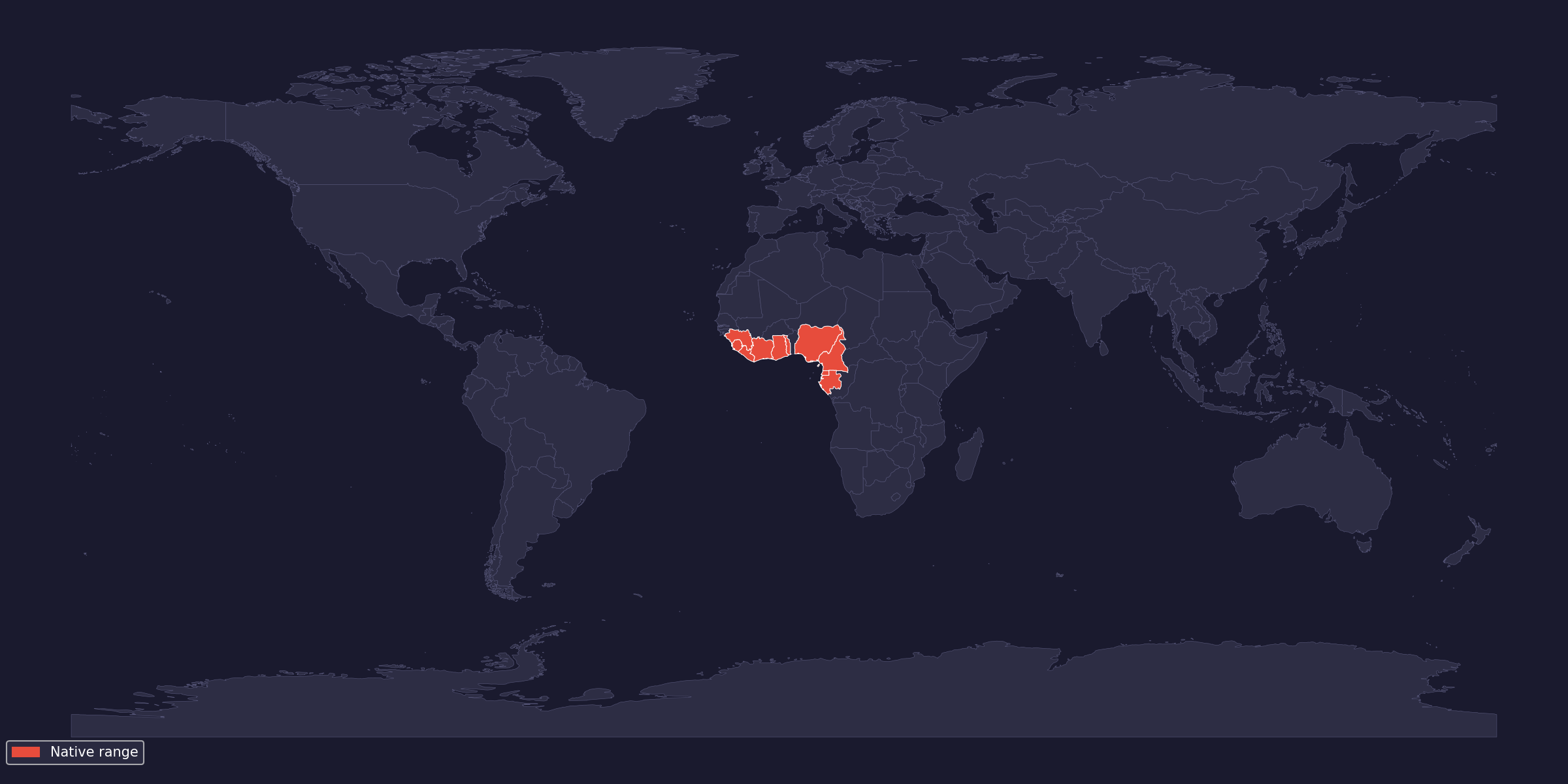
Modern taxonomic limits place Mochlus fernandi in the humid forest belt of West and west-central Africa. The western form is recorded from Guinea and Sierra Leone through Liberia and Côte d’Ivoire to Ghana, with records also extending into Togo. The nominate range continues from Nigeria through Cameroon and Equatorial Guinea, including Bioko, to Gabon. Older sources that carry the name far into eastern Central Africa may include fire-skink relatives separated by the 2009 revision.
Field research in southern Nigeria found skinks in rainforest and altered forest-edge mosaics, often using litter, debris, root systems, and burrows. Activity occurred in daylight, with useful morning and later-day periods, but surface sightings show only a fraction of its time budget. The range map marks countries, not continuous occupancy or the exact remaining forest belt.
🌡 Climate across the native range
Monthly normals from reviewed GBIF occurrences representing the western and west-central forest portions of the species’ range:
Western Area — Sierra Leone (reviewed M. fernandi occurrence)
| Month | Min °C | Mean °C | Max °C | RH % |
|---|---|---|---|---|
| January | 22.8 | 24.3 | 26.1 | 77 |
| February | 22.8 | 24.2 | 26.1 | 79 |
| March | 23.2 | 24.4 | 26.1 | 80 |
| April | 23.4 | 24.6 | 26.2 | 80 |
| May | 23.2 | 24.5 | 26 | 83 |
| June | 22.1 | 23.5 | 25 | 85 |
| July | 21.5 | 22.7 | 24 | 86 |
| August | 21.5 | 22.5 | 23.7 | 87 |
| September | 21.5 | 22.9 | 24.3 | 87 |
| October | 21.9 | 23.5 | 25.1 | 85 |
| November | 22.6 | 24.2 | 25.8 | 83 |
| December | 23.2 | 24.7 | 26.2 | 79 |
Centre Region — Cameroon (reviewed M. fernandi occurrence)
| Month | Min °C | Mean °C | Max °C | RH % |
|---|---|---|---|---|
| January | 20.6 | 23.9 | 29.1 | 77 |
| February | 21.1 | 24.4 | 30 | 77 |
| March | 21.1 | 24 | 29.2 | 83 |
| April | 20.9 | 23.5 | 28.2 | 87 |
| May | 20.7 | 23.1 | 27.6 | 88 |
| June | 20.3 | 22.4 | 26.7 | 87 |
| July | 19.8 | 21.9 | 26.1 | 86 |
| August | 19.7 | 21.9 | 26.2 | 86 |
| September | 20 | 22 | 26.3 | 88 |
| October | 20 | 22.1 | 26.1 | 90 |
| November | 20.3 | 22.6 | 26.7 | 89 |
| December | 20.6 | 23.3 | 27.8 | 83 |
Weather data by Open-Meteo.com · CC BY 4.0 · Monthly normals calculated by Herpeton Academy from daily archive values.
Location references use GBIF.org occurrence data where available; original occurrence records retain their source dataset licenses.
⚖️ Legal status
Checked on 2026-08-30: Mochlus fernandi was not found in the current CITES Appendices, in Annexes A-D of Commission Regulation (EU) 2026/1383, or in the Bern Convention appendices. The EU regulation was also checked under the older combinations Lepidothyris, Lygosoma, Riopa, and Tiliqua fernandi. This means no species-specific listing was identified; it does not mean that imports or ownership are unregulated.
National veterinary, animal-welfare, invasive-species, import, and commercial rules may still apply. Keep the invoice, scientific name, breeder or importer details, import documents where relevant, and transfer history. Captive-bred animals are preferable: they reduce collection pressure and are generally easier to assess and acclimate than newly imported skinks.
🤌 Husbandry
Provide one adult with at least 90 x 45 x 45 cm; a 120 cm enclosure gives a better surface-temperature and moisture gradient. House singly by default. Males should never share a confined enclosure, and multiple females still require far more space, duplicate resources, close observation, and an immediately available spare setup. Cohabitation offers no welfare requirement.
Quarantine every new skink for 60-90 days away from the collection with dedicated tools. Use paper temporarily for observation but provide several opaque hides and a humid hide; prolonged bare housing prevents normal digging. Record weight, prey intake, feces, shedding, skin condition, and activity. Imports and symptomatic animals should be examined by a reptile-experienced veterinarian, with fecal testing when indicated.
Keep routine interaction to tong-feeding and enclosure work. If lifting is unavoidable, close the room, block escape routes, scoop from below, and support the body. Never grab the tail. Allow at least two quiet weeks after arrival before attempting voluntary interaction.
💡 Lighting
Use an 11-12 hour daytime cycle with a bright white daylight source and a linear T5 UVB lamp over the warm half. Species-specific UV exposure has not been experimentally defined. A conservative Ferguson Zone 2 arrangement—roughly UVI 1-2.5 over the most exposed warm surface, declining to near zero beneath cover—provides a useful choice without flooding the forest floor with radiation.
Measure through the installed mesh and preserve deep shade. UVB is strongly recommended even though carefully supplemented skinks have survived without it; dietary vitamin D3 is not a reason to remove behavioural access to UV. Replace lamps according to measurements or the manufacturer’s schedule. Do not use coloured night lamps.
🌡 Heating and temperature
Maintain a basking surface around 33-36°C, a general warm area of 25-29°C, and a cool zone of 24-27°C. Nights may fall to 21-24°C. These are enclosure targets, not instructions to keep every tunnel equally warm. The skink needs warm cover for digestion and cooler moist cover for retreat.
Use a thermostatically controlled overhead halogen source and measure the basking surface with an infrared thermometer. Place digital probes at animal level on warm and cool sides, including one within a representative retreat. Avoid heat rocks and unregulated heat mats beneath deep substrate: they reverse the natural gradient, dry the lower layer, and can overheat a hidden animal. Routine brumation is not required.
💧 Humidity and water
Aim for general humidity around 60-75%, with higher humidity in tunnels and temporary peaks after morning or evening misting. The surface may begin to dry between cycles while the lower soil remains evenly damp, never swampy. Adjust ventilation and watering from measured readings, complete sheds, burrow stability, and the smell and condition of the substrate.
Provide a small stable bowl of clean water and replace it daily or whenever fouled. Good humidity does not compensate for contaminated water. Persistent condensation, sour substrate, fungus outbreaks, and stagnant air indicate excess water or insufficient ventilation. Routine soaking and deep pools are unnecessary.
🌿 Enclosure and decoration
After quarantine, supply 12-15 cm of moisture-retentive, diggable substrate. A workable mix is about 40% pesticide-free topsoil, 40% coconut fibre, and 20% fine washed sand, topped with leaf litter. The mixture should hold a tunnel when pressed but release no water when squeezed. A drainage layer can help in planted enclosures, but it does not justify overwatering.
Add multiple cork flats, half-buried tubes, hollow logs, root-like branches, low plants, shaded retreats, and visual barriers. Support heavy objects on the base so excavation cannot undermine them. Seal every door, lid, cable, and ventilation gap; this strong, smooth skink can exploit surprisingly small openings.
Avoid aromatic cedar or pine, fertilizer, pesticide residues, sharp gravel, calcium sand, permanently saturated sphagnum, and substrate that is dusty when dry. Feed from a dish or clean leaf-litter area and remove uneaten insects so they cannot bite a resting skink.
🪳 Feeding
Feed adults a varied meal about twice weekly; juveniles need smaller meals daily or every other day. Offer prey no larger than the skink’s head and stop when hunting interest falls rather than leaving a large number loose. Suitable staples include crickets, appropriately sized roaches, black soldier fly larvae, silkworms, earthworms, small captive-cultured snails, mealworm or darkling beetles, and occasional larvae with higher fat or moisture.
Gut-load insects for 24-48 hours with nutritious greens and a balanced feeder diet. Lightly dust most juvenile meals and about every second adult meal with plain calcium as a starting point. Use a multivitamin containing suitable preformed vitamin A and calcium with D3 less often, following the product label and adjusting for measured UVB and feeder variety. Do not stack several complete supplements.
Fruit, egg, and newborn rodents are unnecessary treats and should not become routine. Avoid wild-caught prey from places exposed to pesticides, parasite hosts, fireflies or other toxic insects, and prey so large that it cannot be swallowed easily.
🥚 Breeding notes
Sexing can be difficult; mature males tend to have a broader head and heavier build, but visual assessment is not certain. Breed only healthy, mature animals of known origin and maintain separate housing. Provide a deep, quiet nesting area that is moist enough to hold shape without being wet.
Captive reports describe clutches of about 3-6 eggs, with up to 9 possible. A conservative working incubation range is 28-30°C for about 50-65 days in a lightly moist medium; published controlled comparisons are sparse, so record the method and avoid chasing a single exact number. Mark the upper surface before moving an egg and preserve its orientation. Remove hatchlings from adults because cannibalism is possible.
A female that repeatedly digs, stops eating while losing condition, strains, becomes weak, or remains swollen may have retained eggs and needs urgent reptile-veterinary care. Do not massage the abdomen or attempt to induce laying at home.
🩺 Common problems
Common preventable problems include dehydration and retained shed when the lower substrate dries, dermatitis and respiratory infection in stagnant wet housing, burns or chronic hiding from excessive heat, metabolic bone disease from calcium-vitamin D-UVB imbalance, obesity from fatty food, live-prey wounds, and internal parasites in imports. Loose substrate is safest when heat and hydration are correct and food is not coated in it.
Seek veterinary help for sustained weight loss, sunken eyes, abnormal feces, mites, skin sores, swelling, a soft jaw, tremors, weakness, noisy or open-mouth breathing, repeated incomplete sheds, prolonged food refusal with declining condition, or reproductive straining. A skink that remains buried is not automatically ill, so weight and records are more useful than forcing it out daily.
📌 Conclusion
The African fire skink rewards patient observation, not frequent handling. It is a good match for a keeper prepared to maintain deep living soil, warm cover, a measured light gradient, varied live prey, and strict quarantine while accepting that the animal may spend much of the day out of sight.
📚 Sources and further reading
- ReptiFiles: Fire skink care sheet
- Freitas et al. 2019: phylogeny and reclassification of supple and writhing skinks
- Wagner et al. 2009: revision of the Lygosoma fernandi species group
- Akani et al. 2009: activity and habitat selection in southern Nigeria
- GBIF Backbone Taxonomy: Mochlus fernandi
- Baines et al. 2016: UVB provision for captive reptiles
- CITES Appendices, checked 2026-08-30
- Commission Regulation (EU) 2026/1383, checked 2026-08-30
- Bern Convention appendices, checked 2026-08-30