Share

Green Iguana
🔤 Taxonomy
Iguana iguana is the currently accepted scientific name. In trade, use the Latin name when checking animals, locality labels, invoices, and legal documents, because common names can overlap between related species.
English common names used in the hobby:
- Green Iguana
📌 Description
The green iguana (Iguana iguana) is a large, demanding lizard kept by specialist reptile keepers. Adults usually reach 1.2-1.8 m total length, with exceptional males larger and may live 15-20+ years with stable long-term care.
This species should be planned around its adult needs, not its juvenile size. Good care depends on correct enclosure scale, secure hides, measured heat and UVB, clean water, and a diet that matches the species rather than convenient feeder habits.
For day-to-day keeping, the important point is predictability. The enclosure should let the animal choose between exposed warmth, shaded cover, slightly different humidity zones, and a secure sleeping place without being handled or moved by the keeper.
New arrivals should be quarantined and observed before being placed in a planted display enclosure. Track weight, appetite, shedding, feces, and behaviour for several weeks; small changes are easier to correct before the animal is stressed or dehydrated.
Green iguanas are often sold cheaply as small juveniles, but they are large, strong, long-lived herbivores. They are not suitable for a standard glass tank, casual free-roaming, or a keeper who cannot manage daily cleaning, large branches, high humidity, and a powerful basking zone.
🌍 Distribution
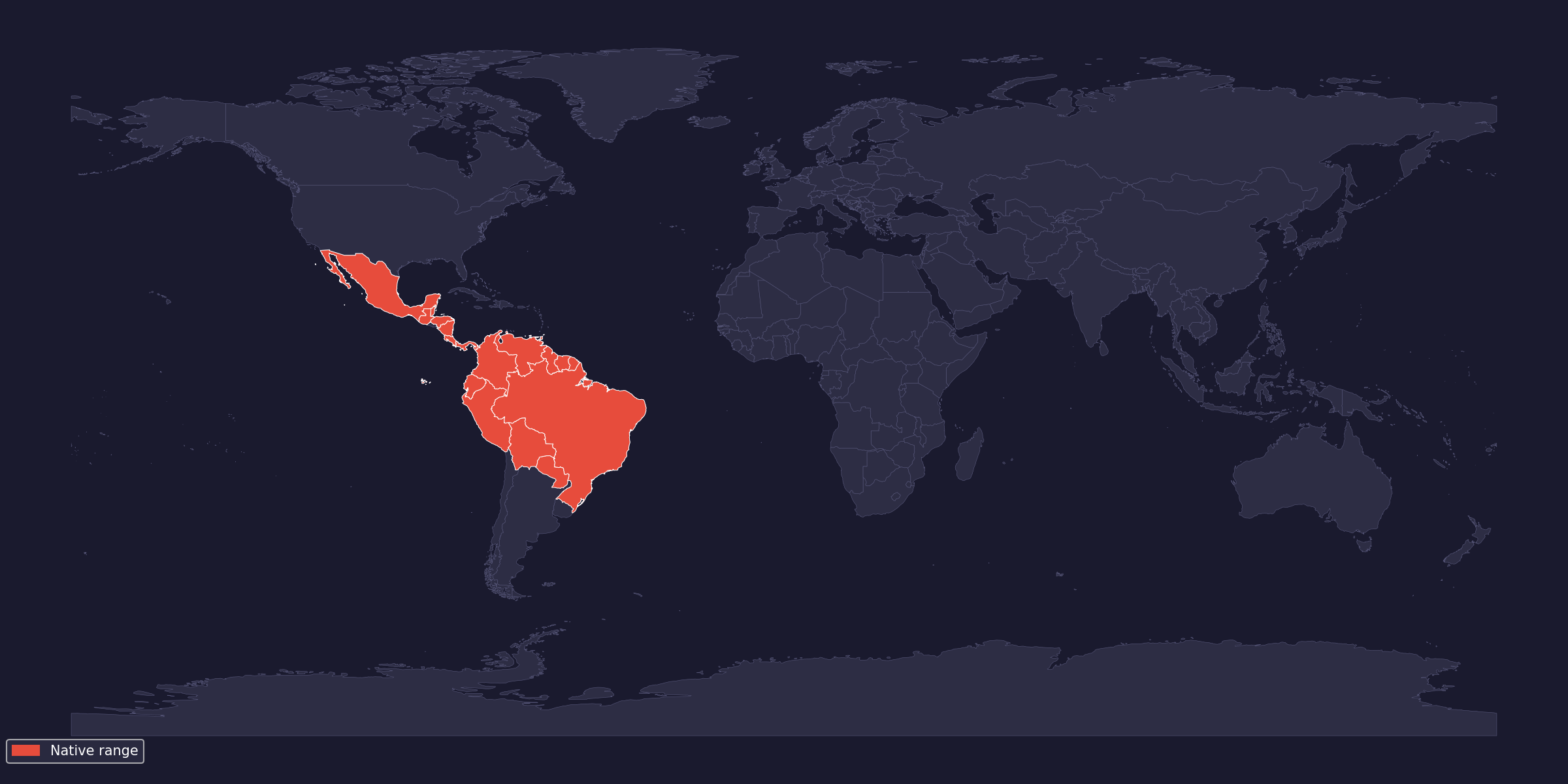
Iguana iguana is native to Mexico through Central America into northern and central South America, with some Caribbean populations; introduced populations occur outside the native range. It is associated with hot, humid tropical forest edges, riverside trees, mangroves, and disturbed woodland.
In captivity, use the functional pattern of the habitat:
- secure retreats and visual cover
- a clear warm-to-cool gradient
- measured UVB and bright daytime lighting
- substrate or climbing structure that supports natural movement
- clean water and humidity appropriate to the species
🌡 Climate across the native range
Monthly climate normals from reviewed GBIF occurrence locations:
Sinaloa — Mexico
| Month | Min °C | Mean °C | Max °C | RH % |
|---|---|---|---|---|
| January | 10.2 | 19.1 | 28 | 63 |
| February | 10.5 | 19.9 | 29.2 | 61 |
| March | 11.6 | 21.1 | 30.7 | 57 |
| April | 13.6 | 23.3 | 32.9 | 55 |
| May | 17.1 | 26 | 35 | 55 |
| June | 23 | 29.7 | 36.4 | 57 |
| July | 24 | 29.8 | 35.6 | 65 |
| August | 23.8 | 29.3 | 34.8 | 70 |
| September | 23.6 | 29.1 | 34.6 | 69 |
| October | 20.6 | 27.7 | 34.8 | 63 |
| November | 15 | 23.6 | 32.1 | 61 |
| December | 11.7 | 20.4 | 29.1 | 62 |
Alajuela — Costa Rica
| Month | Min °C | Mean °C | Max °C | RH % |
|---|---|---|---|---|
| January | 16 | 20.7 | 25.5 | 83 |
| February | 16 | 20.9 | 25.9 | 81 |
| March | 17.2 | 22.1 | 27 | 80 |
| April | 17.8 | 22.6 | 27.5 | 81 |
| May | 17.9 | 22.3 | 26.6 | 85 |
| June | 17.5 | 21.6 | 25.7 | 89 |
| July | 17.8 | 21.8 | 25.8 | 87 |
| August | 17.3 | 21.5 | 25.7 | 89 |
| September | 16.9 | 21.2 | 25.6 | 90 |
| October | 16.7 | 21 | 25.3 | 91 |
| November | 16.6 | 20.6 | 24.6 | 89 |
| December | 16 | 20.4 | 24.8 | 87 |
Weather data by WorldClim v2.1 · Monthly normals queried by Herpeton Academy from raster values; relative humidity is derived from vapor pressure and mean temperature.
Location references use GBIF.org occurrence data where available; original occurrence records retain their source dataset licenses.
The range is broad, but captive care should focus on the functional pattern shared by many populations: warm humid air, strong sun exposure, dense climbing structure, and access to water. Introduced populations outside the native range should not be used as a reason to release or casually move animals.
⚖️ Legal status
As checked against current official sources in May 2026, CITES Appendix II under Iguana spp.; in the EU this normally corresponds to Annex B unless a stricter listing or import suspension applies.
The species is not native to Europe, so the Bern Convention is not the main legal framework for ordinary captive keeping in Europe. National and local rules may still apply to ownership, import, export, transport, sale, breeding, registration, escape prevention, and proof of legal origin.
Buy or adopt captive-bred animals with clear origin records, and consider rescue animals carefully because adult iguanas are often rehomed after outgrowing their first enclosure. Never release an iguana outdoors; in warm climates released animals can become invasive or die slowly from exposure, injury, or starvation.
🤌 Husbandry
A single adult needs a custom room-sized arboreal enclosure; use about 300 x 150 x 180 cm as a practical minimum, and larger is better.
The enclosure should include:
- a hot basking area and cooler retreat zones
- multiple hides or sheltered routes
- secure branches, cork, rocks, or platforms suited to the species
- fresh water that cannot be tipped easily
- strong ventilation without losing the needed humidity
- front access so maintenance does not become a chase
Keep animals singly unless there is a controlled breeding plan and space to separate them immediately. Cohabitation can cause stress, injuries, food competition, and repeated breeding pressure.
The enclosure must be built like a small animal room rather than a display tank. It needs horizontal and vertical branches thick enough for the whole body, basking shelves, shaded retreats, and doors that allow cleaning without wrestling the animal. All shelves and branches must support adult body weight and tail strikes.
Daily maintenance matters: remove feces, replace soiled water, check humidity equipment, and inspect the animal’s toes, tail, mouth, and skin. Adult males can become territorial, especially seasonally, so handling plans should be based on training and predictable routines rather than force.
💡 Lighting
Provide a consistent 10-12 hour day length with bright visible light. Use a quality linear UVB lamp over part of the enclosure, leaving shaded retreats so the animal can self-regulate.
For UV planning, treat this species as Ferguson Zone 3-4, about UVI 3-5 at the upper basking branches. Measure with a Solarmeter 6.5 when possible because mesh, reflector, distance, and lamp age change the real exposure.
Iguanas are sun-loving herbivores. Bright visible light helps normal activity and feeding, while UVB supports vitamin D3 synthesis and calcium metabolism. Use long linear UVB over the basking zone, replace lamps on schedule, and leave shade so the animal can regulate exposure.
🌡 Heating and temperature
Use overhead heat from halogen or other suitable reptile heating equipment controlled safely by thermostat or dimming control. Do not heat the whole enclosure evenly.
Useful targets:
- Basking area: 38-42°C
- Warm side: 28-32°C
- Cool side: 24-27°C
- Night: 22-25°C
Measure basking surfaces with an infrared thermometer and ambient zones with digital probes. The animal must be able to leave the basking zone completely.
Large-bodied lizards need a basking area big enough to heat the whole torso, not a tiny hot spot under one lamp. Use multiple lamps or a broad basking bank, guard fixtures safely, and measure the branch or shelf where the iguana actually rests. Cold iguanas digest poorly and become prone to appetite, gut, and immune problems.
💧 Humidity and water
Maintain humidity around 70-85%, with local variation inside the enclosure. A single number is less useful than a stable gradient with dry resting places, humid retreats where needed, and good airflow.
Fresh water should always be available. Large lizards may need a basin big enough for soaking, while smaller geckos need a shallow dish and periodic light misting or a humid hide.
Many iguanas drink from bowls, moving water, or droplets, and many defecate in water. A soak tub or large basin is useful only if it can be cleaned thoroughly. High humidity should come with strong airflow; stagnant damp air encourages skin and respiratory issues.
🌿 Enclosure and decoration
The enclosure should let the animal move through cover instead of being exposed in an empty box. Use stable decor; heavy items must be supported from the floor or fixed securely before substrate is added.
Useful materials include:
- cork tubes, bark slabs, branches, and roots
- soil-based substrate appropriate to humidity needs
- live or artificial plants for cover
- elevated basking platforms for arboreal species
- tight hides where the animal can feel body contact
Quarantine new animals on simple substrate until feeding, shedding, droppings, and parasite status are understood.
Use non-toxic branches, washable shelves, sturdy live or artificial plants, and visual barriers. Any live plant must be safe if eaten. Do not rely on loose house access as the main enclosure; rooms contain electrical cords, toxic plants, cold floors, open windows, and objects the animal may swallow or knock down.
🪳 Feeding
This species is herbivorous. Suitable foods include dark leafy greens, edible weeds, hibiscus and mulberry leaves, squash, green beans, okra, flowers, and small amounts of fruit.
Feed juveniles smaller meals more often and adults less often according to body condition. Use calcium and multivitamin supplements deliberately; do not use supplements to compensate for missing UVB, poor diet, or low temperatures.
Avoid obesity. Large monitors and iguanas are especially prone to long-term damage when fed too much rich food or kept in enclosures that do not allow exercise.
Feed a chopped salad daily, built mostly around calcium-rich leafy greens and edible weeds. Fruit should stay a small minority of the diet. Avoid animal protein, dog food, cat food, and frequent high-oxalate or goitrogen-heavy staples. Hydration and fiber are as important as calories.
A healthy iguana should look muscular, not swollen with fat. Juveniles grow quickly and need reliable food every day; adults still eat daily but the mix should emphasize leaves, weeds, flowers, and vegetables rather than sweet fruit.
🩺 Common problems
Common captive problems include burns, dehydration, retained shed, parasite loads in wild-caught animals, mouth injuries, obesity, poor appetite from low basking temperatures, and stress from cramped or exposed housing.
Warning signs include weight loss, swelling, wheezing, repeated nose rubbing, weak grip, tremors, retained shed on toes or tail tip, abnormal droppings, wounds, and long refusal to feed. Check temperatures, UVB, humidity, diet, and hiding security first, but serious or persistent signs need an experienced reptile veterinarian.
Iguanas commonly suffer from metabolic bone disease, thermal burns, tail and toe injuries, abscesses, mouth trauma, dehydration, kidney problems, reproductive disease in females, and aggression injuries after unsafe handling. Most are husbandry-linked, so veterinary treatment and enclosure correction usually have to happen together.
📌 Conclusion
The green iguana is rewarding only when its adult size, climate, diet, and legal paperwork are taken seriously. Build the enclosure around natural behaviour and measurable gradients, then choose the animal from a source that can prove legal captive origin.
📚 Sources and further reading
- ReptiFiles Green Iguana Care Sheet
- GBIF Backbone Taxonomy
- CITES Appendices, checked May 2026
- European Commission: Wildlife trade, checked May 2026
- Bern Convention appendices, checked May 2026
💬 Feedback
For questions, corrections, or practical notes, leave us a message in the forum thread.