Share

Pink-tongued Skink
🔤 Taxonomy
Cyclodomorphus gerrardii is the accepted scientific name. Older books and trade material may use Hemisphaeriodon gerrardii or Tiliqua gerrardii. Its closest familiar relatives include blue-tongued skinks, but their diets and enclosure use should not be copied without adjustment.
English common names are pink-tongued skink and pink-tongued lizard; the German Schneckenskink means “snail skink” and accurately signals its dietary specialization.
📌 Description
The pink-tongued skink is a slender, long-tailed Australian skink, usually 35-45 cm long. Adults have a conspicuous pink tongue, while juveniles are strongly banded. The tail is partly prehensile and the animal climbs much more readily than a heavy-bodied blue-tongue.
Captive lifespans of 15-20 years are plausible. Calm adults may accept brief supported handling, but the species is best planned as a semi-arboreal display animal. Its main care challenges are dependable access to suitable snails, correct humidity with ventilation, and a tall enclosure whose branches are safe for a relatively heavy skink.
🌍 Distribution
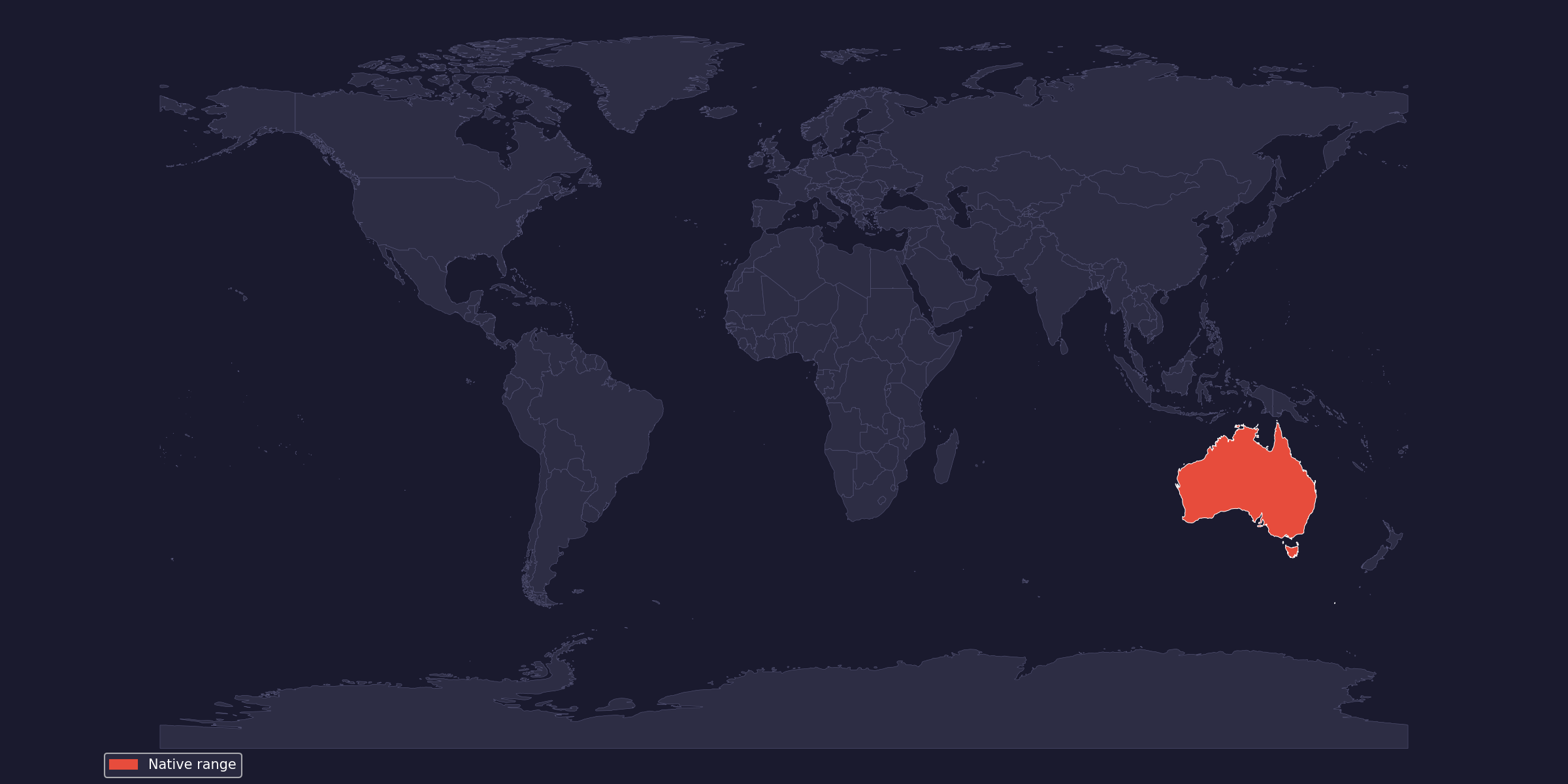
The species is native to eastern Australia from Queensland into New South Wales. It occupies humid forest, wet sclerophyll woodland, rainforest edge, and well-vegetated suburban habitat, often climbing shrubs and low trees while searching for snails and slugs.
The habitat is moist but aerated and offers both sunlit edges and shaded retreats. Captive care should create humidity cycles, leaf-litter cover, elevated routes, and a warm basking choice without maintaining tropical heat throughout the enclosure.
⚖️ Legal status
Checked on 2026-08-20: Cyclodomorphus gerrardii was not found in the current CITES Appendices or EU wildlife-trade Annexes. The Bern Convention is not relevant because the species is not native to Europe.
Australia prohibits commercial export of live native reptiles, and state keeper licensing applies within parts of Australia. Local and national rules can add further possession or transfer requirements. Overseas animals should trace to long-established legal captive lines. Keep invoices, breeder and parent-stock details, transfer records, and photographs; do not treat CITES non-listing as evidence that a recently “exported” Australian animal is lawful.
🤌 Husbandry
Provide one adult with at least 120 x 60 x 90 cm. Use both the floor and height: the skink needs broad stable branches, elevated cork tubes, dense cover, and routes that do not require risky jumps. A 60 cm-high enclosure can work only with exceptional horizontal structure; 90 cm gives a more useful vertical gradient.
House singly unless managing a documented breeding introduction. Even compatible-looking animals may compete for hides and food, and sexing juveniles is difficult. Handle only after the animal feeds reliably; support the body and tail and never pull an animal from a branch.
Quarantine for 60-90 days with separate tools, paper substrate, low washable climbing structures, and snug hides. Record weight, feeding, sheds, and feces. Fecal testing is sensible for uncertain stock or gastrointestinal signs. Newly acquired animals may refuse unfamiliar food, so confirm the breeder’s exact diet before arrival.
| Parameter | Practical target |
|---|---|
| Adult enclosure | at least 120 x 60 x 90 cm |
| Basking surface | 32-35°C |
| Warm / cool air | 24-29°C / 22-25°C |
| Night | 18-22°C |
| Humidity | about 60-80%, with drying and strong ventilation |
| UVB | linear low-to-moderate UVB; UVI about 1-3 at basking level |
| Diet | snails and slugs as the core, with selected invertebrate and complete-food variety |
💡 Lighting
Provide 10-12 hours of bright visible light and a linear UVB lamp over the basking end. Aim for UVI around 1-3 on the highest regular perch, with dense shade in cork tubes and foliage. UVB is recommended as standard husbandry even though the species is often active in dimmer hours.
Select lamp strength from measured distance and mesh loss. Replace it on schedule and do not compensate for weak lighting by heavily dosing D3. Full darkness and a temperature drop are needed at night.
🌡 Heating and temperature
Provide a basking surface around 32-35°C, daytime air of 24-29°C, a cool retreat of 22-25°C, and nights of 18-22°C. The warm area should occupy only part of the enclosure; prolonged temperatures above 30°C throughout the vivarium remove the animal’s escape route.
Use a guarded, thermostatically controlled overhead source aimed at a broad stable perch. Measure the perch with an infrared thermometer and air at several heights with digital probes. Avoid heat rocks, unguarded ceramics, and thin branches directly beneath intense lamps.
💧 Humidity and water
Maintain about 60-80% relative humidity, with higher evening peaks and partial daytime drying. Mist foliage and one side of the substrate, then allow ventilation to clear surface water. Permanently wet soil, fog without airflow, or a dirty water bowl promotes skin and respiratory disease.
Provide a large, shallow, stable dish for drinking and optional soaking, and change it daily. Add a humid hide with lightly moist moss or soil for sheds. Hydration is especially important because shell-rich foods and warm basking increase water demand.
🌿 Enclosure and decoration
Use 8-12 cm of drainage-capable soil, coconut fibre, fine bark, and leaf litter. Keep lower layers lightly moist and the surface varied rather than muddy. During quarantine use paper; avoid cedar or pine, sharp gravel, calcium sand, fertilizer, pesticides, and loose pieces that can adhere heavily to food.
Install cork tubes, thick branches, shelves, sturdy live plants, and hides at both warm and cool levels. Anchor everything for the weight of an adult. Cover cable openings and check behind backgrounds: the slender body and climbing ability make escape gaps easy to underestimate.
🐌 Feeding
Land snails and slugs should form the core of the diet because the broad rear teeth are adapted to crush molluscs. Use captive-cultured or food-grade species known to be safe. Never collect from gardens exposed to pesticides, slug pellets, fertilizers, or rat lungworm and other parasite risks; never offer an invasive snail that is illegal to keep or transport.
Adults generally eat a measured meal every three to five days; juveniles need smaller meals more often. Rotate whole snails, thawed food-grade snail meat, earthworms, occasional roaches or other invertebrates, cooked egg in small quantity, and a reputable complete skink food if accepted. Cat or dog food should not become the permanent staple, and fruit is unnecessary.
Whole snail shell contributes calcium, but boneless foods still require controlled calcium supplementation. Use plain calcium on shell-free meals and a multivitamin according to label and UVB access. Track body condition; rich processed foods easily produce obesity.
🐣 Breeding notes
This species is viviparous and gives birth to live young rather than laying eggs. Reported litters vary widely and can number from roughly 7 to more than 20. Females require excellent body condition, dietary calcium, and minimal disturbance throughout the long reproductive cycle.
Breeding introductions can involve persistent pursuit. Separate animals if the female cannot feed, hide, or thermoregulate normally. Prepare multiple rearing enclosures and a supply of small safe molluscs before birth; do not assume a single communal nursery will prevent competition.
🩺 Common problems
Preventable problems include obesity, nutritional secondary hyperparathyroidism, dehydration, retained shed around toes or tail, respiratory infection from cold stagnant humidity, skin infection from dirty wet substrate, falls, and parasite exposure from wild molluscs. Tail self-biting has been documented in captive animals and requires urgent assessment of pain, trauma, husbandry, and neurological disease.
Seek a reptile veterinarian for sustained refusal with weight loss, swollen jaw or limbs, weak grip, wheezing, discharge, skin sores, abnormal feces, repeated shedding failure, tremors, or biting at the tail. Do not treat presumed parasites with livestock medication or remove damaged tissue at home.
📌 Conclusion
The pink-tongued skink is a rewarding alternative to a blue-tongue only when its differences are respected. Secure climbing space, ventilated humidity, moderate UVB and heat, and a safe year-round supply of snails must be solved before purchase.
📚 Sources and further reading
- ReptiFiles was checked first; no species-specific pink-tongued skink guide was available on 2026-08-20
- The Reptile Database: Cyclodomorphus gerrardii
- Australian Reptile Online Database: Cyclodomorphus gerrardii
- Shea 1990: The genera Tiliqua and Cyclodomorphus
- Silva-Santos et al. 2022: Caudal autophagy in captive C. gerrardii
- Baines et al. 2016: UVB provision for captive reptiles
- CITES Appendices, checked 2026-08-20
- Commission Regulation (EU) 2026/1383, checked 2026-08-20
- Australian Government: commercial trade of wildlife, checked 2026-08-20