Share

Eastern Collared Lizard
🔤 Taxonomy
Crotaphytus collaris (Say, 1822) is the accepted scientific name. The original combination was Agama collaris, and Leiosaurus collaris appears in older literature. Eastern collared lizard and common collared lizard are the most useful English names; German hobby literature commonly uses Halsbandleguan.
The taxon has a complicated subspecies history. The Reptile Database lists C. c. auriceps, C. c. baileyi, C. c. collaris, C. c. fuscus, and C. c. melanomaculatus, while some North American checklists do not recognize all of them and some former populations have been elevated or assigned to other species. Buy by scientific name plus locality and do not apply this guide automatically to C. bicinctores, C. nebrius, or another collared lizard.
📌 Description
The eastern collared lizard is an exceptionally fast, long-legged, day-active predator from rocky open country. Adults measure roughly 20-36 cm including the long tail. Males can develop vivid turquoise, green, yellow, or orange colours and a broad head; females and juveniles are usually less intensely coloured. Two dark bands behind the head form the “collar.” With good care, a life beyond 10 years is realistic.
This is not a small desert lizard for a small tank. It uses space to sprint, climb, hunt, display, and move rapidly between sun and refuge. The main failure points are weak light, a basking patch that is too cool or too small, lack of a safe cool retreat, and monotonous or excessive food. Frequent handling suppresses the behaviour for which the species is kept.
| Parameter | Practical target |
|---|---|
| Adult size | about 20-36 cm total length |
| Enclosure for one adult | at least 120 x 60 x 60 cm |
| Basking surface | 40-48°C over a broad rock platform |
| Cool zone | 25-28°C |
| Night | 20-26°C during the active season |
| Humidity | generally 40-60%; humid retreat 60-80% |
| UVB | Ferguson Zone 3; measured basking UVI about 4.5-6 |
| Food | diverse, gut-loaded live insects; greens are optional enrichment |
| Quarantine | 60-90 days with separate tools and health records |
🌍 Distribution
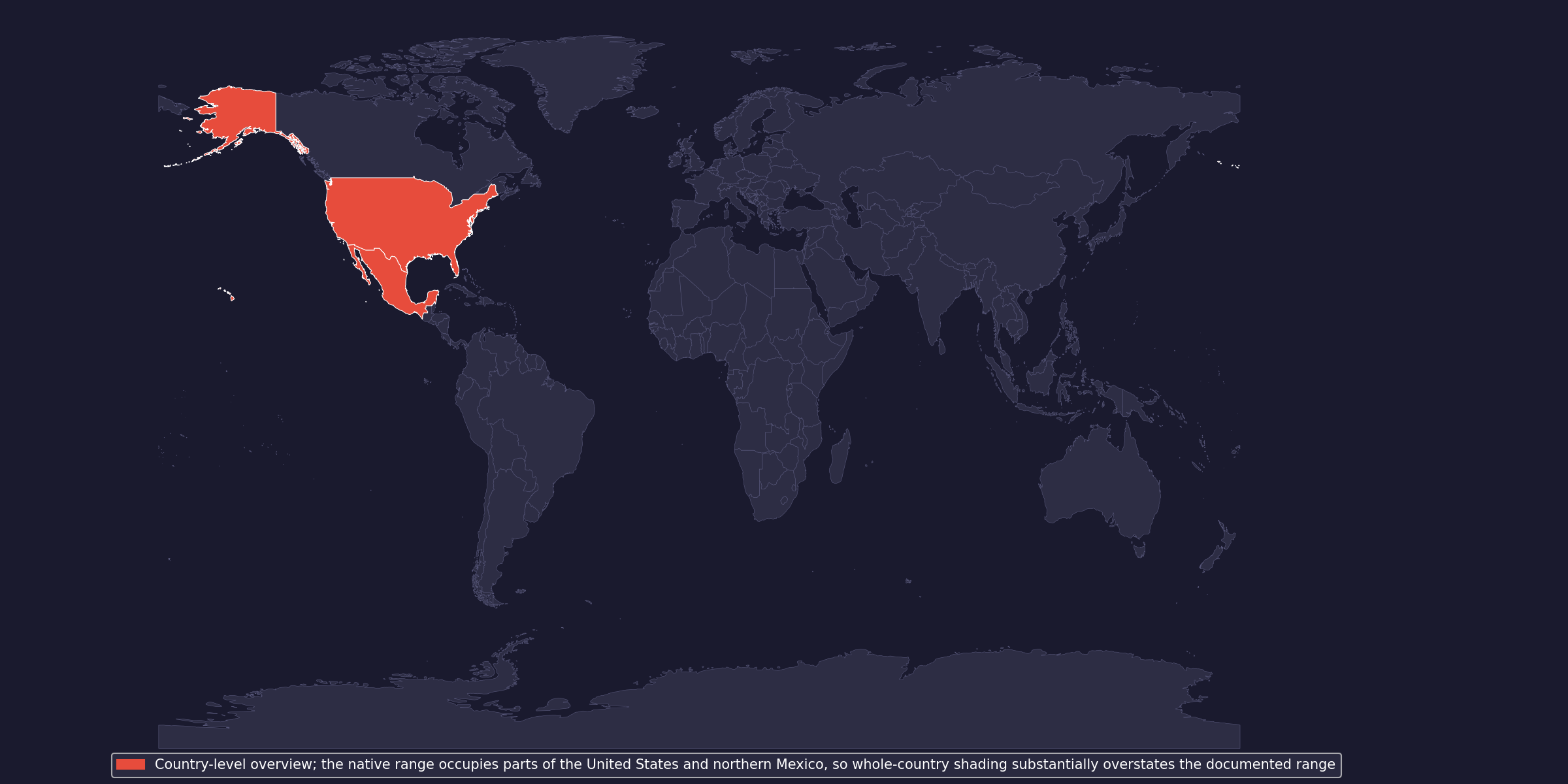
The accepted species occurs in the United States and northern Mexico. The Reptile Database reports it from Arizona, Nevada, southeastern Utah, southern Colorado, New Mexico, Texas, Oklahoma, Kansas, Missouri, Illinois, Arkansas, and western Louisiana, and from Sonora, Chihuahua, northern Durango, Coahuila, northern Zacatecas, Nuevo León, San Luis Potosí, and southwestern Tamaulipas in Mexico. Boundaries differ among taxonomic treatments, particularly in western populations.
Habitats include exposed limestone and granite glades, rocky slopes, canyon margins, desert scrub, and open grassland with abundant basking stones and underground refuge. Eastern populations can experience humid summers and cold winters; Mexican Plateau populations are generally drier. The species regulates its body temperature by switching rapidly between hot exposed rock and protected cracks, so a terrarium must provide both.
🌡 Climate across the native range
Monthly normals from reviewed GBIF occurrences representing the continental eastern and Mexican plateau portions of the native range:
Comanche County, Oklahoma — United States (reviewed C. collaris occurrence)
| Month | Min °C | Mean °C | Max °C | RH % |
|---|---|---|---|---|
| January | 0 | 4.4 | 10.9 | 63 |
| February | 2 | 6.8 | 13.7 | 61 |
| March | 6.6 | 11.6 | 18.8 | 60 |
| April | 11.2 | 16.4 | 23.3 | 59 |
| May | 16.4 | 21.2 | 27.2 | 64 |
| June | 21.3 | 26 | 31.4 | 62 |
| July | 23.7 | 28.7 | 34 | 54 |
| August | 23.4 | 28.3 | 33.7 | 54 |
| September | 19.1 | 23.7 | 29.3 | 59 |
| October | 12.8 | 17.4 | 23.3 | 60 |
| November | 6.4 | 10.7 | 16.5 | 63 |
| December | 1.2 | 5.3 | 11.1 | 64 |
Coahuila — Mexico (reviewed C. collaris occurrence; Mexican Plateau)
| Month | Min °C | Mean °C | Max °C | RH % |
|---|---|---|---|---|
| January | 6 | 11.9 | 19.1 | 51 |
| February | 7.7 | 14.2 | 21.8 | 45 |
| March | 9.7 | 16.7 | 24.5 | 40 |
| April | 12.5 | 19.6 | 27.3 | 38 |
| May | 14.6 | 21.3 | 28.5 | 47 |
| June | 15.6 | 21.6 | 28.1 | 55 |
| July | 15.3 | 20.9 | 27 | 58 |
| August | 15.4 | 21.1 | 27.2 | 57 |
| September | 14.4 | 19.4 | 25.1 | 65 |
| October | 12.1 | 17.9 | 24.3 | 58 |
| November | 9 | 14.8 | 21.6 | 55 |
| December | 6.7 | 12.6 | 19.6 | 52 |
Weather data by Open-Meteo.com · CC BY 4.0 · Monthly normals calculated by Herpeton Academy from daily archive values.
Location references use GBIF.org occurrence data where available; original occurrence records retain their source dataset licenses.
⚖️ Legal status
Checked on 2026-09-04: Crotaphytus collaris was not found in the current CITES Appendices or Annexes A-D of Commission Regulation (EU) 2026/1383. It is not a European native covered by the Bern Convention appendices. This absence of international listing does not override wildlife law at the place of capture, export, import, sale, or ownership.
Some US states protect native reptiles or regulate collection, possession, and commercial activity; Mexican wildlife and export rules also apply. Buy documented captive-bred stock and keep the invoice, breeder identity, locality or subspecies claim, transfer history, and import papers where relevant. Never collect a wild animal or transport one across a border without checking the competent wildlife authority.
🤌 Husbandry
Provide one adult with at least 120 x 60 x 60 cm, front-opening and well ventilated. The length matters: this animal accelerates rapidly and uses horizontal routes. Use the adult enclosure for juveniles when it contains many tight hides and feeding can be observed. Seal cable holes and door gaps before arrival; a juvenile can disappear through a surprisingly small opening.
House singly by default. Adult males are territorial, and females can also be chased, blocked from heat, or overbred. Keeping a pair or group is a breeding-management decision requiring substantially more room, duplicate basking and feeding stations, continuous condition monitoring, and ready spare enclosures—not a social requirement.
Quarantine newcomers for 60-90 days away from the collection with dedicated tools. Use paper initially, multiple opaque hides, and a humid retreat. Record weight, appetite, feces, shedding, limbs, jaw, and breathing. Wild-caught or imported animals, and any lizard with weight loss or abnormal feces, need a reptile-veterinary examination and fecal testing as indicated.
💡 Lighting
Collared lizards are full-sun baskers. Install a linear T5 HO UVB lamp over the warm half and strong white daylight over most of the enclosure. Measure a Ferguson Zone 3 gradient, targeting approximately UVI 4.5-6 at the animal’s back on the main basking site, intermediate exposure nearby, and near-zero UV in enclosed retreats. Mesh type, reflector, distance, and lamp age all change the result.
Use 12-14 hours of light through the active summer and shorten gradually only as part of a planned seasonal cycle. Heat, UVB, and bright visible light should overlap to form a convincing patch of sunlight. Replace lamps by meter reading or manufacturer schedule. Coloured night lamps and all-night visible light disrupt the dark period.
🌡 Heating and temperature
Build a broad basking platform with several connected surfaces from about 40 to 48°C, allowing the entire body to warm without contacting an extreme hot spot. Maintain general warm-side air around 28-32°C, a cool zone of 25-28°C, and active-season nights around 20-26°C. The lizard must always be able to leave the heat; field-based modelling shows that inadequate refuge can turn territorial exclusion into dangerous overheating.
Use a cluster of dimmed or thermostatically controlled halogen flood lamps. Measure stone surfaces with an infrared thermometer and air at animal height with digital probes. Heat rocks, narrow spot beams, and unregulated internal lamps can burn. Do not judge temperatures from the thermostat dial alone.
💧 Humidity and water
For C. collaris, start with general humidity around 40-60% and adjust to locality, room, sheds, and veterinary findings. Keep the basking surface dry, maintain strong ventilation, and provide a cool retreat with slightly damp substrate around 60-80%. Brief morning misting can simulate dew; do not keep the entire enclosure wet.
Provide a small stable bowl of clean water even if drinking is rarely observed, changing it daily or when contaminated. Persistent condensation, mould, or damp warm hides indicate excessive moisture, while sunken eyes, sticky saliva, difficult sheds, and chronically wrinkled skin suggest inadequate hydration or illness.
🌿 Enclosure and decoration
Lay at least 10 cm of compactable substrate; females need a secluded nesting area 15-20 cm deep. A useful mix is approximately 60% fertilizer-free topsoil and 40% washed fine play sand, packed firmly enough to support running and shallow digging. Keep sick, injured, or newly quarantined animals on paper until observation or wound care no longer requires it.
Create an open, pale stone basking platform plus cooler caves, cork tunnels, stable rock cracks, low branches, and visual barriers. Fix all heavy rocks to the base or bond them into stable structures before adding soil. Arrange a continuous running route rather than filling every centimetre with decoration. Safe drought-tolerant plants and leaf pockets can add cover without removing open sun.
Avoid calcium sand, ground walnut, sharp gravel, reptile carpet, aromatic wood, and loose stone stacks. Impaction risk is increased by dehydration, low digestive temperatures, oversized prey, illness, and food heavily coated in substrate; a well-built naturalistic floor is not a substitute for correct heat and hydration.
🪳 Feeding
Feed juveniles a varied small insect meal daily. Healthy adults usually need a measured meal on four to six days weekly rather than unlimited prey; adjust to activity and body condition. Offer only what is hunted promptly and remove insects that hide. Prey should generally be no wider than the space between the eyes.
Rotate gut-loaded crickets, legal roaches, locusts where permitted, silkworms, black soldier fly larvae, darkling beetles, and occasional higher-fat larvae. Vertebrate prey is unnecessary for routine care despite natural predation on small lizards. A small weekly portion of pesticide-free leafy greens or edible flowers can be offered as enrichment, but insects remain the dietary base.
🧂 Supplements
Gut-load insects for 24-48 hours with a balanced feeder diet and hydration source. With measured high-quality UVB, lightly dust most juvenile meals and around every second or third adult meal with plain calcium without phosphorus or D3 as a starting point. Give an appropriate reptile multivitamin containing preformed vitamin A and calcium with D3 less often, following the label and considering actual UVB exposure.
Do not layer several complete products or coat prey so heavily that it is refused. Growth, reproductive condition, feeder composition, and lamp output change the plan, so keep records and review it with a reptile veterinarian if body condition or egg production changes.
💤 Winter rest
Wild populations undergo winter inactivity, and established breeders often use a controlled cool rest. It is not an automatic procedure for every pet. Only a healthy, well-conditioned, parasite-screened animal should be cooled, after food is stopped and the digestive tract has cleared while normal basking remains available.
Protocols vary by locality and breeding goal. A gradual reduction of photoperiod and temperature toward roughly 8-15°C is used in specialist programs, followed by an equally gradual return. Do not cool a juvenile, thin or sick animal, recent arrival, or an animal whose origin and health are unknown. Without a monitored cool facility and experienced guidance, maintain normal safe care instead of attempting brumation.
🥚 Breeding notes
Mature males usually have broader heads, stronger colour, and enlarged post-cloacal scales; reproductive females may develop orange markings. Colour alone is not reliable sexing. Introductions must be supervised because courtship and territorial aggression can injure either animal. Separate after mating and monitor female weight and calcium intake.
Research on captive Oklahoma animals reported clutches of 4-9 eggs, with an average near 6.4. Provide a slightly moist, secluded nest chamber at least 15-20 cm deep. A practical breeder range is 26-29°C for approximately 49-81 days, but development time changes strongly with temperature. Incubation temperature can also influence hatchling sex ratios even though later work found sex chromosomes, so do not experiment with extreme values.
Use a calibrated incubator, individually record eggs, weigh the incubation medium and water, preserve egg orientation, and plan separate rearing space before mating animals. Repeated digging without laying, weakness, straining, swelling, or collapse requires urgent reptile-veterinary care; do not massage the abdomen.
🩺 Common problems
Frequent preventable problems include metabolic bone disease from weak UVB, inadequate calcium, or low basking heat; burns and heat stress; obesity; dehydration and retained shed; impaction; mouth or respiratory infection; live-prey wounds; parasites in wild-origin animals; and trauma from unstable stone or incompatible cage-mates. Chronic hiding can reflect inadequate cover just as easily as low temperature.
Seek veterinary help for sustained weight loss, soft or swollen jaw, tremors, bowed limbs, weakness, sunken eyes, abnormal feces, mites, blackened toes, pus in the mouth, wheezing, mucus, open-mouth breathing away from basking, burns, or reproductive straining. Never catch this fast lizard by the tail; scoop from below, support the body, and handle only when necessary.
📌 Conclusion
The eastern collared lizard is best for a keeper who wants to observe sprinting, basking, hunting, and seasonal behaviour in a bright spacious enclosure. Have the long terrarium, measured UVI, broad heat patch, cool refuge, and reliable live-food supply operating before the animal arrives.
📚 Sources and further reading
- ReptiFiles: collared lizard care sheet
- British Herpetological Society: keeping and breeding Crotaphytus collaris
- Santoyo-Brito et al. 2017: incubation temperature and hatchling sex ratio
- Brewster et al. 2020: temperature and digestive performance
- The Reptile Database: Crotaphytus collaris
- GBIF Backbone Taxonomy: Crotaphytus collaris
- Baines et al. 2016: UVB provision for captive reptiles
- CITES Appendices, checked 2026-09-04
- Commission Regulation (EU) 2026/1383, checked 2026-09-04
- Bern Convention appendices, checked 2026-09-04