Share

Monkey-tailed Skink
🔤 Taxonomy
Corucia zebrata is the accepted scientific name and the only species in its genus. Monkey-tailed skink, prehensile-tailed skink, and Solomon Islands skink are common English names. Locality and subspecies labels occur in the trade; keep them in breeding and transfer records instead of pairing animals solely by appearance.
📌 Description
This is the largest living skink: a heavy-bodied, fully arboreal herbivore with powerful claws and a muscular prehensile tail. Adults are usually 60-80 cm long and may approach 1 kg. Captive animals can live 20-30 years.
The species is mainly crepuscular to nocturnal and uses a three-dimensional forest canopy rather than an exposed basking platform. Published observations show body temperatures around 30°C achieved by selecting among shaded and warmer microhabitats. The practical lesson is choice: foliage, branch thickness, height, shade, and temperature must vary throughout the enclosure.
Monkey-tailed skinks form social units in nature, but unfamiliar adults can attack each other severely. Social biology is not permission to place newly acquired animals together.
🌍 Distribution
The species is native to the Solomon Islands archipelago, with the Bougainville form extending into Papua New Guinea. It lives in humid tropical forest, usually in large trees with dense epiphytic growth and edible browse.
Wild collection, habitat loss, island-locality differences, and very slow reproduction make documented captive-bred stock especially important.
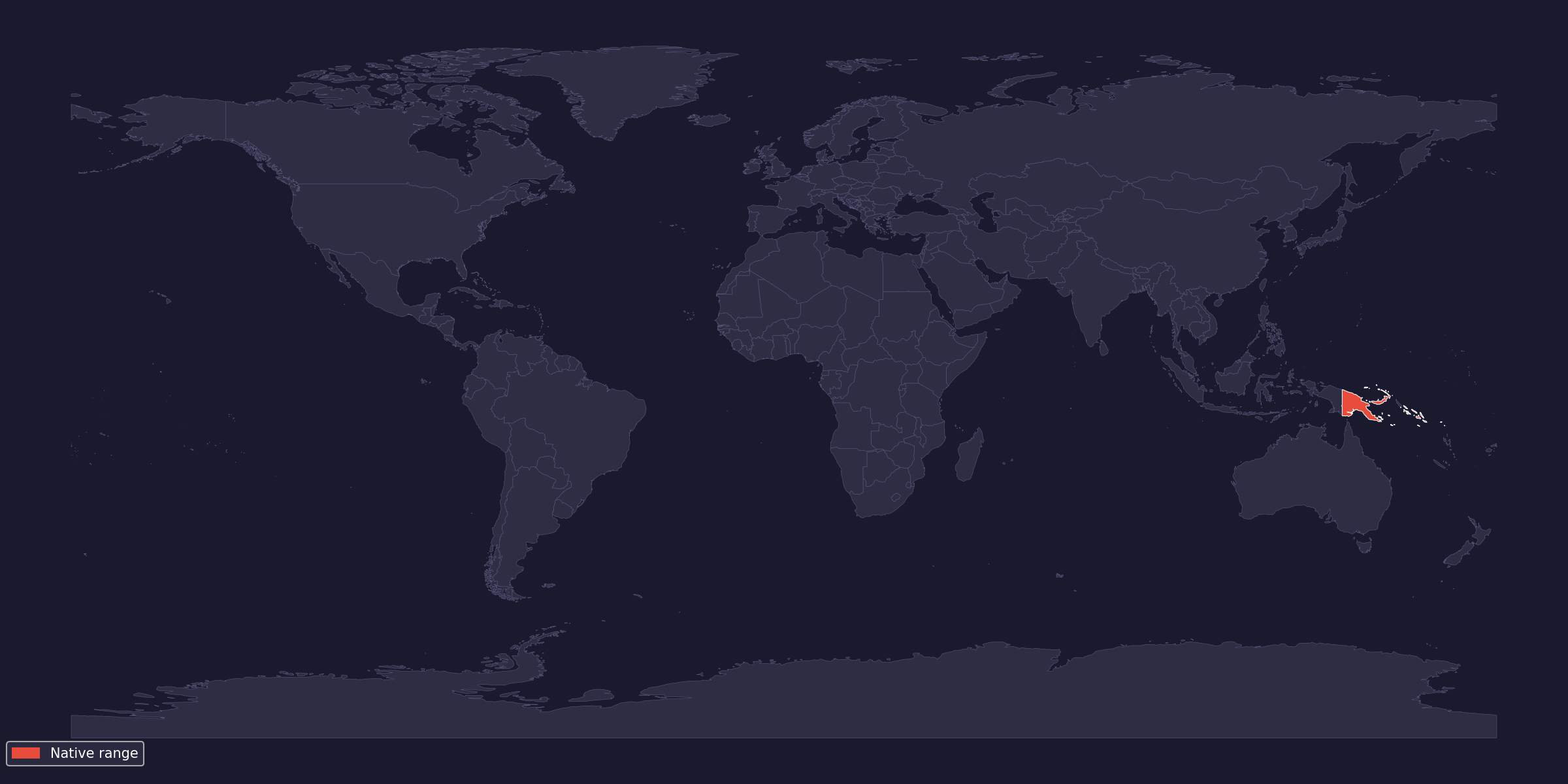
🌡 Climate across the native range
Monthly climate normals from reviewed GBIF occurrence locations on two Solomon Islands:
Guadalcanal Province — Solomon Islands
| Month | Min °C | Mean °C | Max °C | RH % |
|---|---|---|---|---|
| January | 23.6 | 25.4 | 27.7 | 89 |
| February | 23.6 | 25.3 | 27.6 | 89 |
| March | 23.5 | 25.2 | 27.6 | 90 |
| April | 23.5 | 25.2 | 27.5 | 90 |
| May | 23.6 | 25.2 | 27.4 | 89 |
| June | 23.6 | 25 | 27.2 | 88 |
| July | 23.4 | 24.8 | 26.9 | 87 |
| August | 23.2 | 24.7 | 26.9 | 86 |
| September | 23.3 | 24.9 | 27.2 | 87 |
| October | 23.3 | 25 | 27.4 | 87 |
| November | 23.3 | 25.2 | 27.7 | 88 |
| December | 23.5 | 25.4 | 27.8 | 89 |
Isabel Province — Solomon Islands
| Month | Min °C | Mean °C | Max °C | RH % |
|---|---|---|---|---|
| January | 22.3 | 23.8 | 26.1 | 87 |
| February | 22.1 | 23.6 | 25.9 | 88 |
| March | 22.1 | 23.6 | 26 | 88 |
| April | 22.1 | 23.7 | 26 | 88 |
| May | 22.1 | 23.5 | 25.8 | 88 |
| June | 21.9 | 23.2 | 25.4 | 89 |
| July | 21.6 | 22.9 | 25 | 89 |
| August | 21.5 | 22.9 | 25.1 | 87 |
| September | 21.6 | 23.1 | 25.5 | 87 |
| October | 21.7 | 23.3 | 25.8 | 87 |
| November | 22 | 23.7 | 26.1 | 87 |
| December | 22.2 | 23.9 | 26.2 | 87 |
Weather data by Open-Meteo.com · CC BY 4.0 · Monthly normals calculated by Herpeton Academy from daily archive values.
Location references use GBIF.org occurrence data where available; original occurrence records retain their source dataset licenses.
⚖️ Legal status
Checked on 2026-08-05: Corucia zebrata is listed in CITES Appendix II and EU Annex B. The Bern Convention is not relevant to this Pacific-island species.
Keep the original invoice, breeder and seller identity, locality information, captive-origin or transfer record, and CITES import or re-export documents where applicable. Verify national rules for acquisition, sale, breeding, registration, and transport before ownership changes.
🤌 Husbandry
For one adult, use at least 120 x 90 x 180 cm; a compatible pair or established family unit needs substantially more usable volume and duplicate resources. Height counts only when trunks, branches, feeding stations, hides, and thermal choices fill it.
House a new animal alone through quarantine. Never introduce an unfamiliar skink directly into an established animal’s enclosure. Any later introduction needs neutral territory, visual stages, multiple feeding sites, close observation, and a separate permanent enclosure ready. Separate immediately after biting, blocking, persistent pursuit, weight loss, or exclusion from heat and food.
💡 Lighting
Provide bright broad-spectrum visible light and a linear T5 UVB lamp over part of the canopy. Plan around Ferguson Zone 2, with measurable low-to-moderate UV at accessible upper branches and deep shade next to it. Use an 11-13 hour photoperiod and no visible light at night.
Do not create one exposed, scorching perch. This species often regulates by moving through filtered warmth and shade. Replace lamps on schedule or according to meter readings.
🌡 Heating and temperature
- ambient day: 24-28°C
- local warm branch or basking area: 30-34°C
- cool shaded retreat: 22-25°C
- night: 20-24°C
A published six-year breeding account used a mean enclosure temperature near 25°C with animals choosing lamp-warmed positions of 28-34°C. Another thermal study found target body temperatures around 30°C and emphasized structural diversity.
Use thermostated overhead heat, guarded from contact, and measure at several heights. Avoid hot rocks, undertank heaters as the primary source, and prolonged air temperatures above the high 20s without cooler forest retreats.
💧 Humidity and water
Maintain about 60-80% relative humidity, rising to 70-85% after misting and during shedding, with steady cross-ventilation. Mist foliage so drinking droplets are available, then allow surfaces to partly dry. Saturated substrate and still air encourage skin and respiratory disease.
Provide a heavy clean water bowl and, if practical, a second elevated bowl. Change water daily. A drainage layer or drainable substrate system is strongly recommended in planted enclosures.
🌿 Enclosure and decoration
Build a connected canopy of thick trunks, thinner grip branches, cork hollows, shelves, vines, and dense visual cover. The tail must be able to wrap around safe supports. Include hides and feeding ledges at warm, intermediate, and cool heights.
Use 8-12 cm of moisture-buffering soil and leaf litter over drainage. Select non-toxic plants that can survive a heavy browsing skink, and verify every plant before use. Protect lamps and cables; secure branches so a 1 kg animal cannot rotate or pull them down.
🥬 Feeding
The diet should be browse-led and herbivorous. A zoo diet sheet uses fresh browse for 50-75% of each feed, commercial greens for less than 25% when browse is unavailable, and fruit around 25%. For home care, prioritize safe pesticide-free leaves and flowers, dark leafy greens, and varied vegetables; keep fruit limited rather than making it the sweet staple.
Useful foods include mulberry, hibiscus, grapevine and other verified safe browse, dandelion, endive, escarole, mustard or turnip greens, squash, green beans, peppers, and a smaller rotation of papaya, fig, berries, or melon. Avoid avocado, rhubarb, onion-family foods, unknown ornamental plants, and animal protein as a routine food.
Offer adults fresh food three to five times weekly and growing or reproductive animals more often. Use calcium and a controlled reptile-herbivore multivitamin according to UVB and product guidance. Track body weight, droppings, and food selection; repeated preference for fruit should not dictate the menu.
🥚 Breeding notes
Reproduction is viviparous. Females usually produce one exceptionally large young, sometimes twins, after about six months of gestation; births may be 10-12 months apart. The low reproductive rate makes casual breeding and uncertain-locality pairing poor choices.
Established adults may protect young, but this does not guarantee that every captive group is safe. Observe feeding access and body condition closely and keep separation housing ready.
🧍 Handling and safety
Handle only for health checks and controlled transfers. Allow the skink to grip a branch or padded forearm, support the torso, and never pull the prehensile tail free. A defensive adult has a powerful bite that can cause deep crushing injury.
Use a secure shift box for veterinary transport. Children should not handle this species.
🩺 Common problems
Common failures include obesity or nutrient imbalance from fruit-heavy diets, metabolic bone disease, dehydration, retained shed around toes, skin infection in stagnant wet housing, burns, falls, bite wounds from introductions, and stress-related appetite loss. Recently traded animals may carry internal or external parasites.
Watch for weak grip, a soft or swollen jaw, tremors, tail or toe constriction, wheezing, nasal bubbles, persistent hiding, exclusion from food, abnormal feces, or sustained weight change. Quarantine and reptile-veterinary assessment are essential before social introductions.
📌 Conclusion
Monkey-tailed skinks need more than a tall humid box. Success depends on a structurally dense canopy, mild thermal choice, measured UVB, reliable browse, meticulous documentation, and a cautious plan for every social introduction.
📚 Sources and further reading
- Mann & Meek: thermal biology and activity of Corucia zebrata
- Schmidt: husbandry and reproduction of Corucia zebrata
- Colchester Zoological Society: Solomon Island skink diet sheet
- The Reptile Database: Corucia zebrata
- GBIF Backbone Taxonomy: Corucia zebrata
- CITES species record: Corucia zebrata
- EU wildlife-trade regulation, consolidated 29 June 2026, checked 2026-08-05