Share

Sudan Plated Lizard
🔤 Taxonomy
Broadleysaurus major (Duméril, 1851) is the accepted name used by GBIF and the modern molecular classification of African plated lizards. Most older books, import documents, and sale listings call it Gerrhosaurus major. The 2013 phylogenetic revision moved the species into the newly described genus Broadleysaurus and did not support the traditional subspecies G. m. bottegoi as a separate taxon.
Useful trade names include Sudan plated lizard, rough-scaled plated lizard, great plated lizard, and Broadley’s rough-scaled plated lizard. German sources often use Sudan-Schildechse or Braune Schildechse. The name “Sudan plated lizard” does not define its whole range and should never replace the scientific name on paperwork.
📌 Description
This is a stocky, strongly armoured lizard from African rocky savannas and open woodland. The head is short, the rectangular dorsal scales are heavily keeled, and adults are commonly 30-35 cm long, although large individuals may approach 50-60 cm. Captive longevity is imperfectly documented: plan for at least 10-15 years, with credible keeper records exceeding 20 years.
The species is active, powerful, and usually shy when newly imported. It wedges into narrow cracks and can inflate its body, making forced removal dangerous. A well-acclimated animal may approach for food, but this is primarily an observation species. Its space requirement, intense lighting, mixed diet, and common wild-caught origin make it an intermediate project rather than a forgiving first reptile.
| Parameter | Practical target |
|---|---|
| Adult size | commonly 30-35 cm; exceptional animals 50-60 cm |
| Enclosure for one adult | at least 150 x 90 x 75 cm |
| Basking surface | 40-46°C over an area broad enough for the body |
| Cool zone | 23-26°C |
| Night | 15-22°C; heat only if the room falls below 15°C |
| Humidity | dry exposed areas 20-40%; moist retreats 50-80% |
| UVB | Ferguson Zone 3; measured basking UVI about 4-6 |
| Food | varied live invertebrates plus leafy foods and flowers |
| Quarantine | 60-90 days; fecal testing strongly advised for imports |
🌍 Distribution
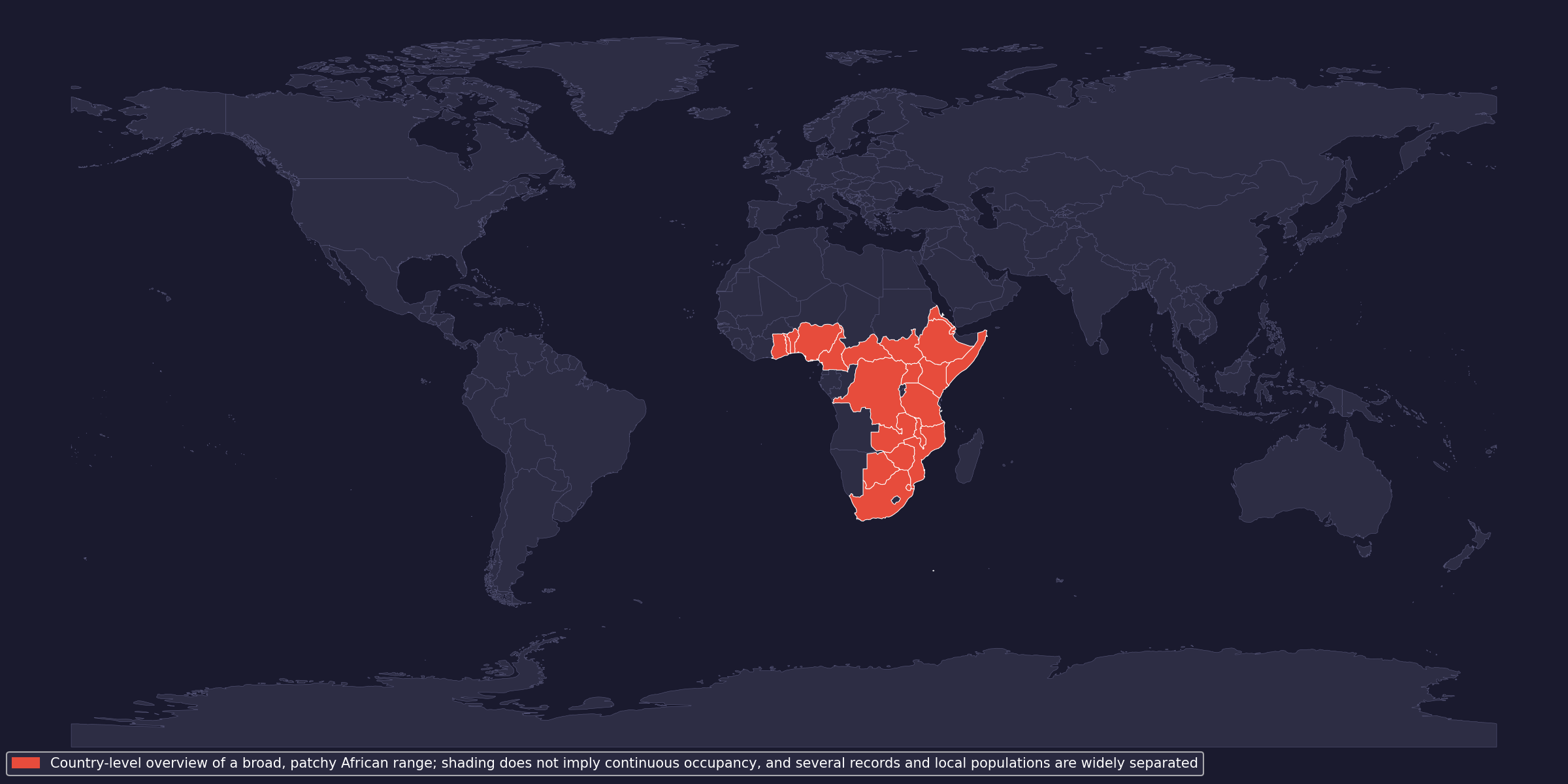
Broadleysaurus major has a wide but patchy African distribution. Records extend through East Africa from Eritrea, Ethiopia, Somalia, Djibouti, South Sudan, Uganda, Kenya, and Tanzania, south through northern Zambia, Malawi, Mozambique, Zimbabwe, Botswana, Eswatini, and northeastern South Africa. Scattered populations are also reported from the Democratic Republic of the Congo, Central African Republic, Cameroon, Nigeria, Benin, Togo, and Ghana. The type locality is Zanzibar, Tanzania.
It occupies rocky, semi-open places in dry and moist savanna, thicket, and coastal woodland, from near sea level to about 1,700 m. Rock piles, hills, termite mounds, animal burrows, and tight cracks provide safer and cooler microclimates than open-air weather readings suggest. The country-level range map therefore shows documented national presence, not continuous habitat.
🌡 Climate across the native range
Monthly normals from reviewed GBIF occurrences representing inland East African, coastal East African, and southern savanna portions of the very broad native range:
Manyara Region — Tanzania (reviewed B. major occurrence; inland East Africa)
| Month | Min °C | Mean °C | Max °C | RH % |
|---|---|---|---|---|
| January | 18.7 | 24.2 | 30 | 63 |
| February | 19 | 24.9 | 31.1 | 59 |
| March | 19.3 | 24.1 | 29.9 | 67 |
| April | 18.8 | 22.3 | 26.9 | 77 |
| May | 17 | 21 | 25.7 | 75 |
| June | 15 | 20.1 | 25.7 | 67 |
| July | 14.1 | 19.8 | 25.8 | 62 |
| August | 15.3 | 21 | 27.2 | 58 |
| September | 16.6 | 22.8 | 29.5 | 52 |
| October | 18 | 23.9 | 30.4 | 53 |
| November | 18.8 | 23.7 | 29.6 | 63 |
| December | 18.9 | 23.7 | 29.3 | 66 |
Kilifi County — Kenya (reviewed B. major occurrence; coastal woodland)
| Month | Min °C | Mean °C | Max °C | RH % |
|---|---|---|---|---|
| January | 25 | 27 | 29.7 | 77 |
| February | 25 | 27.1 | 30 | 77 |
| March | 25.5 | 27.8 | 30.5 | 77 |
| April | 25.2 | 27.1 | 29.2 | 81 |
| May | 24.5 | 25.9 | 27.5 | 82 |
| June | 24 | 25.2 | 26.6 | 78 |
| July | 23.2 | 24.5 | 26 | 78 |
| August | 23 | 24.4 | 26.3 | 78 |
| September | 23.3 | 24.9 | 27 | 78 |
| October | 23.9 | 25.7 | 27.8 | 79 |
| November | 24.4 | 26.5 | 28.6 | 81 |
| December | 25.1 | 27.1 | 29.4 | 79 |
Mpumalanga — South Africa (reviewed B. major occurrence; southern savanna)
| Month | Min °C | Mean °C | Max °C | RH % |
|---|---|---|---|---|
| January | 21.3 | 25.7 | 30.7 | 70 |
| February | 21.4 | 25.8 | 30.9 | 70 |
| March | 20.4 | 25 | 30.2 | 70 |
| April | 17.8 | 22.8 | 28.3 | 68 |
| May | 14.6 | 20.5 | 26.9 | 63 |
| June | 11.9 | 18.2 | 25.1 | 60 |
| July | 11.5 | 17.9 | 24.7 | 59 |
| August | 13.4 | 19.8 | 26.7 | 57 |
| September | 16.1 | 22.4 | 29.1 | 56 |
| October | 17.7 | 23.3 | 29.4 | 61 |
| November | 19.2 | 24.4 | 30 | 65 |
| December | 20.5 | 25.5 | 30.8 | 68 |
Weather data by Open-Meteo.com · CC BY 4.0 · Monthly normals calculated by Herpeton Academy from daily archive values.
Location references use GBIF.org occurrence data where available; original occurrence records retain their source dataset licenses.
⚖️ Legal status
Checked on 2026-09-04: neither Broadleysaurus major nor its older combination Gerrhosaurus major was found in the current CITES Appendices or Annexes A-D of Commission Regulation (EU) 2026/1383. It is not a European native covered by the Bern Convention appendices. No species-specific international listing was identified; import, sale, transport, and ownership can still be controlled nationally.
Keep the invoice, seller or breeder identity, scientific name, country of origin, import papers where applicable, and the transfer history. Ask explicitly whether the animal is captive-bred, captive-born, or wild-caught—these terms are not interchangeable. Captive-bred stock is preferable. Newly imported plated lizards often arrive stressed, dehydrated, thin, or carrying parasites, and unexplained origin is a welfare and traceability warning.
🤌 Husbandry
House one adult alone. A 150 x 90 x 75 cm enclosure meets a useful welfare-oriented starting point for an animal near the reported maximum snout-vent length; larger floor area is valuable. A 120 x 60 x 60 cm enclosure is encountered as a lower hobby minimum, but it sharply limits the gradients and activity space available to a large adult. Juveniles can use a well-furnished adult enclosure if feeding is monitored.
Do not house plated lizards with bearded dragons or other reptiles. They do not need companionship, and shared heat, food, hides, and parasites create avoidable risks. Never keep males together. A presumed pair can also fight, so breeding attempts require separate housing and supervised introduction.
Quarantine every arrival for 60-90 days in a separate room where possible, using dedicated tools and simple cleanable surfaces. Provide secure hides even during quarantine; paper is useful temporarily but should not be the permanent substrate. Record weight weekly, appetite, feces, urates, skin, breathing, and activity. Arrange an examination by a reptile-experienced veterinarian and fecal testing for wild-caught animals, imports, or any individual with weight loss or abnormal stools.
💡 Lighting
This exposed, diurnal basker requires UVB, strong visible light, and overhead heat. Use a linear T5 HO UVB lamp over roughly half the enclosure, overlapping a bright warm side while leaving deep shade. Build and measure a Ferguson Zone 3 gradient: a basking UVI around 4-6, fading through intermediate areas to near zero inside retreats. Measure at the height of the lizard’s back through the installed mesh; lamp percentage alone does not predict exposure.
Add a high-output daylight LED across much of the enclosure. Use 12 hours of light for a simple year-round schedule, or change gradually between about 10 winter and 14 summer hours when managing a healthy animal seasonally. UVB output, daylight, and heat all decline with distance and obstruction, so verify the finished installation before the animal arrives. Do not use coloured night lamps.
🌡 Heating and temperature
Create a broad stone basking surface at 40-46°C, not a tiny hot dot. Maintain warm-side air around 26-32°C and a genuinely accessible cool zone of 23-26°C. Night temperatures may fall to 15-22°C; non-light-emitting background heat is needed only when the room would drop below the safe lower limit. These values are choices within one enclosure, not a uniform target.
Use a cluster of thermostatically controlled halogen flood lamps so the whole torso can warm evenly. Measure the surface with an infrared thermometer and monitor warm and cool air with digital probes. Secure lamps behind guards when mounted internally. Heat rocks, small intense spot lamps, and unregulated mats under deep soil can burn or trap a hidden animal. A cool retreat must remain available even on the hottest day.
A planned cool season is used by some breeders, but methods and incubation reports vary. Do not cool a juvenile, new arrival, underweight or ill animal, or any lizard that has not finished digesting. Seasonal cycling is optional for ordinary care and should never be improvised merely because outdoor winter has begun.
💧 Humidity and water
The enclosure should contain a moisture gradient rather than one humidity number. Exposed warm surfaces may measure roughly 20-40%, while lower soil and a cool humid hide can remain around 50-80%. Water the deeper layer or one end, then allow the surface to dry. Persistent condensation, wet stone, sour soil, or stagnant air means the setup needs less water or more ventilation.
Provide a stable shallow bowl of fresh drinking water and change it daily or whenever fouled; plated lizards may defecate in it. The animal must be able to enter and leave without being trapped. Routine forced soaking is unnecessary. Sunken eyes, tacky saliva, dry constricting shed, or reduced urates require a review of hydration and veterinary assessment if they persist.
🌿 Enclosure and decoration
Use at least 15 cm of firm, excavatable substrate; 20-25 cm in part of a tall enclosure gives better burrowing and nesting opportunity. A practical starting mix is about 50% washed play sand, 30% fertilizer- and pesticide-free topsoil, and 20% excavator clay. Moisten and compact it so it supports shallow excavations but is not dusty or cement-hard. During quarantine or illness, use paper with several tight artificial hides until loose substrate is appropriate.
Build several narrow retreats from stone, securely bonded slate, cork, or artificial rock. Every heavy piece must rest on the enclosure base or a fixed support, never on loose soil that can be undermined. Include a broad pale basking slab, rough branches or logs, visual barriers, leaf litter in a moister corner, and safe edible plants if desired. The animal should be able to hide without becoming impossible to inspect.
Avoid calcium sand, ground walnut, aromatic cedar or pine, sharp loose rubble, reptile carpet, adhesive traps, and pure dry coconut fibre. Loose substrate is not an automatic impaction hazard, but risk rises when an animal is dehydrated, too cool, parasitized, fed oversized food, or allowed to swallow heavily coated prey. Use a clean feeding slab or bowl when needed.
🪳 Feeding
This species is omnivorous, with juveniles taking a greater proportion of animal prey. Offer hatchlings small insects and chopped leafy food daily. Juveniles can receive insects about five days weekly and greens daily; healthy adults generally do well with live prey twice weekly, leafy foods about four days weekly, and one no-food day. Adjust the portion to body condition rather than rewarding every food-seeking response.
Rotate gut-loaded crickets, legal roaches, locusts where permitted, silkworms, black soldier fly larvae, darkling beetles, earthworms, and captive-cultured snails. Prey should generally be no wider than the space between the eyes, and only as many insects as are eaten promptly should be released. Fatty larvae, egg, and vertebrate prey are rare or unnecessary treats, not staples.
Offer endive, escarole, rocket, mustard or turnip greens, dandelion, watercress, pesticide-free edible flowers, and spineless cactus. Fruit is sugar-rich and should be a small occasional treat. Avoid avocado, onion, rhubarb, unidentified wild plants, and food contaminated by fertilizers or pesticides.
🧂 Supplements
Gut-load feeder insects for 24-48 hours with a nutritionally balanced diet and moisture source. With correctly measured UVB, lightly dust most growing-animal insect meals and roughly every adult insect meal with plain calcium without phosphorus or D3. Use an appropriate reptile multivitamin containing preformed vitamin A and a D3-containing product less frequently, strictly following the label and accounting for UVB and diet.
Do not combine several complete supplements or assume more powder is safer. Reproductive females may need an individually reviewed plan, but indiscriminate calcium or vitamin D dosing can also cause disease. Replace products by their labelled shelf life and keep a feeding record.
🥚 Breeding notes
Adult males usually develop broader heads and more evident femoral pores, but visual sexing is not infallible. Females lay approximately 2-6 eggs in soft, slightly moist soil under cover. Provide a secluded nesting zone at least 20-25 cm deep even if breeding was not planned; a female can produce eggs without a current male.
Published and captive reports disagree markedly on incubation, reflecting temperature and probably population and method differences. A cautious documented working range is 27-29°C for roughly 80-145 days in a lightly moist medium; warmer protocols can hatch sooner. Use a calibrated incubator, weigh the medium rather than guessing, preserve egg orientation, and record actual shell temperature. Treat these values as a range to investigate, not a guarantee.
Breeding is difficult and should use healthy, unrelated animals of documented origin. Repeated digging, straining, hind-limb weakness, persistent swelling, or decline after the expected laying period may indicate egg binding and requires urgent reptile-veterinary care. Do not massage the abdomen or try home induction.
🩺 Common problems
Wild-caught imports are particularly vulnerable to internal parasites, mites, dehydration, transport injuries, and secondary infections. Other preventable problems include metabolic bone disease from inadequate UVB, calcium, diet, or heat; obesity and gout risk from excessive rich food; burns; respiratory infection; retained shed; toe or tail injury; mouth infection; and impaction associated with poor heat, hydration, or substrate-coated food.
Seek veterinary help for progressive weight loss, diarrhea or very foul feces, no feces despite feeding, mites, swollen limbs, a soft jaw, tremors, blackened digits, mouth discharge, persistent lethargy, wheezing, mucus, open-mouth breathing away from basking, or reproductive straining. Never pull an animal from a crevice or by the tail; it may shed the tail, damage the spine, or suffer internal injury while resisting.
📌 Conclusion
The Sudan plated lizard suits a keeper who can build a large, structurally safe rocky enclosure before purchase and maintain measured heat, UVB, moisture choices, and a varied omnivorous diet. Documented captive breeding and a disciplined quarantine plan matter more than tameness or a low purchase price.
📚 Sources and further reading
- ReptiFiles: Sudan plated lizard care manual
- Bates et al. 2013: molecular phylogeny and description of Broadleysaurus
- SANBI Atlas and Red List: Broadleysaurus major account
- The Reptile Database: Broadleysaurus major
- GBIF Backbone Taxonomy: Broadleysaurus major
- Baines et al. 2016: UVB provision for captive reptiles
- CITES Appendices, checked 2026-09-04
- Commission Regulation (EU) 2026/1383, checked 2026-09-04
- Bern Convention appendices, checked 2026-09-04