Share

Little Roly-Poly
🔤 Taxonomy
Venezillo parvus (Budde-Lund, 1885) is accepted and was originally Armadillo parvus. A 2020 revision made Sphaerillo boninensis a junior synonym; Venezillo evergladensis, Sphaerillo parvus and Spherillo parvus are also synonyms.
Trade colour names do not change the species. Preserve adult photographs of the hourglass telson, square-ended uropods and paired “spectacle” marks on each pereonite.
📌 Description
This small conglobating woodlouse is about 3-5 mm in reliable sources. It closes into a ball and often burrows or stays under fine litter. Check the telson and uropods to distinguish adults from juvenile Armadillidium.
| Care point | Practical target |
|---|---|
| Adult size | about 0.3-0.5 cm |
| Starter colony | 20 x 15 x 15 cm or larger |
| Temperature | 20-28°C |
| Substrate | 7-9 cm, humid and rich in decomposed leaves |
| Moisture | most lower substrate damp with fresh-air exchange |
| Main failure | drying, coarse vents, overfeeding or release |
🌍 Distribution
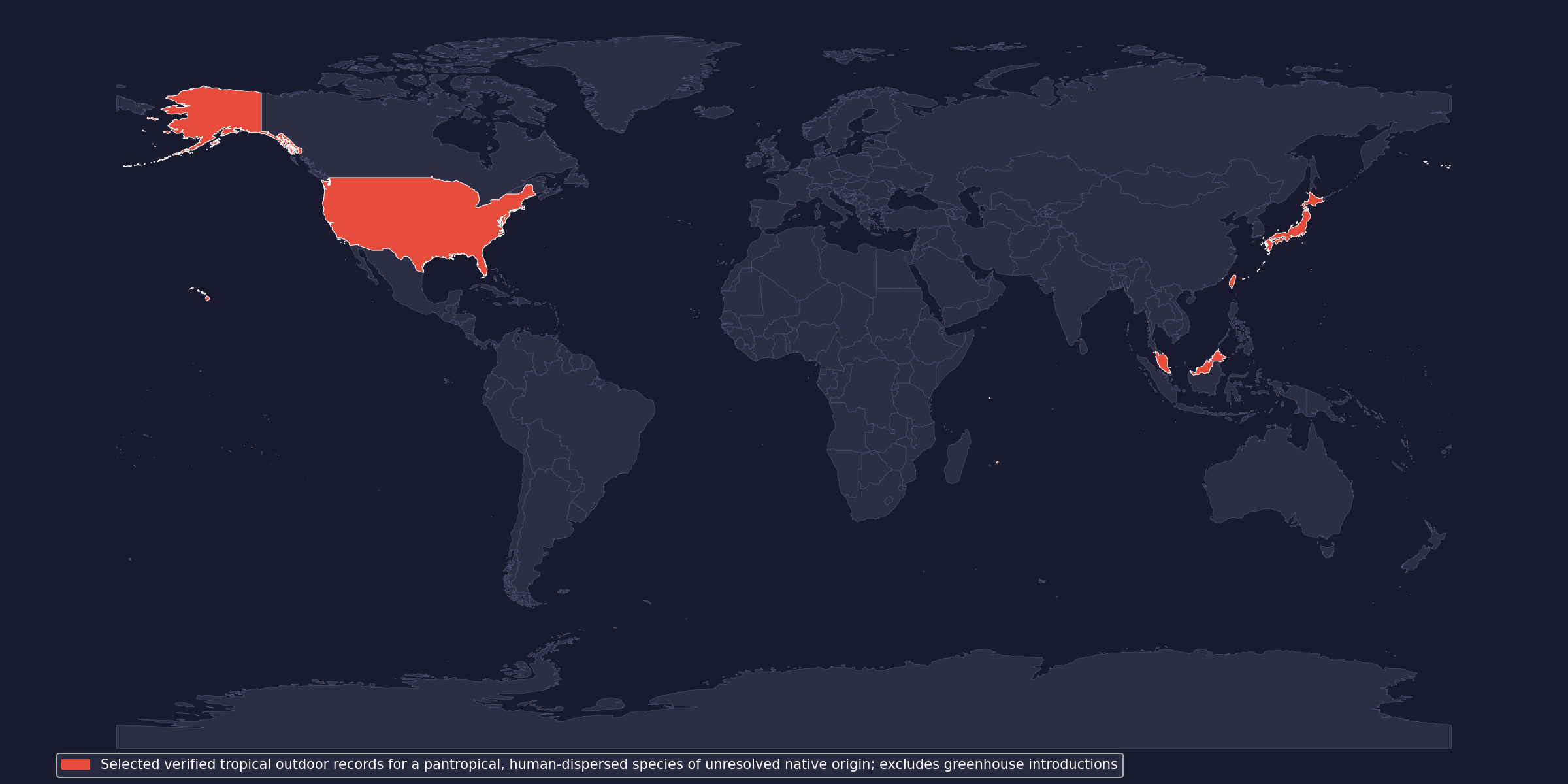
The species is pantropical and its original native area is unresolved after transport with plants and soil. Verified outdoor records include Seychelles, Mauritius, Malaysia, Japan’s Ogasawara Islands, Taiwan, and Florida, Georgia and Hawaii in the United States. It also persists in heated European glasshouses.
The map shows selected tropical outdoor records, not a claim that every country is native or fully occupied. Greenhouse introductions are excluded.
⚖️ Legal status
Local and national rules may still apply.
Checked on 2026-08-29: the species is not listed in CITES, EU wildlife-trade Annexes A-D or Bern Appendices II-III. Live-soil, plant-pest, invasive-organism and agricultural import rules may still control shipment.
Retain invoices and line history. Use escape-proof vents, sterilize discarded substrate and never release animals.
🤌 Husbandry
Start 20-30 animals in a secure 20 x 15 x 15 cm box. Cover openings with very fine mesh. Supply 7-9 cm of moisture-retentive substrate, deep leaf cover and low cork. Keep most lower substrate damp with gentle surface cross-flow.
Quarantine for 45-60 days. Confirm adults rather than assuming every tiny conglobating animal is V. parvus. ReptiFiles has no species guide, but current specialist sources agree on warm humid culture and slower establishment than dwarf whites.
💡 Lighting
UVB is unnecessary. Provide 10-14 hours of diffuse light and deep shade. Avoid direct sun and hot lamps.
🌡 Heating and temperature
Maintain 20-28°C, an 18-23°C retreat and nights around 18-24°C. Current captive guidance places the preferred band near 22-28°C. Avoid prolonged temperatures above 30°C.
Warm one external wall under thermostat control if needed. Never heat below because animals retreat downward for moisture and coolness.
💧 Humidity and water
Keep most lower substrate damp, with a slightly less-wet ventilated surface. Approximate 75-95% RH is useful, but the contact layer matters more. Do not let the refuge dry through.
Add measured water to substrate and use no dish. Dry leaves and disappearing mancae suggest too little water; condensation, sour odour and surface clustering suggest stagnation.
🌿 Enclosure and decoration
Use 7-9 cm of pesticide-free soil, mature leaf mould, rotten hardwood and moisture-retentive bark fines. Cover with fine hardwood leaves, cork and moss pockets. Keep crushed limestone or cuttlebone available.
Avoid fertilizer, aromatic wood and coir-only mixes. Fine mesh is mandatory. Retain most mature substrate because this burrower depends on its microbial layer.
🪳 Feeding
Leaves and rotten wood remain the staple. Offer tiny courgette, mushroom, carrot or squash every three to five days and very little protein weekly. Remove fresh leftovers within 24 hours. Excess food creates mites and fungus rapidly.
🥚 Breeding
“Viviparous” is the repository enum for marsupial brooding. Females retain eggs and embryos in a ventral pouch and release mancae.
Captive sources describe moderate reproduction and warn that colonies may pause after growth. Let a starter establish before exposure to predators. Do not isolate brooding females; divide only when several ages are abundant.
🩺 Common problems
- Drying: restore deep contact moisture before reducing airflow.
- Escapes: use very fine mesh and inspect the lid.
- Boom-and-pause growth: keep conditions stable and avoid excess food.
- Mould or mites: remove fresh food and improve gentle airflow.
- Misidentification: photograph adult telson, uropods and pigment.
- Release risk: sterilize every discarded culture material.
📌 Conclusion
The little roly-poly is a useful humid tropical culture when its tiny size is respected. Deep mature litter, stable warmth, fine containment and patience matter most.
📚 Sources and further reading
- GBIF: Venezillo parvus
- WoRMS: accepted name and synonyms
- Karasawa 2020: revision
- British Myriapod and Isopod Group
- The Bio Dude 2026: captive guidance
- ReptiFiles clean-up-crew overview
- CITES Appendices, valid from 5 March 2026
- Commission Regulation (EU) 2026/1383
- Bern Convention appendices