Share

East African Uramba Woodlouse
🔤 Taxonomy
Uramba triangulifera Budde-Lund, 1910 is accepted and is the type species of Uramba. Older literature confused some East African material with Lyprobius cristatus. Molecular work sampled verified U. triangulifera from Aberdare National Park, Kenya, while finding that current Porcellionidae boundaries need revision.
Trade stock has circulated as “Thermocellio sp. Tanzania.” Retain that hobby history separately from verified wild locality.
📌 Description
Field records span East African lowlands to about 2,500 m and include riverbank, swamp and savanna-region material. Brooding females and young are documented, but detailed tolerances are not. One hobby page reports animals to 1.2 cm and easy breeding; without independent support, adult size and lifespan are omitted from structured metadata.
| Care point | Cautious starting target |
|---|---|
| Starter colony | 25 x 18 x 18 cm or larger |
| Temperature | 20-28°C |
| Substrate | 8-10 cm mineral-rich soil, leaves and rotten wood |
| Moisture | moist refuge grading to a drier ventilated surface |
| Evidence | weekly records of survival, moulting and mancae |
| Main failure | treating one hobby account as a proven limit |
🌍 Distribution
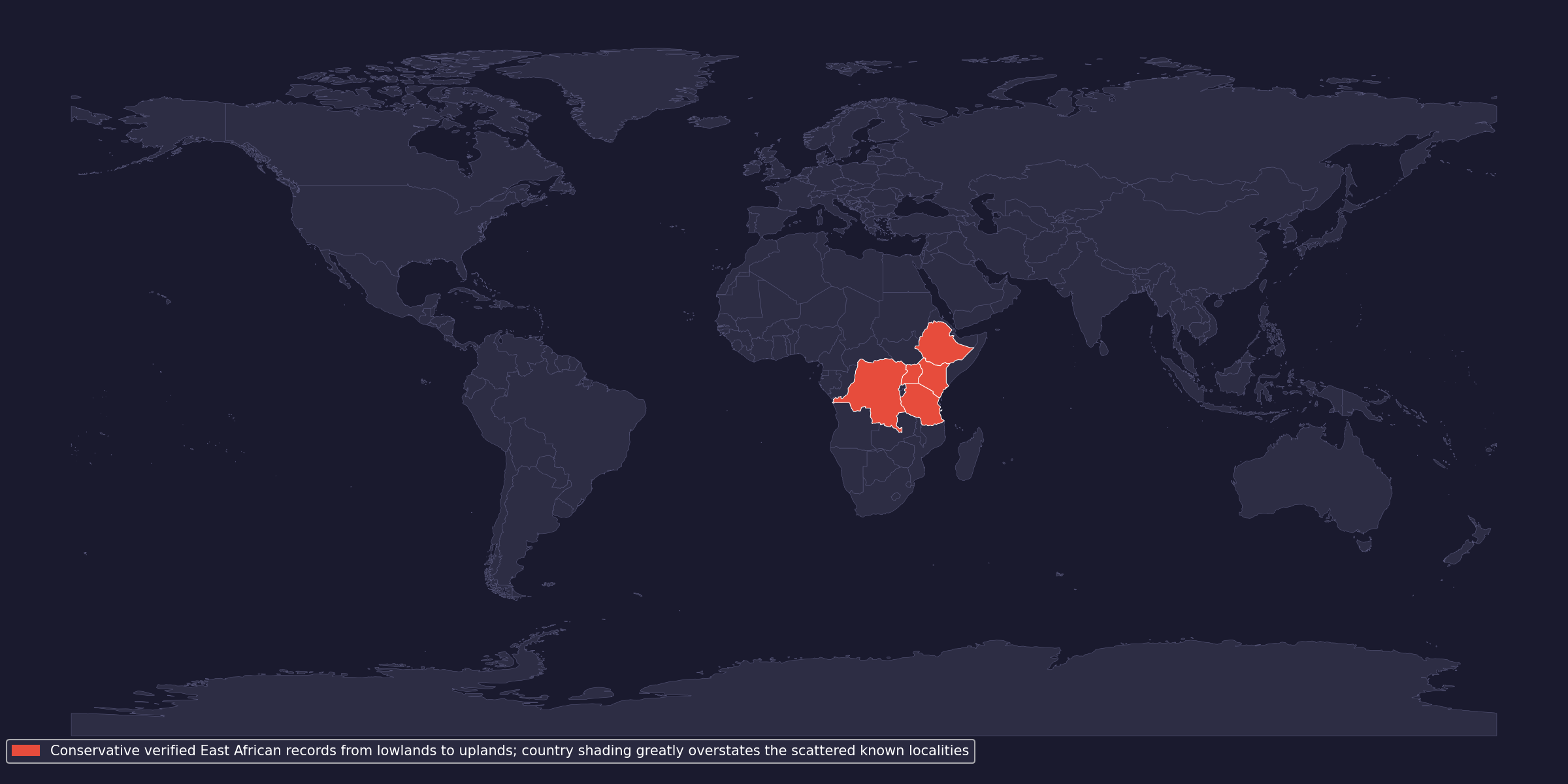
Verified records form an East African arc through the Democratic Republic of the Congo, Uganda, Tanzania, Kenya and Ethiopia. Historic localities include Ishango, Lake Victoria and Tanganyika districts, Nairobi, Kijabe, Samburu, Londiani, Voi and Sagan-Omo. A genetic voucher came from Kenya’s Aberdare National Park.
Country shading greatly overstates these scattered, widely elevated records.
⚖️ Legal status
Checked on 2026-08-29: the species is not listed in CITES, EU wildlife-trade Annexes A-D or Bern Appendices II-III. National collection and export law, protected-area permits, soil-import controls and destination rules still apply.
Acquire documented captive stock, retain invoices and full trade-line history, sterilize discarded substrate and never release animals.
🤌 Husbandry
Start 10-20 animals in a secure 25 x 18 x 18 cm box. Use fine high and low vents, deep soil and several bark and stone retreats. Make about one-third deeply moist, a middle transition and a drier leaf-covered surface at the ventilated end.
Quarantine at least 60 days. Photograph adults and record temperature, deep moisture, losses and mancae weekly. ReptiFiles has no species-level account; its general overview cannot resolve the ecological uncertainty.
💡 Lighting
UVB is unnecessary. Provide 11-13 hours of diffuse light and deep shade. Avoid direct sun and hot lamps.
🌡 Heating and temperature
Begin at 20-28°C, with an 18-23°C refuge and nights around 18-23°C. One hobby source reports tolerance to 36°C, but that is not a verified safe limit. Avoid sustained temperatures above 30°C unless a traceable established culture demonstrates otherwise.
Warm one outer wall under thermostat control if needed. Never heat the base.
💧 Humidity and water
Maintain a deeply moist third grading to a less-wet ventilated surface. Approximate 55-85% RH is an observation range, not a published requirement. Always offer contact moisture without stagnant saturation.
Add water to the refuge, not the whole box. No dish is needed. Crowding in the wet side suggests drying; sour soil and wall climbing suggest excessive water or weak airflow.
🌿 Enclosure and decoration
Use 8-10 cm of pesticide-free mineral soil, mature leaf mould, rotten hardwood and a little coarse sand or limestone grit. Add abundant hardwood leaves, cork, low stones, a small moss pocket and permanent cuttlebone.
Avoid fertilizer, aromatic wood, coir-only substrate and imported field soil. Keep each line labelled and retain mature substrate during maintenance.
🪳 Feeding
Leaves and rotten wood are the staple. Offer small mushroom, squash, carrot or dried greens every three to five days and modest protein every 7-10 days. Remove wet leftovers within 24 hours. Increase only after documented consumption.
🥚 Breeding
“Viviparous” is the repository enum for marsupial brooders. Historic material includes females carrying embryos and separate young, confirming ventral-pouch development.
A hobby account calls breeding easy, but controlled species-level parameters were not found. Preserve the moisture gradient, fine leaves, calcium and long stability. Divide only after several ages appear.
🩺 Common problems
- False precision: keep targets labelled as starting observations.
- Heat stress: protect the cool refuge and disregard 36°C as a routine goal.
- Failed moults: correct contact moisture and calcium without flooding.
- Mould or mites: reduce fresh food and strengthen surface airflow.
- Identity drift: retain “ex. Thermocellio sp. Tanzania” where relevant.
- No recruitment: change one measured variable at a time.
📌 Conclusion
The East African Uramba is an advanced documentation-led culture. Sparse evidence calls for a true moisture choice, conservative heat and careful records.
📚 Sources and further reading
- GBIF: Uramba triangulifera
- ITIS: taxonomy and countries
- Arcangeli 1950: broods and historic localities
- Ferrara 1974: East African Uramba
- Dimitriou et al. 2018: Kenyan voucher
- Vantis Terra 2026: hobby care account
- ReptiFiles clean-up-crew overview
- CITES Appendices, valid from 5 March 2026
- Commission Regulation (EU) 2026/1383
- Bern Convention appendices