Share

European Beach Pill Woodlouse
🔤 Taxonomy
Tylos europaeus Arcangeli, 1938 is an accepted beach-dwelling member of Tylidae. Older records may appear under Tylos latreillei europaeus or broad T. latreillei concepts, so locality and a current identification are important.
📌 Description
This compact, strongly convex woodlouse rolls into a ball and burrows in moist sand above the waterline. Adults are roughly 8–15 mm. It is neither an ordinary terrestrial pillbug nor an aquatic crustacean: it needs oxygenated sand with a stable saline-moist refuge and a drier upper surface.
| Care point | Practical target |
|---|---|
| Adult size | about 0.8–1.5 cm |
| Enclosure | 40 × 25 × 20 cm or larger |
| Substrate | 12–15 cm washed sand with a saline moisture gradient |
| Temperature | 18–26 °C with cooler nights |
| Staple food | clean dried or thawed marine macroalgae |
| Main failure | freshwater-only culture, flooding, heat or stale sand |
🌍 Distribution
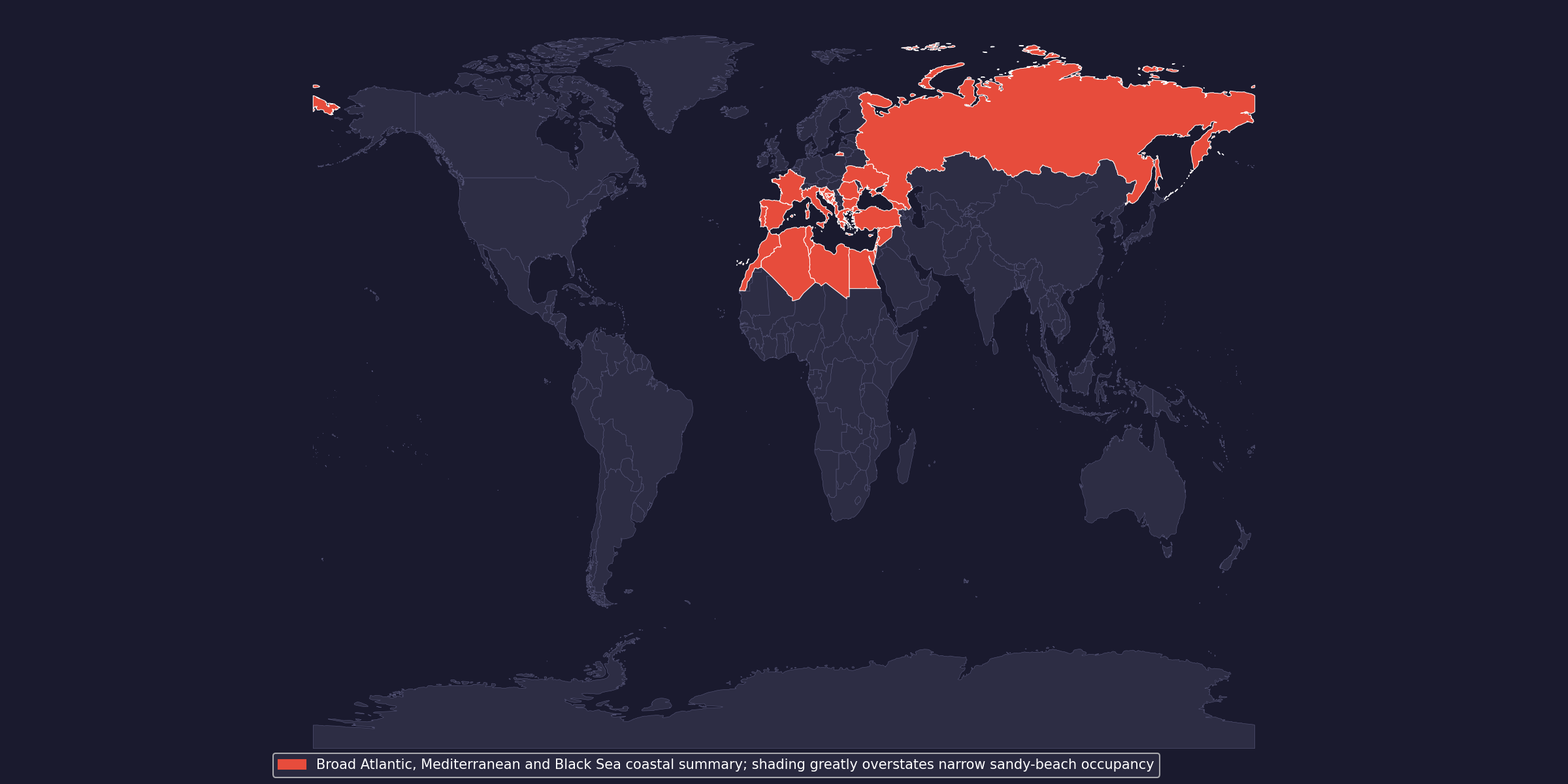
The species is documented from Atlantic shores south of Brittany, the Azores, Mediterranean coasts and the Black Sea. It occupies suitable sandy upper shore rather than whole countries or every beach.
The map is a broad coastal summary. Country shading greatly overstates the narrow supralittoral strip and does not resolve uncertain older records.
⚖️ Legal status
Checked on 2026-08-29: T. europaeus was not found in CITES, EU wildlife-trade Annexes A–D under Regulation (EU) 2026/1383, or Bern Appendices II–III. Local and national collection, protected-coast, export, import, invasive-species, breeding and sale rules may still apply.
Use traceable captive stock and retain the exact beach or breeder line. Do not remove animals, sand or wrack from dunes, reserves or other protected shores, and never release animals or saline substrate.
🤌 Husbandry
Use a 40 × 25 × 20 cm enclosure with fine cross-ventilation and 12–15 cm of washed silica sand. Grade the sand so the lower end remains evenly moist with clean artificial seawater while the upper end is only lightly damp. Supply several thin bark-like inert shelters or flat stones resting safely on the base.
Do not install a deep pool or simulate tides by flooding the enclosure. Quarantine a whole incoming line for 60 days. Species-specific captive protocols are scarce, so these targets are cautious starting points derived from beach ecology and laboratory studies.
💡 Lighting
UVB is unnecessary. Use 10–14 hours of diffuse seasonal light and keep shelters dark. This species is principally nocturnal; direct sun and bright heat lamps over sand can create a rapid lethal temperature spike.
🌡 Heating and temperature
Maintain 18–26 °C, a 16–21 °C cool sector and nights around 14–20 °C. A warmer edge may reach 22–26 °C, but it is not a basking site. Heat the room or one side only when required and measure within the sand as well as above it.
Avoid sustained temperatures above 27 °C. If the enclosure overheats, cool the room and improve shade rather than adding enough water to saturate hot sand.
💧 Humidity and water
Keep the lower sand saline-moist and the upper centimetres better aerated; approximate air humidity may vary between 65 and 90%. Prepare marine-strength artificial seawater with a measured aquarium salt mix, not table salt. Top up evaporation with purified fresh water and replace part of the saline moisture with newly mixed water when salts or waste accumulate.
There is no swimming requirement. A sour odour, blackened sand or animals remaining above ground by day suggests stagnation; collapsed dry burrows and moulting losses suggest insufficient deep moisture.
🌿 Enclosure and decoration
Use washed, rounded silica sand without fertilizer or beach contaminants. A small amount of clean shell grit can provide structure and calcium. Anchor stones on the enclosure base so burrowing cannot undermine them, and make every gap wide enough to prevent trapping.
Avoid garden soil, pure coir, freshwater marsh substrate, collected polluted sand and decorative salt crystals. Maintain a clear wet-to-less-wet horizontal gradient.
🪳 Feeding
Offer tiny pieces of rinsed, pesticide-free marine macroalgae such as Fucus, Ulva or nori every one to three days. Add small amounts of dried deciduous leaf, carrot or squash and only occasional protein. Remove decomposing food before it fouls the sand.
Keep cuttlebone or shell grit available. Never use seasoned culinary seaweed or wrack collected from a polluted or protected shore.
🥚 Breeding
Females brood embryos in a marsupium and release mancae; the repository records this as viviparous. A Portuguese population reproduced from April to July and produced one cohort per year. Captive timing may follow photoperiod and temperature, but it should not be forced with abrupt heat or flooding.
Maintain several adults, deep stable sand and fine food for young. Treat breeding as expert-level until the same locality line raises repeated generations.
🩺 Common problems
- Freshwater-only decline: rebuild the lower refuge with correctly mixed artificial seawater.
- Anaerobic sand: remove spoiled food, renew affected sand and improve ventilation without drying the base.
- Heat losses: cool the room and shade the enclosure; do not flood hot sand.
- Failed moults: verify deep moisture, salinity stability and calcium.
- No recruitment: review season, adult number, food particle size and substrate stability.
📌 Conclusion
The European beach pill woodlouse is a specialist supralittoral culture. Success depends on an aerated saline sand gradient, cool refuge and clean macroalgal diet—not on copying a tropical isopod tub or building an aquarium.
📚 Sources and further reading
- GBIF: Tylos europaeus
- World List of Isopoda: Tylos europaeus
- Schmalfuss world catalog: synonymy and distribution
- Population dynamics and annual reproduction in Portugal
- Environmental control of surface activity and beach zonation
- ReptiFiles clean-up-crew overview; no species guide was found
- CITES Appendices
- EU wildlife-trade Annexes: Regulation (EU) 2026/1383
- Bern Convention appendices