Share

Common Pygmy Woodlouse
🔤 Taxonomy
Trichoniscus pusillus Brandt, 1833 is accepted, but T. provisorius is now separate and looks nearly identical. Females alone are rarely decisive; the male first pleopod is diagnostic. Do not convert records of the T. pusillus aggregate into certain species records.
True T. pusillus includes triploid parthenogenetic populations. Preserve locality, microscope photographs and sex-ratio observations with every culture.
📌 Description
This smooth, purplish-red pygmy woodlouse is generally 3-4.5 mm; verified gravid females reach about 4.5 mm. Each eye has three ocelli. Its small size and dependence on cool damp cover make it easy to overlook and lose through ordinary mesh.
| Care point | Practical target |
|---|---|
| Adult size | about 0.3-0.45 cm |
| Starter colony | 20 x 15 x 15 cm or larger |
| Temperature | 14-22°C |
| Substrate | 7-9 cm of mature damp forest soil and leaves |
| Moisture | deeply moist with a ventilated surface |
| Main failure | drying, overheating, poor leaf quality or uncertain identity |
🌍 Distribution
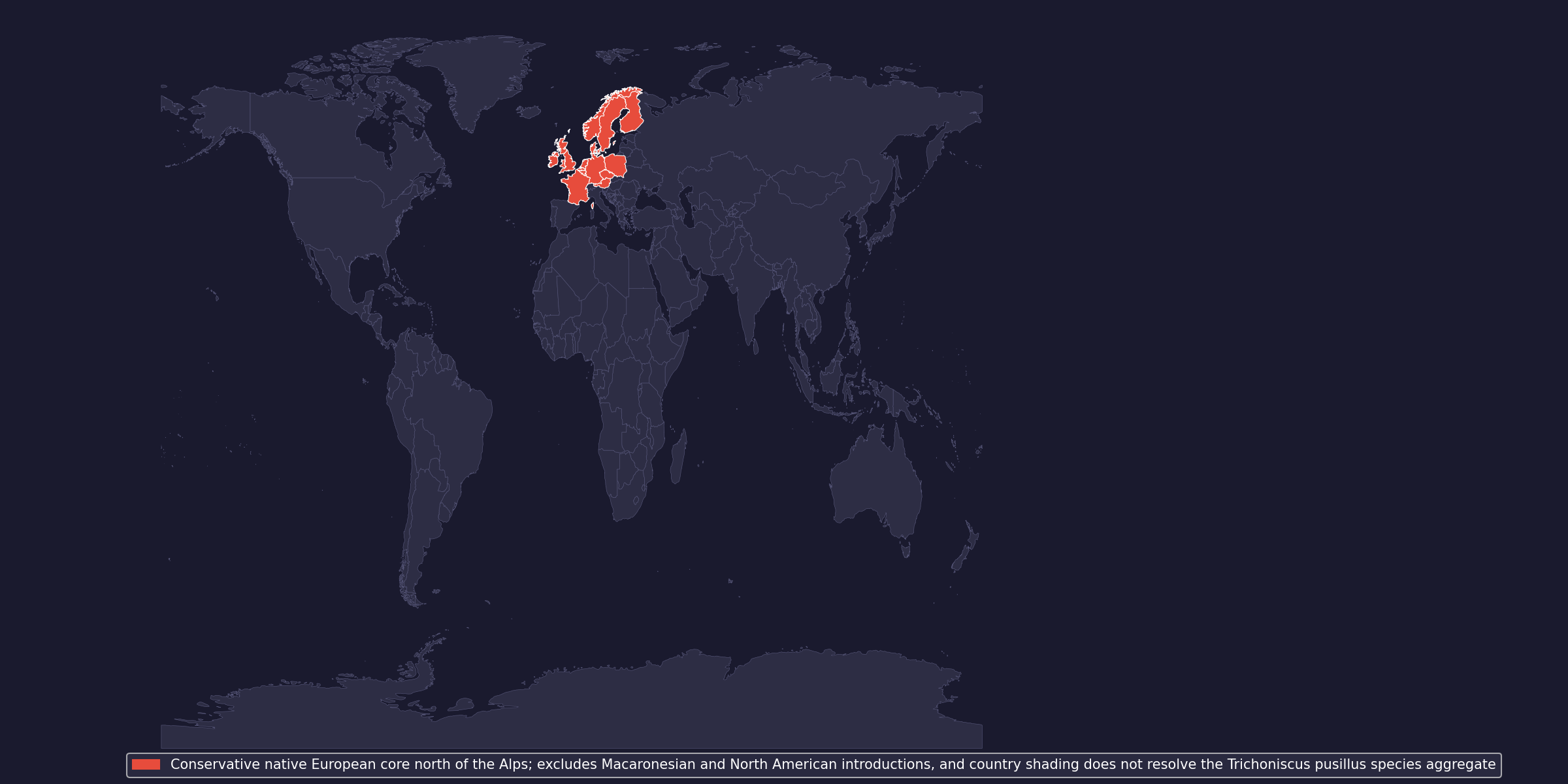
The safely documented native range is European, principally north of the Alps. Britain and Ireland hold abundant verified populations, and the species occurs across western, central and northern Europe. Introductions to the Azores, Madeira and North America are excluded from the native-core map.
The map is conservative because many observations combine T. pusillus and T. provisorius. Country shading does not imply that every record was microscopically verified.
⚖️ Legal status
Checked on 2026-08-29: the species is not listed in CITES, EU wildlife-trade Annexes A-D under Regulation (EU) 2026/1383, or Bern Appendices II-III. Collection, reserve, soil-movement and invasive-organism rules may still apply.
Use documented captive stock, retain locality and invoices, sterilize discarded substrate and never release a culture.
🤌 Husbandry
Start 20-30 animals in a secure 20 x 15 x 15 cm box. Cover every vent with very fine mesh. Provide 7-9 cm of mature soil and litter, overlapping bark and moss pockets. Keep the lower layer continuously moist with gentle cross-flow above it.
Quarantine for 45-60 days with separate tools. Examine multiple adults under magnification. ReptiFiles has no species-level guide; published laboratory work is more useful than generic clean-up-crew advice here.
💡 Lighting
UVB is unnecessary. Provide 8-14 hours of dim diffuse seasonal light and complete shade under cover. Avoid direct sun and warm plant lamps.
🌡 Heating and temperature
Maintain 14-22°C, a 10-16°C refuge and nights around 8-16°C. Avoid prolonged temperatures above 24°C. Cool the room rather than adding water to an overheated box. Normal winter cooling may reduce activity, but do not freeze or deliberately chill weak stock.
💧 Humidity and water
Keep almost all lower substrate moist, with only exposed litter becoming slightly less wet. Approximate 75-95% RH is useful, but contact moisture under wood and moss matters more. Add measured water into the soil; use no open dish.
Dry moss and missing juveniles indicate insufficient water. Constant condensation, sour odour and surface crowding indicate poor gas exchange.
🌿 Enclosure and decoration
Use pesticide-free woodland soil, mature leaf mould, soft rotten hardwood and abundant fine leaves. Alder litter deserves a major share: a controlled study found its microbial activity supported stable reproduction better than other tested leaves. Add flat bark, moss and finely crushed limestone or cuttlebone.
Avoid fertilizer, aromatic wood, sterile coir-only mixes and large vents. Retain most mature substrate during maintenance.
🪳 Feeding
Leaves, fungi and rotten wood form the staple. Keep microbially active alder available and add small mushroom or carrot shavings every three to five days. Offer extremely little protein every 7-10 days. Remove fresh remnants within 24 hours.
🥚 Breeding
“Viviparous” is the repository enum for marsupial brooding. Females retain eggs and embryos in a ventral pouch and release mancae. Many populations reproduce parthenogenetically, although sexual populations exist.
Field work found two annual generations and reproduction from roughly 12 months, with overlapping generations. Stable cool moisture and high-quality litter matter more than warming. Divide only after several ages are visible.
🩺 Common problems
- Wrong identity: verify adults and retain aggregate labels where appropriate.
- Desiccation: deepen substrate moisture and reduce excessive vent area.
- Heat-related losses: cool the room rather than saturating warm soil.
- Juvenile mortality: improve microbially active leaf quality, especially alder.
- Escapes: use very fine mesh and inspect the lid seal.
- Blue iridescence: isolate affected stock because iridovirus is possible.
📌 Conclusion
The common pygmy woodlouse is not a generic dwarf clean-up crew. Verified culture requires cool saturated microsites, fine containment and mature leaf litter.
📚 Sources and further reading
- GBIF: Trichoniscus pusillus
- British Myriapod and Isopod Group
- Schmalfuss world catalog
- Phillipson 1983: life cycle
- Kautz, Zimmer & Topp 2000: leaf quality
- Leandro et al. 2024: laboratory handling
- ReptiFiles clean-up-crew overview
- CITES Appendices, valid from 5 March 2026
- Commission Regulation (EU) 2026/1383
- Bern Convention appendices