Share

Trilobed Woodlouse
🔤 Taxonomy
Trachelipus trilobatus (Stein, 1859) is accepted. Older Romanian literature may use Porcellio racovitzai, now treated as a synonym.
📌 Description
Published and field measurements place adults at roughly 11-18 mm. This broad, conspicuous species is pigmented and troglophilous: it uses humid limestone slopes, forested gorges, scree, cave entrances and short cave margins rather than living exclusively deep underground.
| Care point | Practical target |
|---|---|
| Adult size | 1.1-1.8 cm |
| Starter colony | 30 x 20 x 18 cm or larger |
| Temperature | 15-22°C |
| Substrate | 8-10 cm with limestone, leaves and rotten wood |
| Moisture | humid lower layer with continuous fresh air |
| Main failure | warm stagnant enclosure or loss of provenance |
🌍 Distribution
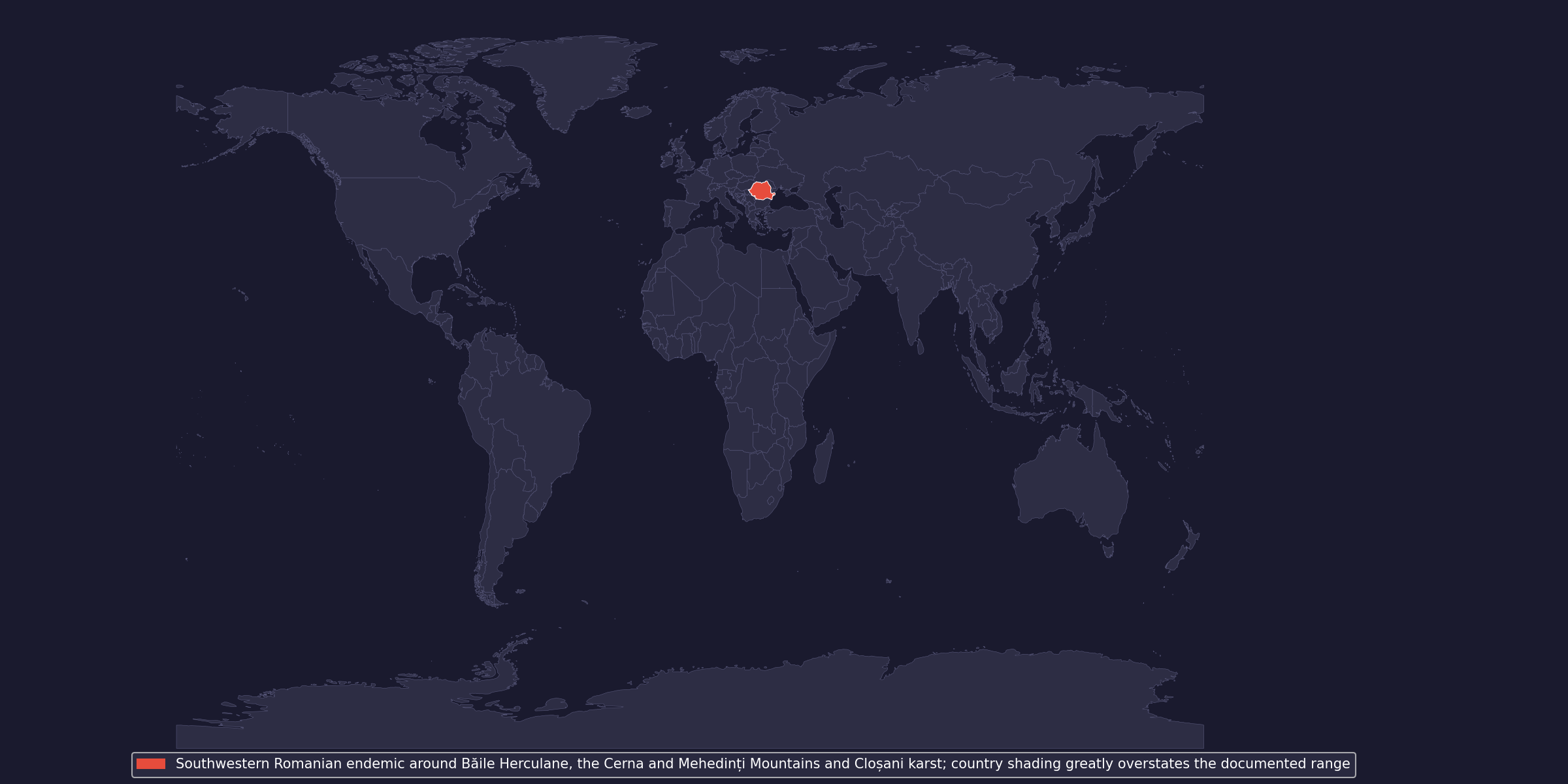
The documented core is southwestern Romania around Băile Herculane, the Cerna and Mehedinți Mountains, Mehadia and the Cloșani karst. A 2025 paper added Romanian localities, but the species remains a Romanian endemic. The country map strongly overstates this restricted karst distribution.
⚖️ Legal status
Checked on 2026-08-29: T. trilobatus is not listed in CITES, EU wildlife-trade Annexes A-D or Bern Appendices II-III. Romanian cave, reserve, habitat and collection rules remain separate and may prohibit removal.
Use captive-established stock, retain invoices and exact locality history, and verify transport and sale rules. Never collect from caves without authority or release culture material.
🤌 Husbandry
House 10-20 animals in a secure 30 x 20 x 18 cm tub with fine high and low cross-vents. Provide deep leaf soil, overlapping limestone and cork, and humid crevices connected to a slightly less-wet ventilated zone.
Quarantine for 60 days with separate tools. Record survival and young through a summer before dividing the colony. Do not merge different Romanian locality lines.
💡 Lighting
UVB is unnecessary. Provide 9-14 hours of diffuse seasonal light and deep shade. Avoid direct sun and warm display lamps.
🌡 Heating and temperature
Maintain 15-22°C, a 12-17°C refuge and nights around 11-17°C. Avoid prolonged temperatures above 24°C. Cool the room rather than soaking a warm enclosure.
Normal seasonal cooling is acceptable for established colonies, but never force it on new, thin or declining animals.
💧 Humidity and water
Keep at least half of the lower substrate moist, with fresh air over the surface and a less-wet option. Approximate 65-85% RH is useful, but avoid standing water and enclosure-wide condensation.
Add measured water to the substrate. No dish is needed. Failed moults and dry leaf undersides indicate insufficient depth moisture; sour smell and surface wandering indicate stagnation.
🌿 Enclosure and decoration
Use 8-10 cm of pesticide-free soil, deciduous leaf mould, rotten hardwood and limestone grit. Add flat limestone, cork, moss pockets and thick hardwood leaves. Keep calcium continuously available.
Avoid fertilizer, aromatic wood, compact mud and coir-only substrate. Never take stone, soil or moss from protected Romanian caves.
🪳 Feeding
Leaves and rotten wood are the staple. Offer tiny vegetable or mushroom pieces every three to five days and a small protein pinch every 7-10 days.
Remove moist leftovers within 24 hours. Cool humid colonies need much less fresh food than their floor space suggests.
🥚 Breeding
The repository uses “viviparous” for marsupial brooders. Females retain eggs and embryos in a ventral pouch and release mancae.
Breeding should be treated as difficult. Stable cool moisture, calcium and fine detritus are safer than raising temperature. Do not isolate brooding females or split a colony before several age classes appear.
🩺 Common problems
- Heat stress: move the enclosure to a cooler room.
- Failed moults: restore deep moisture and calcium while preserving vents.
- Mould or mites: reduce fresh food and increase surface airflow.
- No recruitment: minimize disturbance and maintain seasonal stability.
- Line mixing: preserve exact Romanian locality labels.
📌 Conclusion
The trilobed woodlouse is an advanced cool, humid display species for keepers who can ventilate deep moisture. Its Romanian karst provenance should be preserved as carefully as the colony itself.
📚 Sources and further reading
- GBIF: Trachelipus trilobatus
- Tomescu et al. 2015: morphology, habitat and Băile Herculane records
- Giurginca et al. 2025: new Romanian distribution records
- Romanian cave Oniscidea inventory
- ReptiFiles clean-up-crew overview
- CITES Appendices, valid from 5 March 2026
- Commission Regulation (EU) 2026/1383
- Bern Convention appendices