Share

Taborsky's Woodlouse
🔤 Taxonomy
Trachelipus taborskyi (Frankenberger, 1950) is accepted. It was originally combined as Tracheoniscus taborskyi. Modern comparative work mentions it, but detailed revisionary and ecological information remains sparse.
📌 Description
This western Turkish species is so poorly documented that a defensible adult-size range is omitted from structured metadata. Captive limits are also unpublished. The guide therefore offers conservative temperate choices and clear observation points rather than claiming a proven recipe.
| Care point | Cautious starting target |
|---|---|
| Starter colony | 25 x 18 x 18 cm or larger |
| Temperature | 16-23°C |
| Substrate | 8-10 cm leaf-rich mineral soil |
| Moisture | damp refuge and ventilated transition |
| Identity | adult verification and exact source records |
| Main failure | treating provisional targets as hard species data |
🌍 Distribution
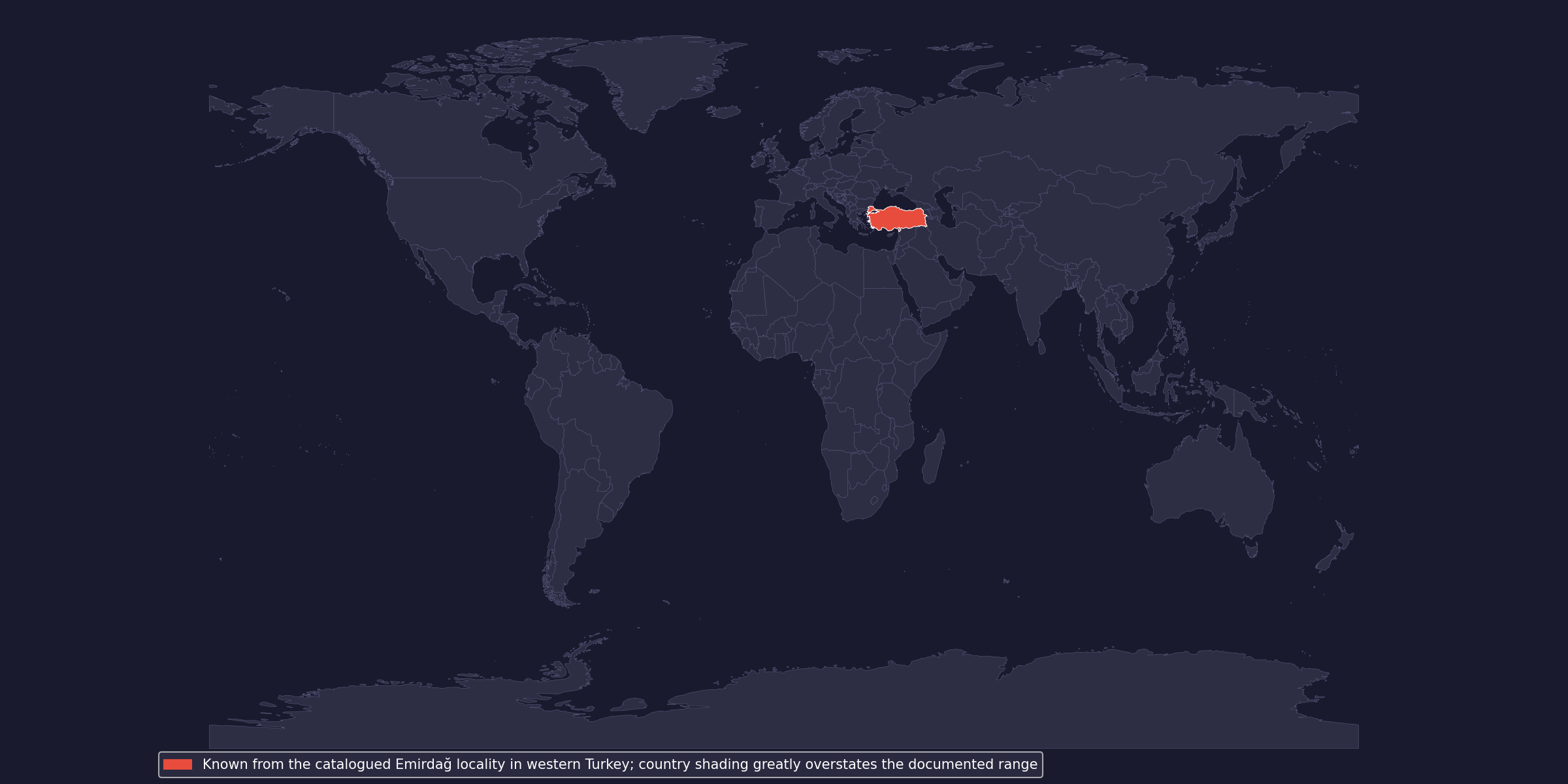
The catalogued locality is Emirdağ in western Türkiye, about 200 km southwest of Ankara. No broader native country range is used here. Shading all of Türkiye greatly exaggerates the known point locality.
⚖️ Legal status
Local and national rules may still apply.
Checked on 2026-08-29: T. taborskyi is not listed in CITES, EU wildlife-trade Annexes A-D or Bern Appendices II-III. Turkish collection and export law, protected areas, import rules and destination-country controls remain relevant.
Acquire only documented captive stock, retain invoices and exact provenance, and do not represent an unverified culture as Emirdağ material. Never release animals or substrate.
🤌 Husbandry
Start a small group in a secure 25 x 18 x 18 cm container with fine cross-ventilation, 8-10 cm of substrate and several bark and stone retreats. Keep a connected damp refuge and a less-wet ventilated section.
Quarantine for at least 60 days. Photograph adults, record weekly survival and recruitment, and change one variable at a time. This observation-led approach is essential when captive evidence is weak.
💡 Lighting
UVB is unnecessary. Provide 9-14 hours of diffuse seasonal light and deep shade. Avoid direct sun and heat-producing lamps.
🌡 Heating and temperature
Begin at 16-23°C, with a 13-18°C retreat and nights around 12-18°C. These are cautious starting choices, not published species limits. Avoid prolonged temperatures above 25°C unless traceable culture history demonstrates tolerance.
Do not force winter dormancy. Adjust only from measured colony behaviour, moulting and recruitment.
💧 Humidity and water
Keep roughly one-third to one-half of the lower substrate damp, grading to a less-wet surface. Approximate 55-80% RH is a broad observation range. Animals should have moisture choice without persistent condensation.
Add water to the substrate and use no open dish. If animals crowd the wettest hide, deepen moisture; if they climb walls over sour soil, improve airflow and reduce water.
🌿 Enclosure and decoration
Use 8-10 cm of pesticide-free soil, leaf mould, rotten hardwood and limestone grit. Add abundant hardwood leaves, cork and permanent cuttlebone or limestone.
Avoid fertilizer, aromatic wood and sterile coir-only substrate. Retain mature material during maintenance and label every container with source and date.
🪳 Feeding
Leaves and rotten wood remain the staple. Offer tiny vegetable pieces every three to five days and a small protein portion every 7-10 days. Remove moist leftovers within 24 hours.
Start lean and increase only when consumption is documented. Food accumulation obscures whether humidity or diet is causing losses.
🥚 Breeding
“Viviparous” is the repository enum for marsupial brooders. Females carry eggs and embryos in a ventral pouch and release mancae.
No reliable species-specific breeding schedule was found. Do not warm the colony merely to accelerate reproduction. Preserve stability and divide only after multiple age classes appear.
🩺 Common problems
- Unexplained losses: record temperature and deep moisture before changing the setup.
- Failed moults: check calcium, damp refuge and overheating.
- Mould or mites: reduce food and improve surface airflow.
- No recruitment: allow long stability; published captive expectations are absent.
- Questionable identity: do not distribute the culture without provenance and adult evidence.
📌 Conclusion
Taborsky’s woodlouse is an expert, documentation-led culture. Its most important care rule is intellectual honesty: begin conservatively, measure outcomes and do not turn sparse literature into false precision.
📚 Sources and further reading
- GBIF: Trachelipus taborskyi
- Schmalfuss 2003: catalogued Emirdağ locality and older combination
- Gongalsky et al. 2023: comparative Trachelipus morphology
- ReptiFiles clean-up-crew overview
- CITES Appendices, valid from 5 March 2026
- Commission Regulation (EU) 2026/1383
- Bern Convention appendices