Share

Rathke's Woodlouse
🔤 Taxonomy
Trachelipus rathkii (Brandt, 1833) is the accepted name. Older field guides and labels often use the spelling T. rathkei, while several old Porcellio combinations are synonyms. Identification should not rest on colour: the useful combination is two antennal flagellum segments and five pairs of pleopodal lungs.
📌 Description
Rathke’s woodlouse is a broad, rough-backed species reaching about 8–15 mm. Grey animals may show three pale longitudinal lines; females can carry orange mottling. It does not close into a complete ball and is frequently confused with Oniscus asellus and Porcellio scaber.
| Care point | Practical target |
|---|---|
| Adult length | about 0.8–1.5 cm |
| Starter colony | 30 × 20 × 15 cm or larger |
| Temperature | 15–23 °C, with a cooler retreat |
| Moisture | deep damp zone plus a merely moist ventilated zone |
| Staple | deciduous leaves and soft rotten hardwood |
| Evidence limit | good field ecology; little species-level captive research |
🌍 Distribution
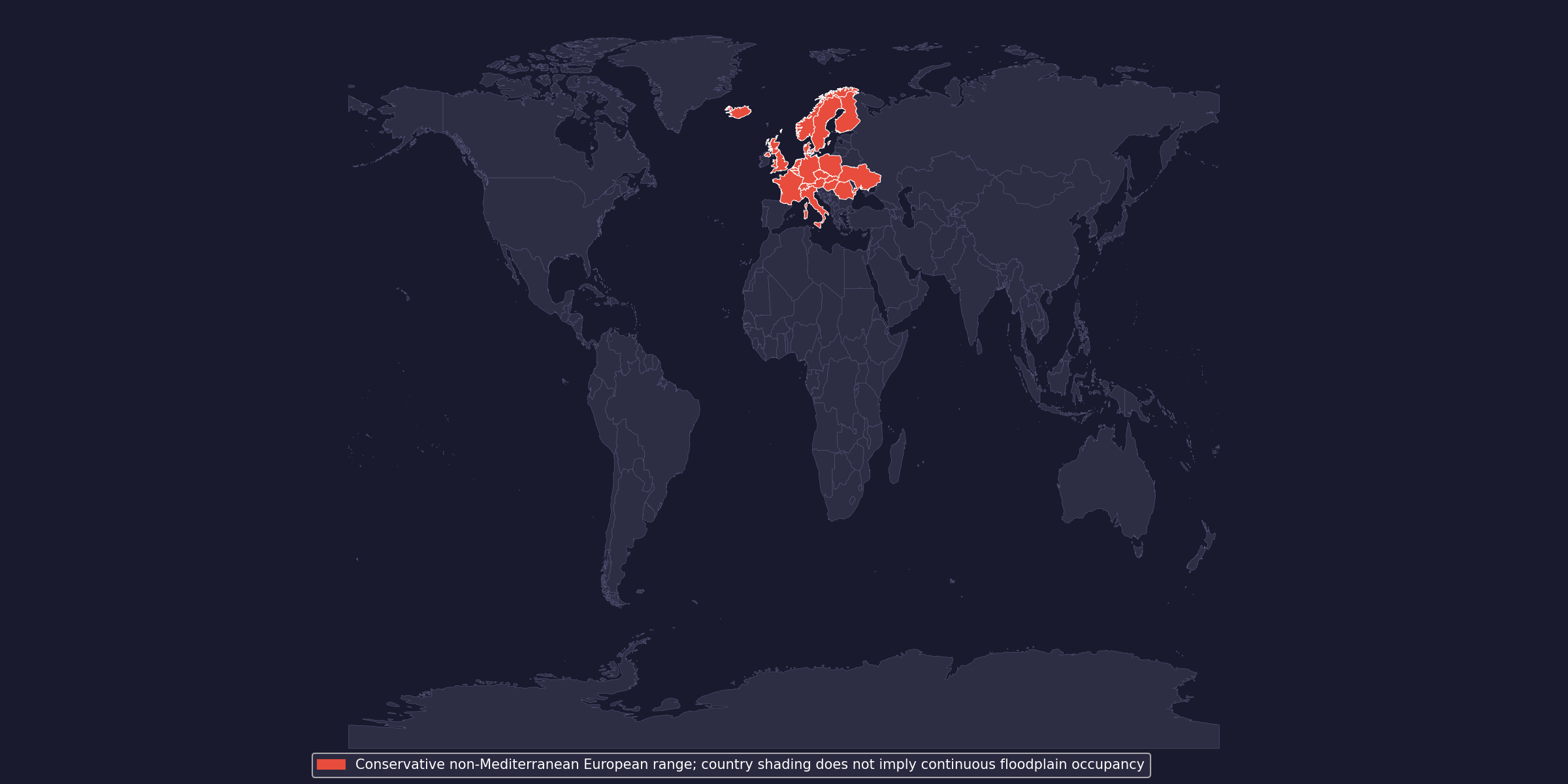
The native range covers much of non-Mediterranean Europe; the species has also been introduced to North America. Published European records extend from Scandinavia and Iceland through central and eastern Europe, with a patchier western edge. The map shows a conservative documented European core and excludes introduced populations.
A monthly climate table would be misleading for such a broad range. Floodplain litter, impeded drainage and refuge moisture describe the usable microclimate better than averages from one weather station.
⚖️ Legal status
Checked on 2026-08-29: T. rathkii was not found in the CITES Appendices, EU wildlife-trade Annexes A–D under Regulation (EU) 2026/1383, or Bern Convention Appendices II–III. This does not make collection or movement automatically unrestricted.
Local and national rules may regulate collection, protected sites, soil transport, sale, import and keeping. Retain invoices and locality data, use captive stock where possible, sterilize discarded substrate and never release a colony.
🤌 Husbandry
Start 20–30 correctly identified animals in a ventilated 30 × 20 × 15 cm box. Provide 7–9 cm of mature soil, leaf mould and rotten hardwood, then cover most of the surface with leaves and bark. Keep one end deeply damp and the opposite end only lightly moist; neither end should become dusty.
Quarantine new stock for 45–60 days with separate tools. Record deaths and reproduction, inspect for iridescent blue individuals and unwanted mites, and do not add an unverified wild culture directly to another vivarium. ReptiFiles has no species guide, so the numerical targets here are conservative extrapolations from field ecology and general isopod practice.
💡 Lighting
UVB is unnecessary. Give 9–14 hours of diffuse room light and permanent shaded retreats. Direct sun or a close plant lamp can overheat a small container within minutes.
🌡 Heating and temperature
Keep the main zone at 15–23 °C, with a 12–18 °C refuge and nights around 10–18 °C. Ordinary seasonal cooling can reduce activity; deliberate cold conditioning is not required for maintenance. Avoid sustained temperatures above 25 °C.
No basking lamp is needed. If the room becomes hot, move or cool the enclosure rather than soaking warm substrate, which combines heat stress with poor aeration.
💧 Humidity and water
An approximate 70–90% RH is useful, but contact moisture under bark matters more. Keep the lower damp zone continuously moist and let only the top leaves at the ventilated end dry slightly. Pour small measured amounts into substrate instead of spraying every surface.
Do not use an open water dish. Persistent clustering at the wettest point, failed moults or retreat into deep soil indicate dryness; condensation, sour odour and wall climbing indicate saturation or inadequate ventilation.
🌿 Enclosure and decoration
Use pesticide-free topsoil, deciduous leaf mould, soft rotten hardwood and a small quantity of sand or fine mineral soil for structure. Add overlapping bark, grass litter and moss at the wet end. Keep cuttlebone, limestone or crushed oyster shell available.
Heavy stones must rest on the enclosure floor before substrate is added. Avoid fertilizer, resinous wood, pure coir, aromatic leaves and material collected beside treated roads or fields.
🪳 Feeding
Deciduous leaves and rotten wood remain available continuously. Offer mushroom, squash, carrot, dried nettle or a balanced isopod food every three to five days. Give a very small protein portion weekly, not enough to foul the damp zone.
Remove wet fresh food after 24–36 hours. Calcium is a constant enclosure resource rather than a powder placed on every meal.
🥚 Breeding
“Viviparous” is the repository enum for marsupial brooding: females retain eggs and embryos in a ventral pouch and release mancae. Field work in Kaluga found gravid females from June to August and 7–106 eggs per marsupium, with fecundity increasing with female size; those field extremes are not a captive production promise.
Mixed-age colonies usually breed when cool moisture and food quality remain stable. Do not isolate gravid females. Split a colony only after several age classes are visible, transferring mature damp substrate with each group.
🩺 Common problems
- Misidentification: verify the five pairs of lungs and antennal segmentation on adults.
- Heat-related losses: cool the room; flooding a hot box reduces oxygen.
- Failed moults: restore contact moisture and check the calcium source.
- No mancae: review seasonal overheating, pesticide exposure and leaf quality.
- Mould or mites: reduce rich food, remove remnants and improve airflow without drying the damp refuge.
- Blue iridescence: isolate affected stock because iridovirus is possible.
📌 Conclusion
Trachelipus rathkii suits keepers who can maintain cool, aerated damp litter and verify their stock. Its tolerance of disturbed outdoor sites should not be mistaken for tolerance of a hot, wet and stagnant culture box.
📚 Sources and further reading
- GBIF: Trachelipus rathkii
- World List of Isopoda
- British Myriapod and Isopod Group: identification and habitat
- Schmalfuss world catalog
- Urban reproduction study
- ReptiFiles clean-up-crew overview; no species guide found
- CITES Appendices, valid from 5 March 2026
- Commission Regulation (EU) 2026/1383
- Bern Convention appendices