Share

Difficult Forest Woodlouse
🔤 Taxonomy
Trachelipus difficilis (Radu, 1950) is accepted. It was described as Tracheoniscus difficilis; the named forms angulatus and rotundatus are not treated here as separate captive taxa. Tomescu and colleagues also placed Trachelipus radui in synonymy.
📌 Description
Measured males and females range from about 8.5 to 14 mm. They are brown-grey with pale lateral spot rows and fine reticulation. The species is associated with humid mountain and hill forests, leaf litter, logs and, regionally, cave entrances.
The challenge is keeping the lower layer moist and cool without producing stale air. It is not suitable for a hot display shelf.
| Care point | Practical target |
|---|---|
| Adult size | 0.85-1.4 cm |
| Starter colony | 25 x 18 x 18 cm or larger |
| Temperature | 14-22°C |
| Substrate | 8-10 cm forest-style leaf soil |
| Moisture | humid lower layer with ventilated surface |
| Main failure | summer heat or drying beneath litter |
🌍 Distribution
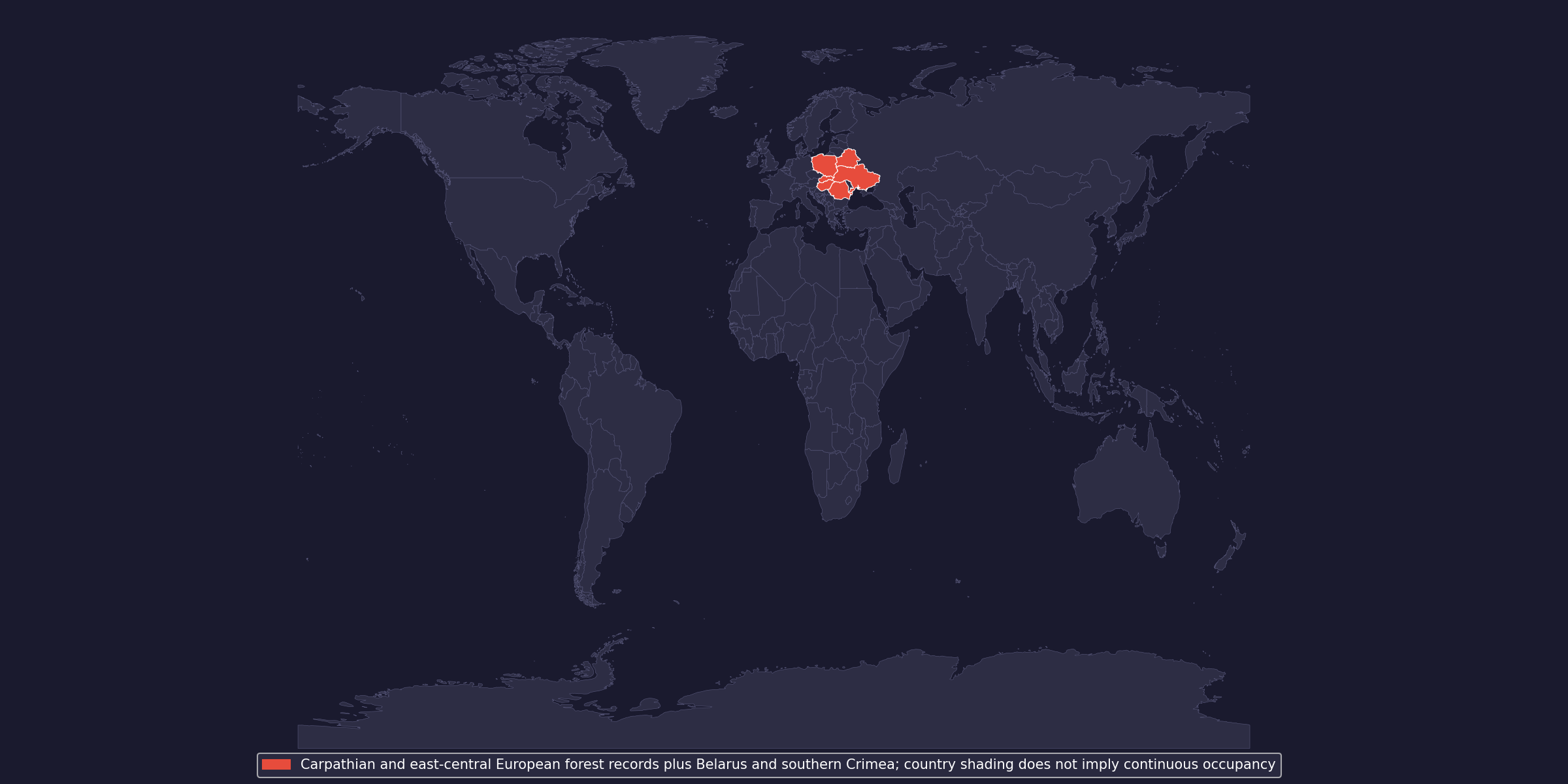
The reviewed core includes Poland, Slovakia, Hungary and western Romania. Additional records occur in Belarus and southern Crimea, Ukraine. These records form a Carpathian and east-central European pattern rather than continuous occupation of every shaded country.
⚖️ Legal status
Checked on 2026-08-29: T. difficilis is not listed in CITES, EU wildlife-trade Annexes A-D or Bern Appendices II-III. Forest reserves, cave sites and national collection rules can still protect habitat or restrict removal.
Use documented captive stock, retain invoices and locality, and check all origin and destination rules. Never release animals or viable substrate.
🤌 Husbandry
Use a 25 x 18 x 18 cm container for 10-20 animals, with fine vents high and low on opposite walls. Deep leaf litter, several bark flats and rotten logs provide the humid crevices used in forest habitat.
Quarantine for 60 days with separate tools. Track survival through the first warm period before changing or dividing the culture. Similar Trachelipus require adult examination for confident identification.
💡 Lighting
UVB is unnecessary. Provide 9-14 hours of diffuse seasonal room light and deep shade. Avoid direct sun and warm plant lamps.
🌡 Heating and temperature
Maintain 14-22°C, an 11-17°C retreat and nights around 10-17°C. Avoid prolonged temperatures above 24°C. Summer room cooling is preferable to heavy misting.
Normal seasonal cooling may slow activity, but do not deliberately chill new, thin or poorly established animals.
💧 Humidity and water
Keep at least half of the lower substrate moist while allowing leaf surfaces at the ventilated end to dry slightly. Approximate 65-85% RH is useful, but the microclimate under bark matters more.
Add water to the soil, not every surface. No dish is needed. Dry lower litter and incomplete moults indicate too little water; persistent condensation, mould and surface wandering indicate stagnation.
🌿 Enclosure and decoration
Use 8-10 cm of pesticide-free forest soil, deciduous leaf mould and white-rotted wood. Cover nearly all of it with hardwood leaves and overlapping bark. Add moss pockets and continuous cuttlebone or limestone.
Avoid fertilizer, conifer wood, compact mud and coir-only substrate. Retain part of the mature substrate during maintenance.
🪳 Feeding
Leaf litter and rotten wood are the staple. Add small pieces of mushroom, squash, carrot or dried nettle every three to five days and a tiny protein portion every 7-10 days.
Remove wet food in 24 hours. Cool humid cultures foul quickly when fresh food is generous.
🥚 Breeding
The repository uses “viviparous” for marsupial development. Females carry eggs and embryos in a ventral pouch and release mancae.
Captive recruitment should be treated as difficult until several age classes are visible. Stable deep moisture and fine leaf particles are more important than warming the colony. Do not isolate brooding females.
🩺 Common problems
- Heat-related losses: move the enclosure to a cooler room and protect the moist base.
- Failed moults: correct deep moisture and calcium.
- Mould or mites: remove fresh food and improve surface airflow.
- No young: reduce disturbance and maintain stable seasonal conditions.
- Misidentification: preserve locality and adult photographs.
📌 Conclusion
The difficult forest woodlouse suits a keeper with a reliably cool room and mature forest substrate. Summer heat, not a shortage of mist, is the main risk to solve before purchase.
📚 Sources and further reading
- GBIF: Trachelipus difficilis
- Tomescu et al. 2015: Romanian morphology, ecology and distribution
- Cartographic analysis of former-USSR woodlice records
- Slovak cave-isopod study
- ReptiFiles clean-up-crew overview
- CITES Appendices, valid from 5 March 2026
- Commission Regulation (EU) 2026/1383
- Bern Convention appendices