Share

Cretan Cave Woodlouse
🔤 Taxonomy
Trachelipus cavaticus Schmalfuss, Paragamian & Sfenthourakis, 2004 is the accepted name. It was described from western Crete and has no established older combination of practical value to keepers.
The species name refers to its cave association. It remains pigmented and should be treated as cave-associated rather than as an obligate, eyeless cave animal.
📌 Description
The original description measured females up to about 15 mm. This is a cool, moisture-dependent Cretan endemic recorded in and around caves. Captive husbandry is poorly documented, so the ranges below are cautious microhabitat targets, not published breeding limits.
| Care point | Practical target |
|---|---|
| Adult size | about 1.0-1.5 cm |
| Starter colony | 25 x 18 x 18 cm or larger |
| Temperature | 14-21°C |
| Substrate | 8-10 cm, calcareous and leaf-rich |
| Moisture | deeply moist with fresh-air exchange |
| Main failure | warmth, drying or stagnant saturated air |
🌍 Distribution
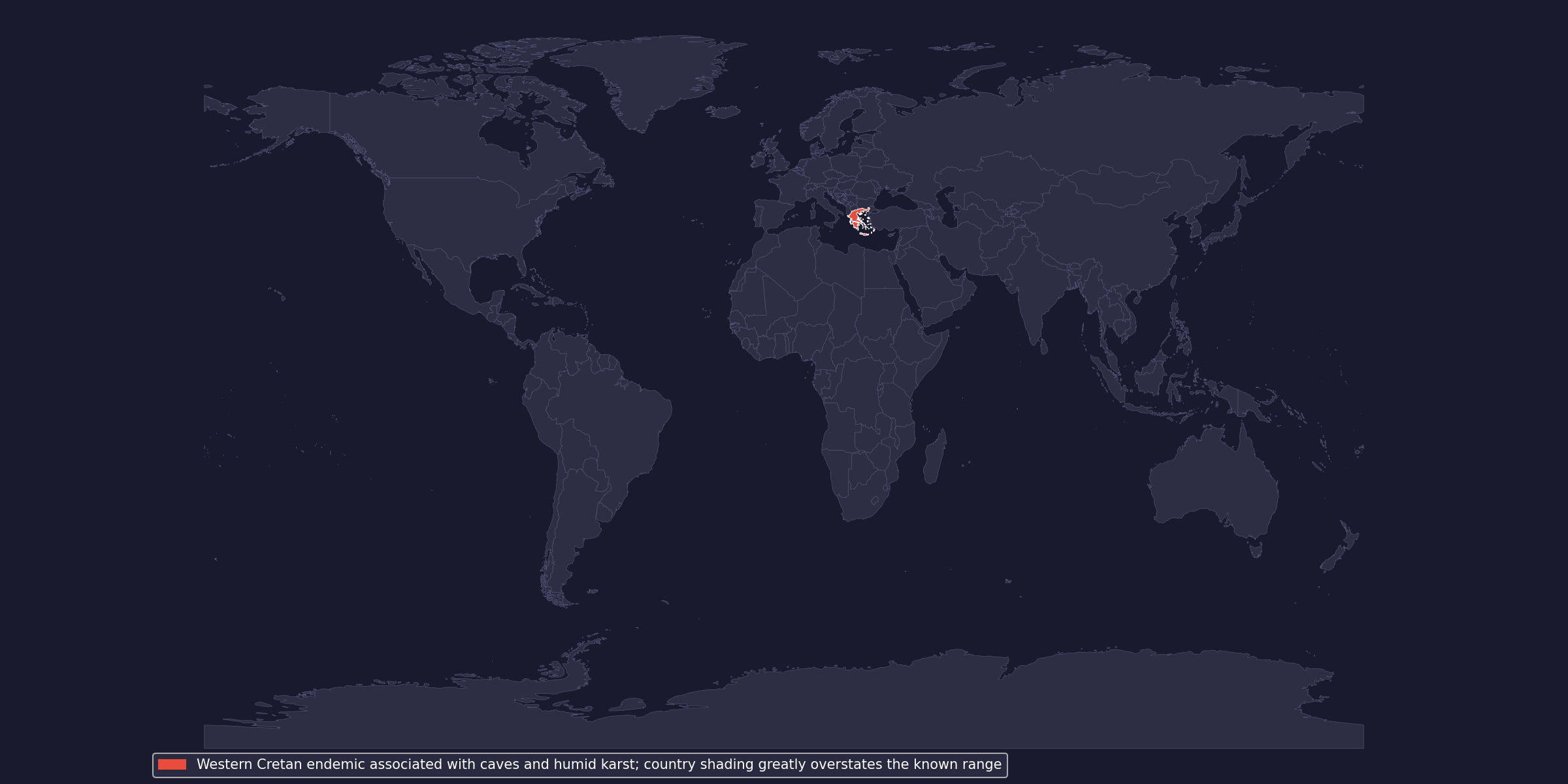
The species is known from western Crete, Greece, with records associated with caves and their surrounding humid karst. A country map necessarily exaggerates this very narrow island range.
⚖️ Legal status
Checked on 2026-08-29: T. cavaticus is not listed in CITES, EU wildlife-trade Annexes A-D or Bern Convention Appendices II-III. Cave access, protected-site collection and Greek export rules can apply independently.
Only acquire documented captive-established stock. Retain invoices and locality history, never collect from caves without explicit authority, and never release culture material.
🤌 Husbandry
Use a secure 25 x 18 x 18 cm container for a small starter group. Provide fine high and low vents on opposite sides, deep substrate and closely spaced limestone and cork retreats. Humidity must coexist with oxygen-rich air.
Quarantine for at least 60 days with separate tools. Record deaths, activity and mancae rather than making rapid parameter changes. Stock sold without traceable Cretan provenance should remain taxonomically provisional.
💡 Lighting
UVB is unnecessary. Use 8-12 hours of dim diffuse light and extensive shade. Bright light is useful only briefly for inspection; avoid direct sun and warm lamps.
🌡 Heating and temperature
Maintain 14-21°C, a 12-17°C retreat and nights around 11-17°C. Avoid prolonged temperatures above 23°C. In a warm home, cooling the room is safer than adding more moisture.
Do not force winter cooling below these targets, especially for new arrivals or weak colonies. If heat is ever required, warm one external wall very gently under thermostat control.
💧 Humidity and water
Keep most lower substrate moist, with the surface beneath one or two hides only slightly less wet. Approximate 70-90% RH is useful, but standing water and constant condensation are unsafe. Ventilation must remain active.
Add small measured amounts to the substrate and monitor its depth. No open dish is needed. Dry retreats, failed moults and surface crowding mean the lower layer is drying; sour odour and deaths at the surface suggest stagnation.
🌿 Enclosure and decoration
Use 8-10 cm of pesticide-free soil, leaf mould, rotten hardwood and crushed limestone. Add flat limestone, cork, moss pockets and a deep hardwood leaf cover. Calcium should remain available as limestone and cuttlebone.
Avoid fertilizer, aromatic wood, coarse sharp gravel and sterile coir-only mixes. Never use cave-collected substrate that may damage a protected habitat or introduce contaminants.
🪳 Feeding
Leaves and rotten wood are the staple. Offer tiny pieces of mushroom, courgette, carrot or dried greens every three to five days and a very small protein pinch every 7-10 days.
Remove fresh leftovers within 24 hours. Cool humid cultures process food slowly; overfeeding creates mould and mites before it improves growth.
🥚 Breeding
The repository records marsupial brooders as “viviparous.” Females retain eggs and embryos in a ventral pouch and release mancae.
Published captive breeding parameters are lacking. Prioritize long-term stability, fine leaf fragments and uninterrupted deep moisture. Do not isolate brooding females or divide a colony until several age classes are present.
🩺 Common problems
- Heat stress: move the enclosure to a cooler room; extra misting is not cooling.
- Failed moults: restore deep moisture and calcium without blocking vents.
- Stagnation: improve cross-flow and remove spoiled food.
- No recruitment: reduce disturbance and wait through stable seasonal conditions.
- Uncertain identity: preserve exact source records and avoid unsupported cave labels.
📌 Conclusion
The Cretan cave woodlouse is an advanced cool-room colony, not a generic tropical cave isopod. Prepare reliable summer cooling and ventilated deep moisture before obtaining this narrow endemic.
📚 Sources and further reading
- GBIF: Trachelipus cavaticus
- Schmalfuss, Paragamian & Sfenthourakis 2004: original description
- Schmalfuss 2003 catalog entry
- ReptiFiles clean-up-crew overview
- CITES Appendices, valid from 5 March 2026
- Commission Regulation (EU) 2026/1383
- Bern Convention appendices