Share

North-eastern Brazilian Yellow Scorpion
🔤 Taxonomy
Tityus stigmurus is the accepted name; Isometrus stigmurus is an older combination. It belongs to a reviewed species complex and can be confused with other yellow Tityus. The dark dorsal stripe and triangular mark help, but a photo or trade label does not replace expert identification and origin records.
📌 Description
Adults are 4.5–6 cm, yellow to golden-brown with a dark longitudinal stripe. Brazilian health authorities recognise it as a medically important species. It is small, fast, capable of climbing narrow seams and commonly parthenogenetic, so a single imported female can produce young. Expert-only, display-only controls are mandatory; never handle it.
☠️ Venom
This species is venomous. Venom exposure can cause pain, swelling or other systemic effects, and severity varies with species, locality, bite site and the amount delivered. A small wound or apparently dry bite is not proof of safety; every bite or sting requires urgent medical assessment.
If an incident occurs, move away, call emergency services or a poison centre, keep the patient still, remove rings and other constricting items, and follow dispatcher instructions. Do not use a tourniquet, cut or suck the wound, apply ice or electricity, give alcohol or medicines as a home treatment, or attempt to catch the animal. Antivenom choice and dosing are hospital decisions; verify the relevant product and local availability in advance. Sources: WHO snakebite guidance and appropriate species-specific toxinology or medical references listed below.
🌍 Distribution
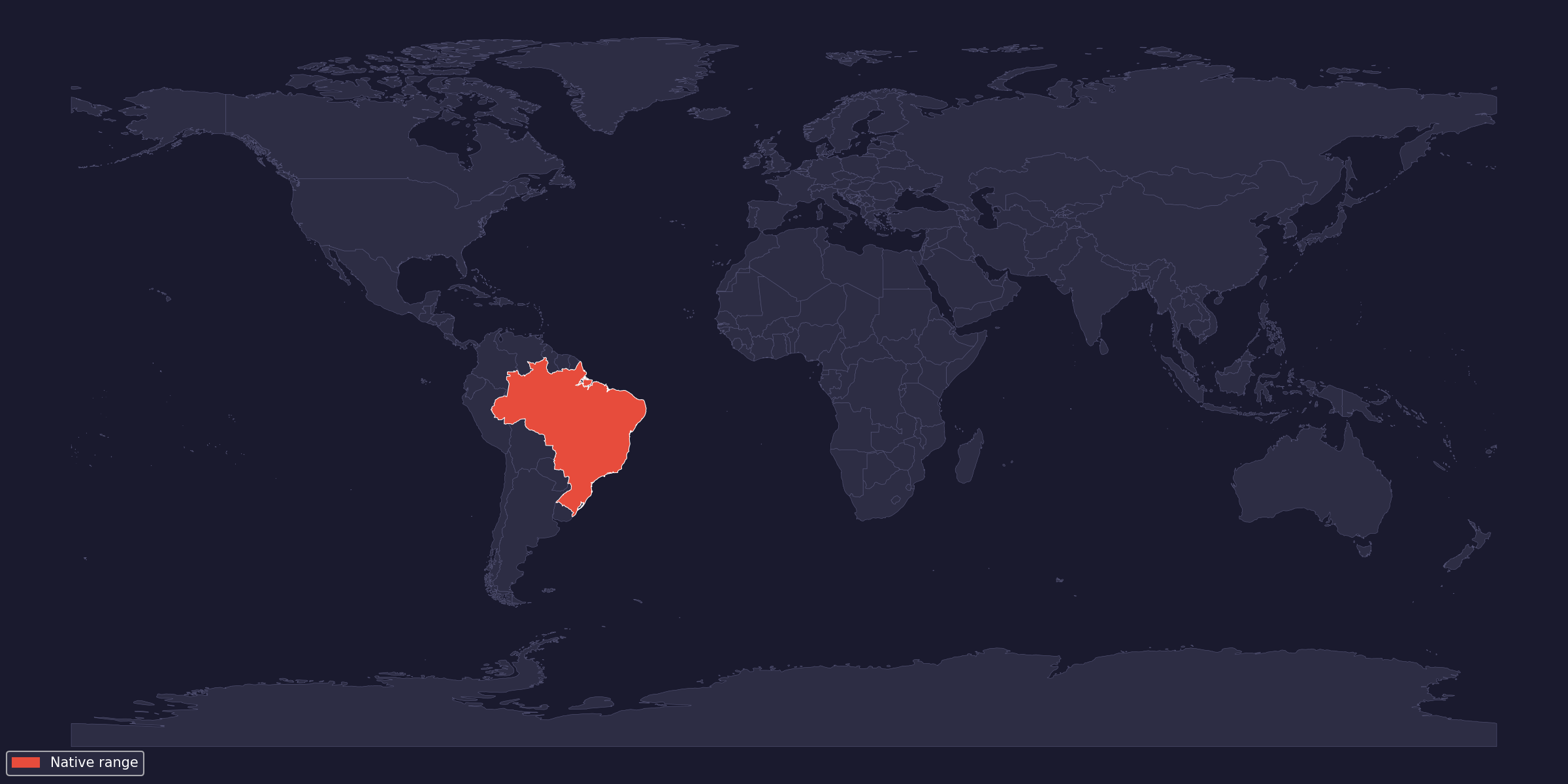
The native core is north-eastern Brazil, including Alagoas, Bahia, Ceará, Paraíba, Pernambuco, Piauí, Rio Grande do Norte and Sergipe. Transport has produced populations beyond the historic core, including Fernando de Noronha and urban records farther south; these introduced records do not expand the native-country map beyond Brazil. It uses Caatinga, humid enclaves and buildings, hiding in bark, rubble and crevices.
🌡 Climate across the native range
Monthly climate normals from reviewed GBIF occurrences in north-eastern Brazil:
Ceará — Brazil
| Month | Min °C | Mean °C | Max °C | RH % |
|---|---|---|---|---|
| January | 23.7 | 27.1 | 30.4 | 77 |
| February | 23.4 | 26.8 | 30.2 | 77 |
| March | 23.2 | 26.4 | 29.6 | 81 |
| April | 23 | 26.3 | 29.7 | 82 |
| May | 22.9 | 26.2 | 29.5 | 79 |
| June | 22.1 | 25.8 | 29.4 | 80 |
| July | 21.7 | 25.6 | 29.4 | 78 |
| August | 21.9 | 25.9 | 29.9 | 75 |
| September | 22.6 | 26.4 | 30.3 | 75 |
| October | 22.8 | 26.8 | 30.8 | 76 |
| November | 23.4 | 27.2 | 30.9 | 74 |
| December | 23.7 | 27.3 | 30.8 | 73 |
Pernambuco — Brazil
| Month | Min °C | Mean °C | Max °C | RH % |
|---|---|---|---|---|
| January | 17.9 | 23.5 | 29.1 | 72 |
| February | 17.8 | 23.1 | 28.5 | 75 |
| March | 17.6 | 22.7 | 27.8 | 78 |
| April | 17.8 | 22.3 | 26.9 | 79 |
| May | 17.4 | 21.4 | 25.4 | 80 |
| June | 16.6 | 20.4 | 24.2 | 81 |
| July | 15.6 | 19.6 | 23.7 | 81 |
| August | 15.7 | 20.3 | 24.8 | 78 |
| September | 15.5 | 20.5 | 25.6 | 77 |
| October | 17.2 | 22.7 | 28.3 | 72 |
| November | 17.7 | 23.5 | 29.3 | 71 |
| December | 18 | 23.6 | 29.3 | 72 |
Alagoas — Brazil
| Month | Min °C | Mean °C | Max °C | RH % |
|---|---|---|---|---|
| January | 20.3 | 25.6 | 30.9 | 77 |
| February | 20.5 | 25.6 | 30.8 | 78 |
| March | 20.6 | 25.5 | 30.5 | 79 |
| April | 20.1 | 24.7 | 29.2 | 81 |
| May | 19.5 | 23.4 | 27.3 | 84 |
| June | 18.3 | 22 | 25.8 | 86 |
| July | 17.5 | 21.2 | 24.9 | 87 |
| August | 17.3 | 21.3 | 25.3 | 86 |
| September | 18.1 | 22.6 | 27 | 83 |
| October | 18.9 | 23.9 | 29 | 79 |
| November | 19.7 | 25.1 | 30.4 | 77 |
| December | 20.2 | 25.5 | 30.8 | 77 |
Weather data by WorldClim v2.1 · Monthly normals queried by Herpeton Academy from raster values; relative humidity is derived from vapor pressure and mean temperature.
Location references use GBIF.org occurrence data where available; original occurrence records retain their source dataset licenses.
⚖️ Legal status
Checked on 2026-08-17 against the official CITES Appendices and EU wildlife-trade annex framework: Tityus stigmurus is not specifically listed. The Bern Convention is not relevant to this non-European native species. Non-listing is not permission to own it. Dangerously venomous-animal laws, licensing, insurance, transport, workplace and exhibition rules may prohibit or condition possession. Local and national rules must still be checked before acquisition or transfer. Obtain written confirmation before acquisition and retain invoice, breeder identity, origin and import documents.
🤌 Husbandry
Keep one T. stigmurus in a mechanically latched fine-mesh enclosure within a second locked cabinet or sealed room. Cap misting ports and close sliding-door channels to the width of a newborn, then arrange narrow cork so every seam can be inspected from outside. Quarantine for at least 90 days in a pale, simple unit with dedicated tools; assume a female may found a parthenogenetic population and prepare numbered micro-enclosures before she is moved.
| Parameter | Conservative target |
|---|---|
| Adult enclosure | 25 × 20 × 25 cm |
| Day air | 24–29 °C |
| Warm area | 29–31 °C |
| Night | 20–23 °C |
| Relative humidity | 55–75%; 70–80% in the protected premoult refuge |
| Substrate | at least 6 cm |
| Feeding | one suitable invertebrate every 7–10 days |
A single female or missed juvenile can found a new parthenogenetic group. Conduct maintenance inside a sealed secondary room and tall white tub so the small yellow body remains visible. Prepare many numbered micro-enclosures, not just two catch cups, before disturbing a gravid-looking female. Cork is lifted with forceps one piece at a time and the animal count is recorded before any material leaves the tub.
💡 Lighting
No UVB is required. Use 10–12 hours of gentle diffuse light and complete darkness at night, keeping all fixtures beyond both containment layers. Light should help the observer distinguish the small yellow body from cork and door tracks; it must not heat the upper climbing route or dry the humid lower substrate, so check both levels after the full daytime cycle.
🌡 Heating and temperature
Maintain 24–29 °C daytime air, a limited upper-side zone at 29–31 °C and a cooler 22–24 °C retreat, with nights at 20–23 °C. Warm one outer side wall through a thermostat and place probes near both the cork route and lower humid layer. Bottom heat removes the cool moist option, while a warm cabinet can turn the sealed secondary space into a heat trap for adults and tiny young.
💧 Humidity and water
Keep the general range around 55–75% RH with cross-ventilation and a protected retreat around 70–80% during premoult or for small juveniles. Add water to one deep corner rather than spraying the animal or saturating the whole floor. Supply a shallow stable water dish. Condensation, mould or flies mean moisture and airflow are out of balance.
🌿 Enclosure and decoration
Use about 6 cm of ventilated leaf soil mixed with sand, moist enough below the surface to buffer humidity but never waterlogged. Add narrow vertical cork flats and one low hide, all simple enough to inspect. Fine stainless mesh, sealed sliding-door channels and capped misting ports are critical because adults flatten into crevices and newborns are minute. Keep the water dish and access point clear of climbing decor.
🪳 Feeding
Offer a small captive-bred roach nymph or cricket every 7–10 days through a capped service port, using abdomen width and premoult behaviour to set the next meal. Release only one feeder after the scorpion has been located; several small prey make an accurate post-service count difficult. Remove remnants within 24 hours and all live prey around a moult or brood, with forceps and without pulling apart occupied cork seams.
🦂 Breeding and young
This species is commonly parthenogenetic, and one isolated female may produce about 10–20 young without recent mating. Brood capacity is therefore part of ordinary custody: prepare many numbered micro-enclosures, newborn-proof mesh and a written room count before acquisition. Leave young on the female through their first moult, offer no live prey during that period and record every individual before any cork, substrate or container exits the work tub.
🩺 Common problems
- Parthenogenetic population growth: an isolated female can give birth and tiny offspring may pass adult-safe ventilation.
- Hidden climber: cork seams and door tracks can conceal the animal during opening.
- Stale humidity: wet, poorly ventilated substrate encourages mould and mites.
- Medically important sting: Brazilian authorities recognise this species; obtain emergency help immediately, especially for a child or vulnerable person.
- Introduced spread: no captive animal, substrate or decor may be released outdoors.
📌 Conclusion
Tityus stigmurus is medically important, very small and commonly parthenogenetic—a combination that makes count control harder than its enclosure dimensions suggest. It requires fine-mesh double containment, a sealed work room and brood capacity from day one. It is unsuitable for ordinary private collections and must never be handled or released.
📚 Sources and further reading
- GBIF species backbone: Tityus stigmurus
- Brazilian Ministry of Health: north-eastern yellow scorpion
- Brazilian scorpionism review
- Souza et al. (2009): the Tityus stigmurus complex
- The Scorpion Files: medically important scorpions
- CITES Appendices
- European Commission: EU wildlife trade
- Council of Europe: Bern Convention