Share

Tityus simonsi
🔤 Taxonomy
Tityus simonsi is the accepted name. Older literature sometimes treated it as Tityus bolivianus simonsi. It is extremely close to T. ecuadorensis; the Ecuador checklist notes that its status may require further testing. A seller’s “Ecuador” label is therefore insufficient—Loja locality and lineage records are important.
📌 Description
This is a medium Tityus in the group whose adults are generally 5–7 cm, with pale yellowish to reddish-brown patterning rather than the black adult colour of the largest Andean species. Colour is variable and cannot separate it reliably from close relatives.
No clinical dataset defines the sting severity of T. simonsi. Because other Tityus cause severe systemic envenomation and Ecuadorian venom research remains incomplete, this guide uses an expert-only, medically significant precaution. It is never a handling species.
| Parameter | Conservative captive target |
|---|---|
| Adult enclosure | At least 25 × 20 × 25 cm |
| Day / night | 21–26 °C / 17–21 °C |
| Humidity | 60–75% with cross-ventilation |
| Retreats | Upright cork plus tight ground-level cover |
| Substrate | 6–8 cm, moisture-buffering but never waterlogged |
| Feeding | One small insect every 7–10 days |
| Housing | Solitary; juvenile-proof ventilation |
☠️ Venom
This species is venomous. Venom exposure can cause pain, swelling or other systemic effects, and severity varies with species, locality, bite site and the amount delivered. A small wound or apparently dry bite is not proof of safety; every bite or sting requires urgent medical assessment.
If an incident occurs, move away, call emergency services or a poison centre, keep the patient still, remove rings and other constricting items, and follow dispatcher instructions. Do not use a tourniquet, cut or suck the wound, apply ice or electricity, give alcohol or medicines as a home treatment, or attempt to catch the animal. Antivenom choice and dosing are hospital decisions; verify the relevant product and local availability in advance. Sources: WHO snakebite guidance and appropriate species-specific toxinology or medical references listed below.
🌍 Distribution
Verified Ecuadorian records centre on Loja and Vilcabamba in the southern Andes, around subtropical elevations near 1,500 m. The species is also reported from northern Peru, but precise modern Peruvian localities are sparse in accessible sources. Records far outside this southern Ecuador–northern Peru area should be rechecked against T. ecuadorensis and other regional species.
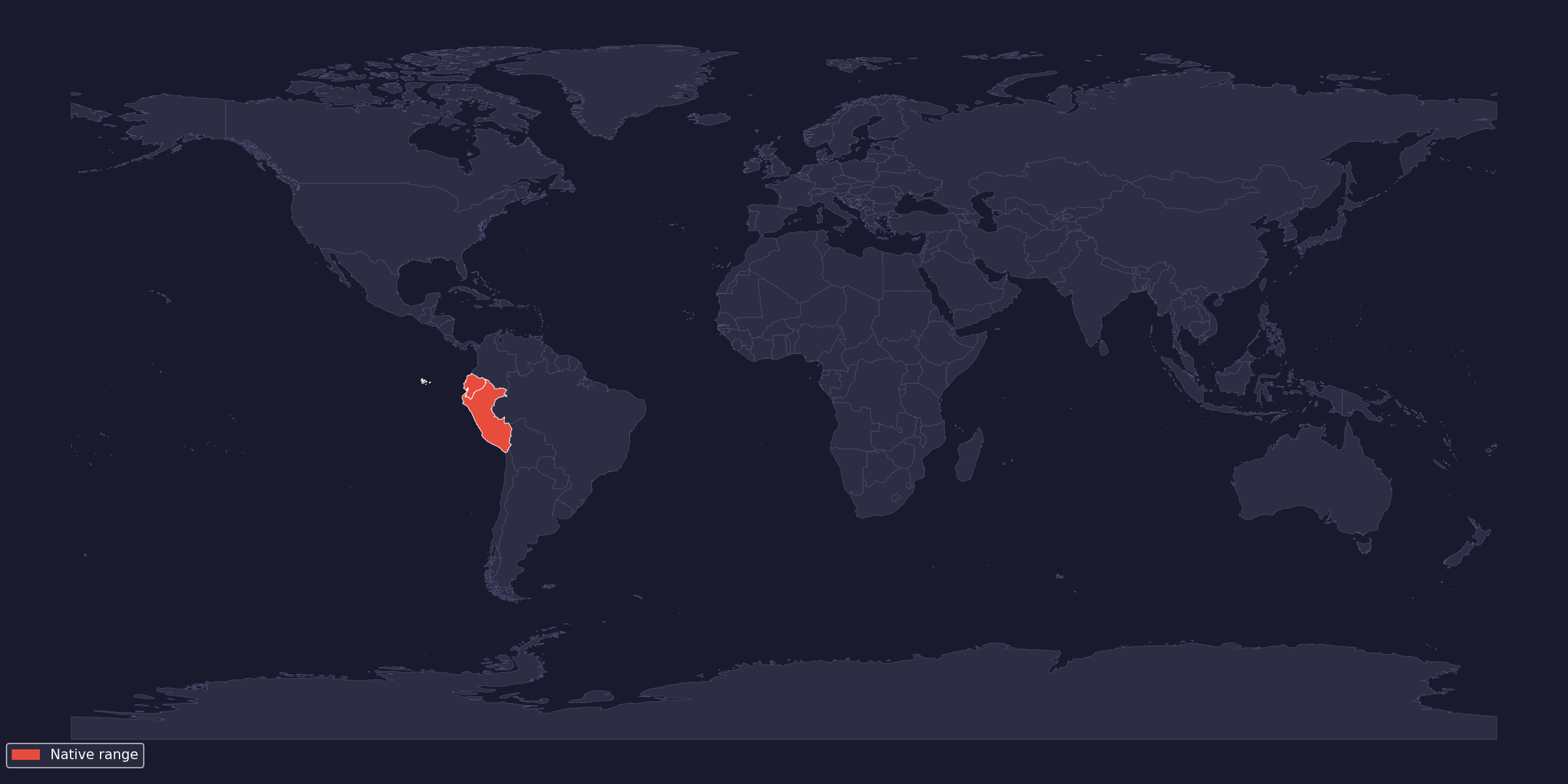
🌡 Climate across the native range
Monthly climate normals from reviewed GBIF occurrences in the literature-supported Loja–Vilcabamba area:
Vilcabamba area, Loja — Ecuador (reviewed occurrence)
| Month | Min °C | Mean °C | Max °C | RH % |
|---|---|---|---|---|
| January | 13.6 | 18.9 | 24.1 | 77 |
| February | 13.7 | 18.9 | 24 | 78 |
| March | 13.9 | 19 | 24.1 | 78 |
| April | 13.8 | 19 | 24.1 | 77 |
| May | 13.3 | 19 | 24.6 | 76 |
| June | 13 | 18.6 | 24.2 | 73 |
| July | 12.8 | 18.4 | 24 | 72 |
| August | 13 | 18.7 | 24.4 | 70 |
| September | 13.2 | 19.1 | 25 | 70 |
| October | 12.9 | 19 | 25.1 | 73 |
| November | 12.8 | 19.2 | 25.6 | 73 |
| December | 13.2 | 19.1 | 25.1 | 74 |
Loja — Ecuador (reviewed occurrence)
| Month | Min °C | Mean °C | Max °C | RH % |
|---|---|---|---|---|
| January | 13.6 | 18.9 | 24.1 | 77 |
| February | 13.7 | 18.9 | 24 | 78 |
| March | 13.9 | 19 | 24.1 | 78 |
| April | 13.8 | 19 | 24.1 | 77 |
| May | 13.3 | 19 | 24.6 | 76 |
| June | 13 | 18.6 | 24.2 | 73 |
| July | 12.8 | 18.4 | 24 | 72 |
| August | 13 | 18.7 | 24.4 | 70 |
| September | 13.2 | 19.1 | 25 | 70 |
| October | 12.9 | 19 | 25.1 | 73 |
| November | 12.8 | 19.2 | 25.6 | 73 |
| December | 13.2 | 19.1 | 25.1 | 74 |
Weather data by WorldClim v2.1 · Monthly normals queried by Herpeton Academy from raster values; relative humidity is derived from vapor pressure and mean temperature.
Location references use GBIF.org occurrence data where available; original occurrence records retain their source dataset licenses.
⚖️ Legal status
Checked on 17 August 2026, T. simonsi was not listed by CITES or in the EU wildlife-trade annexes; the Bern Convention is not relevant to its Andean range. Local and national dangerous-animal, import and transport rules may still apply to Tityus regardless of species-level trade status. Keep the invoice, breeder identity, Loja or Peruvian provenance, photographs and import documents, and confirm that permits use the accepted species name.
🤌 Husbandry
Keep specimens separately. Claims of communal tolerance are not a substitute for controlled evidence and make feeding, births and escape counts harder. Use a latching top-opening enclosure inside a locked second barrier; every ventilation gap must exclude first-instar young. Perform transfers inside a large empty tub with a clear vial and long soft brush.
Quarantine for 90 days with separate tools, especially for imported stock. Record body condition, feeding and moults. Do not mix uncertain “Ecuador” lineages or use offspring for sale under a precise name until identity is supported.
💡 Lighting
UVB is unnecessary. Provide gentle diffuse light for 10–12 hours and dense shade beneath cork. Bright hot lamps are inappropriate for a subtropical montane animal and may drive it into lid corners. Place every fitting outside the primary and secondary barriers.
🌡 Heating and temperature
Maintain most of the enclosure at 21–26 °C, with only a restricted 25–27 °C upper warm area and a 20–23 °C cool retreat. Nights can fall to 17–21 °C. Many rooms will need no added daytime heat; if heating is necessary, apply low-wattage thermostatted heat to one side and verify the cork surfaces.
Do not keep it continuously at lowland tropical temperatures above 28 °C. The verified Loja locality is elevated and noticeably cooler.
💧 Humidity and water
Aim for 60–75% RH with real airflow. Moisten one side of the 6–8 cm substrate and allow the opposite surface to dry. Before a moult, a protected pocket can reach 70–85%, but condensation across the enclosure is not a target. Offer a very shallow water cap and droplets on cork; remove standing water accessible to young.
🌿 Enclosure and decoration
Use soil, leaf mould, a little fine sand and rotten hardwood. Anchor one upright cork panel and add narrow horizontal crevices near the ground, reflecting a small scorpion that may use both bark and litter cover. Leave one retreat inspectable without placing fingers behind it.
Seal sliding-door gaps, cable holes and mesh seams. Loose bark that touches the lid can become an escape bridge, while heavy stones must sit on the enclosure floor before substrate is added.
🪳 Feeding
Offer captive-reared roach nymphs, crickets or flies smaller than the scorpion’s main body every 7–10 days. Juveniles take smaller prey more frequently. Deliver food into an open area with long forceps, never into a crevice that forces close work. Remove leftovers within 24 hours and all live prey at premoult.
🦂 Breeding and young
The species is viviparous, but dependable species-specific brood and gestation data are lacking. Do not copy values from parthenogenetic or medically better-known Tityus. Any breeding attempt needs confirmed adults, a monitored introduction chamber and enough juvenile-proof containers. Leave newborns on the female until their first moult and keep live prey out of the maternity enclosure.
🩺 Common problems
- Misidentification: T. simonsi and T. ecuadorensis are close and vague country labels are inadequate.
- Chronic heat: lowland tropical settings can overheat a Loja-line animal.
- Wet, still air: constant saturation encourages mould and mites despite the species’ humid origin.
- Juvenile escape: newborns can pass through adult-proof door and mesh gaps.
- Sting: call emergency services; do not wait for symptoms or drive yourself.
📌 Conclusion
Tityus simonsi combines taxonomic uncertainty, an uncharacterized venom profile and tiny escape-prone young. It belongs only in an expert collection that can document the lineage, provide cool humid choices with airflow and maintain two secure barriers.
📚 Sources and further reading
- GBIF species record: Tityus simonsi
- Brito & Borges (2015), checklist and medical context for Ecuadorian scorpions
- Lourenço (2005), Ecuadorian Tityus groups and identification context
- Scorpions of Peru checklist
- Veterinary Care of Scorpions
- CITES Appendices
- European Commission: EU wildlife trade