Share

Smooth Cockroach
🔤 Taxonomy
Symploce pallens (Stephens, 1835) is the accepted scientific name. Smooth cockroach and unadorned cockroach are established English names. Older literature may use Symploce lita, S. hospes, Blatta capitata or the original combination Ectobius pallens.
Do not confuse it with hobby cultures formerly labeled S. macroptera and now often identified as S. incuriosa. Adult female S. pallens have conspicuously shortened wings, while both sexes in the latter culture are fully winged.
📌 Description
Adults are plain yellowish brown, about 1.25-1.45 cm long, with darker abdomens and dark antennae that are pale at the base. Males have full wings and fly well; females are brachypterous and cannot fly. Shiny, patternless dark nymphs give the species its “smooth” name.
It is highly social, fast and able to climb clean glass. Warm moist cultures grow quickly. Those traits create an engaging feeding display but also explain its history as a household and food-premises pest in Malaysia and Singapore.
| Care point | Practical target |
|---|---|
| Adult size | 1.25-1.45 cm |
| Starter enclosure | 30 x 20 x 25 cm |
| Temperature | 24-28°C |
| Humidity | 60-80% with ventilation |
| Sexes | flying full-winged males; short-winged females |
| Reproduction | deposited oothecae; 24-48 days |
🌍 Distribution
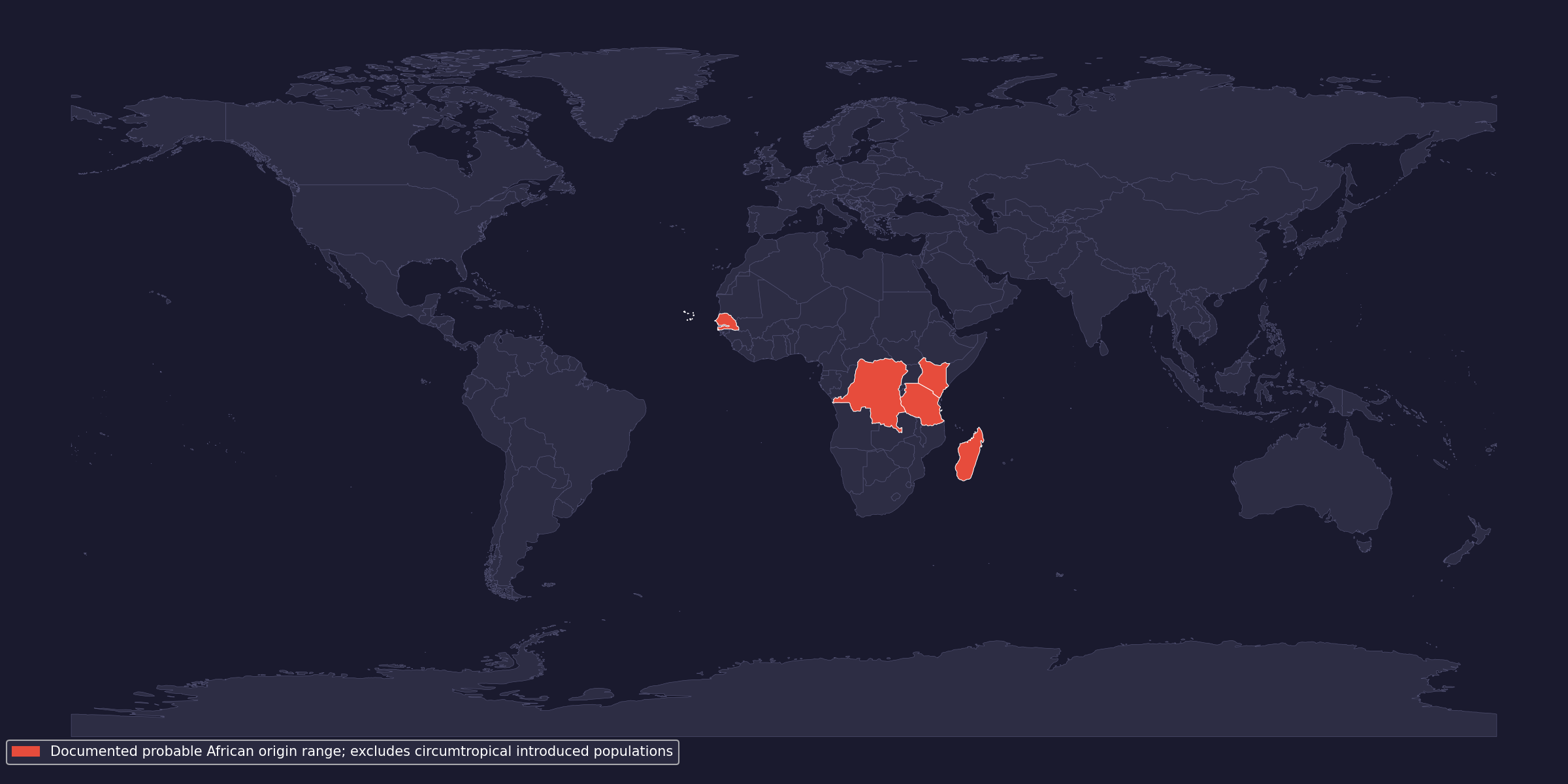
The smooth cockroach is circumtropical and probably African in origin. Published records include Cabo Verde, Senegal, Kenya, the Democratic Republic of the Congo, Madagascar and western Indian Ocean islands, with introduced populations in Malaysia, Singapore, Pacific and Caribbean islands, Mexico, the Galápagos and Florida. The map shows the documented African origin range rather than every introduction.
⚖️ Legal status
Checked on 2026-08-22: S. pallens is not listed by CITES, in Annexes A-D of Commission Regulation (EU) 2026/1383, in the Bern Convention appendices, or on the current EU list of invasive alien species of Union concern.
It is nevertheless a documented domiciliary pest. National biosecurity, plant-health, import, shipping and landlord rules can restrict live cultures. Keep invoices and origin details, confirm permission before cross-border movement and never release animals or untreated oothecae.
🤌 Husbandry
Use a gasketed 30 x 20 x 25 cm box with very fine vents permanently fixed on every edge. Make service openings small and work inside a catch tub. A clean upper barrier is useful backup, but dusty barriers fail and flying males bypass them.
Keep a colony rather than isolated individuals. Experimental work found slower nymphal development in isolated S. pallens, consistent with a real group effect. Quarantine additions for 60 days and do not merge species or unproven localities.
💡 Lighting
UVB is unnecessary. Use a 10-12-hour day cycle and provide dark bark retreats. Males orient toward light and may fly when disturbed, so dim nearby lamps before opening the enclosure.
🌡 Heating and temperature
Maintain 24-28°C, with a 26-29°C area and a 21-24°C retreat. Nights may drop to 20-23°C. Laboratory colonies have been maintained at 25°C, and the detailed Penang study documents steady development under warm controlled conditions.
Warm one side under thermostat control. Overhead heat can dry externally deposited oothecae before the substrate reading changes.
💧 Humidity and water
Aim for 60-80% RH with strong ventilation. Keep the lower substrate and one moss-free corner moist, but let bark surfaces partly dry. Specialist cultures are notably intolerant of complete dryness; continuous condensation, however, encourages mold and fouls the dense colony.
Offer moisture-rich vegetables and a tiny textured water point. Protect first instars from any open water.
🌿 Enclosure and decoration
Use 3-5 cm of coir or pesticide-free soil mixed with leaves. Stack thin cork vertically and diagonally and add fine twigs. Numerous narrow contact surfaces support aggregation and give females secure ootheca sites.
Avoid coarse mesh, open cable ports, loose foam, damp cardboard and oversized decor that makes a fast colony impossible to inspect. Keep the upper few centimeters free of furniture.
🪳 Feeding
Provide fine balanced roach food or fish flake, dried leaves and small portions of carrot, squash, apple or greens. Feed every one or two days in several shallow dishes. Newly hatched nymphs benefit from food close to the aggregation, and established colony material supports transfer of gut microbes through coprophagy.
Remove wet leftovers daily. Do not sterilize or replace all colony substrate routinely, but do quarantine disease-risk additions separately.
🥚 Breeding
Females briefly carry a rotated ootheca externally and deposit it early in development. In the Penang study, incubation averaged 36.1 days with a 24-48-day range. Females averaged 16 oothecae and 17.6 nymphs per ootheca; nymphal development averaged 118 days and adult longevity about 309-323 days. A second laboratory study found shorter but still productive cycles, showing that line and conditions matter.
Do not peel attached oothecae from furnishings. Keep them warm, locally moist and ventilated. Because production can be rapid, arrange surplus and containment before allowing a large adult cohort to breed.
🩺 Common problems
- Oothecae fail together: check desiccation, upper-hide temperature and direct misting.
- Nymphs grow slowly: maintain a true group, stable warmth and fine food near shelters.
- Sudden mold or odor: reduce portions, remove residues daily and increase cross-ventilation.
- Escapes: inspect mesh bonds, lid gasket and the maintenance routine; do not rely on a barrier alone.
- Allergy and sanitation: cockroach debris can sensitize people. Damp-clean, wear gloves and suitable respiratory protection, and keep the culture outside food-preparation areas.
📌 Conclusion
The smooth cockroach is biologically well documented and easy to reproduce, but that does not make it a casual culture. It suits a keeper who can combine humid microhabitats with fine ventilation and pest-grade containment.
📚 Sources and further reading
- GBIF: Symploce pallens
- Blattodea Species File: S. pallens
- Bujang & Lee 2010: biology of S. pallens
- Lee et al. 2000: biological parameters
- Lihoreau & Rivault 2008: group effects in cockroach aggregations
- Quah & Lee 2005: coprophagy and nymph survival
- ReptiFiles — checked; no species care guide was found
- CITES Appendices, valid from 5 March 2026
- Commission Regulation (EU) 2026/1383
- EU list of invasive alien species of Union concern
- Bern Convention appendices