Share

Symploce incuriosa
🔤 Taxonomy
Symploce incuriosa (Saussure, 1899) is accepted by GBIF and ITIS. European hobby colonies were long traded as “Symploce macroptera”; examination of cultivated material led specialists to relabel those stocks as S. incuriosa. Because GBIF also recognizes a distinct S. macroptera, the old hobby label should be treated as a culture-history clue, not a synonym that applies automatically to every specimen.
Published synonyms of S. incuriosa include Phyllodromia trigonalis, Ischnoptera uniramosa and Ischnoptera pitmani.
📌 Description
Adults are small, orange-brown cockroaches around 0.9-1.1 cm long; measurements of a laboratory “S. macroptera” stock gave about 9.7 mm for males and 10.4 mm for females. Both sexes are fully winged. Every stage runs rapidly and climbs smooth glass or plastic, while disturbed adults may fly.
The species lives largely on the surface and in narrow leaf-litter spaces rather than burrowing deeply. It makes an active colony display, but small deposited oothecae and fast first instars demand finer containment than its adult size suggests.
| Care point | Practical target |
|---|---|
| Adult size | 0.9-1.1 cm |
| Starter enclosure | 30 x 20 x 25 cm |
| Temperature | 23-28°C |
| Moisture | mostly dry surface with one moist refuge |
| Furniture | fine leaf litter and narrow bark stacks |
| Reproduction | deposited oothecae; data limited |
🌍 Distribution
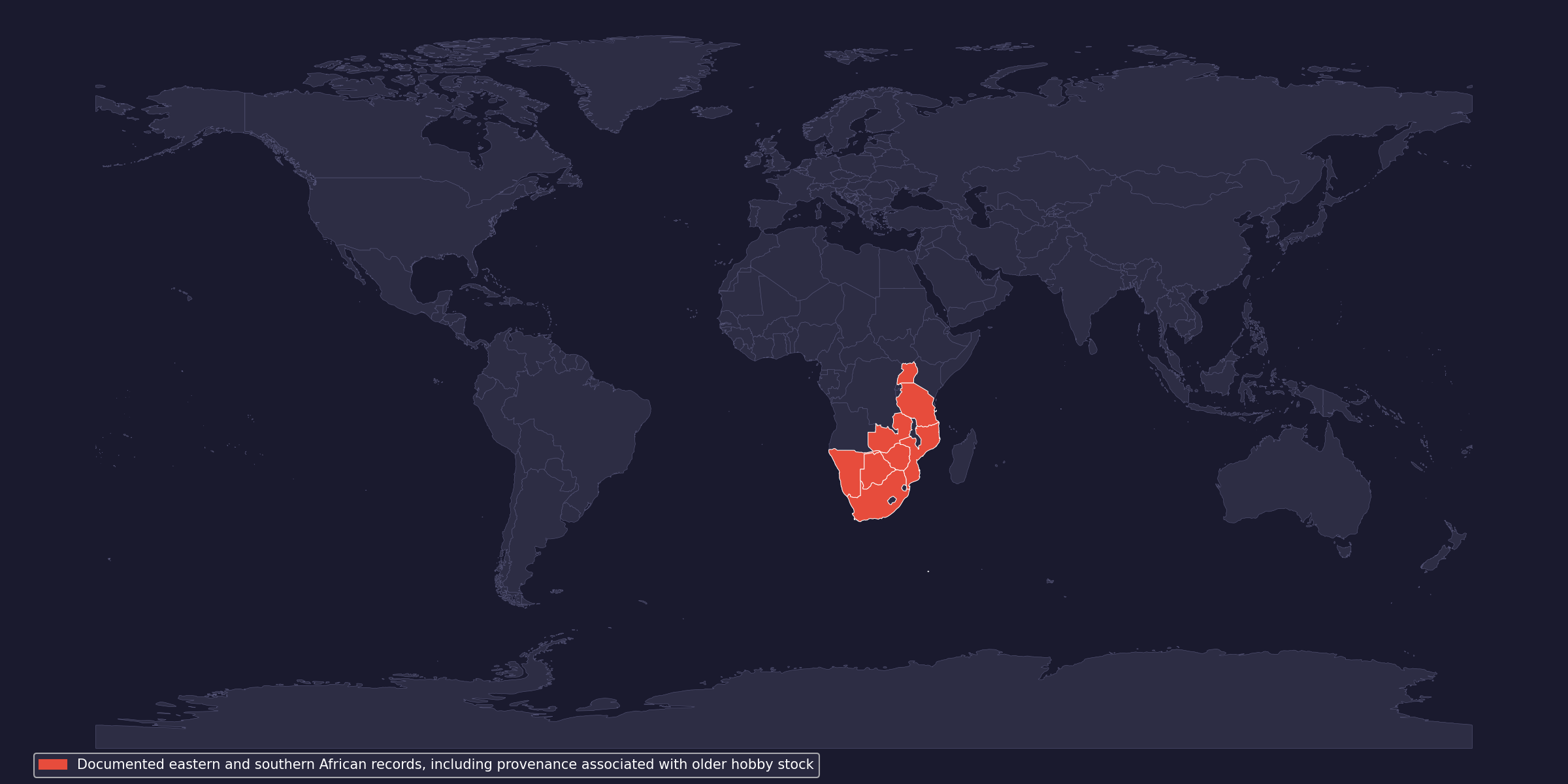
Records place S. incuriosa across eastern and southern Africa, including Uganda, Tanzania, Zambia, Zimbabwe, Botswana, Namibia and South Africa. Hobby stock associated with the older “S. macroptera” label has also been linked to Mozambique and South Africa. This documented country set is broader than any single captive lineage’s known origin.
⚖️ Legal status
Checked on 2026-08-22: S. incuriosa is not in the CITES Appendices, Annexes A-D of Commission Regulation (EU) 2026/1383, the Bern Convention appendices or the current EU list of invasive alien species of Union concern.
Live-insect import, shipping, workplace, tenancy and national biosecurity rules still apply. Keep invoices and the old/new stock labels together, confirm requirements before international movement, and freeze or seal unwanted oothecae and enclosure waste where local rules allow. Never release the species.
🤌 Husbandry
Use a 30 x 20 x 25 cm container with a gasket lid and securely bonded fine mesh. Treat every lid seam and ventilation edge as an escape route. Open the colony inside a smooth catch tub, and remove food through the smallest practical hatch.
Keep the species as a group with several adult pairs and different nymph sizes. Quarantine new stock for 60 days. Never combine it with genuine S. macroptera or S. pallens: the resulting culture cannot be assigned reliably from trade labels.
💡 Lighting
UVB is unnecessary. Use a 10-12-hour day cycle with diffuse light and shaded bark. Adults may launch toward a bright room lamp when the lid opens, so dim the work area or cover nearby light sources during maintenance.
🌡 Heating and temperature
Maintain 23-28°C, a 26-29°C warm area and a 21-24°C retreat. Nights may fall to 20-23°C. Colonies reproduce slowly when kept continuously at the cool end, but strong top heat desiccates oothecae hidden in bark seams.
Warm one side under thermostat control. Measure the upper bark stack because its temperature can exceed the air reading.
💧 Humidity and water
Keep average RH near 45-65%. Water one corner of the substrate and let the rest of the surface dry; raise local moisture to about 60-75% around shedding nymphs and ootheca retreats. A permanently wet enclosure conflicts with the relatively dry specialist culture reports and promotes mold.
Offer moisture-rich vegetables and a tiny textured water source. Hatchlings can drown in open dishes.
🌿 Enclosure and decoration
Provide 3-5 cm of coir or pesticide-free soil under a generous layer of dry hardwood leaves. Stack thin cork pieces vertically and diagonally with narrow gaps. Fine twigs increase surface area for nymphs and deposited oothecae.
Avoid coarse mesh, loose foam, damp cardboard, aromatic wood and heavy furnishings that crush animals during inspection. Keep all climbing structures several centimeters below the lid.
🪳 Feeding
Offer fine balanced roach diet, fish flakes and crumbled dried leaves as staples. Add small pieces of carrot, squash, apple, pear or leafy vegetables every one to three days. This surface-active species finds several small feeding points more readily than one deep bowl.
Remove fruit before it ferments. Do not let a dry protein powder coat ventilation, climbing barriers or ootheca crevices.
🥚 Breeding
Females deposit very small oothecae in protected gaps. Cultures associated with this name reproduce sexually and more slowly than S. pallens. Published species-specific timing is scarce; at 24-28°C, a conservative keeper range is roughly 35-60 days to hatching. Treat that as an observation window rather than a fixed incubation promise.
Leave sound oothecae attached to bark, maintain one locally moist retreat and keep hatchling food close by. A culture may take several generations to become productive, so avoid frequent substrate replacement or harvesting from a small starter group.
🩺 Common problems
- No growth after purchase: confirm adult pairs, reduce disturbance and allow more than one oothecal cycle before changing conditions.
- Dry or collapsed oothecae: add local moisture without wetting the whole enclosure.
- Mold: decrease fruit portions and improve airflow; do not solve it by drying every retreat.
- Escapes: renew the lid seal and fine mesh. Barrier products are backup only and fail when dusty.
- Identity drift: keep stock labels and photographs; seek expert genital examination if the colony must be taxonomically verified.
📌 Conclusion
S. incuriosa suits a keeper who values a lively, small colony and can work at hatchling scale. Fine containment and patient maintenance of dry and moist microzones matter more than forcing fast production.
📚 Sources and further reading
- GBIF: Symploce incuriosa
- ITIS search record: accepted S. incuriosa
- Culture-stock identification note: “S. macroptera” to S. incuriosa
- Specialist husbandry comparison for the older culture label
- Museum and distribution summary
- ReptiFiles — checked; no species care guide was found
- CITES Appendices, valid from 5 March 2026
- Commission Regulation (EU) 2026/1383
- EU list of invasive alien species of Union concern
- Bern Convention appendices