Share

Raffaele's Pill Woodlouse
🔤 Taxonomy
Spherillo raffaelei (Arcangeli, 1927) is accepted by GBIF and the World List of Isopoda. It was described as Armadillo raffaelei and later placed in Formosillo. Names such as “Hainan orange” may describe captive appearance or provenance, not a separate scientific taxon.
📌 Description
This small armadillid reaches about 5–6 mm in the limited captive account available. Animals are generally grey to sandy with variable ochre or orange flecking and can conglobate when disturbed. Published taxonomic figures, not colour alone, are needed for secure identification.
Chinese biogeographic literature associates the family primarily with tropical and subtropical forest leaf litter, where animals contribute to decomposition. Species-specific captive evidence is limited to keeper reports rather than controlled trials. Temperature, humidity, lifespan and breeding values below are therefore conservative starting points, not proven physiological limits.
🌍 Distribution
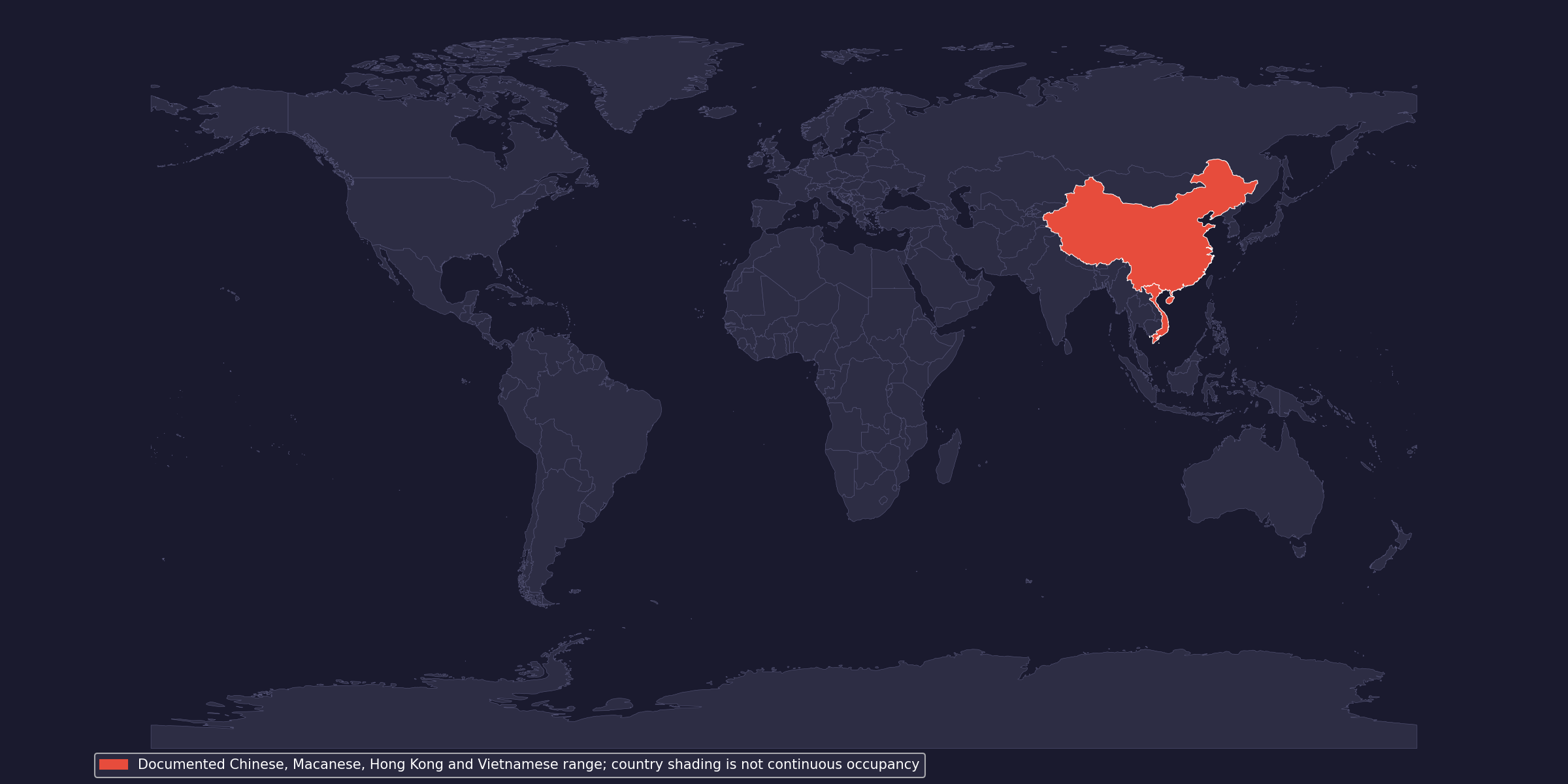
The taxonomic revision records S. raffaelei from China, Macao, Hong Kong and Vietnam, including material from Yunnan. A Chinese review calls it comparatively widespread within the country’s armadillid fauna and notes its occurrence in neighbouring Vietnam.
The map shades China and Vietnam. It cannot show the scattered southern Chinese localities, the very small areas of Macao and Hong Kong, or distinguish verified populations from gaps in sampling.
⚖️ Legal status
Checked on 2026-08-29: S. raffaelei was not found in CITES, EU wildlife-trade Annexes A–D under Regulation (EU) 2026/1383, or Bern Appendices II–III. National collection, cave and protected-area rules, export permits, plant-health controls and live-invertebrate import requirements may still apply.
Choose traceable captive-bred animals. Do not accept a colour label as evidence of locality, and never release animals or substrate.
🤌 Husbandry
House a starter group in a secure 20 × 15 × 12 cm box with 6 cm or more of moisture-retentive substrate, deep leaf litter and ventilation on more than one side.
| Parameter | Conservative starting point |
|---|---|
| Adult length | about 0.5–0.6 cm |
| Temperature | 19–27 °C |
| Moisture | roughly half damp, half less wet |
| Main food | leaves, rotten wood and small supplements |
| Evidence quality | taxonomy/distribution good; captive targets sparse |
Quarantine for 60 days. Handle by moving bark or substrate, never by pinching a rolled individual.
💡 Lighting
UVB is unnecessary. Provide 10–12 hours of indirect room light with dark cork and leaf retreats. Avoid direct sun and intense display lighting.
🌡 Heating and temperature
Use 19–27 °C with a cooler 18–22 °C sector. This band comes largely from limited captive experience and broad subtropical ecology; it is not a measured species-specific optimum. Begin around 22–24 °C and adjust only from sustained observations.
If heat is required, apply it to one side wall through a thermostat. Continuous wall climbing, tight clustering in the cool end or sudden inactivity requires prompt reassessment.
💧 Humidity and water
Keep roughly half the enclosure damp through the full substrate depth and the other half less wet but never dusty. A 60–80% RH display reading is a starting reference. Pour small amounts into the damp corner and retain cross-ventilation; no water dish is required.
Failed moults and juveniles confined to moss suggest dryness. Condensation on every wall, sour odour or animals fleeing upward suggests saturation and low oxygen.
🌿 Enclosure and decoration
Use pesticide-free topsoil, deciduous leaf mould and crumbled rotten hardwood. Add cork flats, a deep layer of leaves, moss at one end and permanent calcium. Small surface crevices help mancae feed without competition.
Avoid coir alone, fertilizer, aromatic timber and imported wild substrate. Keep decorative rocks light and stable so a rolled animal is not trapped or crushed.
🪳 Feeding
Maintain leaves and white-rotten wood continuously. Offer tiny portions of mushroom, squash, carrot, dried greens or complete isopod food two or three times weekly. A small protein portion once or twice weekly and a calcium source support growth, but species-specific protein demand has not been tested.
Remove fresh residues within 24–36 hours. Reduce supplements if mites multiply; do not remove the stable leaf-and-wood base.
🥚 Breeding
Females brood embryos in a marsupium and release mancae; metadata records this as viviparous. Captive sellers describe the species as breedable, but controlled data on brood size, age at maturity and seasonal cues were not found.
Maintain stable moisture, fine foods and calcium. Do not isolate gravid females. Wait for multiple cohorts before dividing a colony and move mature substrate with each split.
🩺 Common problems
- Colony remains rolled or hidden: check disturbance, heat and moisture before adding food.
- Failed moults: reconnect the damp zone through the substrate and verify calcium.
- Mites or mould: reduce rich foods and improve ventilation.
- Slow growth: do not raise temperature automatically; confirm food particle size and identification.
- Colour change: age, diet and locality may affect appearance; colour alone does not prove a morph.
📌 Conclusion
Spherillo raffaelei is a compact, attractive pill woodlouse for an observant intermediate keeper. A ventilated warm leaf-litter enclosure with a real moisture gradient is a defensible starting point. Because captive evidence is thin, good provenance and records are part of responsible care.
📚 Sources and further reading
- GBIF: Spherillo raffaelei
- World List of Isopoda: Spherillo raffaelei
- Schmalfuss world catalog: synonymy and distribution
- Kwon & Taiti: revision, specimens and China–Vietnam range
- Chinese terrestrial-isopod biogeography and forest-litter context
- Limited captive account used cautiously for size and starting parameters
- ReptiFiles site search completed; no species-specific guide found
- CITES Appendices
- EU wildlife-trade Annexes: Regulation (EU) 2026/1383
- Bern Convention appendices