Share

Madeira Cockroach
🔤 Taxonomy
Rhyparobia maderae (Fabricius, 1781) is the accepted name of the Madeira cockroach or drummer. Leucophaea maderae remains common in laboratory literature, and the original combination was Blatta maderae.
The submitted sale-list spelling “Rhyparobia maderea” reverses two vowels and is not the accepted species epithet. This guide uses maderae in its metadata, URL and taxonomy tree while recording the submitted spelling here for search clarity.
📌 Description
Adults are robust, fully winged cockroaches 4-5 cm long, mottled olive-brown and tan. Nymphs are darker with pale lateral spots. The common name reflects the type locality, not a secure native origin; historical evidence points instead to tropical West Africa followed by centuries of trade-mediated spread.
This is a conspicuous nocturnal colony species. Adults can make tapping or drumming sounds and climb textured furnishings. Its large body is easy to observe, but pest history, long adult life and mobile winged animals justify stricter containment than a typical non-climbing display roach.
| Care point | Practical target |
|---|---|
| Adult size | 4-5 cm |
| Small colony enclosure | 45 x 30 x 30 cm |
| Temperature | 24-29°C; warm end 27-30°C |
| Humidity | 55-75% with a moist refuge |
| Diet | leaves, vegetables, fruit and measured protein |
| Reproduction | sexual; internal ootheca, about 60 days |
🌍 Distribution
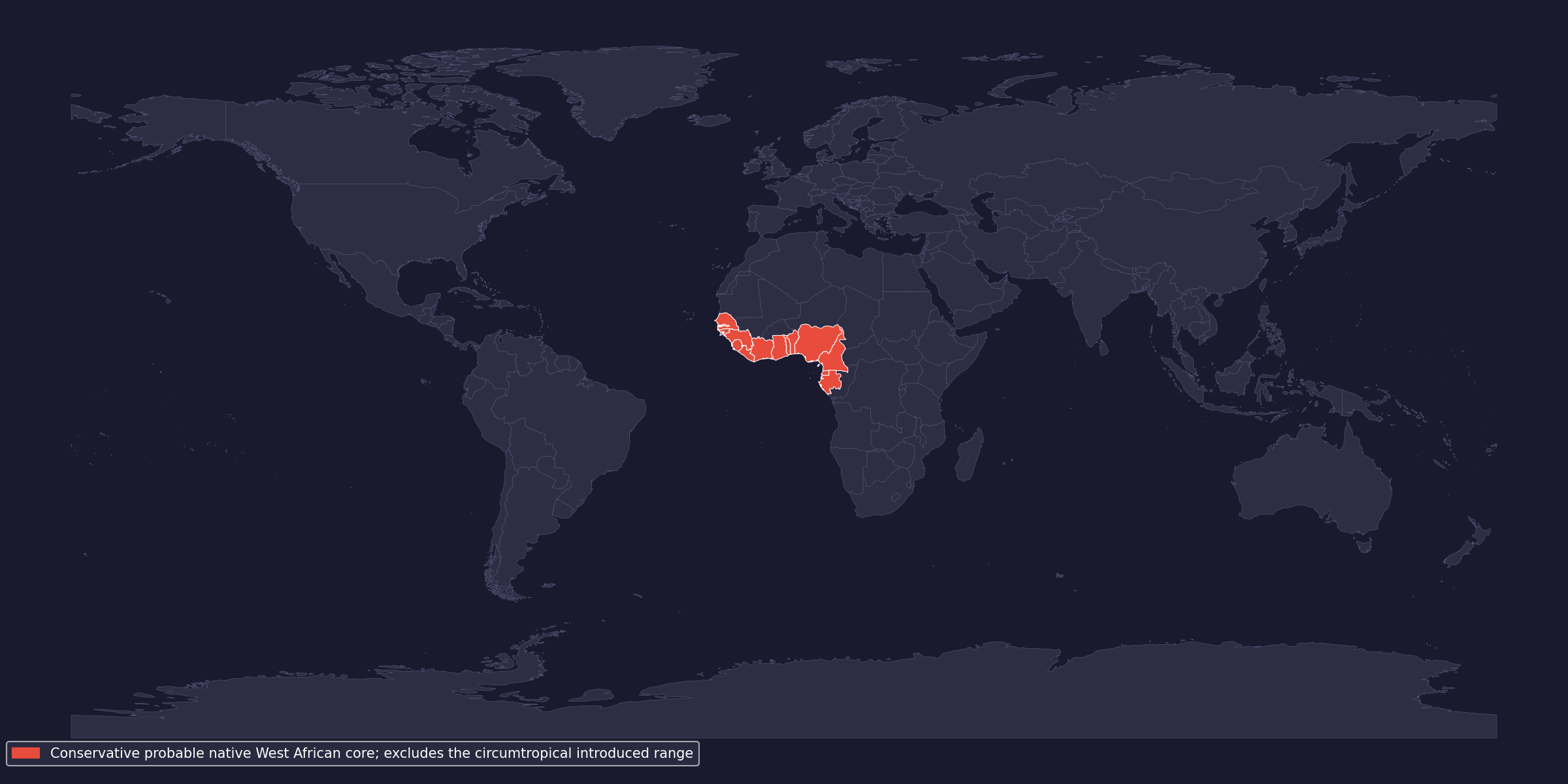
The Madeira cockroach is now circumtropical and occurs in parts of Africa, Madeira and the Canary Islands, the Caribbean, Central and South America, and scattered warm sites elsewhere. Historical biogeographic work places its probable origin in equatorial West Africa. The map therefore shows a conservative West African native core, not introduced colonies.
⚖️ Legal status
Checked on 2026-08-22: R. maderae is not CITES-listed, no entry was found in Annexes A-D of Commission Regulation (EU) 2026/1383, and it is not a Bern Convention species. It was also absent from the current EU list of invasive alien species of Union concern.
The species has a domiciliary-pest and transport history. Import, agriculture, shipping, landlord or national exotic-animal rules may still restrict it. Retain invoices and origin information, use the accepted spelling on paperwork, and confirm destination rules before transfer. Never release animals or untreated enclosure waste.
🤌 Husbandry
House a starter group in a strongly lidded 45 x 30 x 30 cm enclosure. Fix vents mechanically, protect cable gaps and keep cork below the rim. Open the colony inside a larger catch tub. A clean upper barrier may be backup containment, but it must not replace a fitted lid.
Quarantine new animals for at least 60 days in simple housing with separate tools. This species is used in laboratory parasite research and wild or mixed-origin stock may carry mites, nematodes or gregarines. Do not mix colonies until behavior, feeding and mortality remain normal.
💡 Lighting
UVB is unnecessary. Provide a regular 10-12-hour light cycle and dim viewing light after dusk. Bright heat lamps make exposed upper hides too dry and suppress natural emergence. Keep a shaded route between shelter and food.
🌡 Heating and temperature
Maintain 24-29°C, with a 27-30°C warm side and a 22-25°C retreat. Nights may fall to 20-24°C. Laboratory colonies are commonly maintained near 27°C; reproduction slows in cool rooms.
Use a thermostated side heater or warm the room. Check the temperature between stacked bark pieces, where animals actually aggregate. Avoid sustained temperatures above 31°C and do not heat a waterlogged base.
💧 Humidity and water
Keep average RH around 55-75%. Moisten roughly one-third of the substrate and allow the remaining surface to dry between waterings. Good ventilation matters because a crowded large-bodied colony produces considerable moisture and waste.
Provide a shallow, textured water dish or insect-safe gel in addition to vegetables. Clean it often. Small nymphs can drown in smooth deep containers.
🌿 Enclosure and decoration
Use 5-8 cm of coir or pesticide-free topsoil mixed with leaf litter. Stand several cork slabs vertically with gaps wide enough for adults, and leave one removable inspection stack. Surface area and airflow are more valuable than heavy decoration.
Avoid aromatic softwood, fertilized compost, unstable rock, waterlogged moss and cardboard that remains damp. Replace the dirtiest substrate gradually so young nymphs and the established microbial community are not discarded unnoticed.
🪳 Feeding
Offer decomposed hardwood leaves continuously. Feed carrot, squash, sweet potato, greens and small fruit portions every two or three days. Add a measured protein source such as fish flake or balanced roach diet once or twice weekly. Pregnant females naturally eat less while the internal egg case occupies the brood sac; that alone is not a reason to add richer food.
Use two dishes in a large colony and remove wet leftovers within 24 hours. Chronic excess protein, fermentation and crowding cause more trouble than a short interval between feeds.
🥚 Breeding
Both sexes are required. Females form an ootheca and carry it in the brood sac; embryos rely on yolk rather than maternal milk. Published laboratory work describes about 30 eggs and gestation of roughly 58-60 days under warm conditions, after which the young emerge together.
Do not pull an exposed ootheca from a female: brief extrusion and rotation can be normal, while a repeatedly dropped case often signals disturbance or poor conditions. Maintain several adult pairs and overlapping nymph cohorts. Female feeding commonly increases after parturition as the next ovarian cycle begins.
🩺 Common problems
- Aborted oothecae: check repeated handling, overheating, dehydration and nutritional imbalance.
- Wing or leg damage: widen bark gaps and reduce adult crowding.
- Persistent odor and mortality: remove fermenting food, clean the water source and increase ventilation.
- Parasites or unexplained weight loss: isolate the group and consult an exotics veterinarian or experienced invertebrate diagnostician; do not medicate the colony blindly.
- Allergy: use damp cleaning, gloves and suitable respiratory protection when handling frass or old substrate.
📌 Conclusion
The Madeira cockroach is an impressive sound-producing display animal for a keeper with a genuinely secure enclosure. Stable warmth and layered cork are straightforward; quarantine and pest-proof handling are the disciplines that decide whether the colony is appropriate.
📚 Sources and further reading
- GBIF: Rhyparobia maderae
- Blattodea Species File: R. maderae
- WHO: Cockroaches, their biology, distribution and control
- Gurney 1953: distribution and probable West African origin
- Page 1990: brood-pouch biology and gestation
- Clopton 2014: gregarine from R. maderae
- ReptiFiles — checked; no species care guide was found
- CITES Appendices, valid from 5 March 2026
- Commission Regulation (EU) 2026/1383
- EU list of invasive alien species of Union concern
- Bern Convention appendices